Great White Egret

Great White Egret

            The Great White Egret is Yolande Essiembre’s first chapbook of poetry. The title poem offers an image, a white egret, that is central to the whole collection. Summarized in this one poem are the concepts of pantheism, mindfulness, self-questioning, and receiving lessons and inspiration from the natural world that surrounds the narrator and her poetic voice.

            Pantheists often consider the universe, or nature, to be identical to the divinity. In simpler terms, it’s the old Greek idea of Gaia, the world spirit – spiritus mundi, in the Latin of Moncton’s Northrop Frye – that links nature and the divinity. Pantheism can be found in both religious and philosophical contexts, with some branches of pantheism rooted in traditional religious beliefs and others stemming from poetic perspectives. In the case of The Great White Egret, the narrative voice sees nature as an all-embracing poetic concept that makes possible a life, both physical and spiritual, in the immediate present.

            The lessons the narrator receives in the course of observing The Great White Egret are (1) to take one step at a time, (2) to be still, and (3) to be one’s own reflection. This third lesson reaches out to include the cover photograph. Verbal and visual blend when the egret, reflected in the water, parallels the reflection of the poet in the stillness of nature. This is further complicated by the double meaning of reflection as mirror image and of the thought process involved during the observation of the bird. The visual and mental images become reminiscent of the hymn “on the wings of a snow-white dove.”

Part of the beauty of Yolande Essiembre’s poetic meditations lies in the extension of image and metaphor beyond the page and into the mind of the reader where they create a mirror universe of reciprocal reminiscence and creativity. Other poems that reach out in similar fashion to explore the deity manifest within the natural world include A Force of Love in Our Universe, Breath of Life, Glimpses, and In the Sanctuary. This last poem works on the basis of repeated images that stand strong and clear, for example, “Life pressing through a blade of grass. / Leaves shimmering, dancing, waving. / Light flickering, casting shadows.” Life and movement, especially movement – pressing, shimmering, dancing, flickering, casting – create a sense of wonder in the natural setting where the poet finds sanctuary.

            Mindfulness is a mental state achieved by focusing one’s awareness on the present moment, while calmly acknowledging and accepting one’s feelings, thoughts, and bodily sensations. It is often used as a therapeutic technique and can be compared with the yoga techniques which our poet practices. This yoga technique is compounded in the poems where breathing is emphasized, as in Breath of Life, for example, where we read “Who are you breath of life / Who fills my lungs with air”. It can also be found in the poem In Your Presence “In the stillness of the morning / I breathe / I listen / I breathe”.         

This chapbook is more than a mere collection of poems. It is a compendium of personal feelings, inner thoughtfulness, and natural observations. It is the work of a thinker and feeler, in tune with the universe and continually seeking answers to some of life’s most important questions. Reading The Great White Egret, you too may start asking similar questions. More important, you may even find some meaningful answers.

The Great White Egret
Sitting, rocking, gazing upon a lake,
Pondering, reflecting, wondering.
How one can choose purpose over comfort?
How does one remain true to oneself?

On a wing span comes an answer.
A bird, a Great White Egret
Lands at the edge of the water.
Tall, magnificent, breathtaking.

Steps in slow motion, into the lake,
Advances one long leg at a time.
Proud, confident, in no hurry.
My first lesson: “Take one step at a time.”

The bird stops, remains still,
Listens, stretches its long neck,
So still that I hold my breath.
We wait.
Second lesson: “Be still.”

The majestic bird gracefully glides
In the calm clear water.
Its reflection a thing of beauty.
Like a mirror, reflects divinity.
Third lesson: “Be my own reflection.”             
The End of Time

The End of Time

A thin violin crying
its cat-gut heart out
in tears of sound, falling,
rhythmic raindrops,
down a grey-streaked face
tight with stress and taut with pain.

Such concentration,
such soulfulness packed
into each mindful note.

An audience of one,
I sit, head bowed, meditating
on the meaning of meaning
and the nothingness
of a being condemned
to oblivion, yet oblivious
of the how and when.

Each note a hammer-blow,
then, the piano pounding nail
after nail into this living coffin,
this body I drag through the motions
of extracting meaning
from this meaningless life.

Comment:

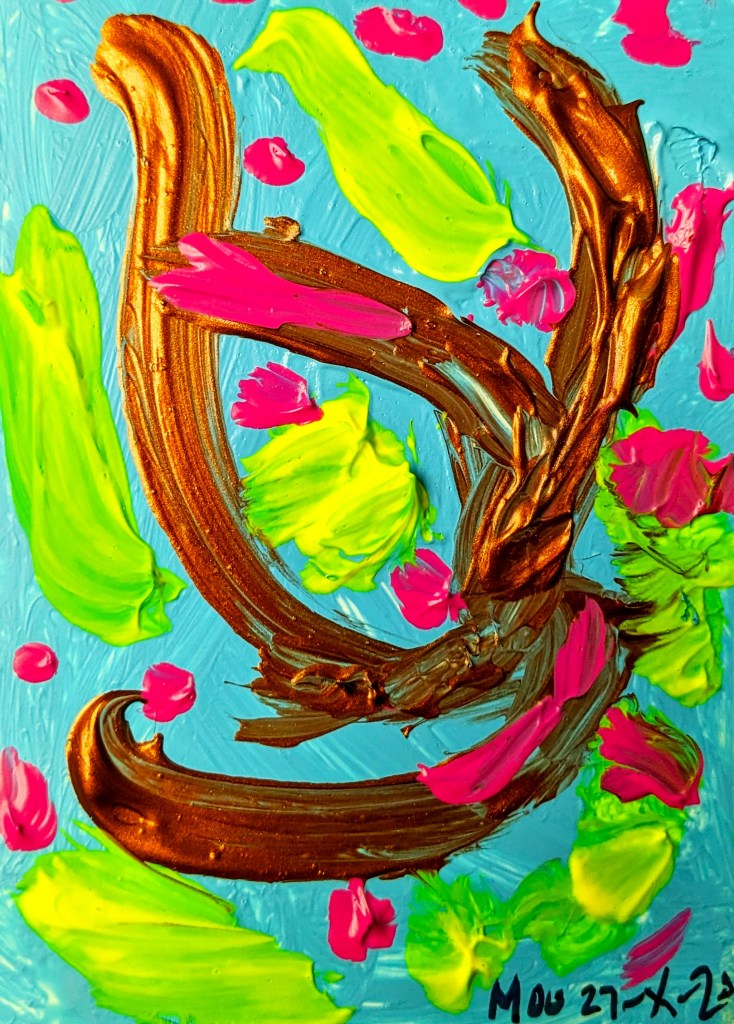
The End of Time is the second poem in the first sequence (Crystal Liturgy) of Septets for the End of Time. The painting, by my friend Moo, expresses his impressions of the nature of the end – but he doesn’t tell me the end of what. Certainly not of our friendship, I hope.

I am always worried by those last two lines: extracting meaning from this meaningless life as I don’t think that life is meaningless. However, there are times when it certainly feels that way. Those are the times when we need our beliefs in truth and the purity of art to survive. But how do you define them, you ask me. In all honesty, I don’t. I can’t. Art changes. What we consider to be true changes. Relativism? Yes, to a certain extent. I know what I believe. I don’t know what you believe. But I would never try to inflict or enforce my beliefs on to you. That is not how I work.

As for Moo, I don’t know how his mind works. I think he just sees things in color and shape and in the creation of movement within the stillness of a two dimensional illusion. I also think he thinks like a child. Maybe, like me, he has entered his second childhood, though I don’t really remember ever having had a first one. Oh dear – the meaning of meaning – one of the great enigmas of this wonderful world in which we live.

Do you play in your daily life? What does ‘playtime say to you?

Daily writing prompt
Do you play in your daily life? What says “playtime” to you?

Do you play in your daily life? What does ‘playtime say to you?

Poesía de juego y poesía que expresa la autenticidad del ser / poetry as play and poetry that expresses the authenticity of being. For me, poetry is play. However, it is far more than just ‘play‘ – because it is a play that expresses the authenticity of my being.

I write in my journal on a daily basis. As I write, I sometimes spot little gems, thoughts or word clusters that can be turned into poems. For me, playtime is when I start to elaborate the words (signifiers) and turn them into thoughts (signified). The meaning may be the message, but the words that carry the message are the building bricks of the poetry of play which sometimes, with a happy Midas touch, turns into the poetry of gold that expresses the authenticity of who and what I am.

But play is also what I do when I paint. And sometimes I sit beside my mirror image friend, Moo, and paint with him. While Moo is great with colours, he is sometimes at a loss for words. Then I help him by playing with words, shuffling them around, until he finds the title that he wishes for his poems. Sometimes I consult, on Moo’s behalf, with other friends, and they are the ones who join in the game, and settle the dispute by agreeing upon the name that Moo will finally choose for his painting.

But, speaking of painting, there is no play better than the game of making meaning out of color [does it really matter how you spell it? ] and shape while taking a line for a walk and turning it into something playful yet meaningful. Mix and match, and stitch and patch, and then add the lines and title that ease the metamorphosis of color into shape and meaning.

There are other games I play to help fill in the daily gaps that have entered my post-retirement life. Online games of patience, crosswords, chess games with their intricate patterns of red and white or light and dark. Then their [now it does matter how you spell there!!!] are mining games when I dig deep into other people’s poetry and search among the gems of Octavio Paz, Antonio Machado, Dylan Thomas, John O’Donohue, Milton Acorn, Valverde, Quevedo, St. Teresa of Avila, Gongora, Sor Juana, Cervantes, or many other friends, their voices now silences, with whom I speak with my eyes, in order to find something that inspires me to play yet another game – hunt the symbol.

Re-reading Rudyard Kipling is a game too. “Do you like Kipling?” “No, I never Kipple.”And in books like Kim, the great game of life goes on and on, and Kipling’s signifiers (words) turn into a signified (meaning) that is warped by my creative mind and changed into my ideas of a new game in which hunt the symbol turns into the game of Brillig where the slithey troves of new words, fresh words, are reborn into my game-world and emerge from their game-whirled into my own word-play conversation with my own thyme and plaice [or should that be time and place?] And long may Moo and I play that game!

Where did your name come from?

Daily writing prompt
Where did your name come from?

Where did your name come from?
That seems to be a strange sort of question. First of all, what do you mean by ‘your name’? My surname (or family name), my Christian name, my second name, my nick-name? I have already answered that particular question – to find out, click on this link – What’s the story behind your nickname?

As for my surname, well, that came from my father, and his came from his father, and his came from his father – and so on, ad infinitum. If we go back to the original chicken and egg theory, then we find out that, according to Wikipedia, Moore (pronounced mʊər or mɔːr/ is a common English-language surname. It was the 19th most common surname in Ireland in 1901 with 15,417 members. It is the 34th most common surname in Australia, 32nd most common in England, and was the 16th most common surname in the United States in 2000. It can have several meanings and derivations, as it appeared as a surname long before written language had developed in most of the population, resulting in a variety of spellings. Variations of the name can appear as MooreMore or Moor; as well as the Scottish Gaelic originations MuirMure and Mor/Mór; the Manx Gaelic origination Moar; the Irish originations O’More and Ó Mórdha; and the later Irish variants O’Moore and de Mora. The name also arises as an anglicisation of the Welsh epithet Mawr meaning great or large.

So, where did my surname, Moore, come from? Well, you tell me. Because Wikipedia didn’t exactly give me a perfect location for its origin.

As for Roger – well, here we go again. Wikipedia says the following – Roger is a masculine given name, and a surname. The given name is derived from the Old French personal names Roger and Rogier. These names are of Germanic origin, derived from the elements hrōdχrōþi (“fame”, “renown”, “honour”) and gārgēr (“spear”, “lance”) (Hrōþigēraz). The name was introduced into England by the Normans. In Normandy, the Frankish name had been reinforced by the Old Norse cognate Hróðgeirr. The name introduced into England replaced the Old English cognate HroðgarRoger became a very common given name during the Middle Ages. A variant form of the given name Roger that is closer to the name’s origin is Rodger. So there you are. Or you could blame my father and mother, or the gentleman who dipped me in the baptismal font and baptized me with that name. Personally, I cannot remember a thing about it.

Of course – wrth gwrs – me being a creative writer with a sense of humor and a parentage that was also creative, my name might have been drawn out of a hat, or found in a Christmas Cracker, or suggested by the slip of paper inside a Fortune Cookie, or discovered in a bottle left by that ubiquitous Welsh or Irish or French or Scottish or English milkman, Moore the Milk. I only know that I am one of the few people I have ever met blessed with that name. Alas, I never met my namesake – Roger Moore aka James Bond aka .007 [respect that dot, it comes from Rudyard Kipling!] – although I have been gifted with those names and that number by several of my acquaintances.

What are you curious about?

Daily writing prompt
What are you curious about?

What are you curious about?

I am curious about how you generate prompts for people to write about. Do you put words in a hat and pull them out? Or do you examine a multitude of Christmas crackers to see what words of wisdom are contained within them? As for me, I am curious about Olde Curiosity Shoppes and the curious things that one finds in them.

I am also curious about aliens. There are so many of them. At night, they often invade my brain and stamp around causing enormous damage up there. I think they think the own the place, throwing parties at two in the morning and chanting things that shouldn’t be chanted. They embarrass me. Even worse they sometimes shame me. You should hear the things they say and sing. Snippets of old rugby songs and limericks that never even saw the shores of the Emerald Isle. Sometimes, next day, they are still partying, and those little snippets go earwigging their way on and on.

What’s worse, they speak several languages and I hear them chanting in Latin, French, English, Spanish, Catalan, Italian, Galician, and even in Welsh. As for the Welsh, it rolls on and on – ar hyd a nos – in fact they sing until Harry is hoarse. I looked in the mirror one morning, and I saw a whole crowd of them waving their tentacles like multiple octopi and chanting yma o hyd. And yes, indeed, they were still there. They weren’t going anywhere. They followed me around all day.

Another thing about which I am curious – how do I de-alienate the aliens who have alienated me from my old peaceful world of curiosity shops? “Ho-ho-ho-ho-ho, tell me if you know, who the, why the, where the, what the, where do aliens go?”

And if you happen to be curious about what makes me tick, well, I have a long arm and a short one, just like a grandfather clock, and a key in the middle of my back with which you can wind me up and set me off on any topic, however curious it may be. Just light the blue paper and retire.

What’s in a name?

What’s in a name?

“A rose by any other name would smell as sweet.” What’s in a name? And how do we name things? Perhaps, more important, why do we name them? Perhaps when we name something, we feel that we control, if not the thing itself, then perhaps our relationship to it.

The Naming of Cats – that seems to be a strange place to start. To begin with, do we think we can control our cats when we name them? Now that is a very good question. And what name should we give to a cat when, in the words of T. S. Eliot and Old Possum, only a cat knows its one and only inscrutable name.

So, is a cat inscrutable? Does a cat have the inscrutable smile of the Sphinx? I wonder what the cat, pictured above, is thinking. One, two, three, where’s my breakfast? Oh yes, that’s Rudyard Kipling, my dearly beloveds, as you well know. Or do you? So much knowledge is being lost, swallowed up by the black hole of AI that is gnawing away at our brains the same way the moon gnaws at the sun disc in a solar eclipse.

“Sitting on my back porch watching the moon
devouring the sun with a big, black spoon.”

So what would we like to call the inscrutable cat who lounges so luxuriously on the bed in the above picture? Old Deuteronomy? No. Princess Squiffy? No. Willow, as in Pussy Willow? No. That’s somebody else’s cat. Blackjack? No. Blackjack is a black dog and this cat is white. Seamus? Sorry – wrong house, wrong family, wrong set of memories. Spot? No. Sorry, that’s what my grandfather called his zebra. Smudge? No. No smudges on that beauty. Sphinx? Or Sphincter? No. Mustn’t be rude.

Control. It’s all about control. Do you really think we can control that cat merely by naming it? Or , as is all too often the truth, do you thank that a cat like that actually controls us. In that case we must move from Thy Servant a Dog to Thy Master (or Mistress) a Cat.

“Do you like Kipling?”
“Not really. I never Kipple.”

So how about Master? Mistress? Colonel Bogey? Sergeant Major? Boss? Top Cat? Prince or Princess? Queen or Queenie? Please send your answers on a postcard to the North Pole via dog sled, preferably before Christmas, and maybe Santa will send you a nice present – if you give Saucy Sue her correct name.

PS. It’s not Saucy Sue. Roll the dice and try again.

Doubts

Doubts

At midnight,
when that dark owl calls,
I sip a bitter wine.

The thoughts I think
are not my thoughts,
how could they ever
be mine?

And yet they are
the thoughts I think,
and round and round
they twine.

They wrap me in
a thousand threads
and none of them
are mine.

Whose are they then,
these thoughts I think?
They do not come from me.

And yet they make me
double think
this person that is me,
and who I am,
and what I am,
and where I’m going to be.

Comment:
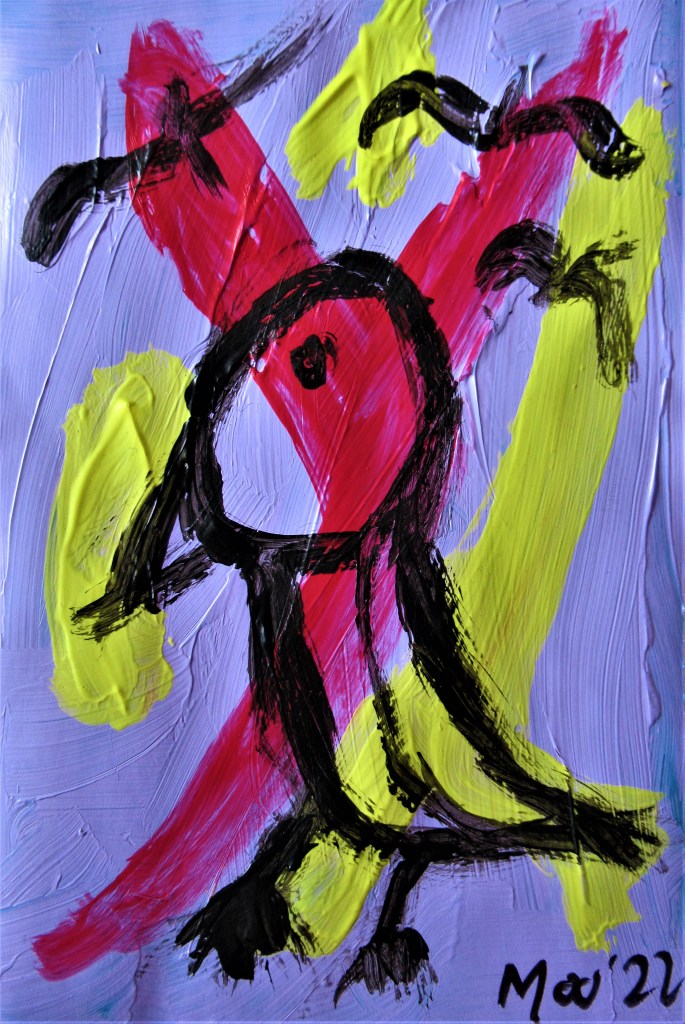
I guess that’s what happens when you finish your bottled sunshine (sol embotellado) before going to bed. The painting and the poem match up nicely though, ribbons of dark thought streaming through an empty head. Guessing and double-guessing, thinking and double-thinking, doubting and finding yourself inside that great cloud of unknowing in which you rarely know where you are going. Still, if you don’t know where you are going, any road will take you there. Pen-y-Bont, anyone? Or Abertawe, Cas Newydd, Llandeilo, Caerfili, Rhiwbina, Treorci, Trebanog

What was your favorite subject in school?

Daily writing prompt
What was your favorite subject in school?

What was your favorite subject in school?

I never had one. I hated every school I attended with a passion. I hardly passed an examination during my school days and I remember, in Mathematics, dropping from Level I, to Level II, to Level III. I failed the first exam in Level III and earned this comment on my school report “Now I know why he descended to Level III.” I still have those school reports, incidentally, complete with the signatures of the Masters of my – limited, very limited – universe. How I appreciated Pink Floyd’s The Wall, when I first heard it. “We don’t need no education, we don’t need no thought control, no dark sarcasm in the classroom, hey, teacher, leave those kids alone. You’re just another brick in the wall.” And yes, I built walls around me, many of them. But I survived.

Another comment from that report: “He has read widely and indiscriminately – I do hope it has done him some good.” That reading included the complete works of Jean-Paul Sartre and Albert Camus, lots of Andre Gide, the theatre of Jean Anouilh – some of which I saw live in Paris -, an immersion in the Existentialist philosophical movement, the complete plays of Corneille, Moliere, Racine, Beaumarchais, a variety of French Poets, including Apollinaire and Jacques Prevert, a selection of Spanish poets, novelists, and playwrights, and a series of modern-(ish) British poets, including John Manley Hopkins, Wilfred Owen, Dylan Thomas, Vernon Watkins, and ‘indiscriminate others’! I wrote a great deal of poetry at that time, some of it in imitation of Francois Villon and Gilbert Chesterton (of whom I read many works as well).

Alas, my enthusiasm was not appreciated, especially as I scorned many of the texts that I was forced to read for my examinations. I should add I also scorned the limited, authoritarian interpretations of them that were forced upon us. The slavish imitation of ‘teacher’s remarks’ gained an A+. Any attempt to think outside the authoritarian boxes built oh so carefully for us, earned an F-.

But, if I had to choose one subject, it would be Myself. Protecting that self, developing that sense of self, growing into myself, understanding myself, and finally, having left those schools, those ideas, and that country far, far behind me, becoming the self that I am – and have always wanted to be. “What do you want to be when you grow up?” “I just want to be me.” And I am, thank heavens. And it’s a good job too, for, as Oscar Wilde once said “Everyone else is taken.”

What aspects of your cultural heritage are you most proud of or interested in?

Daily writing prompt
What aspects of your cultural heritage are you most proud of or interested in?

What aspects of your cultural heritage are you most proud of or interested in?

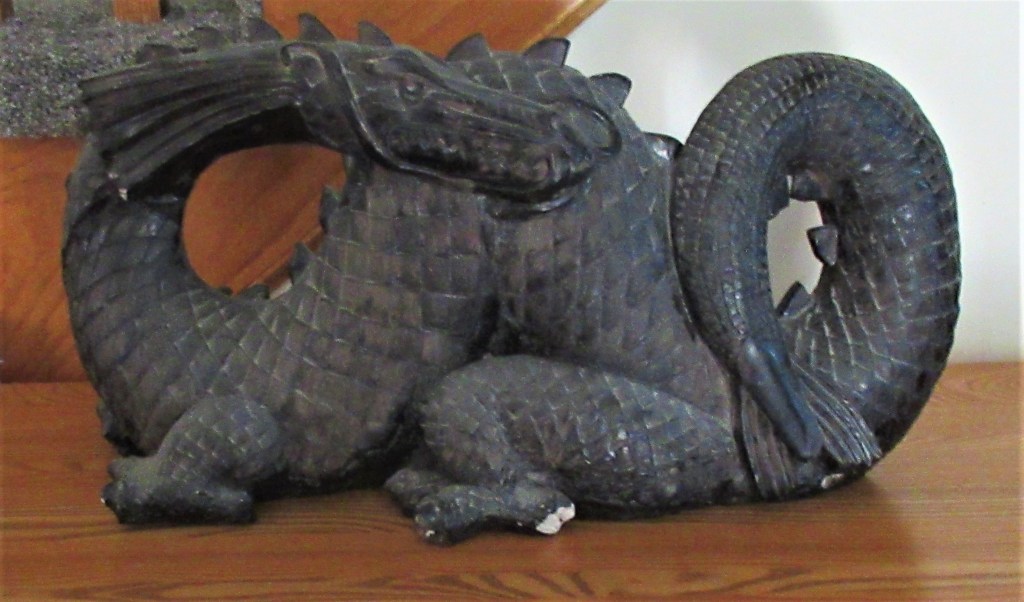
This dragon is not a dragon, well, it’s not a Welsh Dragon anyway. So, let us change the question – What aspects of your cultural heritage are you least proud of? Now that changes the perspective totally. I guess that I am least proud of the fact that, although born in Wales, I was never allowed to speak Welsh as a child. I speak with an English accent because I was sent to school in England so I wouldn’t even speak English like a person born in Wales. I am not proud of that aspect of my cultural heritage.

But I am proud of one little thing that stems from that Welsh cultural heritage – learning how to speak Welsh in my old age. It’s not easy to do that, here in Canada, but the internet carries many blessings, one of which is the learning of ‘foreign’ languages. Strange that Welsh should be considered a foreign language for somebody born in Wales. Something else not to be proud of, I suppose. Here’s my story.

Here I sit, an old man now, in front of my computer, learning at last my mother tongue, Welsh. I have discovered the beauty of simple words, not so much their meaning as their sound, the way they flow, the poetry of remembered rhythms: Cwmrhydyceirw, the Valley of the Leaping Stag, though legend has it that ceirw was really cwrw, and cwrw is beer, and its real name was the Valley of the Brown Stream Frothing like Beer.

Words have their own music, even if you cannot pronounce them properly: Mae hi’n bwrw glaw nawr yn Abertawe / it’s raining now in Swansea. Mae’r tywydd yn waeth heddiw / the weather’s worse today. Bydd hi’n dwym ddydd Llun / it will be warm on Monday. Place names also have their own magic: Llantrisant, Llandaff, Dinas Powis, Gelligaer, Abertawe, Cas Newydd, Pen-y-bont … Meaning changes when you switch from one language to another:  gwyraig ty / a housewife, gwr ty / a househusband, a concept of equality that has ruled Welsh lives since long before Julius Caesar invaded Albion, coming from Gaul with his legions in 55 BC.

The photographer asks me to smile. He wants me to say ‘cheese’ so I say it in French [fromage], then Spanish [queso], then Italian [formaggio]. “No, no, no,” he shakes his head. “I want to catch the real you. Try again.” So I say it in Welsh [caws]. He checks the memory card in his camera and looks puzzled.

“Your facial expression changes each time you speak a different language,” he tells me. “Please, won’t you just say ‘cheese’ in English? I want the real you.”

French, Spanish, Italian, then Welsh: all different and he wants the real me. Each language carves a new a map into my face.  Am I a clown, then, a comedian, a chameleon to wear so many masks and to slip so easily from one to another? And who am I, this stranded immigrant, marooned on a foreign shore that has finally become my home? Who or what is the real me?

“Cheese!” I say in desperation. “Got it,” he grins. “At last, I have captured the real you.”

How would you describe yourself to someone?

Daily writing prompt
How would you describe yourself to someone?

How would you describe yourself to someone?

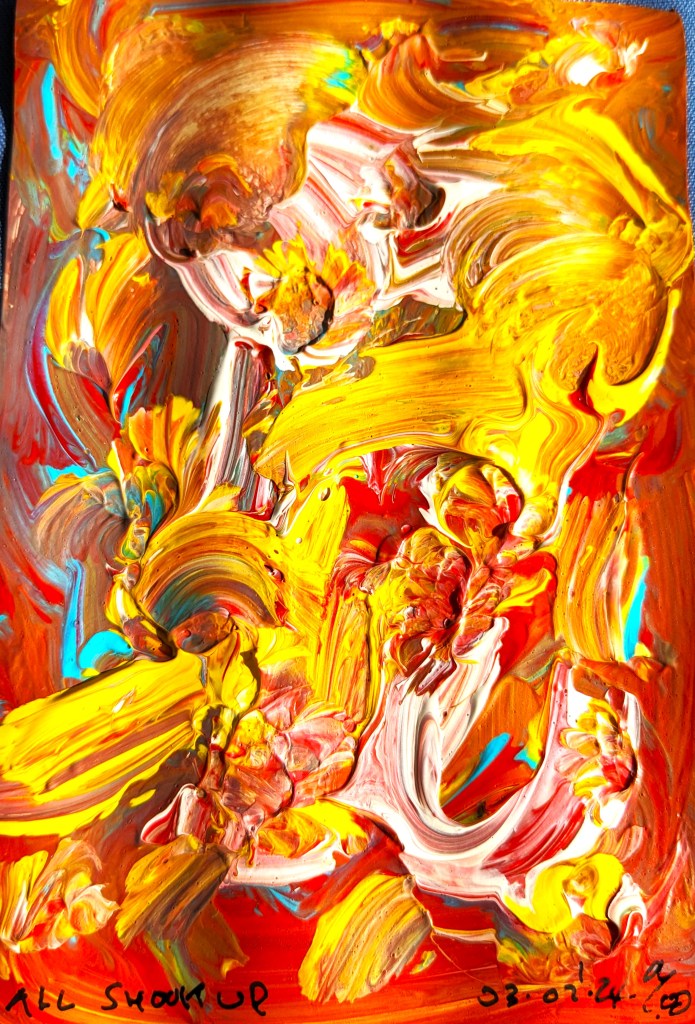
I wouldn’t. Why should I? I might give them a self-portrait, or a painting of me, by my friend Moo. Or I might give them a poem or a book of poems or short stories. That way they could see me for themselves or read about me and make a decision about me that way.

“Ah, would some power the giftie gie us, to see our selves as others see us.” Robbie Burns, if I remember correctly. For those who don’t follow the Scottish accent – the giftie gie us = give us the gift. I don’t have that gift. What I see in the mirror when I shave is not the same as what people see when they look at me with their own eyes or, with their own ears and minds when they read my words or hear me read.

Meanwhile – I invite you to read this. There’s a little bit of me in there somewhere. If you can find it before it floats away down the plug-hole.

Self-Portrait

I smell. I whiff. I gloriously stink.
My arms, my feet, my crotch, reek with beauty.
This is me. I am still alive. I’m rank.
The time has come, the Walrus said, to take
a shower. I strip. I weigh. I obey.

Hot water streams. Bathroom steams up. I draw
faces on grey glass, smiling, glum. Soft soap
works its miracle turning Japanese
nylon into a rough body cloth that
rubs and cajoles all putrid dirt away.

Butterfly from its chrysalis, I step
from the shower, sniff with caution, and stench
no more. I am clean. I no longer pong. 
My body has been taken over by
perfumes no longer mine. Who am I now?

I am no more myself. I am no more
my own gorgeous underarm muscular
ripeness. I have left my odor circling
in the soap suds and drifting down the drain. 
What a pain. It will take me a week or 
more to start smelling like myself again.