Indoor Plants

Indoor Plants

Those that have been chosen to survive have walked indoors, Now they are safe behind glass, in the warm, low sunshine that floods the rooms. We watch the sun’s fingers starting to reach into the deepest corners and know that winter is on its way.

Thanksgiving has come and gone yet we still give thanks: indoor flowers to brighten the dark days, flu shots tomorrow, blood tests on Friday. I guess it’s a case of ‘last man standing’!

Orion confirms this. He has risen in the night sky and now accompanies me on my journey through the dark hours, sword at belt, faithful dog at heel. Yes. Winter is on its way. Warmer clothing. Thicker jerseys. Non-slip shoes. Oh the joys of Canada.

Remember: there is no such thing as bad weather, only inadequate clothing. Locked out of the university, walking the picket lines at -35C, we learned the facts of outdoor winter life only too well. So, dress warmly. Keep safe. Keep your distance. Wear those masks. Did out your snow tires. Tune up the snow blower.

And may you always wake with the flowers in the house.

Dancing Bananas

Dancing Bananas

“The only difference between a madman and me is that I am not mad,” Salvador Dali. It is a great honor to borrow his words and to be able to make the same declaration: the only difference between a madman and me is that I am not mad.

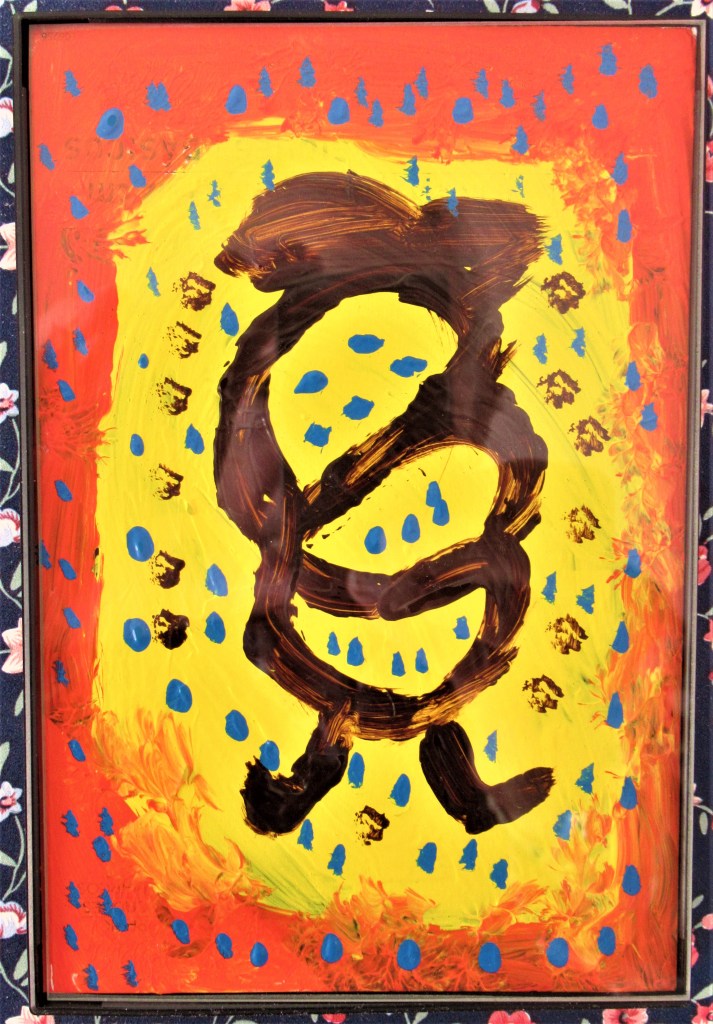
Mikhail Bakhtin: carnival, the world turned upside down, the world going bananas and those bananas dancing, as you can see in the painting above. It is a mad moment frozen in the still time of paint. And why shouldn’t bananas dance? Some one out there will remember Thunder Bay, 1981: ‘you just have to go bananas’ and the bananas duly appeared at half time instead of the oranges. Saint John, 1985: same thing.

And now the dancing bananas have emerged once more to fill your minds with pleasure and your hearts with joy. Go, bananas, go. Bananas-a-go-go. Way to go, bananas. And I tell you, given the current state of society, going bananas is the only way to go. So, in the next election, I shall form the Banana Party and we can all stand firmly, shoulder to shoulder and shout “Oh, Mighty Banana!” and “Go, Bananas!”

Ah yes, and my next painting? Maybe it will be Banana Custard or Banana Splits, not that I have ever done the splits!

Into the Sunset

Into the Sunset

So, the writing is back. I have reformatted The Nature of Art and the Art of Nature and am now checking it through one last time before I send it to the publishers. This feels good. I haven’t stopped painting though. Luckily the original, hanging on the wall, looks better than the photo. My angles are all wrong and the colours are definitely not as sharp as in the original. As I always said, when introducing Spanish Art via slides and photos: “Do not trust the imitations. Go back to the original.” Easier said than done, especially when the original may be tucked away in a foreign museum hidden in a small town. As Dylan Thomas once said of Swansea Museum: “it’s the sort of museum that ought to be in a museum.”

As for the Introduction of Art, and please note I do not write ‘the teaching of art’, here’s my article on my career as an art facilitator! ‘In the beginning was the picture and the picture was in the book.’ I guess my art career ran parallel to my career as a facilitator of Spanish literature, prose, theatre, and poetry. Some things you can present and introduce. But no, you cannot teach them, not unless you are completely without humility and understanding.

Now that’s what it is meant to look like!

Dizzy Dawn

Dizzy Dawn

There is so much happening. It’s hard to keep track of it all. Reading and annotating the material I am working on for my online writing seminar. Painting: a delightful relief and relaxation. Who cares if I can’t paint? I can make meaning out of shape and color, like my friend Matisse. Writing: the poetry is back and I will start revising those short stories again soon. I may also go back to my first novel. I have abandoned it for too long.

Meanwhile, each dawn is a busy dizzy time. This morning I decided to lie in bed until 24 birds had flown past my new bedroom window, one for each new pane of glass. It took about fifteen minutes. I watched the mist rise and then the sun start to break through and when the sun came, so did the birds. Dizzy Dawn is now hanging on the wall, along with another set of paintings I have finished recently.

Life is good. I hope it stays that way for as long as possible.

True Love

True Love

True love flows so much deeper
than an exchange of body fluids
or a handing over of ritual rings.

Our advancing lives are no longer
ruled by nature’s primal urges.
Our bodies have been taken over
by old age stiffness, aches, and pains.

Some nights, I wake up to find
she no longer breathes. I reach out
in panic, touch her gently, and when
she breathes again, I heave a sigh
redolent with love and relief.

Listen to podcast here.
True Love

Pianissimo

Pianissimo


            You sit at the piano, my old piano, still extant in my father’s house, yet soon to be given away, though we don’t know that yet. It’s an upright, iron-frame Bechstein, a piano that I was given when I was the same age as you are now. Handel’s Largo, the Harmonious Blacksmith, hours and hours of scales. They locked me in the front room, my mum and dad, and there I stayed for an hour, two hours, or more. I came to hate music. As soon as I could, I gave up the piano, I rejected piano practice, I turned my face away from the discipline of the lock up.
            Now, I listen to you. Your untaught fingers tickle the black keys, then the white keys, one after another. You are six years old. You’ve never had a lesson, but you have music in your blood and some residual instinct latches on to rhythm and sound. Your fingers are long and supple and your touch is light, so much lighter than mine used to be, and now, on the deep bass notes of the left hand, your stronger hand, you pound away, awakening the dark ghosts of soul music that pour through my memories awakening echoes in this piano.
            I think of you as a jazz musician. Thelonius Monk, perhaps, a tinkle here, a light touch there, now a chord or two, inexplicable, and who would want to explain. It is a joy to sit here, to see your smile of absolute absorption. Mood music you call it, and today your moods are as dark as the shadows that tug at my heart, and as light as the sunlight that floats through the windows and makes the dust motes sparkle. It also frames a halo round your head. You hum to yourself as the morning sunshine fragments into colored gems and you sculpt your rainbow of sound.
            “Stop that noise. You’re driving me mad,” your grandfather, my father, stumbles into the room. He has taken his last cigarette out of the packet and the white cylinder hangs down from his lips, like an extraneous chalk outcrop hanging from the lip of an errant teacher. He pats his pockets. “Where are my matches? Has anyone seen my matches?”
            “They’re on the table in the kitchen,” I reply. “Where you always put them.”
            “I thought I left them in here,” my father leans on his stick then turns and stumbles out of the living room and into the kitchen.
            You hop off the piano stool, take the matches from your pocket, and carefully place them on the arm of your grandfather’s favorite chair.
            “Sssssh!” you say, putting a finger on your lips. Then you skip back to the piano and start playing pianissimo on high notes that float like tiny raindrops of sound produced by miniscule angels.          
            Your grandfather returns, glances round the room, spots the match box, and pounces upon it, a caged tiger finally served his red meat.
            “That’s funny,” he mutters. “They weren’t there a moment ago.” He takes out a match, strikes it, lights up his cigarette, inhales a lungful of smoke, then exhales it in a great locomotive puff of cloud. He grimaces at you through a haze of smoke.
            “There’s nice music you’re playing.”
            Your young lungs, unaccustomed to a house of smokers, can’t cope with this thin, grey, choking cigarette waste. You stop playing, put a hand over your mouth, and start to gag.

Listen to the Podcast here:
Pianissimo
Crocodile Tears

Crocodile Tears

The crocodile lives in the wind-up gramophone. The gramophone lives in the top room of the house. The boy winds up the gramophone with a long brass handle, round and round, till the spring is tight. A tight spring frightens the crocodile and he sits quietly in his cage. But as the record goes round and the spring loosens up, the crocodile roars and demands to be freed. He’s the Jack that wants to jump out of the box. His long-term dream is to eat up the witch who looks out of the window and watches the boy as he plays in the yard.
            Last week the boy decided to dig. He picked up a spade and dug a deep hole that went all the way down to his cousin in Australia. The little dog laughed and joined in the fun, scraping with his front paws and throwing earth out between his back legs like happy dogs do. The witch in the window cackled with laughter and the rooks in the rookery rose up in a cloud and cawed in reply. Only the boy is able to see the witch and he only sees her when she sits in the window. But he knows she wanders through the house, and the air goes cold when she enters and exits the rooms, especially when she brushes past the boy and sweeps his skin with her long, black gown.
            When the boy got tired of digging, he drove the spade into the ground and left it standing by the hole. When his father came home it was well after dark. He didn’t see the hole but he saw the spade. So he didn’t fall in to the shaft of the coal-mine that went down to Australia. No free trip to the Antipodes for that unlucky dad. He beat the boy for that, for digging that hole. Then he beat him again for lying because the hole didn’t go to Australia. Australia was too far away and the angle was wrong. The boy laughed when he saw that his dad didn’t know where Australia was.
            “Ha-ha,” he laughed. And his dad beat him again, this time for laughing.
            Sometimes at night the boy can hear rats running through his bedroom walls. They scuttle and scuffle as they hunt through the guttering. The crocodile growls from time to time in that upstairs room. The witch cackles with laughter. The boy puts his head under the blankets and cries himself to sleep. Sometimes he wishes the crocodile would come and eat up his dad. But he loves his dad like the dog loves his dad even though his dad beats both the boy and the dog. Sudden beatings, they are, that arrive without warning: hail and thunder from a sunny summer sky.
            “Well, you’re not laughing now,” his father announces as he beats him one more time. “A beating a day keeps disobedience away. There will be no disobedience in this house.” When the father beats the boy, the dog cowers beneath a chair. The boy hears the crocodile growl and smiles through the tears as he wipes salt water from his eyes.
            “Are you laughing at me? I’ll make you laugh on the other side of your face,” the father taunts the son and beats him again.
            The crocodile growls. The old witch cackles. The rooks in the rookery rise up in the air and the father’s hair stands up on end like it does when lightning lights up the sky, and thunder rolls its drums, and the sky’s wheels rattle like an old warrior’s chariot whose wheels have not been greased. The veins stand out in his father’s cheeks as the old man once more raises his hand to the boy.
            The old man tells the same old jokes again and again. The boy must always remember to laugh at them as if he had never heard them before. If he doesn’t laugh, his father gets angry. Some of the jokes are good, and the boy likes the one about the Catholic with the pet crocodile who goes into a bar in Belfast and asks the barkeep if they serve Protestants. ‘Of course we do,’ says the barkeep. ‘Good,’ says the man. ‘I’ll have a pint of bitter for myself and a Protestant for the crocodile.’  Or is it the one in which the Protestant goes into the bar and ask the barkeep if they serve Catholics … anyway … whatever … one night, the boy dreams and it happens like this. The crocodile escapes from the gramophone. The witch hands the boy a leash and a collar and between them they restrain the crocodile.
            “Walkies?” says the boy.
            The crocodile nods his head and crocodile and boy walk down the street to the Kiddy’s Soda Fountain on the corner. When the boy walks in with the crocodile, the waitress raises her eyebrows and opens her mouth.
            “Do you serve grown ups in here?” the little boy asks her.
            “Of course we do,” says the waitress.
            “Good. I’ll have a glass of Dandelion & Burdock for myself and a grown-up for the crocodile. Please.”
            The witch says grace, the boy sips his Dandelion & Burdock, and they all shed crocodile tears as the boy’s pet crocodile chomps on the fast-disappearing body of the boy’s dad.
            Next morning, the boy wakes up. The witch and the crocodile are sitting on his bed.
            “I had a funny dream last night,” says the boy.
            The witch cackles. The crocodile burps, then sheds crocodile tears. The boy starts to laugh. He laughs until he cries and then the witch sheds crocodile tears too.

Teddy Bears’ Nit-Pick

Teddy Bears’ Nit-Pick
Friday Fiction
27 August 2021


            “So, Teddy, how did we all end up in here like this?”

“Kicked him out, she did, just like that, Freddy. Told him to sleep in the spare bedroom. She couldn’t take it any more. She couldn’t sleep. He had to go.  It was the diuretic that did it, mind, the diuretic.
            After the radiation treatment, they gave him hormone injections, told him he’d put on ten to fifteen per cent of his current body weight, but not to worry. It was quite natural. It was the hormones, see?
            He told me all about it. Told me how he used to stand on the bathroom scales without a care in his heart. Watched his weight rise, five per cent, ten per cent, fifteen per cent. When he reached twenty per cent, he started to worry. Swollen ankles. Swollen knees.
            At twenty-five per cent, he was really worried. Socks no longer fitted. Couldn’t put on his shoes. Couldn’t bend to tie his laces. Had to wear sandals and slip-ons.
            At thirty per cent, he started to cry. He told me he was ugly, so ugly. He was down to one pair of shoes and one pair of sandals that fitted. He went to the pharmacy. The pharmacist took one look at his feet and gave him a long list of Latin names. Told him he’d need a prescription, from his doctor, to get pressure socks, and medical shoes that would help him walk.
            ‘It’s the feet, see, the feet,’ the pharmacist told him. ‘Once they start to swell, you’re in big trouble. There’s nothing we can do. Go see your doctor.’
            ‘I’ve seen the doctor.’
            ‘Go see him again.’
            So he did. Told me he broke down crying when he entered the surgery.
            ‘I’m down to one pair of shoes. You’ve got to do something, doc.’
            So the doctor wrote him out a prescription for pressure socks, medical shoes, appointment with a psycho-something, attendance at a clinic, everything the doc thought he needed. Then, just as he was about to leave, the doc stopped him.
            ‘Hang on a sec,’ doc said. Sat at the desk. Checked the computer. Wrote out another prescription. ‘New tablets,’ he said. ‘Take these brown ones. Stop taking those white ones.’
            He went away happy. Stopped at the pharmacy. Got the new pills. Went home. Took them. And straight away started to pee. Told me he’d peed all day and then I watched him as he peed all night. Every 15 minutes. That’s when the missus kicked him out of bed.
            ‘Go. Sleep in the spare room,’ she said. ‘You’re peeing every fifteen minutes. I can’t sleep anymore. I can’t stand it. And take that teddy bear with you.’
            So he went. Grabbed me, his faithful Teddy Bear, tucked me under his arm, and we went to the spare room with its cold, lonely bed. Except he had me, his Ted.
            Lost four pound that first night. Twelve pound the first week. Twenty pound the first month.
            ‘Ted,’ he said to me one morning, ‘I feel good. Time for us to go back to the old bed.’
            We tried. But the missus wouldn’t let us back in.
            He’s looking pretty good now. Back down to ten per cent body weight up. Says he can live with that. Likes sleeping with all his Teddy bears he tells me. Says we don’t snore. Unlike that missus of his.
            It’s the first anniversary next week. He told me to gather all the bears, Rosie, and Blanche, and you, and Blueberry, and Basil of course. And that French bear, Pierre.
            ‘We’re going to have a midnight dormitory feast and a Teddy Bears’ Nit-Pick.’
            Sorry Fred, I don’t know what the missus is going to say about that.”

Quack!

Quack!

A duck, in cricket, means the batter has been dismissed without scoring. The 0 resembles a duck’s egg, and hence score of naught is known as a duck! A golden duck means the batter has been dismissed first ball, without scoring, a sad fate indeed. A King Pair is first ball in each innings of a four innings match (two per side).

My cartoon shows an English cricketing duck carrying his bat through a golden shower of life’s purple patches. There are several clichés and double entendres in this title. First, of course, the ignominious duck. Carrying his bat: this has a double meaning (a) to literally carry a cricket bat, as this duck is doing, and (b) to open the batting and carry your bat throughout the innings, un-dismissed, although the other ten wickets have fallen around you. To carry your bat for a duck is as near as impossible as it can possibly be. A golden shower: alas, we are all now familiar with the pornographic version. Some will be familiar with the myth of Jupiter descending as a shower of gold. The golden shower here also represents the shower of golden ducks that has currently descended upon the English cricketing team. Purple patches can be good. However, a purple patch of golden ducks is only good for the opposition bowlers, if you are on the batting side.

England top order quacking and creaking into history of the duck: this article in Tuesday’s Manchester Guardian cricketing section will explain the makings of current duck history for all who are interested. Equally interesting are the double meanings (a) within the verbals of the above cartoon and (b) within the visuals of the drawing itself. For example, the golden duck holes / eggs pecked in the bat, the mingling of gold and purple in the shower falling, the duck eggs woven into the batter’s shirt…

So, here we go, swinging low, swinging to miss, and swinging into history, where batter itself is a neologism replacing batsman as a non-generic term for those who bat, much as bowler, the man, not the hat, is a non-generic term for those who bowl, or fielder for those who field. Now, what on earth are we going to do with ‘gloveman’? Glover, perhaps, or wicket-person, or a return to wicket-keeper, or just a limited keeper? Language is so lovely and the mixture of language and cartoon is is doubly good, as long as everyone is bilingual and can entendre.