Self Isolation Day 21

IMG_0638

Self-Isolation Day 21
Bakhtin’s Chronotopos
Man’s dialog with his time and place

Chronos / time + Topos / space = chronotopos: the time and space within which we live.

Chronos: this morning, when I woke up, I moved back into my own time and space. But what is my time? It was 5:45 am when I awoke, so was that my time? I stayed in what the Spanish call the duermivela, that drowsing dream-world in which we all wander, half-conscious. I stayed there until I decided to get up at 7:45 am. Was that my time? Well, yes,  all of that is / was my time. But time extends further than that. Real time is static and only exists in this second as I type the s of second, but look how it has flowed or flown. So my time drifts backwards into a knowable and then an unknowable past. I knew my parents, and my grandparents. But I know nothing of their childhood, their war days (WWI and WWII), their courting, their marriages. Their time is time lost for me. Sure, I can invent it, renew it, recreate it … but it can never be mine. All I can possess is this Second when I preSS the S key, a Second that haS already flowed paSt me, flown and gone. The same with future time. It is there, stretching out before me, for how long, I do not know. It is not yet mine, and when I come to possess it I will only posses it, really possess for those precious Seconds when I inhale, or exhale, or press the S key. And now I have bewitched you, and your concept of time, and your keyboard will never be the same.

Topos / Place: so what is my place? When I awoke this morning, it was the kennel-cave of the bed in which I hibernate each night. Then it morphed into the bathroom where I dressed and prepared for the day. After that, I walked downstairs. Descending the stairs, a step at a time, feeling for the steps with my cane, as I do, I find that each step is my place. Luis de Góngora, one of my favorite Spanish poets, wrote, a long time ago that “Cada pie mal puesto es una caída, / cada caída es un precipicio”each footstep, badly placed, is a fall, / each fall is like tumbling down a precipice. Ipso facto, I must take care not to fall each time I place my foot on a stair, and each stair, therefore, is my concentrate of time, and this moment of time manufactures my space.

Then there is my breakfast place, my office place, my work place. Time spent in each of these spaces is a link backwards and forwards, past, present, and future all inexorably bound in each passing second that I live.

But there are other spaces, spaces in which time flows at a different rate in objective time (the thirty minutes you spend in the dentist’s chair) and subjective time (the hours and hours those thirty minutes take to pass as each second limps by, like a three legged tortoise with gout). hen there is creative time: and creative time, especially on the computer, leads us into a different space, a sort of hyper-space, in which we hover between this place (the place of the office and the house) and that place (the place in which we create our visions and dream our dreams). Lost in that creative hyper-space we drift in a timeless amniotic sea where all time is one and all places are one and we are the masters and mistresses of our own creative universe. Y aquí, as my good friend José Hierro once told me, el tiempo no tiene sentido / here time has no meaning.

Jane Tims wrote these words to me today. “The idea that some of our words will live on, on the page… I wonder where our WordPress and Facebook words will reside in 300 years? Will some antiquities student make the headlines having managed to upload the forgotten words of people who wrote about the days of the coronavirus?”

My reply: “These are very true words, Jane. It looks like you have gifted me with the topic of tomorrow’s blog! Thank you.”

Indeed, the online medium is so ephemeral and can be wiped out in seconds. Tweets can be erased, changed, and altered. Written words and written histories have also been erased and wiped out. In our brave new world, the truth changes from day to day with no vital record attached to it. Historians always say that the conquerors write history … and when they do so they usually destroy the writings of the conquered. I think of all those Mexican Codices, destroyed by the Spanish priests on their arrival in Mexico as the works of the Devil. We know so much from the surviving ones, for example the history of Ocho Venado, born in 1063 and sacrificed in 1113 in accordance with the fifty two year annual cycle. Only five Mixtec codices now survive, one, the Vindobonensis, still bears the scorch marks from when it was plucked from the flames that were meant to devour it. Man’s inhumanity to man. How much have we lost? How much are we losing? How much will we retain? And what is truth …?

As for us and our chances of survival, another good friend of mine, the poet and philosopher José María Valverde once wrote of nosotros, los pobres poetas de hoy, destinados a ser polvo seco de tesis doctoralwe poor poets of today, destined to become the dry dust of doctoral theses. In spite of all this, it is our fortune and our duty to exist within our time and our space, to live letter by letter, painfully tapped on the keyboard, and to engage in our dialog with our own time and space, for that my friends is all we have, the single instant of that one letter S.

Comment: The watch in the photo belonged to my father. I wind it up and wear it on his birthday every year. It now measures my time, as it once measured his, and its place, at least once a year is on my wrist. Its function is to tell me the time. One day, it will do the same for my daughter, and then my granddaughter and they too will have their dialog with their own time and place.

Self-Isolation Day 19


IMG_0718 (2)

Self-Isolation Day 19
Platero yo yo
Meniscus: Crossing the Churn

I am eking out my reading of Platero y yo much as I eke out the food supply: small portions, and a chapter at a time. In the same ay that I am enjoying my food so much more, savouring each mouthful, cutting down on the accompanying wine, tasting life to the full, so I am slowing down my reading. I am learning to enjoy the journey, the perusal of each word, each phrase, the long-drawn out aftertaste of every image, the lingering bouquet of each metaphor. Yes, Platero y yo is a fine wine drawn slowly over the palate to be tasted and tested, not swigged and swallowed.

Not for the first time in my life, I am jealous, jealous of this writer with his Nobel Prize for Literature and his wonderful way of choosing le mot juste, the exact word, with which to illustrate his tales. It is not the Nobel Prize of which I am jealous, but the talent, the skill, the patience, the taste of each word. I wish I could write like that. I wish I could take the world outside in my garden and imprison it on the page.  Imprison: that’s what I do. Juan Ramón Jiménez imprisons nothing. His birds and butterflies fly free. His donkey roams free. His village women, young and old, wander freely across the pages as do the gypsy children and the children of the poor, with their dreams of gold watches that will not tell the time, their shot-guns that will not kill hunger, their donkeys that will carry them to a pauper’s death. Reading at this level, I rediscover my inevitable inability to write the way I want, to capture what I see, to give life and liberty to my words, enchained all, and lavishing in their captivity.

There is, of course, an alternative, one of which I am also incapable: to create a new world. I know of few people who are capable of doing that. Tolkien, of course, created Middle-Earth, the Shire, Mordor, Gandalf, and the Lord of the Rings. Rowland created Hogwart’s and the world of magic that surrounds Harry Potter. Closer to home, Alexandra Tims created Meniscus, a planet that travels around twinned suns and is in turn circled by two moons. Here water effervesces and flows uphill or generates dramatic water-climbs and lake-like churns.Erosion occurs by wind-scour and frost-heave. It holds predators (slear-snakes and kotildi) and humans have been brought her, as slaves, from earth itself, to eke out a miserable existence amidst the dystopia created by Dock-winders, Gel-heads, Argenops, and the Slain.

What I love about this series includes the invented language, the flora and the fauna, the wonderful drawings and maps that occur regularly throughout the books. This is no Middle-Earth, a recognizable world inhabited by humans and figures of magic drawn from our own legends and mythologies. It is a flesh-and-blood creation of something new and startlingly different.

Wolfgang Kayser suggested, a long time ago, that there were three types of novels: novels of action (the easiest to write, if you have that calling), novels of character (the development of an individual or a series of individuals), and novels of place (where the world, or a small part of it, is captured in detail). Occasionally, a great novelist, and Miguel de Cervantes was one of those, manages to write a book (Don Quixote) that contains all three of these features. Mikhail Bakhtin talks about ‘man’s dialog with his time and place’. Well, Ms. Tims has created ‘a woman’s dialog with her created time and space’ and I, personally, am so very happy that she did so.

Comment: [added 27 March, 2020]
Meniscus: Crossing the Churn can be found at
Here are the other books in the series.
Book One – Meniscus: Crossing The Churn

Book 1.5 – Meniscus: Forty Missing Days
Book Two – Meniscus: South from Sinta
Book Three – Meniscus: Winter by the Water-climb
Book Four – Meniscus: The Village at Themble Hill
Book Five – Meniscus: Karst Topography
Book Six – Meniscus: Oral Traditions
Book Seven – Meniscus: Encounter with the Emenpod


CV-19 Week 3 Day 3


IMG_1337 (2)

CV-19 Week 3 Day 3
A Change of Scene

Nothing serious happening with this change of scene, but this morning I put Phillip Larkin on one side and turned to a new book, Neil Sampson’s Apples on the Nashwaak (2019). This may be just the read you need in times like these. An excellent foreword locates the text of Neil’s narrative poem(s) in the long line of European narrative poetry. Neil’s introduction places his text in his own life on the land where he lives and wanders in Upper Durham, above the Nashwaak River. The text itself places us, as readers, in the long successions of repeated lives and deaths that mark the early settlements in New Brunswick, Canada. And yes, we have passed this way before, for better or for worse.

This is not a re-statement of ‘mal de todos, consuelo de tontos‘ / shared ill’s are a fool’s consolation. The colored apples on the stark tree that adorns the cover are a statement of hope, long term hope, even among the bleakness of difficulties, tragedies, and deaths. Like it or not, these things happen, and yes, there are survivors. Hopefully, there will always be survivors. And thus we must always live in hope. It is one of the threads that come through Neil’s poetry.

Only four trees are still alive.
The last of that first
generation
ponder existence and being
unable to walk
— no chance of pilgrimage —
have seeded their hope of redemption,
in Self.

Sounds like us, tucked away at home for three weeks and three days now ‘unable to walk’ outside and with no immediate ‘pilgrimage’ in sight or ‘hope of redemption’. Yet we sit here, un-suffering, following the news on television and radio, talking with friends on the telephone, reaching out to loved ones, near and far, on Skype, e-mailing and encouraging fellow un-sufferers, house bound, like us, ‘Children / hugging the chimney, // warm long after / the embers had died’.

Wait! In the orchard!
There’s One who’s come to call.
Those four pioneers
cankered with rot;
bark-skinned, limbs,
thin, draped in swags
of moss —

they know
who He is.

Enough for now, Neil. I shall read your book today and perhaps tomorrow, and then I will move on with head held high and hope in my heart. Thank you for your words. They are doubly meaningful at times like these reaching out to us with comfort, love, and understanding, and warming our hearts.


CV-19 Week 3 Day 2

IMG_1053 (2)

CV-19 Week 3 Day 2
Reading in Multiples

Legend tells us that Francisco de Quevedo possessed a revolving book stand-cum-lectern. He placed this on his table at meal times and he would have four books open at the same time, moving rapidly in his reading from one to another. I have always liked this idea. As a result, I am now doing something similar.

I began by taking out Don Quixote, which I am once again reading in Spanish. The adventures of our Ingenious Gentleman are a delight and this time, the slowness of my 28th reading of the 1605 text allows me to taste every word, to roll the syllables round the tongue, and to savor every word. With CV-19 on the loose, there are no deadlines, no use by dates, and nothing to prevent me from delaying the full enjoyment of each word of the text. Equally important, there is no class preparation, no waiting audience, just me, an old man now, following the thoughts and adventures of an old man as written by an old man, Miguel de Cervantes, way back when.

I have the Collected Poems of Phillip Larkin on the table beside me. What a different world. What depth of insight and observation. What a bearing of witness to the follies and foibles of an England that I left behind so long ago, much of it vanished now, along with the old choir stalls and the hedgerows, the cuckoos and the skylarks. I read and re-read The Old Fools and realize just how close I am to that cliff edge, that precipice, that Alpine peak, beneath which I shelter and seek succour. Then I turn to This be the Verse and I start to laugh at this portrayal of middle-class parental pretensions. This is Larkin’s open wit, but his sly wit, like that of Cervantes, but more bitter, creeps up on you and catches you unawares, unless you know how and where to look for it.

At my left elbow, Juan Ramón Jiménez’s Platero y yo awaits my attention. No children’s book this, but a wonderfully poetic recounting of a poet’s observations of Moguer, a small seaside town in Andalusia. This too is a book to read slowly, to savour, to taste each word, each story. This too is prose poetry at its best. Cervantes wrote that ‘epic poetry can be written in prose’ / la épica también puede escribirse en prosa‘. JRJ might equally well have written that ‘poetry can also be written in prose’ … an edict that I have tried to follow in my own writing.

For my more serious reading, I am dipping into the late Roger Scruton’s A Short History of Modern Philosophy (from Descartes to Wittgenstein). This is heavier reading, in some senses, yet the parallels between Descartes philosophical observations and Cervantes’s literary ones are well worth considering, for Cervantes often offers the practical where Descartes puts forward the theoretical.

I will be adding more titles to my reading as I progress. Needless to say, I am also wandering through the labyrinth of my own earlier writings, and they are so much fun to revisit too. I will add more on this topic, as our enforced enclosure progresses.

Comment: These visitors came to my garden last summer. It is a delight to offer my photographs of them as a counter to CV-19 for these butterflies symbolize the brevity and the beauty of our lives. Butterflies on a rock: poetry and literature in Canada, and even more fragile in these times of utmost fragility. Keep well, keep safe, and keep in touch with your loved ones by telephone, Skype, Messenger, e-mail, and keep everything safe.

CV-19 Week 3 Day 1

IMG_1058 (2)

CV-19 Week 3 Day 1

So, yes, I am starting the third week of my self-imposed isolation. I am also in the first week of an imposed provincial State of Emergency. What I was doing willingly before, self-isolation, has now become law, self-isolation by edict.

It seems a minor change, but it isn’t. Whereas before I was happy not to go out, now the very prohibition makes me want to go out. Yes: I now want to be out there, wandering the now-empty streets, shopping in the now-closed stores, and visiting the newly locked and barred bars and restaurants.

This situation reminds me of the word-games we used to play as children in which you were given a word which you mustn’t use and then you discovered that you really, really wanted to use it, simply because you had been told not to. One such banned word, in my childhood, was bloody. All the grown-ups used it, but it was forbidden to the little children. Bloody hell, we thought. Or bloody nice weather, we said to friends of our own age. Then, if our parents caught us using the forbidden word, out came the carbolic soap and it was mouth wash time again. Yuck: I have never forgotten the taste and smell of that carbolic soap.

We devised schemes for getting round the prohibition. I guess children of all ages devise schemes for breaking down prohibitions. That’s why so many soldiers in WWI used to ‘break out of barracks’ as they resisted the imposition of nightly curfews with their locks and keys. “Oh we’re breaking out of barracks,” they would sing, “as we have done before.” Then came the other verses. “Take his name and take his number.” “Up before the CO.” “Forty days in prison.” Back to bread and water, as we have done before.”

So, when my mother took us to the butcher’s shop one day, we were all primed. “Look at all that bloody meat” we cried out , shrieking with laughter and rolling all over the saw-dusted floor. My mother was furious, but we were spared her wrath as the butcher, and his other customers, found it so amusing.

But CV-19 (Corona Virus \ Covidis 19) is not so funny and the punishments are much more drastic than a simple carbolic soap mouth wash session. That said, the itch to break the prohibition is so much stronger now that the law is provincially enforced and not self-imposed. That said, these are rules well worth following. Nobody wants to catch this and, much more important, nobody wants to be responsible for passing it on to somebody else, especially if that somebody else is in the target range for a serious, perhaps fatal, bout with the virus.

Funny old world, eh? And some funny old people living in it.

Creativity

IMG_1526 (2)

Creativity

When creative artists get together they talk and walk and hug and hold and discuss so many things, like how the creative spirit can inflate the body and send it soaring like a trial balloon, how listeners can be swept away by a magic vortex of voice, and how time and space can be suspended in the glories of creation that spin a web of forgetfulness around us and makes us disregard who and what we are as we forge new worlds.
Dark earth-spirits of love, want, and creation, hold us captive and drive us onward and inward until we give birth to that which was waiting patiently to be born, even though we never knew that the seed had been planted. “What is this?” we ask as we survey the new-born entity fresh on the page, held in the hands, suddenly full of life and breathing on its own, a thing of beauty, an essential being. It makes complete sense as we struggle to hold it as it grows and transforms from internally ours to eternally theirs, a product of our mind and body now belonging no longer to us but to the world beyond us.
We long to know its fate, to watch it as it walks along its path, its destiny now in its own hands. “What is it?” people ask as we stand still and know not what to tell them. Some sigh, some mutter ‘nice’, others just turn and walk away, lost in a self-created labyrinth of cul-de-sacs, dead end streets, and black, blind walls. Many go back to their two-thumbed clicking and surf the networks, bereft of the imagination to see and explore that which has been thrust fresh before them, this new-born babe beautiful in its swaddling clothes, a new creation.

Comment: The photograph … a geranium against the snow. Truth and beauty can survive even the hardest winters. As true creative artists we must be prepared to fight for our creative ideals. When the skies seem to be at their darkest (see my recent posts Poem from the Cree, Co-[vidi]-s and Outrageous Fortune) that is when we must strive to re-create the light, not just for ourselves, but for others as well.  

Co-[vidi]-s

15 May 2002 Pre-Rimouski 141

Co-[vidi]-s
17 March 2020

Time has changed with the clocks
and my body clock
is no longer in sync
with the tick-tock chime
that denounces each hour.

Hours that used to wound
now threaten to kill.
They used to limp along,
but now they just rush by
and I, who used to run
from point to point,
now shuffle a step at a time.

Around us, the Covidis
thrives and flowers.
Wallflowers, violets,
we shrink into our homes,
board up the windows,
refuse to open doors.
We communicate by phone,
e-mail, messenger, Skype.

Give us enough rope
and we’ll survive a little while,
fearful, full of anguish,
yet also filled with hope.

15 May 2002 Pre-Rimouski 035

Revisions

img_0128

Revision
“We are not writers, we are re-writers.” I do not remember who said this, but it is extremely well said. We write, yes. But then we rewrite, sometimes obsessively, again and again. But how does that rewriting process take shape? Why do we rewrite? How do we rewrite? And what do we do when we re-write? These are all vital questions.

Mechanical revisions and rewrites
This, for me, is the search for typos, punctuation errors, mis-spellings, grammar corrections, that sort of thing. Yes, we can rely on a (reliable?) editor and a not so reliable spell-check, but the editor usually costs money. Or we can learn to do it ourselves, which is what I recommend very strongly.

Grammatical revisions and expression checks
These are usually a little more difficult to deal with. Do the verb tenses check out? Are subject and verb clearly delineated? Does the wording make sense, not just to us, but to the outside reader? A second pair of eyes is always useful at this point. Also, a sense of distance from the text is useful. Leave it a day (or two) and come back to it later when he creative rush has fled the system.

Structural revisions 1
Whenever we do a structural revision, it is essential to check that the revision ties in with the rest of the piece and that we maintain consistency throughout. A simple example: I decide, on page 77 of my novel, to change my main character’s name from Suzie to Winnie. Clearly, her name has to be consistent, both backwards (1-77) and forwards (77 onwards). While this is obvious, other changes, taste, color of hair, color of eyes, height, weight, tv program preference, may not be so easy to check and double-check. But it must be done.

Structural Revisions 2
This is where we must pay attention to the vision in the re-vision. We must ask the question, what does the poem / story / chapter / text want to say? What is it actually about? Often, in the flush of creation, we write words (actions, thoughts, emotions) on the page and they flow like water from a fountain. It’s a wonderful feeling. Later, during the re-vision process, we must ask ourselves, again, deep down, what do these words mean, what are they trying to say? This is actually a slightly different question from what am “I” trying to say?
The speaking / writing voice may want to say something, but the words (and characters and actions) themselves may want to say something else. Now we are faced with a dilemma: do we write what we want to say or do we follow the intricate word-path growing from what we have written? As a beginning writer, I did the former. As a more mature (and I hope, a slightly better writer) I now do the latter.
The result is often a piece that is radically different from it’s starting point. When you listen to what the story / poem / text / characters etc are telling you and when you follow words and characters, then structure changes, paragraphs switch places, thoughts move around, expressions change. We are no longer forcing words into our meanings, we let the meanings grow out of the words. This is particularly important in short story telling and the writing of poetry. It is vitally important to the novel where any inconsistency must have a relevance to the development of action, plot and character. It is also a totally different approach to the meaning of re-vision.

Summary
I realize many writers may have difficulty accepting these points. Those trained originally in the academic world, in particular, will respond negatively to the idea of the words ‘not being forced into the correct academic shape by the quasi-omnipotent academic mind’ aka Constable Thesis Editor. However, the more creative a writer is, the more that writer will respond to the creativity that lies within both the creator and the creation that has appeared on the page and, as writers, we must never lose sight of that creative act, for it is one of the most truly wonderful things that we can do.

Comment

This is a golden oldie. However, it is still worthy of being reconsidered. Why do we revise? How do we revise? I hope this article is of use to the many out there who are looking for help and encouragement.

Writers’ Block

IMG_0182

Writer’s Block
(For Kentucky Blue Angel)

This is a golden oldie that I am re-posting. Today, several people talked to me abut writers’ block. Here are my thoughts on the topic.

Every day, well, almost every day, I meet people who tell me that they cannot write anymore. They have abandoned their current project. They sit in their work space and stare at blank screens or empty walls. They have come face to face with the dreaded Writer’s Block.

While some consider Writer’s Block to be an actual illness, others flaunt it like a flag or a badge of honor:

“Don’t touch me — I’ve got Writer’s Block: I wouldn’t want you to catch it.”

“I’m having a bad week: I’ve got Writer’s Block.”

“Sorry, I can’t make the writer’s meeting, I’ve got Writer’s Block.”

According to Wikipedia, “Writer’s block is a condition, primarily associated with writing, in which an author loses the ability to produce new work or experiences a creative slowdown. The condition ranges in difficulty from coming up with original ideas to being unable to produce a work for years. Throughout history, writer’s block has been a documented problem.”

We have probably all experienced the sensation of being unable to write, unable to think, unable to continue. As an academic, I found that something similar happens frequently in examinations with young students whose minds suddenly go blank when faced by a white page and an awkward question. This form of Writer’s Block comes at the most unfortunate times. Students need to be switched on just when their minds switch off. And something similar happens to writers.

Examination Block can be overcome. In many cases careful preparation for an exam will reduce or eliminate examination block. These preparations may well include correct note-taking and relevant revision procedures. There should be no last minute all-night study the night before the exam and a good night’s sleep, proper food, and water are essentials. Appropriate physical exercises before the exam starts are also useful as these make the heart beat and the blood flow. All these things prepare both body and mind and free the student for that most important task: the struggle with the blank page and the awkward question.

Will a similar set of preparations work for those who suffer from Writer’s Block?

In order to answer this question, I would rather take a different approach. Instead of seeing Writer’s Block as a physical / mental presence that stops us writing, why not look at it as an absence that can be overcome? What can we call that absence? Personally, I look upon it as an absence of creativity. If the creativity isn’t there, then writing creatively won’t happen. So what do we do?

Let us define creativity. For me, creativity is the expression of the creative principle that dwells within all of us. It is there, within us. We may suppress it or we may let it be suppressed. We may ignore it or we may deny it: but it is still there. It is always there. Sometimes it is beaten out of us; or we think it is. But it is still there, beneath the surface, waiting to be called on. The Roman poets spoke of it as Deus est in nobis … the god that dwells within us.

Creativity, for me, is like a river that vanishes underground and then reappears: it will be back.

The most important thing in my opinion is what you do when you’re not writing, what you do when you’re faced with that wall of blackness, what you do when you stare at that blank screen and nothing makes your fingers dance on the key board.

Here’s what I do. I make up my mind not to force myself to be creative. Forget about writing. Do something else. Ignore all idea of Writer’s Block, or the End of the World, or the Imminent Disaster of not being able to write. It may take a mental effort, but forget about it.

Now do something else, something positive. Different people respond to different stimuli. Here’s what I do.

(1) I read books
I read other people in their creative moments. I love reading people who write in other languages that I speak and read, because my own mind tries to recreate their images, their stories. This re-creation is a form of creation in itself. New words, new ideas, new combinations, rise to the surface of the mind, like bubbles on a river.

(2) I color and draw
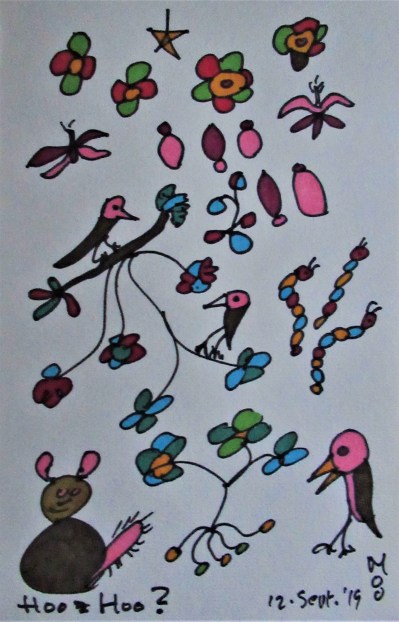
As any who have seen my drawings know, I cannot draw. However, I can take a line for a walk. And that’s what I do. Then I color the spaces I create. My friends thought I was wasting my time and I believed them until I read one of Matisse’s sayings: “My ambition: to liberate color, to make it serve both as form and content.” Voilà: I have my raison d’être. Nature abhors a vacuum. When you create a space, color and meaning rush in.

(3) I take photos
The capturing of a moment: a sunset, a new bird at the feeder, deer wandering through the garden, a black bear visiting, rain on a spider web, sunlight through a prism, a cat made out of cherry stones … the re-creation of the moment is the creation of the memory. More bubbles flow on the surface of the stream.

(4) I go for a walk, look at nature and the world around me, people too
It is incredibly important to do this. A visit to the local coffee shop, a walk around the super-market or corner store, a seat in the park on a sunny day … just be yourself, believe in your existence, watch things as they happen, relax, look and listen, empty yourself, let the world flow back in … look at the ducks on the lake or the goldfish in the tank … more bubbles on the water, more ideas floating down the stream …

(5) I listen to music
De gustibus non disputandum … we can’t argue about taste. Where music goes, each person must make their own choices. The music I like fills my mind, relaxes me, flows out when it ends, takes my mind for a walk and leaves … a vacuum … into which dreams and colors, words and ideas, build like clouds …

(6) I cook
Cooking has always relaxed me. Sometimes the repeating of an old recipe helps clear my mind. Sometimes I have a need to invent something new. Hands and mind occupied, the secret, sacred underground river of creativity flows on …

(7) I sew
Last summer, an unexpected event led me to join a quilting group … oh what fun … a man quilting among a dozen women … I learned so many things … so many different ways of looking at the world … so many concepts that I would never have dreamed of on my own … Sewing runs in the family: I still have my grandfather’s sewing kit … darning and sewing needles that served him for two years before the mast … that darned his socks as he survived in the trenches of the First World War … it bears his name and I use it with pride … and what memories arise in my mind as I choose the needle … his needle … the one that will lead me into the next adventure, be it quilt, button or patch …

(8) I keep a journal
… and come hell or high water, I write in it every day and have done so since 1985. That’s 31 years during which I have scarcely missed a day. The writing maybe banal, it may be nothing but a note on the weather or a comment on a sporting event … but it’s there … a vital challenge to the idea that Writer’s Block can take me over and stop me writing. This journal is 95% drivel … maybe more … but bobbing along the stream of words are ideas, verses, rhyme schemes, choruses, stories, flashes of inspiration, jokes, memories, magic moments, falling stars, … the secret is to catch these falling stars, to recognize these rough diamonds and to return to them and polish when the moment is ripe … and it will be, sooner or later … for bubbles are buoyant and will lift you to the stars.

(9) Free Writing and the Creation of Metaphors
I also use the journal for free writing and automatic writing. These techniques, drawn from the Surrealists, allow the mind to wander at random. While wandering, the mind creates an interior monologue or a stream of consciousness that in fact turns up a series of delightful metaphors that can be polished and re-used at will. When I use this style of writing, I am reminded of Dalí’s saying (again and as always, from memory): “I don’t know what it means, but I know it means something.” My own theory of metaphor is that the metaphor is defined by two (sometimes more) points and rather than settling on one or the other (as in a simile), the mind moves and flickers sub-consciously between the two extremes so that meaning is sensed, but rarely can be grasped or stated in definitive terms. Thus, the marvelous line from André Breton, quoted by Mr. Cake,  “The wolves are clothed in mirrors of snow” has, according to my theory of metaphor, four defining points, namely, wolves … clothed … mirrors … snow. All four of these defining points creates an image, a very personal image, in the reader’s mind. The mind moves quickly between each defining point and meaning is lost in the rapid shift from image to image. Quite simply, “the hand cannot grasp it, nor the mind exceed it.” This means we have to return, as readers, to the unconscious level where the metaphors were first created. Then: “when we no longer seek it, it is with us.” This same analytical exercise can be performed for each line of Breton’s poem. When we indulge in free writing, much of what we write can be abandoned. The secret is to recognize and rescue the little gems we so often find.

(10) I believe
Through all this runs a thread of belief … belief that the black cloud of despair will not win. The Writer’s Block will go. Creativity will never be not lost. It is there, beneath the surface, always ready to be contacted, waiting to rise and take you over again. And all too soon and quite unexpectedly, one form of creativity slips into another and the creative writing (it never really went away because of the journal) comes back.

Writer’s Block: it does exist. It’s how we deal with it that’s important. Creativity rules: forget Writer’s Block and let creativity and the multiple ways back to creativity grow and flow. Sooner or later the clouds will lift, the sun will return, the block will unblock and the words will flow again.

Remember the words on the Roman sundial: Horas non numero nisi serenas … I count only the happy hours. And remember: the clouds will lift, the sun will return.

Trust me.
And believe.