Heart and Hearth

Heart and Hearth

I remember the old coal fires in Swansea.
My grandmother’s house in the Hafod,
with a hearth separate from the kitchen.
The hearth held a huge cast iron fire-place
where cookpots and kettles hung
 or nestled into smouldering coals.

My grandfather’s house in Brynmill,
had a magic fireplace. Banked in before bed,
it gave warmth and light all through the night.
Warmth, comfort, the family gathered,
the wisdom of the old shared with the young,
traditional tales and songs passed down.

Everybody was welcome and each one
had a special spot reserved around the fire.

Comment:

I have been revising this poem, shortening it, and changing it very gently. Funny how the old days come back and dance before us, like the flames dance on the coals, as the old ghosts walk now upon the logs.

Click here for Roger’s reading.

Questions

Questions
Four Elements, p. 137

After my mother died,
I lit a candle in every church,
a real bees’ wax candle,
not those tiny electric lights
that glow for a little while,
when you insert money
in the insatiable slot.

Like the minuterie
on each landing of a Parisian
staircase, it gives enough light for
a quick prayer, or a very short
moment or two of silence.

Where does the light go
when the electricity switches off?
Where does the flame go
when the candle is snuffed?
Where did my mother go
when her light went out?

One day, but not too soon, I hope,
I will have to follow her and find
the answers to all of my questions.

Click here for Roger’s reading.

Hearth and Soul

Hearth and Soul

The kitchen – hearth and soul of the house. Here we gather, sit around the table and talk our hearts out. But here, in Island View, we have a kitchen, a gathering, but no hearth, and hence no real heart around which the household revolves.

In spite of that, old habits die hard. I remember the old coal fires in Swansea. My grandmother’s house in the Hafod, with a kitchen in a separate room from the stove, with a huge cast iron fire-place where cookpots and kettles could be hung or nestled into the coals. My grandfather’s house in Brynmill, where kitchen and hearth were separated, but the fire-place still held its magic. Banked in at night, those fires gave warmth and light ar hyd a nos and then they we resurrected the next morning.

We have a woodstove here in Island View, but we rarely light it as the fine particles make breathing difficult after a while. We keep it for emergencies. This winter we lit it when the temperatures dropped to -40C, with the wind chill factor, and heat pump and electric furnace needed assistance.

Warmth, comfort, the family gathered, the wisdom of the old folks shared with the young, and the passing on of traditional melodies. All the old memories and thoughts, the wishes and desires, the hiraeth too, handed down, from old to young. Everybody was welcome and everyone had his or her special place.

Such memories tug at the heart strings – hearth strings. Anyone who shares them with me will know what I mean.

Swansea

Swansea

To be Welsh in Swansea is to know each stop on the Mumbles Railway: the Slip, Singleton, Blackpill, the Mayals, West Cross, Oystermouth, the Mumbles Pier. It’s to remember that the single lines turn double by Green’s ice-cream stall, down by the Recreation Ground, where the trams fall silent, like dinosaurs, and wait, without grunting, for one to pass the other. It’s to read the family names on the War Memorial on the Prom. It’s to visit Frank Brangwyn in the Patti Pavilion and the Brangwyn Hall. It’s to talk to the old men playing bowls in Victoria Park. It’s to know that starfish stretch like a mysterious constellation, at low tide, when the fishnets  glow with gold and silver, and the banana boats bob in the bay, waiting to enter harbour, and the young boys dive from the concrete pipes without worrying about pollution.  But when the tide turns, the Mumbles Railway has been sold to a Texan, the brown and yellow busses no longer run to Pyle Corner, Bishopston, Pennard, Rhossili, sweet names of sand and tide, where my father’s ghost still fishes for salmon bass, casting its lines at the waves as they walk wet footprints up the beach to break down the sand-castle walls I built to last forever at Brandy Cove and by the Slip on Swansea sands.

Click here to listen to Roger’s reading on Anchor.

On Being Welsh – Dydd Dewi Sant

On Being WelshDydd Dewi Sant

On being Welsh
in a land ruled by the English

 I am the all-seeing eyes at the tip of Worm’s Head.
I am the teeth of the rocks at Rhossili.

I am the blackness in Pwll Ddu pool
when the sea-swells suck the stranger
in and out, sanding his bones.

Song pulled taut from a dark Welsh lung,
I am the memories of Silure and beast
mingled in a Gower Cave.

Tamer of aurox, hunter of deer, caretaker of coracle,
fisher of salmon on the Abertawe tide,
I am the weaver of rhinoceros wool.

I am the minority, persecuted for my faith,
for my language, for my sex,
for the coal-dark of my thoughts.

I am the bard whose harp, strung like a bow,
will sing your death with music of arrows
from the wet Welsh woods.

I am the barb that sticks in your throat
from the dark worded ambush of my song.

On Being Welsh – short stories – Amazon and Cyberwit

On Being Welsh – poems included in my selected poems (1979-2009)

Cherry always listened to my readings

Click here to here Roger’s reading on Anchor
– On Being Welsh

Writing in the Red Room

Writing in the Red Room

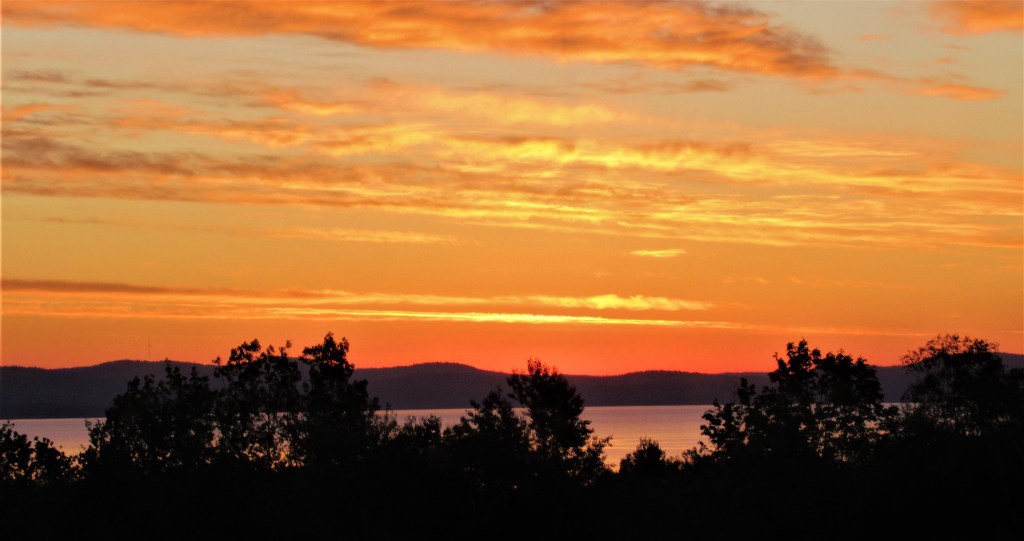
Dawn over Kingsbrae, as seen from the writer’s desk in the Red Room in KIRA. “A poet could not but be gay, in such a jocund company.” Wordsworth, thankfully, for how words change their value as language transforms itself and old values and meanings grow wings and flit away.

Gai saber – from Old Provençal: “gay knowledge” or “gay science”, the art of composing love poetry, especially the art of Provençal troubadours as set forth in a 14th-century work called the Leys d’amors. But one doesn’t have to be gay, in any sense of the word, old or new, to write poetry, and it is difficult not to write poetry when the sun creeps over those hills and lights up the room and the bay below.

Warmth and light flood into your heart. The pen fills with words and they splash out over the page, moving the writer as the sun moves, as light moves, as light breaks where no sun shines as yet, but will, soon, so very soon, and here it comes, filling the heart once more with wonderment, the bay with light, and the page overflowing with the joy of light.

To be here is to be honored and privileged beyond words. To be able to share that joy with others is a blessing that many seek and few find, and none possess, for, like fairy gifts, such powers fade away all too swiftly. And, when all is said and done, one can only be humble, rejoice in each moment, and give thanks.

Goodbye

Goodbye

It is never easy to say Goodbye. Some goodbyes are easier than others. Some are indeed difficult. “In my end is my beginning and my beginning is in my end.” Conscious goodbyes are one thing. We say farewell knowing we will never be back that we will never see each other again. These are the hard ones.

I stood in the bar of El Rincon, in Avila, at 6:00 am, waiting for the taxi that would take me to Madrid and away for the last time. I was planning to return the following year and then it hit me – this was indeed my last goodbye and I would never return to that place. A tidal wave of emotion swept over me and I felt a deep, earthy sorrow – the sorrow of permanent loss.

It was matched on two other occasions. The first occurred when I drove to the sea shore of my childhood in Wales, with my mother’s ashes in the back seat and strict instructions on how and where to scatter them. Walking away was one of the most difficult things I ever did. Even more difficult was leaving my father, a widower now, in his bed, and saying that goodbye. It was not the final goodbye, but I knew I would never see him again, in that house, under those circumstances.

I cried in the taxi, all the way to the railway station. Great, heart-rending sobs that tore me apart, body and soul. The spill over from my nostrils reached the floor of the cab, a long, thick spider-thread of deep-seated despair, because I knew my life had changed forever, and the support on which I had always counted would no longer be there.

People and pets – both are difficult. Holding the paw of a beloved cat, while the vet slips the needle in, and the companion of ten, fifteen years, drifts quietly to sleep. Or watching a faithful dog, slipping slowly downhill, and knowing that someday, soon, the decision must be made, the dark deed done. The knowledge that one relieves suffering and brings an easy release does not decrease the heartfelt pain of that last goodbye.

I used to visit the Sappers Club in Toronto. In the basement of that establishment I discovered a wealth of photographs from WWI. The old men would lead me downstairs and, through thick salt tears, explain what each photo meant to them. Round about midnight, a group of them would stand before a photo called Goodbye Old Friend. It depicted a shell-shocked, broken horse, with a pistol held to its head. The men, they explained, had volunteered for war, and knew all about its suffering. The animals were innocent, and knew not the reason why. Ah, ending the sufferings of the innocent, human or beast, that is, perhaps, the saddest farewell, for some, but not for others.

We each will hold a private moment within our own hands and minds. To share or not to share – that is the question, for each of us – poor creatures, as Dylan Thomas says, born to die.

My Teenage Self

My Teenage Self

What advice would you give to your teenage self? In one word – grow up. Useless advice really, because it happens, whether we want it to or not. That said, I have lost so many young rugby players that I coached or played with, to driving accidents and other misfortunes, sometimes self-inflicted via alcohol or drugs, that to say grow up – please! – is so important.

Each morning I read the obituaries in the local newspaper. Afterwards, I look back over the path I have journeyed. If I had perished at the age of the current ‘missing person’ – say, 45 – 50 – 55 – 60 – I think of all that I would have missed in those intervening years. Then I grieve for all that they will have missed in the life that should have lain ahead of them.

“Don’t cry over spilt milk” – Old Welsh Proverb. And no, we mustn’t cry over what is lost. We must celebrate what has been achieved, Dylan Thomas (1914-1953), one of Wales’s greatest Anglo-Welsh poets, dead at 39 – what other glory may have lain ahead of him? Garcilaso de la Vega (1501-1536), one of Spain’s purest and most innovative poets, dead at 35. What more might he have written in an extended lifetime? Federico Garcia Lorca (1898-1936), executed, many say tortured and murdered, at the age of 38. Think of the theatre, the poetry, the Gypsy Ballads, the songs of a dark love – what more did he have, hidden inside him, that was never allowed to spread its wings and fly out into the light of day?

So, I would give to my teenage self, the same advice that I would give to any teenager – grow up – please, grow up, don’t go too soon, – and please grow into that unique and wonderful being that you have the potential to be.

My Favourite Candies

My Favorite Candies

I searched for the blog prompt, but I couldn’t find it. Not by name and I don’t remember the number, nor do I know how to search for it. So – here I am, on the sea shore, stranded, looking for something I may never find. Yet an echo of it has found me.

I googled ‘candy’ to find out what it meant because when I think ‘candy’ I think of Candy Floss, that long, thinly-spun web of sticky pink sweetness sold at the fairgrounds and the ice-cream stalls of my childhood beaches, back in Gower. Barred and banned it was, and seen as a source of cavities and visits to those much-to-be-feared, brutal, ex-Armed Forces dentists who terrified our childhood while working in those days in the NHS.

Candies, in my Olde English language, were called sweets. In post-war Britain, where rationing was the unwelcome rule, sweets were rare, for they cost us coupons, and were therefore, very, very precious. In those days, my grandfather had many friends and his friends were priceless. On Saturday mornings he would take me to Swansea Market, the one that had been bombed during the war. It had been rebuilt but, in those days, remained roofless. There he would work a shift at Green’s Sweet Stall while someone took a break – and I helped him. We would take the orders, count and weigh the sweets, take the cash, count it, check it, place it in the till, and hand over the correct change along with small, white paper packets that contained the hand-made sweets.

We received no money for this pleasurable work. However, when our duty was done, I would be given my choice of hard-boiled sweets. My favourites were those red and white striped sweets, called winter warmers, laden with the lusty tang of cloves that lingered long in the mouth. We held competitions to see who could make their sweet last longest. And woe betide the losers who cracked them, or swallowed them whole, for they were mocked and forced to watch, minute by minute, the lucky ones whose sweets dwindled on and on, shown off, paper thin, on tongue tip, for all to see.

But better than any candies were the Cockle Women in their tall black hats and red Welsh shawls who came all the way from Penclawdd on Saturdays with their baskets of cockles and their buckets of laverbread – bara lawr – at thruppence a pound. Laverbread – Welsh Caviar, Richard Burton used to call it, a delicacy to be savoured for breakfast or lunch and sweeter to the enthusiast and devotee than any candied sweets, even winter warmers.

Parents

Parents

Today’s prompt – what were my parents doing at my age? Well, actually, they were both dead. We aren’t meant to mention death anymore, so let me say ‘they had passed’. Loads of cliches of course – pushing up the daisies – moved into higher society – or lower but I hope not – deceased – demised – expired (like my driver’s license) – extinct (like the Dodo) – passed on – recycled – enough – no more – it’s not as sweet now as it was before – nor do I like any potential answer when I look in the mirror and wonder – who am I? – What am I? Where am I going? Am I next?

My father being an excellent rugby player – on the wing – in the old days – I can imagine him running, and kicking and chasing – but I can’t imagine him passing. Or setting up a maul or a ruck. Dear Lord – times have changed – and the laws of rugby have changed – and the rules of etiquette have changed – and political correctness has put dark hands upon our throats and choked us -let us not contemplate the myth of freedom of speech – but consider the endless stupidity of senseless questions that changeth not and abide with all of us, on radio and tv and in the newspapers – all day and everyday.

Here’s anther prompt – Where have all the young men gone? Depends on which song you listen to – emigrated – gone down the mines – gone west – gone AWOL – gone astray – gone to graveyards, everyone. But will we – or they – ever learn – blydi hel – a good Welsh expression – I doubt it.

So – I ask myself – what are my parents doing today? – and the answer is – I really do not know. I would like to think they are happy – happy in the knowledge that they did their best for me – happy to know that I am still here – ar gwaetha pawb a phopeth rh’y n’i yma o hyd – I hope I spelled that right – I have seen several versions – and yes – in spite of everything, I am still here – I am well – and I would like to tell them that I love them – and I would like to thank them for all they did right – and forgive them for anything they did wrong – and yes, I loved them so much – and still do – and I miss them – and blydi hel – now you’ve got me crying.