Minus

IMG_0133 2.jpg

Minus

“The earth is geoidal, i.e. earth-shaped.”
These words, dictated to me by the geography
master when I was about fifteen years old,
taught me that teachers didn’t really know
all there was to know. Nor, indeed, did they
need to know everything. “I don’t know,
I’ll check and tell you later,” breaks the myth
of infallibility but sets up sympathetic links.

“What do groundhogs eat?” the little girl
asks her classroom teacher. “Spaghetti,”
comes back the instant answer from one
who doesn’t know that every day the child
watches the groundhog that lives in her yard
devour delicate New Brunswick violets.
“Spaghetti, with mushroom sauce, of course.”

Then one day comes the spelling test:
“How do you spell minus?”
“M-I-N-O-S.”
“Wrong. Try again.”
“M-I-N-A-S.”
“Wrong again.
You think you’re so clever.
Everybody knows it’s
M-I-N-U-S.
Don’t we class?”
The class breaks into shrieks and giggles.

Everyone knows how to spell minus:
even the one who has just read how Theseus
followed Ariadne’s thread to escape from
the Minotaur who roamed the Labyrinth
beneath the Cretan Palace of Knossos.

That one was present too, in her own mind,
at the Siege of Minas Tirith, when Gandalf
held five evil kings at bay and Aragorn fought
the nameless Dark Lord who dwelt beneath
the shadow in the land of M-O-R-D-O-R,
a Lord not so powerful M-I-N-U-S his ring.

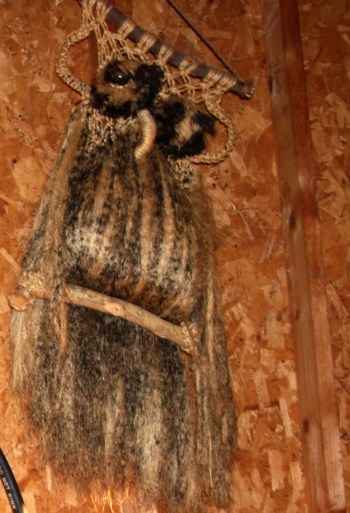
Old Eight Hoots

IMG_0263

Old Eight Hoots

Winter has touched us
with this change of clocks
and darkness clutches now,
an hour or so too soon.

Old eight hoots watches:‑
he calls; I cough;
but he will not swoop.

He sits tight‑perched, out of sight;
chills me with his ghostly chorus,
hoo‑hooing me home.

Bright stars crackle the sky.
Frost crisps fallen leaves.
A mist weaves webs scarce‑seen.

And all around,
as cold ground creaks
its wordless tongue‑leafed language,
night‑shapes abound.

Pony

img_0291

Pony

for Jude
(and the WYPOD)

“A pony, a pony, my kingdom for…” Of course,
he didn’t want a pony. He was losing the battle
and the kingdom’s sceptre is not a baby’s rattle
to be tossed aside, even for the fastest horse.

Ponies and palfreys are not for kings. A princess
may ride a pony, and a side saddle, fit for a queen,
may grace a horse’s back, but a horse between
a princess’ legs is crass. How cramped the dress,

how wrinkled the nobleman’s brow seeing
his daughter, his wife, the female of the breed
straddling, legs apart, a broad-backed steed.

No: ponies are for Christmas, not for kings fleeing.
A horse, then, hung with bells, covered in red:
not with ribbons, but the old king, flayed and dead.

Dydd Dewi Sant Hapus.

14633208_10207317214799871_1242532105939959170_o

To be Welsh on Sunday


(This poem should be read out loud,
fast, and in a single breath!)

To be Welsh on Sunday in a dry area of Wales is to wish,
for the only time in your life, that you were English and civilized,
and that you had a car or a bike and could drive
or pedal to your heart’s desire, the county next door,
wet on Sundays, where the pubs never shut
and the bar is a paradise of elbows in your ribs
and the dark liquids flow, not warm, not cold, just right,
and family and friends are there beside you
shoulder to shoulder, with the old ones sitting
indoors by the fire in winter or outdoors in summer,
at a picnic table under the trees
or beneath an umbrella that says Seven Up and Pepsi
(though nobody drinks them) and the umbrella is a sunshade
on an evening like this when the sun is still high
and the children tumble on the grass playing
soccer and cricket and it’s “Watch your beer, Da!”
as the gymnasts vault over the family dog till it hides
beneath the table and snores and twitches until “Time,
Gentlemen, please!” and the nightmare is upon us
as the old school bell, ship’s bell, rings out its brass warning
and people leave the Travellers’ Rest, the Ffynnon Wen,
The Ty Coch, The Antelope, The Butcher’s, The Rhiwbina Deri,
The White Rose, The Con Club, the Plough and Harrow,
The Flora, The Woodville, The Pant Mawr, The Cow and Snuffers …

… God Bless them all, I knew them in my prime.

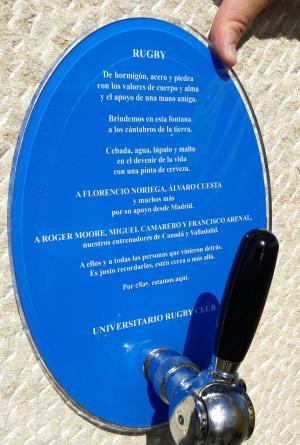
Comment: When I was living in Wales, back in the fifties and the early sixties, the country divided itself into counties that could drink alcohol on Sundays (wet Wales) and those that couldn’t (dry Wales). There were twelve counties in those days and people commuted from the dry to the wet, on Sundays, if they wanted to drink. Some took the wet / dry divide very seriously. Others didn’t. Where do I stand? I refuse, even now, to say. But check out, very carefully, the attached photo. Not every rugby coach has his name engraved on a beer spigot in a rugby club in Santander, Spain. Happy St. David’s Day, everyone. Dydd Dewi Sant Hapus.

Water 1

15 May 2002 Pre-Rimouski 277

Water

Water seeks its final solution as it slips from cupped hands.
Does it remember when the earth was without form
and darkness was upon the face of the deep?

The waters under heaven were gathered into one place
and the firmament appeared.
Light was divided from darkness
and with the beginning of light came The Word,
and words, and the world …

… the world of water in which I was carried
until the waters broke
and the life sustaining substance drained away
throwing me from dark to light.

The valley’s parched throat longs for water,
born free, yet everywhere imprisoned:
in chains, in bottles, in tins, in jars, in frozen cubes,
its captive essence staring out with grief filled eyes.

A young boy on a tricycle bears a dozen prison cells,
each with forty captives: forty fresh clean litres of water.
“¡Peragua!” he calls. “¡Super Agua!”

He holds out his hand for money
and invites me to pay a ransom,
to set these prisoners free.

Real water yearns to be released,
to be set free from its captivity,
to trickle out of the corner of your mouth,
to drip from your chin,
to seek sanctuary in the ground.

Real water slips through your hair
and leaves you squeaky clean.
It is a mirage of palm trees upon burning sand.

It is the hot sun dragging its blood red tongue across the sky
and panting for water like a great big thirsty dog.

Comment: Water: such a precious commodity, and more than a commodity, the very substance of life. Without it, we shrivel and die. Vegetation struggles to survive, the desert shifts its boundaries outwards, and a high tide of sand rises to engulf the cultivated land.

In Oaxaca, Mexico, the Atoyac, the Green River, often runs dry. When it does, women kneel on the sand and pebbles to dig holes into which the water seeps. They wait for the holes to fill and use little cups to pour that water into their buckets. These water holes are also used to wash their clothes and they hang them out on the riverbank bushes to dry beneath a burning sun.

Twice I have been in Oaxaca when the rains have not arrived. I have seen the reservoirs sink lower and lower as the sun laps up the precious liquid and no rain falls. Oaxaca, with or without rain, is a land of dry toilets, chemical toilets, chemicals to put in the tap water when you wash and peel fruit and vegetables. You drink only bottled water. It is sold to the households in forty litre bottles and hawked round the street by boys on tricycles who cry out their wares.

In Oaxaca, almost every house has its own supply of water. The flat roof, azotea, catches the rain when it falls and channels it into large internal cisternas that trap the water and keep it cool.  Water to waste is a luxury that few can afford and most water is recycled when possible in one way or another.

The rules are strict: drink nothing direct from the tap; do not clean your teeth in tap water;  beware of ice cream and ice cubes; drink only water delivered from trusted hands. In addition: eat food only from establishments with running water and a reputation for safety. Avoid street vendors, especially the little ladies in the street who cook over open fires and and change their babies’ nappies only to return to their cooking with unwashed hands … There are so many things you learn if you want to be safe and streetwise. Above all, close your nose to the delights of those wonderful street side cooking smells.

 

Poem from the Cree

IMG0061_1
Poem from the Cree

The Cree have retreated from the streets.
Their violinist has taken time out, leaving
his last notes dancing from a street lamp.
Only the Fire-Brave remains, inhaling thick
black oily smoke. He juggles twin balls of fire.

Bones gather together to gather dry dust. Hollow
metal buffalo: a cold wind blew and plucked out
his heart. Five climate controlled pedestrian
walkways cross the prairie, linking building
to building. A glass wheat field shimmers
and tinkles to the rhythm of air conditioning.

The black cow, cast iron hide set free from rust,
ruminates behind its plate glass window.
The night wind whisks white buffalo bones
pale across the sky. Oskana ka asasteki.

With these words, I will leave you, suddenly,
abruptly. A light going out. Now I am here.
Oskana ka asasteki. And now I too am gone.
Comment: Another Golden Oldie, re-discovered. I wrote this in Regina back in the nineties, last century, last millennium … how long ago is that? In our kitchen, an ear of wheat, purchased in the glass wheat field museum, still shelters in its gilded frame, a memento from that trip. So many memories, so many pictures, drifting … just drifting.

Losing It

IMG0075_1

Losing It

When you lose it,
whatever it is,
your fingers pick at seams,
hankies, skirts, shirts, jeans,
or strip a label from a bottle,
or crumble bread, or …

There are so many things
you can do,
personal things.

On the table:
a vacant cereal bowl,
a silver teaspoon in a saucer,
an empty teacup
returning your round
moon-face stare.

Comment: I would like to thank everyone who joined in this discussion today (blog, e-mail, and Facebook). The poem transcribed above is the final version, subject to later consideration of course. Earlier versions, with selected comments, are set out below.

1

Losing It

When you lose it
whatever it is
your fingers pick at seams
hankies skirts shirts jeans
or strip a label from a bottle
or crumble bread or

there are so many things
you can do
personal things

on the table
a vacant cereal bowl
a silver teaspoon in a saucer
an empty teacup
returning your round moon stare

your hands
twist and pull
your nails
click together

blunt needles knit
then unpick stitches
trying to unravel
then to repair
this ball of empty air

 Comment: This is a Golden Oldie. It dates from the final illness and passing of my mother, thirty years ago next month. When I wrote it, I wasn’t punctuating my poetry. Nowadays, I prefer punctuation as it guides the reader in terms of the rhythm and flow of words. Leaving it exactly as I wrote it means you, as reader, have to wrestle with the meaning, the order, the pauses, the rhythm. My guess is that this over-complicates the poem. However, it was a difficult time, so the poetry I wrote at that time was also difficult. I will be interested in any comments on the following question: to punctuate or not to punctuate?

Comment from Judy: An out there idea: what if  for Losing it – you ended poem with first stanza?
Reply from Roger: What if, indeed? Then it would need a tweak or two, something like this: the poem changes, but does it gain or lose?

2

Losing It

blunt needles knit
then unpick stitches
trying to unravel
then to repair
this ball of empty air

your hands
twist and pull
your nails
click together

your fingers
pick at seams
hankies skirts shirts jeans
or strip a label from a bottle
or crumble bread or

there are so many things
you can do
personal things

on the table before you
a vacant cereal bowl
a silver teaspoon in a sauce

an empty teacup
returning
your round moon stare

Comment from Jan: Play it again, this time with punctuation. This time I have returned to Judy’s original suggestion, and just placed the last stanza first. Then I have punctuated the poem. Revision and re-creation time: this is fun! I punctuated the above version, then cut it down to the first poem published at the start of this article. Tank you all for the help.

Mice

img_0177-2

Mice

“When the cat’s away, the mice …”
they said, with a knowing wink, but
there was no play and you left me
with an emptiness I couldn’t fill.

It was our daughter’s fourth birthday.
She and I baked a cake, though to tell
the truth, I did little more than watch
and all encouragement from the side
-lines. So competent, she was, I called
her ‘Mother Two’ when she told me to
do all the things she wanted me to do.

Her cake turned out fine. She used
a whole packet of icing sugar, layered
so thick there was more icing than cake.
It was just a bit liquid too, and we could
not be bothered to wait until it cooled.

Drinking hot tea, munching  a slice of
her birthday cake, I sang a line or two
of Happy Birthday and then fell silent
as I wondered what you would be doing.
Later, we fed tiny cake crumbs to the dogs
who sat there, begging, not wanting their
own food, drooling, missing you, just like us,
and all of us waiting for you to come home.

Candles

img_0136

Candles

I love the flicker of flame,
the yellow light dancing
shadows on face and plate.
Let’s clear away the dishes
and bring the table back
to its pristine state: grained
wood. Now let’s talk of old
times back home when coal
fires roared and drafts ran
from dark corners, raising
hair on necks and sending
shivers down spines. It’s so
easy to believe in ghosts
when night winds howl
through windows, dogs bark
at nothing, houses are older
than families, and the land
snuggles down to sleep
in its winter blankets.
Beware of the sudden draft
on the oil lamp’s frail chimney:
cold will crack the glass, sending
us to bed by candlelight while high
on corridor walls old folk come
alive and frown down from
their sepia photographs. Cold
and frightened by their restless
afterlives, we shiver in the grave
cloths of our damp beds.

Love the Sorcerer

img_0200

Love the Sorcerer

“What sorcery love must be
to make such fools of men.”

There’s more to love than the magic
conjured from chemistry as eye
meets eye or flesh makes secret
contracts, body to body, in free
trade agreements that are remade,
over the dinner table, day after day.

Hands that plug in the kettle,
pour boiling water on the tea,
poach or fry the breakfast eggs,
brown the early-morning toast,
write out the weekly shopping list,
flick the switch on washer and dryer,
peg wet laundry to the outdoor line,
pack the children’s lunch boxes
and get them ready for school
day after day:
such love is truly a magician.

My cartoon speaks
not three words
but a thousand.

Ties that bind:
what more can I say?