Last Legs

IMG_0170.JPG

Last Legs

A wooden carving of Don Quixote stands guard over the mini-carnation pinks that have now lasted for 23 days. Alas, they are now suffering and several are ready to bow their heads and take their leave. They have done marvelous service. Arriving on December 21, a present from Gwen and Victor, these flowers have graced our house and table for over three weeks: a singular service in this age of rapid floral turnovers. We have looked after them, talked to them, cared for them, tended them, given them fresh water and sweet music. They have responded by filling our days with color and charm.

IMG_0168.JPG

Here they are in the early morning sunshine casting a shadow onto the wall behind them. So beautiful, the play of the early morning sun, through glass and water. Even the shadows are filled with tiny bursts of light. They were never heavily scented, these pinks, and their beauty lay more in their color and their longevity.

“Gather ye rosebuds while ye may.” Well that’s one way of putting it. But the roses, regal as they are, break down so quickly, while these little fellows have hung on and on. What a pleasure to count the days and watch them flourish. “Gather ye mini carnation pinks,” I say, for they last longer and their love is more constant.

What joy, to rise in the morning and to know they will still be there. But now their days are numbered. My birthday draws near, and our Christmas flowers oh so rarely last through into mid-January. Perhaps I should crowd source and get a host of flowers, tossing their heads in sprightly dance, sent to me through e-mail. Now that would really be fun.

IMG_0486


“Forget us not,” they whisper to me through their leaves. “You’ll never be forgotten,” I murmur back. A sense of light and warmth wraps itself round me and now I can face whatever the future brings with joy in my heart.


Mums

IMG_0125.JPG


Mum’s the word: in this case baby mums. Here they are, just starting their third week. Incredible how they have lasted. Wedding anniversary > Christmas Eve > Christmas Day >  New Year’s Eve > New Year’s Day > heading for Reyes (on January 6). Who knows how long they will go.

Some friendships are like that. They appear out of nowhere and go on, seemingly for ever, in spite of so many changes. I guess a few good friends are worth a great deal more than many casual acquaintances who flicker in and out of our lives, or those fine weather friends, who are there when all is merry and well, and gone at the first sign of a dark cloud gathering on the horizon.

Think too of the caring, giving friends, who are there when you need them. They are a pleasure to be with. Then there are the friends who always borrow, and take, and never return … nice to be around, while they are receiving. Gone when they realize they can take and receive no more.

So, here’s to those faithful friends who stand by and with us. Like well-watered flowers, they hang on and are loved and respected. Carpe diem: seize the day, and hold both friends and flowers tight while you still have them, for one day, like it or not, much sooner than you think, we will all be gone.

IMG_0094.JPG

Ice

IMG_0061.JPG


Ice, so many meanings: sliding on ice, as cold as ice, icing the puck, walking on thin ice, skating on thin ice, ice-blue eyes, an icy stare … ice is also nice, as in icing on the cake, ice lollipops, ice in the drinks, holding it on ice …

IMG_0057.JPG

Stalagmites and stalactites, like ants in the pants, the -mites go up and the -tites come down. Ice giants, ice demons,  silent ice, groaning ice, ice floes, the river iced up, the head pond so many different shades of grey and blue and white, fading in places into black, and these look like black-and-white photos, but they aren’t, there’s always a tinge of color, even when you least expect it.

IMG_0053.JPG

Silent ice, singing ice, groaning ice, and the steady drip-drip of melting ice and what a show, sunshine stealthy on ic, stepping across it on tip-toe, and the ice as radiant as a stained glass window … and oh, there was so much more I wrote and still want to write. Too late now. It was incredible! I added a third photo to my original post early this morning, and, when I updated the post, the whole blog post was deleted and I uploaded a blank page. How tragic. Never mind: the ice will have to speak for itself in its own silence, in its own creaking and groaning, in its spectacular ice palace of glimmer and glow.


IMG_0062.JPG


Nativity

IMG_0073.JPG

Nativity

We keep this beautiful, hand-carved nativity scene on the sideboard all year round. It is tiny, approximately 2″ x 2″ and came from Central Europe, possibly Hungary, where a friend was travelling in the mid-seventies. He brought it back for us as a gift and we revisit it every Christmas, moving it into a more central place of honor and beauty by the Advent calendars and the Christmas scenes.

It will soon be time to remove most of these Christmas adornments. Some will stay up longer though and this is one of the pieces that will remain in sight to delight us all year round.


IMG_0214 (2).JPG


This is another piece that will stay with us. It shows our photo of Tigger being visited by Kiki the Cat and several little puppies. Tigger gazes at them from his Royal Portrait, making them all feel welcome and protected as he endows them with the seasonal spirits that will extend well into the New Year.

Advent Calendars

IMG_0068.JPG

Advent Calendars

We have multiple Advent Calendars. Some are online, others are religious, and yet others, like the one pictured above, are forest scenes with Santa, courtesy of my daughter and Playmobile. We particularly like this one. Each day, from December 1 to December 24, we get a different set of pieces to add to the background. Then, on December 25, Santa arrives ad we keep him around, usually until the New Year, sometimes until Reyes, the Spanish and Mexican Christmas, on January 6.

Every morning, Clare opens the large Playmobile Box and adds the day’s pieces to the scene. Bit by bit, the scene grows until everyone is present in the same forest glade they have inhabited for many years now. Every year, I search for new animals, and they live in the scene next door, cats and dogs and kittens and puppies, all watched over by a framed photo (2001) of my favorite dog: Tigger.

No, the spirit of Christmas doesn’t reside in a cardboard box and its plastic figurines. Rather it resides in happy memories (horas non numero nisi serenas / I count only the happy hours) and in the new memories, usually very happy, that we create each year. Clare is a sun-watcher. Each day, she calls out the minutes as the days lengthen, post-mid-winter, and the earth tilts slowly back into spring, then summer. We also watch the sun shadow creeping up the wall (pre-Christmas) and then slowly back down again, post-Christmas, into the New Year, Reyes, and my birthday.

Christmas visitors in our plastic Christmas forest scene are joined by real visitors in the world outside. Deer walk up to the bird feeders by night and squirrels (red and grey), chipmunks, and a variety of birds feed there by day. By night we also get raccoons and the occasional fox. By day, our neighbors’ thin, predatory cats tinkle their Christmas bells, and patrol the garden in search of their Christmas dinners. Every year, we watch the splendor of birds at the feeder and hope that the cats go hungry for now, to be filled later in the safety of their own feline dishes safe indoors.

Xmas Baby

IMG_0062


Xmas Baby

Plural, it should be plural really, Christmas Babies. In Oaxaca, Mexico, the cribs lie empty, awaiting the miracle of the Christmas birth. All the cribs, everywhere, in the main square, in the cathedral, in the shop windows, in the schools, in the houses, the homes, the hallways, the bed-rooms. How can the baby be lying in the crib throughout December, when he isn’t born until midnight on the 24th? All those empty cribs, all those foster mothers and fathers, in waiting, so to speak.

Joyous times, full of expectation. The piñatas swinging from the flat roofs of the azoteas, and the puppet masters pulling the strings as the young children, blind-folded, take turns swinging with stick or baseball bat, trying their best to break the papier-mâché and release the Christmas goodies from their shattered container. There are many kinds of birth, and re-birth. Such joyous expectations. So many ups and downs as the clubs are swung and the piñatas are raised and lowered. Then, the lucky strike, and the silver-paper-wrapped treasure trove falls to the ground and the children dive in and collect their long-awaited goodies. Such joy. Such merriment. Such great expectations, and so seldom deceived.

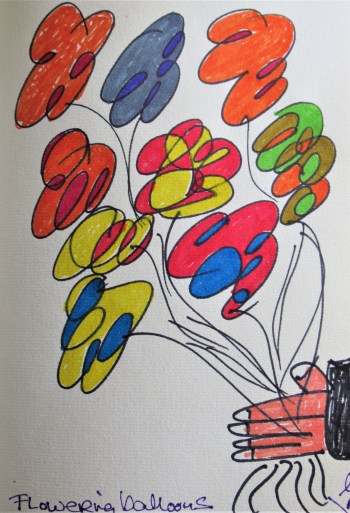
Meanwhile, in the zócalo, the central square, the balloon lady sits in her  castle surrounded by the technicolor splendor of her plastic walls waiting for the children who will arrive, coins in hand, to purchase her wares and take them on their wind-walk through the square. How wonderful to see them, aerial dogs sky-walking with proud owners tethered to the ground below. How sad to see the child’s face as the occasional balloon seeks freedom in the blue sky above the cathedral towers. What pleasure to see the joy restored as another balloon replaces that first one.

Last night, they set fire to the castillos and waves of firework and flame flooded down church walls as rockets climbed to the sky to knock on heaven’s door and demand that the gods wake up and not forget their people rejoicing here in the streets below. Yes, the gods, for Oaxaca is still a pagan land where the old gods roam and devil and angels mingle on the cathedral steps with the witch doctor who lights his fire, burns his copal, and worships the old gods in the good old ways that never perished, in spite of the attention paid to them by the priests of the Spanish Inquisition. They hang on, the old gods, the old customs, the old Mixtec calendars, in barber shops and craft stores and you can purchase them in the market place or in the secret stores where mescal is brewed in the centuries’ old way and the yellow worms wiggle and glisten as they sink to the bottom of the bottle where they lie in wait to sink their hallucogenic teeth into the minds of  unsuspecting tourists.

Today, however, is Christmas Day. The baby is born. The cribs are filled with his little image. Some shops have a live child, with his mother and father standing there, waving, showing their baby off to the worshiping crowd who cluster, mouths open, at the window. Marimbas play. Village bands march. The State Orchestra warms up. What joy in the land, this Christmas morning as, back home in Merrie Olde England, all the bells are ringing and across the frosty meadows, carillon carols ring out loud and clear.

Gifts

IMG_0206.JPG

Gifts

What greater gift for Christmas than one person giving themselves to another? On 24 December, 1966, 6 days after she arrived in Canada, my beloved and I were married in Kincardine, Ontario.

How fitting, then, that today, 52 years later, my beloved and I, still together, should celebrate with this other gift, a portrait of a hollyhock, gifted to us by Geoff Slater, the art director at Kingsbrae / KIRA. This gift is also a gift resulting from a gift, for in the summer Geoff visited us, saw our beautiful hollyhock, photographed it, and carried away some of its seeds to sow in his own garden when he got home. Little did we know, in the summer, that those small seeds would have grown into this fabulous, timeless painting.

Geoff is known for his line-paintings and to have one hanging on display in our kitchen in a place of honor is to celebrate creativity, art, the role that flowers play in our lives, and the friendship that goes with gifting and re-gifting that which is beautiful and most precious to us.


image1 (2).JPG

Here is my poem for Geoff and his beautiful wife Andrea. It is based on one of Geoff’s analyses of this painting (Studio 1, October 2018) and is my verbal gift from me to them, from poet to painter and painted.

No Exit
for Geoff and Andrea Slater

Where is the entry point, where the exit?
This labyrinth of lines, straight, not circular,
baffles the eye, confuses with a negative space
that lightens colors and begs more darkness.

Mystery surrounds the sitter’s form: the board walk,
no Dutch kitchen this, the chair on which she sits,
the locket she wears, the landscape, seascape
against which she is framed. White noise, perhaps,

but noise that turns to a single voice, a single line,
that of the paint-brush tip-toeing, delicate its thread
through interior, exterior meaning, just beyond

the viewer’s grasp. Yet walking past, each person stops,
stands still, as the painting draws them in, ties them up,
binds them with an ineffable thread, stronger than words,

mightier than the eye that traces its way along paths
that deceive, baffle, disturb, throw us from the high-wire
created by a mind that turns linear into circular space.


Xmas Trees

tree.png


This year we have abandoned real, once living trees in favor of plastic trees with LED lights. The house doesn’t smell the same, nor did cool air fill the space beneath the tree. No more watering the tree. No more collecting dry pine needles. No more worrying about the cat climbing the tree or the dog pulling the tree down as it chases the cat or tugs and worries at a string of lights. Nor do we have to worry that the puppy might chew its way through the electric cord and electrocute itself. And no more electric eels in the fish tank, even though they are the current thing.

That doesn’t mean to say we are in for a bleak mid-winter, not at all. We have strings of lights, music on the stereo, and even  peces en el rio que ven a Dios nacer, as they sing in Oaxaca (the fishes in the river who come to see God born). And who could not be merry at Christmas time with a fire in the fireplace, a Charlie Brown Christmas on the stereo, and guelaguetza music from Oaxaca waiting to be played and warm the party up. Nobody, but nobody, not even the meanest Scrooge or the most insistent Grinch, can resist the Oaxacan pineapple dance, played at full volume by the state orchestra or a local village band, at midnight, in the zócalo, when the rockets climb skywards to knock on the front door of the gods and the Virgen de la Soledad parades in all her mystery and glory through the candle-lit city streets.

Add to all of this a small miracle: the reappearance this year of the Christmas tree Clare’s auntie used to place every Christmas upon the counter in her shop in Cheap Street, Frome: one of the most famous and eligible streets in Merrie Olde England. We have placed auntie’s Christmas tree on the table in the hall by the front door and surrounded it with lights. What joy: the old and the new, hand in hand, in this new found land that is itself, so very, very old and where we now live together with our memories of a distant past.

And for those who still wish to decorate their very own Christmas tree, you can do so online, adding toys and lights, and an angel on the top, whenever you wish. And remember: where there’s a will there’s always a way.

Cricket

IMG_0236


Cricket

            Street cricket. Played on ancient, cracked tarmac. The wicket: three sticks whitewashed on to the high stone wall of the cul-de-sac where my grandmother lived. It backed onto the wall that cut us off from the railway yards that led into High Street Station. That wall was the boundary, as were the neighbor’s front yards. Six and out if you hooked the cricket ball and hit it behind the wicket and over the railway wall. And you had to retrieve that ball. Lost ball stopped play and play stopped until you went across the bombed buildings at square leg, for a right-handed batsman, climbed the railway wall at its lowest spot, looked down at the rail yards forty feet below, and shouted until someone emerged from a workman’s hut to find the ball and threw it back.

            No worker … no ball … no game. Then you had to run out of your street, down the main road, up the hill for two streets, beg permission at the locked railyard iron gates: “Please, mister, can I get my ball?” Then run all the way back to where the waiting cricketers hung over your own street wall, by those bombed buildings, shouting and cheering. Search for the ball among shiny rails, shunting rails, rusty rails, dandelions, thistles, and nettles. Avoid the occasional shunting engine, with the driver leaning out of the cab and screaming warnings as the steam hisses out from the engine, brakes squeal, and wheels slowly clack on crossing tracks. Find the ball. Try unsuccessfully to throw it back over the wall. Try again. No good. Wall too high. Carry ball back to iron gates. Thank gateman politely so you can come back next time. Return ball to game. Game continues, rain or shine. Unless it’s real rain. The pissing down type. If so, run for nearest house and shelter by fire in kitchen.

            Other rules. Six and out over the railway wall. Two runs and fetch the ball yourself if you hit it into the bomb buildings at square leg, next to that railway wall. No fielders there. Too many loose bricks and too much scattered debris. Fragile walls still wobble or crumble warning you of cellars that might open up. Low walls that might collapse. You score four and out if you hit the ball into neighbor’s front yard. Some neighbors are nice and don’t mind. But watch out for the old witch whose fenced off garden is guarded by a gate.  If you hit her window, even with a tennis ball, she’ll be out quick as a flash, and steal your ball or stick a knitting needle in it, old spoil-sport. Otherwise, it’s single batsmen. You run your runs and walk back from singles. One hand one bounce, and tip and run once you’ve scored twenty. Much more difficult to stay in and everyone gets a chance to bat. One hand off the wall if you don’t clear it for a six and out. Dog stops play if your fox terrier gets the ball and runs around in circles, chasing its tail, with the ball getting soggy in his mouth. Damned dog. Damn difficult to catch. Lost ball stops match if dog runs back into the house and gives the ball you stole in secret back to your gran who was saving it for tennis.

            Cricket, in those days, was civilization. It had survived the bombing raids that missed the railway yards and bombed the bomb buildings. It had survived the machine-gun fire from the fighter-bombers that had strafed the street leaving bullet-holes, still unrepaired, in walls and shattering now-mended windows. It gave us a sense of rule and law, for the rules were strict and nobody broke them and stealing runs, touch and go, in tip and run was a skill and never a crime.

            Cricket: a small, bright window on the back-street where I lived, a window filled with happiness and light, even when it’s over the wall and six and out, or the dog runs away with the tennis ball, or the ball vanishes down a mysterious rabbit-hole in the bomb buildings and slides down to someone’s ruined cellar.

            Game’s over. The real Test Match is on, England versus Australia, though we live in Wales. The one primitive, tiny black-and-white tv screen in the street lights up with flickering figures and we sit around on the floor watching real men playing the real game on a sunny field in another world, the world, the world of black and white that many of us, us backstreet children from a ruined neighborhood, will never be allowed to know or see.

Safety Blankets

IMG_5811_2


Serendipity, really, that the links below should appear so close together. First, Meg Sorick’s post on drawing toys  and childhood memories. Some of us can draw (well done, Meg, congratulations). Others can’t, and must take a line for a walk, or must color or crayon or live with their black and white memories. Yet we never forget these early comforters, these early friends.

Traumatic, sometimes, the separation of us from our childhood beloveds and then the substitution of wool and cotton, of Teddy and struggle from the flesh and blood that never quite fulfilled the hollowness within us.

“Grow up,” the grown ups said. And offered us a world of cynicism and misery.

I remember when I asked the priest (I was about 4 years old at the time) if I would see my dead dog when I got to heaven.  He told me that dogs didn’t have souls and I’d never see him him again. Tough luck. I was lucky. The dog wasn’t. Apparently that particular priest had never heard of the Rainbow Bridge.

‘You must grow up,’ he said.

“If that’s your reality,’ I said, echoing the words of Atahualpa, ruler of the Incas,  “I don’t want to go to your heaven, and I don’t want to grow up. Ever.”

“So what will you do, who will you be?”

“I’ll be Peter Pan,” I said. I think I was four, but I might have been five.

At an international conference, a few years ago, while I was still recognized, before the age of 65, as a real, productive human being, a young lady, hearing my strange, outlandish accent, asked me “Where did you grow up?” “I don’t think I have,” I replied.

Why do we have to grow up? Picasso said that he had spent most of his adult life learning to see the world once more through the eyes of a child. And why ever not? Metaphors, beliefs, myths, acceptance, understanding, friendship, openness, willingness to learn  … things that are gradually worn away as hierarchy, authority, obedience, socialization are taught to us by those who think know best.

Are these the ones who also brought us so many things that are wrong with our world? The inability to think for ourselves, fear of authority, the need to fit in and be accepted, fear of the mob, the crowd, of those who believe in what they are told to believe. The fear of the other. The need to destroy that which we don’t understand.

Advertisements? I love them and sing them all day long. Tee-shirts with slogans? Wonderful. I wear them and show them proudly to my friends. Sound bytes? I never question them and I circulate them to my friends. For ‘whether I think for myself or no, I’m sure is only touch and go’. You may or may not recognize the poet, but I do. I was born less than a mile down the road  from him. You’ve probably never heard of him, but I have.

Accept my poet-neighbor and reject what modern society throws at me? It’s a difficult choice, isn’t it? How do we choose and why? What do we think and why do we think it? Or do we just follow the mob, the herd instinct, the sheep?

“If there were five sheep in the field, and one got out, how many would be left? Mary.”

“None, miss.”

“What do you mean, none? What’s one from five, Mary.”

Mary was the local farmer’s daughter. She didn’t think like that.

“No, miss,” said Mary. ” Sheep don’t think like that. If one got out the field, the rest would follow. There’d be none left.”

Terrible mathematics. Wonderful sheep psychology. A young creative mind thrown on the rubbish heap of ‘true’ knowledge at five years of age. Dismissed as an ignorant fool. What a pity.

And what’s wrong with Teddy Bears and childhood toys? I love them. I still have my daughter’s Paddington Bear beside my bed. Yellow Sou’wester, yellow welligogs, for those who know what they are. Here’s Meg Sorick’s take on my folly:

https://megsorick.com/2018/12/09/the-year-of-drawing-adventurously-week-49-toys/

Who is Meg Sorick? In my own mind, she is a bright, intelligent human being, who looks upon our ageing and cynical world with childhood in her mind, and intelligence in her paint-brush and her pen.

As for the real world? What’s it all about, Alfie, Bertie, Cecily, Dewi?

Living in my own world, with a creative Joey in my Kangaroo pouch, not really Roger the Ripper Roo, I honestly don’t know. A Marsupalian view of the universe? Why ever not? If you can believe in the koala, and the marsupials, and the kookaburra, and the platypus duck, you can believe in anything. Read the linked article below about childhood teddies … if you dare … I did … many won’t.

https://www.theguardian.com/society/2018/dec/12/still-have-childhood-teddy-psychological-power-toys-we-keep