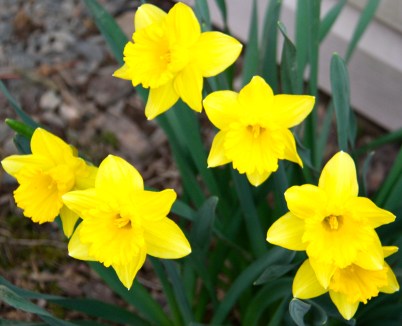
Daffodils A poem for the lady who brought some to us when Clare fell
Daffodils in our garden, last year in Island View. We won’t see the live ones until May, at the earliest. I dream of them at night, tossing their heads in sprightly dance’, in Roath Park and Blackweir Gardens, Cardiff. They will be out now, all ready to welcome Dydd Dewi Sant on March 1.
Daffodils
For ten long days the daffodils endured, bringing to vase and breakfast- table stored up sunshine and the silky softness of their golden gift.
Their scent grew stronger as they gathered strength from the sugar we placed in their water, but now they have withered and their day’s done.
Dry and shriveled they stand paper- thin and brown, crisp to the touch. They hang their heads: oncoming death weighs them down.
Where e’er she treads, the glossy flowers shall rise and light, like the light of flowers, will pierce any gloom and brighten the room.
Silence
When I wait for words to come and they refuse, I know that silence is golden and spreads its early morning sunlight across the breakfast table where yellow butter melts on hot toast.
Light from the rose window in Chartres once spread its spectrum over my hands and I bathed in its speckled glow.
My fingers stretched out before me and I was speechless, for in such glory, mortal things like words cease to flow.
So much can never be said even if it is sensed: fresh coffee, poutine à pain, bread baking, flowers bursting into bloom, the sense of immanent beauty that fills me each time my beloved enters the room.
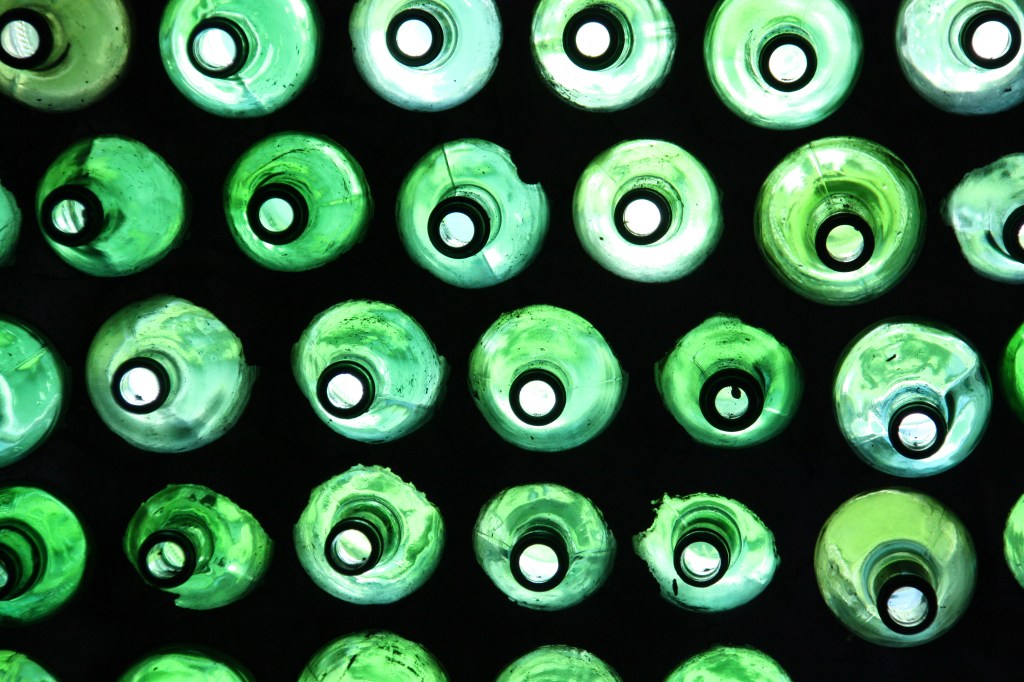
Light through glass, darkly: bottles set in one of the bottle house walls in PEI. The gardens are wonderful and well-worth a visit.
Bottle House, PEI The day begins with flowers: at the entrance, beneath the windows, flowers everywhere, a delicacy of scent. Beyond these flowers, even more flowers, then playthings in the garden: a child’s paradise, these sculptured faces, this glass among the trees, sun and shade, the fountain’s water, this dream of an old man, kept alive now by his children, a dream of health and sanity and peace out by the bay, where the mud red waters roll and the tide’s hand grasps at the land and pulls it down with watery fingers. Everywhere: faces and elements of faces: a nose, eyes, a mouth, open in surprise. Carved wooden faces, glass faces, pottery faces, flesh and blood faces, grandma’s face, grandpa’s face, then the grandchildren. Tourists travelling, old islanders returning to see family and friends, young islanders returning to visit the almost forgotten farms which their families worked a generation or three ago, before their exodus from the land. “This was grampy’s house!” they say or “that was my grandmother’s farm!” as if a life could be reborn in that pointed finger, those casual words. How many memories are snapped in each picture? How many lives are caught in this snapping of the fingers as the past is instantly summoned and perfection is bottled for a second or two in the magic of this house, this garden where the builder’s spirit roams. Sit still awhile. Be silent: you may hear him breathe, glimpse him, for a second, staking out the flowers, extracting a weed, checking the set of the concrete foundations, polishing a bottle, resting on a wooden seat, avoiding the slow snail on the path bejewelled by rain-drops from the trees or spray from the fountain. For where there are flowers, there must be water and rain and peace and happiness and all good things, glimpsed darkly through smoked glass yet grasped so smoothly in the sun’s bright light. This is the house of bottles, the glass house, where rough winds are shunned and the bottles are set in concrete. It is a museum of light and dark, the creation of sun and shadow as sunshine fails and the lighthouse’s flashlight beam reverberates from glass to stone and back again. Shapes, shadows, memories curved and carved in glass, set in glass, this shimmering beacon this glass house, this light house built as a heaven-haven for harboured ships and the soul’s refreshment, here, in these gardens, among these bottles, and at the chapel door, an angel-in-waiting.
Angel or fairy? It doesn’t matter. She was a gift one morning, when we visited. In this photo you can see how the bottles are set in the wall.
I looked for a picture of music, but could find nothing. No Carlos, no flute, no nothing. So, I invite you to use your imagination: just pretend these are the notes of an Andean flute, floating in the early morning air. Now close your eyes and listen carefully. Can you hear the music?
The Red Room
Carlos makes music on his flute. He lives in the Green Room, with its door just opposite mine
He creates the highest note of all and it floats before me in the air, a trapeze artist caught in a sunbeam and suspended between the hands that fling and those that catch.
His musical rhythms are different. I try to follow his fingering.
In the space between notes, tropical birds flash jungle colors as they flit between flowers.
With a whirring of wings, all music stops, save for the robin’s trill refreshing the early summer with his eternal song.
Comment:
I finally found a photo of Carlos. Here he is, in Kingsbrae Gardens, playing Beethoven’s Ode to Joy on ‘half-filled’ water bottles tuned to play a perfect scale. Like an Andean bird, the man could pluck notes from the air and fill the world with music.
Searching for le mot juste, the exact word that sums it all up, catches the essence of the thing and holds it in the mind forever.
Think flowers. Think scent. Think of the limited ways we describe how daffodils lift and clematis clings.
I look across the breakfast table and see my wife of fifty years, a teenager reborn, walking into that café where we had our first date.
I search my memory and my mind for the words to describe that beauty, that surge of excitement, I still feel when she enters the room:
but find I cannot find le mot juste.
Comment: I shortened this poem from its earlier version. You can click on this link to compare the two versions. I am always puzzled by the dilemma of lengthening or shortening. My thoughts center on the longer and shorter versions of some Raymond Carver stories. Follow the editor’s advice and cut all material down to its essential bones or fill out the skeleton with flesh and blood and expand the creative process further. I also think of the exhortation to ‘stay in the moment’. Anything that takes the reader away from the central experience is superfluous. Experienced writers are aware of that moment and its importance. Writers at my stage are often baffled by it and need to be told yes, this is the moment or no, that is not the moment. I guess the more we write, the more we understand the process. Understand: do we work this out consciously or does it develop in unconscious fashion? Are some people just born with those skills or we must work hard to develop them? Sunt rerum lachrimae: tears are in all things and I guess hard work is all part of the process. As I was told a long time ago: genius is 99% perspiration and 1% inspiration. You have to put in the hard work for that little light bulb to go ‘pop’!
Seize the day. Squeeze this moment tight. Nothing before means anything. Everything afterwards is merely hope and dream.
A tiny child, you chased wind-blown leaves trying to catch them before they hit the ground Elf parachutes you called them and trod with care so as not to crush the fallen elves as they lay leaf-bound.
I stand here now, a scarecrow scarred with age, arms held out, palms up, in the hope that a leaf will descend, a fallen sparrow, and rest in my hand.
When one perches on my shoulder and another graces my gray hair, my old heart pumps with joy.
Comment:Autumn in the Garden was framed by Geoff Slater who gifted it to me this summer. Thank you Geoff. A double picture, it shows the flowers and the trees with that first touch of drifting snow. NB it snowed here in Island View early September this year while we still had flowers and leaves. The poem, Carpe Diem, is from a series of quasi-sonnets. Quasi, because they rarely have 14 lines! Oh Petrarch: shake in your shoes.
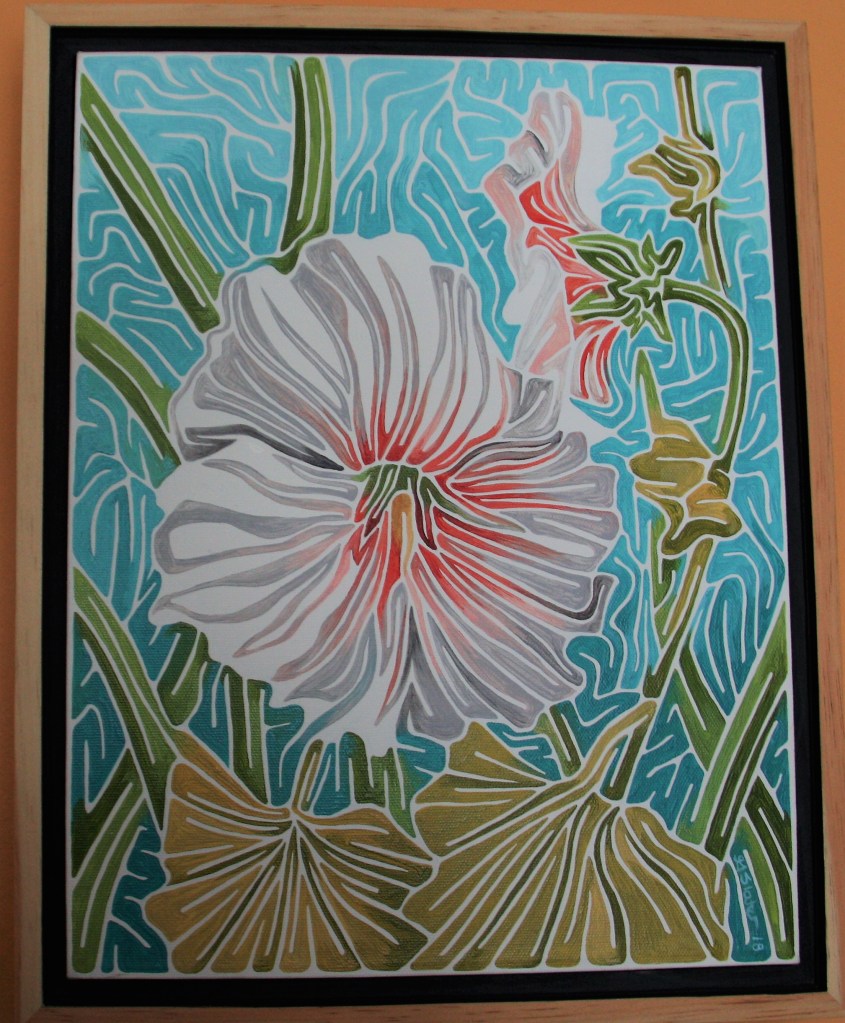
No Exit a line painting by Geoff for Andrea Slater
Where is the entry point, where the exit? This labyrinth of lines, straight, not circular, baffle the eye, confuse with a negative space that lightens colors and begs more darkness.
Mystery surrounds the sitter’s form: the board walk, no Dutch kitchen this, the chair on which she sits, the locket she wears, the landscape, seascape against which she is framed. White noise, perhaps,
but noise that turns to a single voice, a single line, that of the paint-brush tip-toeing, delicate its thread through interior, exterior meaning, just beyond
the viewer’s grasp. Yet walking past, each person stops, stands still, as the painting draws them in, ties them up, binds them with an ineffable thread, stronger than words,
mightier than the eye that traces its way along paths that deceive, disturb, throw us from the high-wire created by an artist who turns circular colors into linear space.
Comment:No Exit forms a part of my manuscript collection The Nature of Art and the Art of Nature that placed second in the WFNB’s Alfred G. Bailey Award (2020). This collection will soon be made available online at Amazon / KDP.
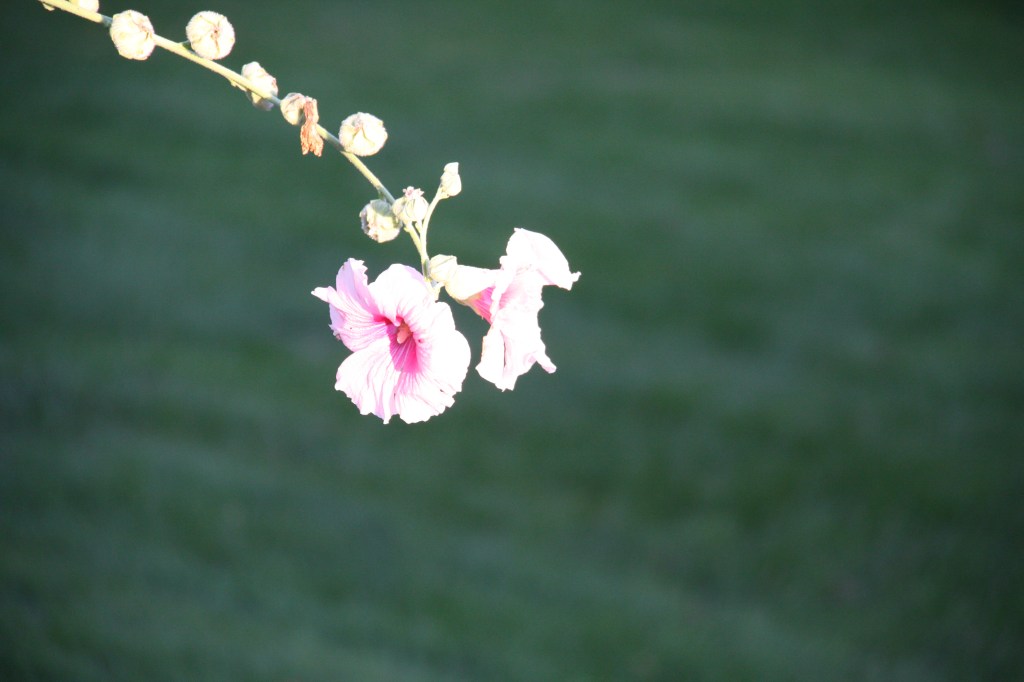
Geoff Slater the inventor of line-painting, gifted me this painting, one of my hollyhocks about two years ago. This is indeed a gift that keeps on giving.
A feather upon the cheek, this fern held fragile, hesitant between fine fingers. Touch and smell: two senses engaged.
A paint brush sounds, brush-brushing lightly on expectant skin. Faint the taste tested suggestive on tongue tip.
No sight, just insight. I have a sense of senses lacking. My words reach out like fingers, but they can neither retain nor explain the meaning of it all.
Eyeless in Kingsbrae, They push me, blindfolded, around the garden. Gravel crunches beneath the wheelchair wheels, sharpens my inability to be sure of shadows and shapes that are no longer there.
The ones who push me talk and tell but cannot show. How could they hold a rainbow before my sightless eyes or explain those lights that crisp and crackle in the night sky?
There’s warmth in a color, and heat’s visible to the touch. Shocking pink has a different feel beneath blind fingers, and it has no name that you and I, sighted, would ever know.
Oh, Song of Songs, and the singer deaf to his own sublimity. Oh dealer of false cards, fingerless pianist, and dancer shuffling on amputated stumps.
Comment: The poem Eyeless in Kingsbrae Garden is contained in my book One Small Corner: A Kingsbrae Chronicle (2017), available online at Amazon / KDP.
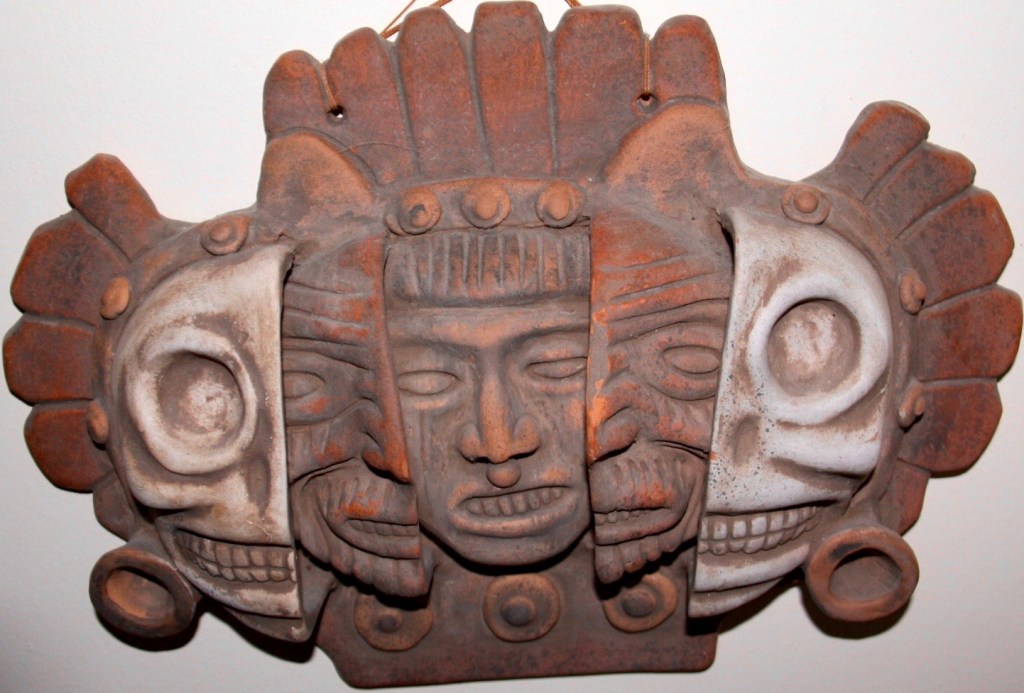
Outside the church, a boy pierces his lips with a cactus thorn.
The witch doctor catches the warm blood in a shining bowl.
He blesses the girl who kneels before him.
On her head she carries a basket filled with flowers and heavy stones. He sprinkles it with her brother’s blood.
All day she will walk with this basket on her head until evening’s shadows finally weigh her down.
Cobbles clatter beneath her clogs.
When the stones grow tongues, will they speak the languages in which she dreams?
Comment: Revisiting and revising some earlier poems. The early version can be found here. The original poem comes from the collection Obsidian’s Edge, which can be found on Amazon.





 rogermoorepoet