Mythras: Flash Fiction

F1010015.JPG

Mythras
Bistro 16

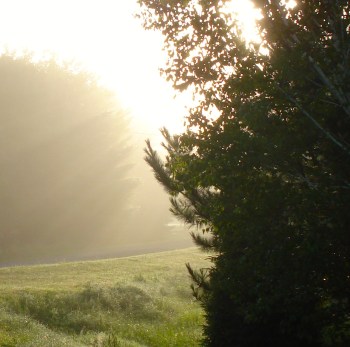
In the pearly morning light, before the sun had burned off the mists from woods and fields, Jim contemplated the breakfast potential of the mushrooms pushing their stubby skulls through the damp grass. Jim refrained from gathering any until he came across a mushroom as large as a stepping-stone. He lifted it up with great care and placed it in the canvas bag he carried. Then, casting his glance from side to side in search of the best of the crop, he continued to wander along the faint path that led downhill to the field below.

Dai Jones, the farmer, was plowing a neighboring field into earthen waves that disappeared in the morning mist. His sheepdogs, Floss and Jess, ran free between the furrows of fresh-turned earth.

“Watch out for that bull,” Dai called to Jim, as he turned the tractor by the dry stonewall. “He’s loose in that lower field. He’s in a bad mood this morning.”

The roar of the tractor accelerating out of the turn swallowed Dai Jones’s last words.
Jim bent to collect another mushroom. Downhill he walked, following the path as it led him through the mushroom patch and toward the lower field. He stopped at the gate and gazed towards the trees where the mist gathered its folds. Night still dwelt in that woodland temple and the field seemed empty. Jim opened the gate and walked through, closing it behind him.

Jim wasn’t afraid of Dai’s bull. He had met bulls before and had never had any problems with them. He had holidayed in Spain one year and at the village bullfight he had vaulted over the protective barrier with two of his drinking friends and found himself face to face with a fighting bull. It wasn’t really a fighting bull. It was a young bull, a novillo with padded horns, all the village could afford, but he well remembered how the animal sensed his presence, raised his horned head, pawed at the ground, and charged.

Jim recalled the elation of flying, of side stepping, of turning aside from the novillo‘s uncontrolled rush. The villagers, aficionados all, began by laughing at that teenager thrust into a sacrificial, prehistoric culture. But Jim stood his ground, unafraid, and allowed the novillo to come towards him, again and again, before dancing merrily away.

The novillo became furious. It charged with less and less control, and, as it tired, Jim’s two friends combined with the villagers who jumped the barrier to catch the novillo by its tail and drag it snuffling and snorting from the ring.

Later, after the bullfight, Jim met another bull. Its horns and head were fixed to a wooden frame crammed with fireworks and carried on the backs of six large men. When the village clock struck midnight, this carnival bull charged into the square where the villagers were dancing. The bull’s wicked glass eyes flashed, the fireworks exploded, and sprays of bright sparks spurted from the bull’s wooden back. The six men whooped and bellowed, and everybody, except Jim, pretended to be afraid and ran.

As he knelt to gather another large mushroom, Jim remembered the holes burned in his sweater by those bright sparks. He knelt there and the early light cast a luminous spell around him. It was as if he knelt at prayer, just like a bullfighter, en capilla, kneels and prays in the bullring chapel before his entrance into the ring. But Jim wasn’t afraid. He wasn’t affected by any mystery or myth, what he called ‘the bullshit of the bull’.

Within the mist, his bulk enlarged, his horns sharpened and curved, Dai’s black bull also knelt, snuffling gently, sensing Jim’s presence. Then the bull heaved his bulk slowly upwards until he reached a standing position. He couldn’t see Jim through the mist, but he sensed him, heard him breathe, and knew exactly where the young man was. The bull scraped his horns in the mud and pawed the ground.

Lost in his memories, Jim picked his last mushroom.

He looked up with astonishment when the black bull charged.

Jim’s world ended in a whimper as the bull’s sharp horn drove into the young man’s chest cavity, lifted him from the ground, severed the aorta, and pierced his heart.

F1000008.JPG


Miracle: Flash Fiction.


F1030024 2.JPG

Miracle
Bistro 15

A tiny man in a dark brown robe bustled into the library.

“Brother Marcos: come quick. There’s a miracle. We’re witnessing a miracle.”

Brother Marcos raised his eyebrows and Robin looked horrified. Will didn’t know what to think.

“A miracle?” Brother Marcos asked. “What kind of miracle?”

“There are angels and visions. Oh, I can’t explain. It’s happening now. You must come and see. Oh, you must come and see.”

The tiny man scampered out of the library door and Robin and Will followed him.

“Ship of fools,” said Robin to nobody in particular. “We’re all sailing in a ship of fools.”

“Wait and see,” said Brother Marcos. “We must not pass judgment. Wait and see.”

The man in the brown robe led them to the main altar at the heart of the monastery where the lignum crucis stood on display.

A group of tourists clustered around a man on his knees in front of the true cross. A ray of sunlight pierced the stained glass window and picked out the kneeling figure whose arms spread out like an angel’s wings as he knelt there motionless.

It was LJ. His eyes were open and his chest hardly moved. Fragments of colored light from the stained glass window flowed over and around him and at times they gave the impression of flowing through him too. They gifted him with what, in the shifting light of the sun’s ray, seemed to be a halo round his head. Golden specks of dust sparkled in the sun’s bright rays and danced like little angels in the air.

Brother Marcos drew in a deep breath, knelt, and made the sign of the cross.

“Little angels, ascending and descending,” he mused out loud. “How many, I wonder, could dance on the head of a pin?”

“It would depend on the size of the pin,” said Robin. He pushed past the staring crowd. Some were on their knees, their rosary beads clacking through their fingers. Others stood and looked on in wonder at the light descending. Others crossed themselves and looked towards the altar where the lignum crucis was displayed, the time-blackened nail hole exposed in all its glory.

“Come along, now, LJ,” said Robin, touching him on the arm. “That’s enough of that. Get up off your knees now. We’re going.”

There was a low mumble of disapproval from the absorbed spectators.

“Don’t touch him,” said one.

“It’s a miracle,” said another.

Noli me tangere.” The voice, a deep voice, not at all the voice of LJ, rose seemingly from the kneeling man’s mouth.

The crowd sighed. Some drew closer, in seeming awe. Others drew back in fear.

“I didn’t know LJ spoke Latin,” Will said.

“He doesn’t,” Robin shook his head. “But he could have learned those words at any time while he was in school. Even I know them. It’s a neat trick with the voice, though.”

“It’s no trick,” Brother Marcos crossed himself. “We have witnessed other miracles in this very place, though none quite like this.”

“This is my beloved son in whom I am well pleased.” The voice spoke again. And immediately the crowd responded and with the exception of Robin and William those still standing dropped to their knees and joined in the prayers. More rosaries appeared.

“Let the night’s stone be rolled away. Let sunshine pierce the shadows. LJ, my son, pick up thy cross and follow me.”

Two things happened almost at once. First, the sunray that illuminated the scene flickered and vanished and then LJ toppled over and lay on his side.


F1030024 2.JPG

Lily: Flash Fiction

DSC02020.JPG

Lily
Bistro 14

One morning, in the Jeu de Paume, LJ found his own true love. The sun rose in Giverny and cast rose colored petals across the lily pond. And there she was, his Lily Marlene, floating in that watery space, her face framed among the lilies.

He remembered what she used to wear as she waited for him, standing beneath the lamplight where he could see her. He recalled their tender whispers and felt once again that wave of love sweeping over him. His tongue touched base on his lips and he swallowed his saliva: so sweet, her resurrection. She lazed there among the blossoms, each flower gigantic beneath the Japanese footbridge. LJ gazed on her, that Lily who toiled not, nor did she spin, and sighed as she rested there, cushioned among the lily pads, a work of wonder in a watery labyrinth of fragmented light.

He remembered the night they sent him away. “All troops confined to barracks,” the notice said. He thought of her standing out there, waiting for him. He remembered too that first encounter with the enemy when fortune rattled its poker dice leaving them to fall haphazardly, never to be recalled, yet not falling by chance, and the cast dice turning into flowers, red flowers, that stained his knife crimson. He gazed at her as she lay there, a conjurer’s trick her floral eyes pulled from a dark sleeve and floating in a pantheon of mysterious magic, a thicket of flowering water.

Each day he came to the Jeu de Paume to pay tribute and to see her reclining on her lily-pad. Very soon he saw her everywhere, coy in shop windows, languid in pavement puddles where raindrops rippled her eyes, couched among the floating clouds as evening stole color from the day. She became once more his Lily of the Lamplight and, as dusk’s shadows stalked street and square, he kept watch at street corners, from dusk to dawn, hoping to see her again, highlighted in the early morning by the rising sun.

LJ dreamed that one day they would walk together, hand in hand, at noon, perhaps, when the cathedral wears its strawberry suit, or in late afternoon when a blueberry blush descends with prayers and bells to sound the magic of Vespers. But it wasn’t to be. One evening, in a fit of despair, he threw myself into those clinging waters and sought her side. Dark bells rang out their bull-frog chorus as he plunged through shadowy waters in search of the light of her countenance there, where dusk is a violent bruise, scoured purple and red across the horizon. Yes, he followed in her footsteps, his Lady of the Lake, and became one with those waters.

LJ still doesn’t know who drew him forth; but when he emerged, he sensed that all had changed and that nothing had changed more than the viewer, this once-young man, now old and arthritic, typing away, one finger at a time, battering his key-board to recreate the wanderlust of those day-dreams wrought sous le Pont Mirabeau, along the banks where the Seine flows, or up by the bouqinistes and the Marché aux Fleurs, and past the Marché aux Esclaves where he searched for her, but he didn’t find her and raindrop words bounce off the page as photos of Monet’s Lilies bewitch with the staring madness of her drifting hair that floats through the cathedral’s eye, through the great rose window of Notre Dame reflected in the waters where his Lily still waits and holds a place in the rippling river for his un-drowned heart.

Closure: Literary Theory

Closure
Writing or Re-Writing 7

Yesterday’s post, Lagartija (Bistro 13, Flash Fiction) raises the question of closure. For me, closure sets a double problem: when to close and how to close. These two concepts, when and how, may seem to be the same; but in fact, they are not. Let us take a closer look at Lagartija and use it as an example.

Lagartija
(Bistro 13)

There are striations in my heart, so deep, a lizard could lie there, unseen, and wait for tomorrow’s sun. Timeless: this worm at the apple’s core waiting for its world to end. Seculae seculorum: the centuries rushing headlong. Matins: wide-eyed this owl hooting in the face of day. Somewhere, I remember a table spread for two. Breakfast: an open door, a window that overlooks a balcony and a garden.
“Where are you going, dear?”
Something bright has fled the world. The sun unfurls shadows. The blood whirls stars around the body.
“It has gone,” she said. “The magic. I no longer tremble at your touch.”
The silver birch wades at dawn’s bright edge. Somewhere: tight lips, a blaze of anger, a challenge spat in the wind’s taut face. High-pitched the rabbit’s grief as it struggles in its silver snare. The somnambulant moon tiptoes in a trance.
If only I could kick away this death’s head, this sow’s bladder, this full moon drifting high in a cloudless sky.

Lagartija falls neatly into two parts. These are divided by the spaced paragraph division. The first part ends with the line: “If only I could kick away this death’s head, this sow’s bladder, this full moon drifting high in a cloudless sky.” In terms of HOW to end, this is a great ending. The piece could end right there: powerful image, sense of closure, strong line and sentiment. In terms of WHEN to end, however, I wanted to say more. So I added another paragraph.

Who knows when the skeleton will take to the limelight, peel off her gloves, doff her hat, lay down her white cane, and use me as fuel for a different kind of fire. Grief lurks in the bracelet’s silver snare of aging hair. I kick my legs in the chorus line and my day fades into shadowy shapes that unfurl leathery wings.
Pebbles catch in my throat and the word-river once flowing smooth backs up to spill leaf-freckled foam over the tiniest barriers of branch and weed. I try to speak but a gypsy has stolen my tongue and sewn my lips together.
Leaves outside my window grow rusty with rain. A sharp-shinned hawk no bigger than the blue jay he stalks drives like a whirlwind at the feeder. Winter touches with his jack-frost fingers and Old Eight Hoots waits in the tree and calls my name.
Bright stars crackle the sky. Frost crisps leaves. A mist weaves webs scarce-seen. All around, as I walk to my lonely home, the cold ground creaks its wordless tongue-tied whispers.

Night shapes abound.

Let me begin by stating that I am not sure about the second paragraph. I wanted to emphasize the sense of loss of love, the sense of being dislocated in time and space: but is this overkill? I am in two minds about this: one half of me says OVERKILL; the other half says: LIVE WITH IT. Now, just looking for a phrase and finding those words: LIVE WITH IT makes me feel that both the WHEN and the HOW of the ending fall at the end of that first paragraph. Much as I like the second part, it must go. Perhaps it can stand on its own?

The problem is exacerbated because Lagartija is actually a prose excerpt of a poem from Though Lovers be Lost. I wanted to see if some of the magic of the poetry could be retained in the prose version. I think it can, provided the HOW and WHEN of closure ends early. To extend the prose passage is to weaken it. To extend the prose passage is also to betray the poem. Here it is: Building on Sand (from Though Lovers Be Lost, 2000)

Building on Sand

1
Everywhere the afternoon
gropes steadily to night.
Some people have lit fires;
others read by candlelight.

Geese litter the river bank,
drifts of snow their whiteness,
stained with freshet mud;
or is it the black
of midnight’s swift advance?

They walk on thin ice
at civilization’s edge.
Around them,
the universe’s clock
ticks slowly down.

2
Who forced that scream
through the needle’s eye?

Gathering night,
the moon on the sea bed
magnified by water.

Inverted,
the big dipper,
hanging its question
from the sky’s dark eye lid.

Ghosts of departed
constellations
walk the night.

Pale stars scythed
by moonlight
bob phosphorescent
flowers on the flood.

3
The flesh that bonds;
the bones that walk;
the shoulders and waist
on which I hang
my clothes.

Now they stand alone
beneath the moon
and listen at the water’s edge
to the whispering trees.

They have caught the words
of snowflakes
strung at midnight
between the stars.

Moonlight is a liquor
running raw within them.

4
There are striations
in my heart, so deep,
a lizard could lie there,
unseen, and wait
for tomorrow’s sun.

A knot of
sorrow in daylight’s throat;
the heart a great stone
cast in placid water,
each ripple
knitted to its mate.

Timeless,
the worm at the apple’s core
waiting for its world to end.

Seculae seculorum:
the centuries
rushing headlong.

5
Matins:
wide-eyed
this owl hooting
in the face of day.

Somewhere,
I remember
a table spread for two.
Breakfast.
An open door.
“Where are you going, dear?”

Something bright has fled the world.
The sun unfurls shadows.
The blood whirls stars
around the body.

“It has gone.” she said. “The magic.
I no longer tremble at your touch.”

6
You can drown now
in this liquid
silence.

Or you can rage against this slow snow
whitening the dark space
where yesterday
you placed your friend.

The silver birch wades
at dawn’s bright edge.

Somewhere,
sunshine will break
a delphinium
into blossom.

7
Tight lips.
A blaze of anger.
A challenge spat
in the wind’s face.

High-pitched
the rabbit’s grief
in its silver snare.
The midnight moon
deep in a trance.

If only I could kick away
this death’s head,
this sow’s bladder.

Full moon
drifting
high in a cloudless sky.

8
After heavy rain
the house shrinks.
Its mandibles close.

A crocodile peace
descends from the jaws of heaven.

I no longer fit my skin.
Iguana spots itch.
Walls encircle me,
hemming me in.

The I Ching sloughs my name:
each lottery ticket,
a bullet.

None with my number.

9
Late last night I thought
I had grasped the mystery:
but when I awoke
I clasped only shadows and sand.

Building on Sand now asks another set of questions, for it offers multiple possible points of closure, key lines where the poem might end, but doesn’t. Is closure possible? Or are we always faced with continuations and further possibilities? In Building on Sand, each possible point of closure opens another set of perspectives. Without being infinite, the cycle is continuous. In Lagartija, on the other hand, the closure poses a different question, for although the prose poem seems to come to an end with the line “If only I could kick away this death’s head, this sow’s bladder, this full moon drifting high in a cloudless sky”, the ending is in fact rather more open than closed. As a result, the reader is left wondering how and if the narrator has managed to cope with the circumstances.

Writing or Re-Writing? Sometimes, as writers and re-writers, we must make difficult decisions. Often we must reject and eliminate some of our favorite words and images. Hard to do? Definitely: but we all face that choice. Hopefully, the above study will help clarify not only the difficult choices we must make when trying to close out our creative pieces but also the some of the key differences between the HOW and the WHEN of closure. It also raises the question of the extent to which a piece of good creativity resonates and whether it can ever be completely closed.

Lagartija: Fast Fiction


DSC02058.JPG

Lagartija
(Bistro 13)

There are striations in my heart, so deep, a lizard could lie there, unseen, and wait for tomorrow’s sun. Timeless: this worm at the apple’s core waiting for its world to end. Seculae seculorum: the centuries rushing headlong. Matins: wide-eyed this owl hooting in the face of day. Somewhere, I remember a table spread for two. Breakfast: an open door, a window that overlooks a balcony and a garden.
“Where are you going, dear?”
Something bright has fled the world. The sun unfurls shadows. The blood whirls stars around the body.
“It has gone,” she said. “The magic. I no longer tremble at your touch.”
The silver birch wades at dawn’s bright edge. Somewhere: tight lips, a blaze of anger, a challenge spat in the wind’s taut face. High-pitched the rabbit’s grief as it struggles in its silver snare. The somnambulant moon tiptoes in a trance.
If only I could kick away this death’s head, this sow’s bladder, this full moon drifting high in a cloudless sky.

Who knows when the skeleton will take to the limelight, peel off her gloves, doff her hat, lay down her white cane, and use me as fuel for a different kind of fire. Grief lurks in the bracelet’s silver snare of aging hair. I kick my legs in the chorus line and my day fades into shadowy shapes that unfurl leathery wings.
Pebbles catch in my throat and the word-river once flowing smooth backs up to spill leaf-freckled foam over the tiniest barriers of branch and weed. I try to speak but a gypsy has stolen my tongue and sewn my lips together.
Leaves outside my window grow rusty with rain. A sharp-shinned hawk no bigger than the blue jay he stalks drives like a whirlwind at the feeder. Winter touches with his jack-frost fingers and Old Eight Hoots waits in the tree and calls my name.
Bright stars crackle the sky. Frost crisps leaves. A mist weaves webs scarce-seen. All around, as I walk to my lonely home, the cold ground creaks its wordless tongue-tied whispers.

Night shapes abound.


Writing or Re-Writing? 5


IMG_0130 copy 4.jpg


High Tide exists in two separate forms under two different names: (1) the prose poem High Tide and (2) the poem, Though Lovers Be Lost. The title of the poem comes, of course, from Dylan Thomas.

High Tide     

High tide in the salt marsh and now you are a river flowing silver beneath the moon, your body filled with shadow and light. I dip my hands in dappled water. Twin gulls, they fly down stream then perch on an ice floe of half-remembered dreams. An eagle with a broken wing, I am trapped in this cage of flame. When I turn my feathers to the sun, the black and white of a convict’s bars stripe my back.

Awake, I lie anchored by what pale visions fluttering on the horizon? White moths wing their snowstorm through the night. A feathered shadow ghosts frail fingers towards my face. Butterflies stutter their kisses against the closed lips of shuttered eyes and mouth. Hands reach out to grasp me. A candle flickers in the darkness and I am afraid.

Who mapped in runes the ruins of this heart? Eye of the peacock, can you touch what I see when my eyelids close for the night? Black rock of the midnight sun, blocking the sky’s dark cave, when will I be released from my daily bondage? Last night, the planet quivered beneath my body and I felt each footfall of a transient god.

The prose poem shortens the verse poem and turns it into a rushing hurly-burly of breathless words strung together by metaphor and magic. They flash and twist this way, that way, like minnows in shallow waters, allowing no time for pause, no time for thought. When I have read the passage in public, the listeners have always looked slightly stunned, bemused, battered almost by the storm of emotion tied into the piece.

The prose poem was published in Fundy Lines (2002) but it was originally conceived as a poem written in stanzas and took this form when published in Though Lovers Be Lost (2000). When the poem is set out in stanzas, it is shaped by the spaces that surround each line. These spaces slow the poem down, allowing the reader to permit the listener, to dwell on each group of words. Obviously, in a silent and private book reading, each one of us will read poetry and prose in our customary way. That said, in a public reading, I usually read the prose slightly faster than I do the poetry. The metaphoric nature of the language stands out in the longer version, and instead of the rush of words (prose), we have a measured resonance that shapes meaning. Impact in prose versus depth of meaning in poetry: I think both forms work in different ways.

In addition, the prose poem has been very selective and has abandoned several of the images and themes that appear in the poem. This increases the sense of urgency and unity while diluting the strength of the metaphors. Although the words are basically the same, the shapes and forms make for two different works, two distinctive appearances.

Though Lovers Be Lost

1
Once,
you were a river,
flowing silver
beneath the moon.

High tide
in the salt marsh:
your body filled
with shadow and light.

I dipped my hands
in dappled water.

2
Eagle with a shattered wing,
my heart batters
against bars of white bone.

Or am I a killdeer,
trailing token promises
for some broken god to snatch?

Gulls float downstream.
They ride a nightmare
of half-remembered ice.

Trapped in my cage of flame,
I return my feathers to the sun.

3
Awake,
I lie anchored by
what pale visions of moths
fluttering on the horizon?

A sail
flaps canvas wings
speeding my way
backwards into night.

A feathered shadow
ghosts fingers over my face.

Butterflies
stutter against
shuttered windows.

Strange hands
reach out to grasp me
and again I am afraid
of the dark.

4
When was my future
carved in each sliver of bone?

A scratch of the iron pen
jerks the puppet’s limbs
into prophesied motion.

Who mapped in runes
the ruins of this heart?

Above me,
a rag tag patch of cloud
drifts here and there,
shifting constantly;

like this body of water
in which I sail.

5
Eye of the peacock,
can you touch
what I see when
I close my eyelids
down for the night?

Black rock of the midnight
sun, rolled up the sky,
won’t you release me
from my daily bondage?

Last night, the planet
quivered beneath my body
and I felt each footfall
of a transient god.

6
Thunder knocks
on the door of my dream
and I am afraid.

I no longer know my way
through night’s dark wood.

Who bore her body
out in that rush of rain?

Could she still sense
the sigh of wet grass?

Could she still hear
the damp leaves whisper?

7
A finger of fog
trickles
a forgotten face
down the window.

The power of water,
of fire, of frost;
of wind, rain, snow,
and ice.

Incoming tide:
stark waters.

Rising.

I would welcome any comments you may have (a) on the difference between the two forms, as they impact you; (b) on the perceived differences between the prose poem and the poetry; and (c) on the perceived revision and thought process that turns poetry into prose, and vice-versa.

Bistro 12 Flash Fiction

IMG_0170.JPG

High Tide     

High tide in the salt marsh and now you are a river flowing silver beneath the moon, your body filled with shadow and light. I dip my hands in dappled water. Twin gulls, they fly down stream then perch on an ice floe of half-remembered dreams. An eagle with a broken wing, I am trapped in this cage of flame. When I turn my feathers to the sun, the black and white of a convict’s bars stripe my back.

Awake, I lie anchored by what pale visions fluttering on the horizon? White moths wing their snowstorm through the night. A feathered shadow ghosts frail fingers towards my face. Butterflies stutter their kisses against the closed lips of shuttered eyes and mouth. Hands reach out to grasp me. A candle flickers in the darkness and I am afraid.

Who mapped in runes the ruins of this heart? Eye of the peacock, can you touch what I see when my eyelids close for the night? Black rock of the midnight sun, blocking the sky’s dark cave, when will I be released from my daily bondage? Last night, the planet quivered beneath my body and I felt each footfall of a transient god.

Bistro 11 Fast Fiction

Doppelganger

IMG_0147.JPG


Last summer, in Oaxaca, Tom bumped into his twin, Gerry. Candles flickered on the engraved glass panels of the cathedral’s main doors illuminating Gerry’s ghostly face as if it were that of a young martyr. Mouth open, Tom stared at the apparition, but neither of them spoke. Tom’s neck-hairs bristled, his mouth ran dry, and his hands shook. He closed his mouth, tried to swallow, but the dryness in his throat prevented him from doing so. He opened his mouth and tried to speak, but words stuck in his throat and meaningless sounds emerged.

Three old crones, dressed in black, broke the spell. One stood in front of Tom and struck him with the large black bag of knitting that she held in her hand. Thin threads of red wool spilled out as she pushed him away. The second threatened Tom with a pair of scissors that she held in her left hand, jabbing them repeatedly towards his eyes. The third produced a tailor’s measuring rod and, using it like a cattle goad, prodded Gerry in the side. Gerry nodded, smiled sadly, and then the three women shepherded Tom’s dead twin away, hurrying out through the cathedral’s glass doors and back into the square. Tom stood motionless for a moment and then as the doors snapped shut he pulled them open and ran out after the group.

The setting sun filled the square with shadows that whispered and moved this way and that. It was as if the earth had shaken, a hole had appeared in the cemetery wall, and a whole generation of dead people had walked out of the cemetery to gossip beneath the trees and dance in the rays of the dying sun. Tom stood on the cathedral steps and called out his twin’s name. Gerry half-turned, but the three old ladies closed together and the herd hurried on.

Tom ran out into the crowd and followed the shadowy quartet, pushing his way through insubstantial people who stood firm one moment and then melted away the next like clouds or mist so thick one could almost lean on it. He ran as far as a side street that led away from the square and there he stopped.

The three crones pushed Gerry into an alley and Tom ran in after them. At first, it was dark. Then, as he brushed through a final curtain of mist, he emerged into a sunlit courtyard. Three beautiful young women in diaphanous garments sat working at an enormous loom. One spun thread and she beckoned to Tom. He approached and she pointed at the loom where tiny figures walked up and down the wool as it was being woven. He felt himself grow smaller and smaller. Then the weaver picked him up and placed him firmly on the loom and wove him into the threads. The third lady clicked her scissors and severed the wool that held him. The wooden shuttle clacked and he remembered no more.

Gerry emerged from the alley and entered the square where real people, flesh and blood beings, turned to gaze at her.  A group of villagers carrying the banner of a small town in the hills stood in a group behind their village band. An elder, carried a live-match in his hand. Deep lines scarred his face with living shadows that danced in the match-light. He put the live-match to the taper of a rocket and it soared upwards with a long-drawn out whooooosh. The village band struck up a traditional dance tune as the rocket clawed its way into the sky to explode with a loud knock against the door of the ancient gods.

Afraid of grasping at shadows and scared by this living phalanx of bandsmen that suddenly marched towards her, Gerry retreated across the main square and hurried back to the cathedral. There, she knelt at the altar of La Virgen de la Soledad, the patron saint of Oaxaca. She inserted five pesos in the collection slot, took a taper, lit it, and applied it to a candle.

Then she started to cry. Her twin brother Tom had been wearing his best grey suit over a light blue shirt and a dark blue, hand woven tie. These were the same clothes in which Gerry had dressed him for burial.

Gerry was on her knees before the statue of the Virgin. Her breath came in short, sharp bursts. She clenched his fists so tightly that her fingernails gouged into her palms. She looked into the Virgin’s eyes and candle light sparkled through the single, silver tear that trickled down the Virgin’s cheek.

https://rogermoorepoet.com/2016/07/03/writing-or-re-writing-4/

IMG_0147 2.JPG

Writing or Re-Writing? 4

IMG_0130.jpg

Writing or Re-Writing? 4

 I visited San Diego for a conference in 1994 and, while I was there, I decided to cross over the border and visit Mexico, a country to which I had never been. I took the train from San Diego to Tijuana, crossed the border, and went downtown to the cathedral. As I opened the cathedral door, a man who looked exactly like my father walked out. My father had passed away in 1989, four years earlier. We stopped and stared at each other. I blinked, turned away for a second, and when I looked back, I was alone on the cathedral steps and the man was no longer there. That event continues to haunt me. I wrote about it in People of the Mist, my first novel.

  1. People of the Mist

As I step into the church a man comes out. I look at his face and I stare into the washed out blue of my father’s eyes. We stand there gazing at each other in silence. My father’s fawn raincoat is still missing a button at the neck and the old scar of a stain marks the absence on his lapel of the usual carnation. He is also wearing the grey suit with the blue shirt and the red and black tie in which I dressed him before I buried him.

Then, the spell breaks. My father starts to speak but his hand claws at his throat and no words emerge. His mouth twists in an anguished “no, no, no.” The small hairs stand erect on the back of my neck. A cold hand moves down my spine and I shiver. I close my eyes for a second, take a deep gulp of air and when I open my eyes, my father has disappeared.

If it really was my father … I wish I had said something, caught him by the arm, held him. I should have told him that I missed him, told him what had become of me. If it wasn’t my father, I should have asked him who he really was, told him he looked like the man I had buried far away and long ago. I should have asked him if I could see him again … But the moment has passed and the man who seems so much like my father has gone.

I go into the church, light a candle, fall down on my knees, and pray.

It is hard to explain such a disturbing event and even harder to come to terms with it in writing. I have returned to it again and again, both as a single piece and as part of a larger narrative. I decided, as part of the re-writing process, to take myself out of the story, and to re-tell the story in the third person. In this re-write, Tom, the central character meets his father on the steps of the church.

  1. Gravitas

Last summer, in Oaxaca, Tom bumped into his father. Candles flickered on the engraved glass panels of the cathedral’s main doors illuminating Tom’s father’s face as if it were that of  some long gone saint. Tom’s father wore his best grey suit over a light blue shirt and a dark blue, hand woven tie. In the funeral home, Tom had had dressed him for burial in just that outfit. Both the suit and its wearer had perished the following day in the crematorium.

Tom and the apparition who appeared to be his father stared at each other but neither of spoke. Tom’s neck-hairs bristled, his mouth ran dry, and his hands shook. He opened his mouth and tried to speak, but words stuck in his throat and meaningless sounds emerged.

Three old women, dressed in black, broke the spell. One stood in front of Tom and struck him with the large black bag of knitting that she held in her hand. Thin threads of red wool spilled out as she pushed him away. The second old lady threatened Tom with a pair of scissors that she held in her left hand, jabbing them repeatedly towards his eyes. The third produced a tailor’s measuring rod and, using it like a cattle goad, prodded Tom’s father in the side. Tom’s father nodded, smiled sadly, and then the three women shepherded Tom’s father away, hurrying him out of through the cathedral’s glass doors and into the square. Tom stood motionless for a moment and then as the doors snapped shut he pulled them open and ran out after the group.

The setting sun filled the square with shadows that whispered and moved this way and that as if a whole village of dead people had walked out of the cemetery to stand beneath the trees and dance in the rays of the dying sun. Tom stood on the cathedral steps and called out his father’s name, but he could see no sign of him among the cut and thrust of the shadowy crowd.

Tom ran out into that crowd and pushed at insubstantial people who stood firm one moment and then melted away the next like clouds or mist so thick one could almost lean on it. He ran as far as a side street that led away from the square and there he stopped and let out a loud cry of grief.

Real people, flesh and blood beings, turned to gaze at him.  Villagers carrying the banner of a small town in the hills stood in a group behind their village band. An elder, deep lines scarring his face with living shadows that danced in the last rays of the sun, put a live match to the taper of the rocket that he clutched between his thumb and forefinger. The taper caught fire and the rocket soared upwards with a long-drawn out whooooosh. The village band marched forward and struck up a traditional country song as the rocket clawed its way into the sky to explode with a loud knock on the door of the gods.

Afraid of grasping at shadows and scared by this living phalanx of men that now marched towards him seeking access to the main square, Tom retreated to the cathedral and knelt at the altar of La Virgen de la Soledad, the patron saint of Oaxaca. Tall wax candles stood before her altar. He  inserted fifty pesos in the slot, took a taper, and lit candle after candle.

He knelt before the virgin and, for the first time in years, he cried. Tears ran down his cheeks, his breath came in short, sharp bursts, he clenched his fists so tight that his finger nails gouged into his palms, and, for the first time since the funeral, he broke down and he prayed for his father, and his mother and, above all, for himself.

The changes are radical and obvious. My own thoughts, as I re-wrote, were that I had found a new freedom and a release from the autobiographical content of the original episode. This freeing up of the narrator is so important. Now I can concentrate on the power of the piece and the possible meanings tied up, not in the autobiographical event, but in the narrative sequence itself. It is packed with potential. What happens, I asked myself, if the man is not the father, but some sort of doppelganger?

I googled doppelganger and found this:

 A doppelganger — also written “doppelgaenger” or “doubleganger” — is quite simply a double. It can be a ghost or physical apparition, but it is usually a source of psychological anxiety for the person who sees it. The word comes from the German Doppelgänger, literally meaning “double-goer,” and has found widespread use in popular culture.

 Many different types of doppelganger have arisen in cultures around the world. A doppelganger may be an “evil twin,” unknown to the original person, who causes mischief by confusing friends and relatives. In other cases, the double may be the result of a person being in two places at once, or even an individual’s past or future self. Other times, the double is merely a look-alike, a second individual who shares a strong visual resemblance. The goals of the doppelganger often depend on the role it plays for the original person.

 In folklore, the doppelganger is sometimes said to have no shadow or reflection, much like vampires in some traditions. These doubles are often malicious, and they can haunt their more innocent counterparts. They may give bad advice or put thoughts in their victim’s heads. Seeing one’s own doppelganger or that of a friend or relative is usually considered very bad luck, often heralding death or serious illness. In some traditions, a doppelganger is considered a personification of death.

http://www.wisegeek.org/what-is-a-doppelganger.htm

My next experiment was with the idea of the twin brothers. What happens if one twin dies and the other survives? What happens if the wrong twin survives? Can there be a replacement? These waters run deep. Here is the third re-write. Did I really write “the third re-write”? I shouldn’t have: this is, rather, the third major revision in the sequence of multiple rewrites that this little event has engendered. There will, I am certain, be many more.

     3. Gravitas 2

Last summer, in Oaxaca, Tom bumped into his twin brother, Gerry. Candles flickered on the engraved glass panels of the cathedral’s main doors illuminating Gerry’s face as if it were that of some youth martyred for his faith. Mouth open, Tom stared at his brother, but neither of them spoke. Tom’s neck-hairs bristled, his mouth ran dry, and his hands shook. He closed his mouth, tried to swallow, but the dryness in his throat prevented him from doing so. He opened his mouth and tried to speak, but words stuck in his throat and meaningless sounds emerged.

Three old crones, dressed in black, broke the spell. One stood in front of Tom and struck him with the large black bag of knitting that she held in her hand. Thin threads of red wool spilled out as she pushed him away. The second threatened Tom with a pair of scissors that she held in her left hand, jabbing them repeatedly towards his eyes. The third produced a tailor’s measuring rod and, using it like a cattle goad, prodded Gerry in the side. Gerry nodded, smiled sadly, and then the three women shepherded Tom’s twin brother away, hurrying him out of through the cathedral’s glass doors and back into the square. Tom stood motionless for a moment and then as the doors snapped shut he pulled them open and ran out after the group.

The setting sun filled the square with shadows that whispered and moved this way and that. It was as if the earth had shaken, a hole had appeared in the cemetery wall, and a whole generation of dead people had walked out of the cemetery to gossip beneath the trees and dance in the rays of the dying sun. Tom stood on the cathedral steps and called out his brother’s name. Gerry turned his head, but the three old ladies closed around him and herded him on.

Tom ran out into the crowd and followed the shadowy quartet, pushing his way through insubstantial people who stood firm one moment and then melted away the next like clouds or mist so thick one could almost lean on it. He ran as far as a side street that led away from the square and there he stopped.

The three crones pushed Gerry into an alley and Tom ran after them and followed them in. At first, it was dark. Then, as he brushed through a final curtain of mist, he emerged into a sunlit courtyard. Three beautiful young women, working at an enormous loom, beckoned to him. He approached and they pointed at the loom where tiny figures walked up and down the fabric as it was being woven. He felt himself grow smaller and smaller. Then one of the ladies picked him up and placed him firmly on the loom and wove him into the threads. The wooden shuttle clacked and he remembered no more.

Gerry emerged from the alley and entered the square where real people, flesh and blood beings, turned to gaze at him.  A group of villagers carrying the banner of a small town in the hills stood in a group behind their village band. An elder, carried a live-match in his hand. Deep lines scarred his face with living shadows that danced in the match-light. He put the live-match to the taper of the rocket that he held in his other hand. The taper caught fire and the rocket soared upwards with a long-drawn out whooooosh. The village band marched forward and struck up a traditional dance tune as the rocket clawed its way into the sky to explode with a loud knock against the door of the ancient gods.

Afraid of grasping at shadows and scared by this living phalanx of men that suddenly marched towards him, Gerry retreated across the main square and hurried back to the cathedral. There, he knelt at the altar of La Virgen de la Soledad, the patron saint of Oaxaca. He inserted fifty pesos in the collection slot, took a taper, lit it, and applied it to candle after candle.

Then Gerry started to cry. His brother Tom had been wearing his best grey suit over a light blue shirt and a dark blue, hand woven tie. These were the same clothes in which Gerry had had dressed him for burial just last year. Both the suit and its wearer had perished the following day in the crematorium.

Gerry was on his knees before the statue of the Virgin. Tears ran down his cheeks, his breath came in short, sharp bursts. He clenched his fists so tightly that his fingernails gouged into his palms. He looked into the Virgin’s eyes and prayed for his brother, Tom. Then he prayed for himself and, for the first time since Tom’s funeral, he allowed himself to truly grieve for the brother he had lost.

Comments on preferences and the re-writing process will be very welcome.

Bistro 10 Flash Fiction

IMG0038_1.jpg

Gravitas

Last summer, in Oaxaca, Tom bumped into his father. Candles flickered on the engraved glass panels of the cathedral’s main doors illuminating the old man’s face as if it were that of  some long gone saint. Tom’s father wore his best grey suit over a light blue shirt and a dark blue, hand woven tie. In the funeral home, Tom had had dressed him for burial in just that outfit. Both the suit and its wearer had perished the following day in the crematorium.

Tom and stared at the man who appeared to be his father, but neither of them spoke. Tom’s neck-hairs bristled, his mouth ran dry, and his hands shook. He opened his mouth and tried to speak, but words stuck in his throat and meaningless sounds emerged.

Three old women, dressed in black, broke the spell. One stood in front of Tom and struck him with the large black bag of knitting that she held in her hand. Thin threads of red wool spilled out as she pushed him away. The second old lady threatened Tom with a pair of scissors that she held in her left hand, jabbing them repeatedly towards his eyes. The third produced a tailor’s measuring rod and, using it like a cattle goad, prodded Tom’s father in the side. Tom’s father nodded, smiled sadly, and then the three women shepherded Tom’s father away, hurrying him out of through the cathedral’s glass doors and back into the square. Tom stood motionless for a moment and then as the doors snapped shut he pulled them open and ran out after the group.

The setting sun filled the square with shadows that whispered and moved this way and that. It was as if the earth had shaken, a hole had appeared  in the cemetery wall, and a whole generation of dead people had walked out of the cemetery to gossip beneath the trees and dance in the rays of the dying sun. Tom stood on the cathedral steps and called out his father’s name, but he could see no sign of him among the cut and thrust of the shadowy crowd.

Tom ran out into that crowd and pushed at insubstantial people who stood firm one moment and then melted away the next like clouds or mist so thick one could almost lean on it. He ran as far as a side street that led away from the square and there he stopped and let out a loud cry of grief.

Real people, flesh and blood beings, turned to gaze at him.  Villagers carrying the banner of a small town in the hills stood in a group behind their village band. An elder, deep lines scarring his face with living shadows that danced by match-light, put the live match that he clutched between his thumb and forefinger to the taper of the rocket that he held in his other hand. The taper caught fire and the rocket soared upwards with a long-drawn out whooooosh. The village band marched forward and struck up a traditional country dance tune as the rocket clawed its way into the sky to explode with a loud knock on the door of the gods.

Afraid of grasping at shadows and scared by this living phalanx of men that now marched towards him, Tom retreated across the main square and hurried back to the cathedral where he knelt at the altar of La Virgen de la Soledad, the patron saint of Oaxaca. Tall wax candles stood before her altar. He  inserted fifty pesos in the slot, took a taper, lit it, and applied it to candle after candle.

He knelt before the virgin and started to cry. Tears ran down his cheeks, his breath came in short, sharp bursts. He clenched his fists so tight that his finger nails gouged into his palms. He looked into the Virgin’s eyes and prayed for his father, and his mother and, above all, for himself.

Then, for the first time since the funeral, he allowed himself to mourn.