Re-Writing or Writing? 3


IMG_0130 (1)


Fear of the Hawk

For Jane Tims
https://janetims.com/2016/06/29/mourning-dove/

            I was inspired to write this particular blog when I read Jane’s account of how she had worked and re-worked her poem on the mourning doves in her yard. Thank you, Jane, for encouraging me to complete this exercise.

              Empty Nest, the first version of Fear of the Hawk, started as a short story featuring a series of dialogues between an elderly couple who lived in a world filled with misunderstanding. They had no children and were more interested in the birds in the garden than they were in each other. The man buried himself in his journal and the woman occupied herself with the everyday details of running the house: an odd couple indeed, but far more normal than we sometimes realize. I tried to emphasize the gaps where the two ends of the conversation didn’t meet, the lack of understanding, the concentration on the trivial things that made up their existence, but I never felt that the story functioned properly as a story. It was, like their relationship, loose and woolly, and the narrative elements contrasted too strongly with the poetic elements. All in all, it was a mixed-up mish-mash, a tangle of gnarled strings. But I liked it.

Empty Nest (2013, 1458 words)

“I heard a bang against the window. When I went out, I found him lying there; he looked like an abandoned sock. Do you think he’ll get up and fly away?”

“She looks dead to me.”

“He can’t be dead. It was only a little bump.”

“Look at how the breeze is ruffling her feathers: she’s dead alright.”

“What do you think we should do with his body? We can’t just put him in a plastic bag and throw him in the garbage. I know: we could bury him in the flowerbed; then you could say nice words over him. You can fold his little wings and lay him gently down. He’ll trust you. You’re so good with words.”

“I am?”

“Of course you are. You’re always writing in your journal. We’ll have some lunch and then we’ll bury him in the garden.”

“Ground’s too hard.”

“You’ll think of something. I don’t want him eaten by the neighbor’s cat.”

“Just put her in the garbage.”

“Don’t say that. If you had been an ethereal spirit and had flown the skies with the wind ruffling your feathers, you wouldn’t want to be buried in a garbage bag.”

“If I were dead, I wouldn’t care.”

He writes: On the balcony there is a sudden flurry of Mourning Doves. They are nipping at each other and pecking the grain she has put out for them. Unmated males do aerial displays rising up then descending in a long spiral glide. Sometimes they get spooked by hawks, or the shadows of hawks, and then they fly into the windows. It’s not unusual for one to break his neck.

“Shall we have some lunch now? You must be hungry. We only had half a grapefruit and a slice of toast for breakfast. What would you like for lunch?”

“I don’t mind.”

They call them Mourning Doves because they mate for life and mourn, such a sorrowful sound, if one of them dies. There’s safety in numbers: one or two perish but the flock survives. Swift flash of the shadow hawk skimming the feeder: empty husks blown on the breeze, the birds have scattered. Just one remains, lying there, lifeless. Tonight, without him, her nest will be empty. We can only hope that the chicks have already flown.

“I’m worried about that bird. Will the cat eat him?”

“I doubt it.”

“After lunch, we’ll put him in the garden and pile stones around him. That way he’ll rest in peace. You can say a little prayer; then when spring finally comes, he’ll fly away to heaven to become a Morning Angel instead of a Mourning Dove.”

“A Morning Angel: that’s nice.”

The Evening Grosbeaks are wild. Christmas decorations, they sit in the leafless trees and chatter with excitement. The Redpolls are random, like thoughts, and totally untamable. They hop up and down and flit away when anyone appears. Only when the balcony is empty do they drop down for food and even then they’re scared of their own shadows.

“I’m going to make lunch now. Would you like some soup? I’ll take the vegetables left over from last night, add a tomato or two and a drop of sherry and then I’ll put it in the blender and warm it up. It’ll be lovely: lots of roughage and vegetable fiber.”

“That sounds nice.”

“Or would you rather have a tin of soup?”

“You choose.”

“You always like tomato soup. I’ll open a tin of tomato soup. While the soup’s warming, I’ll cut some bread.”

In spite of the bright light from the morning sun, there are secret shadows everywhere. The light prances and the old snow is no longer smooth, but dimpled; it sparkles with tiny dots of color. The spring snowflakes fly everywhere covering the ground with a delicate tracery that sparks beneath the sun. It reminds me of another day, long ago, cold like this, when the ground was hard and the snow danced in the wind.

“Lunch is almost ready. Put your pen down; come along now: I love it when we do things together. Here’s the soup.”

“Where’s the bread?”

“I haven’t cut any yet. Do you want plain bread and butter? Or would you like me to make toast?”

“I don’t mind.”

“Isn’t the soup nice? I do like tomato soup. Isn’t it a lovely day?”

“Not for that dove, dear; she’s going to her own funeral.”

The light is special here in the kitchen. Streams of sunlight bounce off every surface. The amaryllis has opened four scarlet trumpets of joy. The hyacinths weigh down the air with a heavy scent. As for the cyclamen, its soft white leaves are fringed with an emperor’s purple and its sharp leaves point the path to spring. They make me think of those other flowers.

“That was very nice. I’ll make some tea then we can go out and bury him. Would you like some tea?”

“Please.”

“I’ll just put the kettle on and make you a nice cup.”

“Sure.”

I have pondered the chances that led us here. ‘What would have happened,’ I often wonder, ‘if they had lived?’ But they didn’t; and that’s all in the past and best forgotten.

“Here’s your tea. Now, I’ve given you milk, but no sugar. Stop that writing and drink your tea before it goes cold.”

“Yes, dear.”

“Are you thinking of some nice words to say over that poor dove? I’m sure he’ll appreciate it, knowing as he flies to heaven that your words have sped him on his way.”

“I’m thinking.”

“A few simple words will do: ‘Mourning Dove, Mourning Dove, fly away home … your nest is on fire and your children have flown’ or something like that. You’re so good with words.”

“I’ll think of something.”

“Now drink up your tea, it’s getting cold. And do be careful. Thank heavens I gave you a saucer. You’d spill the tea everywhere, if I wasn’t here to look after you. You’re like a little child. You wouldn’t know what to do without mother to look after you. And don’t be long: you know how short the days are. I want to bury him in daylight, not in the dark.”

“She won’t know the difference.”

“Oh yes he will. How would you like to be buried at midnight, with the owls hooting? There’s no telling where you might end up. No, a proper daylight funeral is the only thing. He’ll be much happier when we’ve tucked him into his little earthen bed with the sun still shining, won’t he?”

“I suppose so.”

“Come along now. Put down your pen and drink up your tea. The tea’s no good to you cold. You must finish whatever it is you’re doing and come out with me so we can bury him.”

“I’ve nearly finished, dear.”

“Come along then. I’ll just go to the bathroom and then I’ll put on my hat and coat. And you get those lovely words ready. Wrap up warmly. We don’t want you to catch cold.”

That dead dove is a female, not a male. She could never distinguish between the sexes. We are burying HIM, not HER. Males have a light grey crown with iridescence at the side of the neck. Females are a uniform brown. It’s funny how memories flock back. It’s twenty years almost to the day since we buried the children. She buried our son and I buried our daughter. After the accident it was even more difficult to tell them apart. But I knew: she didn’t. The snow was falling, just like today, as we laid them side by side. We are both only children and one day one of us will have to bury the other. And who will look after the survivor now the nest is empty and the chicks have gone?

“Are you going to sit there and finish that bottle?”

“Yes.”

“Why don’t you come and watch the television with me? There’s a nice program on.”

“I’m thinking.”

“Are you thinking about that little chap we buried today?”

“Sort of.”

You can drown now in this liquid silence. Or you can rage against this slow snow whitening the dark space where you placed your children. The silver birch wades at dusk’s dark edge. Somewhere, sometime, sunshine will break spring flowers into blossom.

“I heard that ‘pop’: you aren’t opening another bottle, are you?”

“Yes: and I’m going to drink it.”

Tight lips. A blaze of anger. A challenge spat in the wind’s face. High-pitched the rabbit’s grief in its silver snare. Staring skull: the midnight moon floating deep in a trance. If only I could kick away this death’s head sow’s bladder. Full moon drifting high in a cloudless sky. Emptiness. Empty nest.

            By 2014, I had re-visited the story on several occasions, picking at it, pulling it apart, sharing it to my online writing group, worrying over it with them. I was looking for something more dynamic, something that would catch and hold an audience. After much thought, I shortened the story considerably, removing the dialog and the wife, and came up with When the telephone rings (2014). In many ways, this was the start of Fear of the Hawk.

When the telephone rings (2014, 873 words)

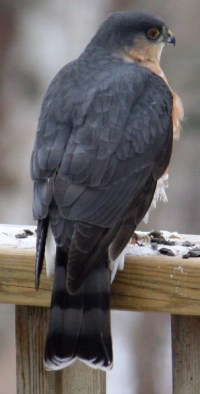
            The sharp-shinned hawk glides in on silent wings. He sits on top of the hydro pole and surveys his empire. Bored, he takes a step into space and drops the weight of his body onto the gangplank of the fragile air. He opens his wings and sends his feathered arrow streaking across my garden.

Yesterday morning, the television news anchor talked of another IED attack in Afghanistan and this morning video clips showed thick, heavy smoke rising from a destroyed vehicle. My son’s regiment has been ambushed twice already. He always e-mails me before he calls, but we haven’t spoken for a couple of days now. I hate it when he sets out on patrol to protect those friends who may yet be enemies and lightning strikes so fast over there, often from a cloudless sky.

            The late spring sun carves charcoal lines of shadow. Light dances and reduces the snow to tiny islands of white that float in a rising sea of green blades. What remains of the winter snow is no longer smooth, but dimpled and wrinkled, glowing with a million tiny dots of color. Dew point: an occasional snowflake floats down like a feather.

The mourning doves clamber all over the back porch. They nip at each other, pecking at the black oil sunflower seeds I have scattered. I watch as unmated males perform their aerial displays rising up then descending in a long spiral glide.

The hawk is back. He skims his shadow over the feeder and the doves scatter, merging with the empty husks blown on the breeze of the predator’s passage. One bird flies my way and thumps into the window. I look out: on the porch, the stunned bird twitches weakly, once or twice, then the grey glove bursts into life, spreads its wings, and flaps away. A military robin, nonchalant in the sunshine and bright in his scarlet uniform, steps his sentry duty across the lawn.

The feathered arrow comes from nowhere, makes contact, feet first, lifts the robin and slams him against the ground. The redbreast’s shrill shriek emerges from a beak that shreds failing air. The hawk tightens his grip. I watch the claws clench, the robin’s movements weaken, one pair of eyes glaze over, the second pair throws a defiant light across the garden towards the window from which I watch.

One final spasm, a last quick twitch, and the robin is gone, one wing dragging, borne skywards in the claws of the triumphant hawk.

I open the door and walk to where the killing took place. Feathers and blood mark the spot. Around me, not a leaf moves: the woods are silent.

I gaze around the garden. Beneath the silver birch a large bundle of brown and white feathers flutters in the breeze. A red-tailed hawk, one of our largest predators, lies there motionless. It possesses, even in death, the yellow eyes of a juvenile. I turn its body over with my foot and see the gashes, beneath its left breast, where marauding beaks have punched their way through the white bones of the rib cage into the heart. No wonder the crows were making so much noise earlier this morning.

I walk to the garage, fetch a shovel, and pick up the hawk. Then I carry it to the back step and leave it there while I go inside and make a cup of tea.

As I sip my tea, a flight of pine grosbeaks crowds into the feeder. They are the wildest birds of all. They squat among the light green fists of leaves like Christmas decorations and chatter with excitement. Then they descend to the feeder in waves. They lock claw to claw in aerial combat and rise in frantic displays to fight over their food.

           
What shall I do with the hawk? I can’t just throw the corpse into a plastic bag and leave it for the garbage men. I’ll have to dig yet another grave and bury it in the trees at the garden’s foot near the spot where once I planted the ashes of my wife and daughter to keep them close.

           
I go to the garage and exchange the shovel for a spade. The ground’s still a little bit hard, but I’ll be able to scratch a shallow grave for the hawk, a scrape, if nothing more. It will be enough to keep the neighbor’s cat at a distance and to deter stray dogs.

When I return to the kitchen, dots of refracted sunshine spin out from the sun-powered crystals that turn in the window. They cut through the heavy air that the hyacinths weight with their redolence. The soft white flowers of the cyclamen respond to the dancing points of light and the curved edges of its veined leaves soak up the sun. Redpolls clamor at the feeder. They are random, like thoughts, and completely untamable.

“Never two without three,” I think as I sit at the window and watch them dance.

The telephone breaks suddenly into life. I jump to my feet, catch my breath, and place a hand over my heart. A hard lump rises in my throat and my mouth twitches into a grimace as I reach for the phone.

The bare bones of the story are visible from the start. Yet the balance still isn’t right. Hawks, doves, crows, grosbeaks, redpolls: there are just too many birds and bird species. As a result, the essence of what might be a story is cluttered and fails to stand out. I tried to rewrite the story on several occasions, but at this stage I was unable to pinpoint the faults. They were still present in the second version in which I expanded the situation in Afghanistan. That second version didn’t convince me either: and if I cannot convince myself, how can I convince a reader? It is still wordy. It still lacks sharpness.

           I left the story for nearly a year. During this time I thought about it, re-read it, shuffled the words around, and then abandoned it. I had read it at least twice in public, but my readings hadn’t convinced me that this was the tale I wanted to tell, written in the way I wanted to tell it. I abandoned it. But there were episodes that I really liked. I revisited those episodes and determined to turn them into poems. Here they are, sharper, cleaner, more focussed.

Sharp-shinned Hawk

She surveys her empire
from a tall tree then steps
into space and plunges her
body’s weight into fragile air.

A feathered arrow, she makes contact,
feet first, and pins the unsuspecting robin
to the ground. His shrill shriek emerges
from a beak that shreds failing air.

The hawk’s claws clench
as her victim’s movements weaken
and his eyes glaze over.

One final spasm,
a last quick twitch, and the robin is gone,
one wing dragging, borne skywards
in the hawk’s triumphant claws.

Passerines

Light dances and reduces spring’s snow:
tiny white islands floating in a rising sea of green.

The late spring sun carves charcoal lines of shadow.
What remains of the winter is no longer smooth,
but dimpled and wrinkled,
glowing with a million tiny dots of color.

Dew point: occasional snowflakes
float down — feathered parachutes.

Dots of refracted sunshine spin out from the sun-
powered crystals that turn in my window.
They cut through the heavy air that the hyacinths
weight with their redolence.

The soft white flowers of the cyclamen
respond to the dancing points of light,
the curved edges of its leaves soak up the sun.

Returning passerines clamor at the feeder.

They are random, like thoughts,
flighty and totally untameable.

Crows

Masters of the airways,
they ride the skies,
fingertips spread to grasp
handholds of air
only they can feel.

Tribal, territorial,
they mob a hawk

spearing and stabbing
till the hawk body
tumbles to the grass.

Beneath its still warm wing,
sharp beaks broke bone bars,
laid bare the intruder’s heart:

a murder of crows.

            As I converted prose to poetry, some interesting things happened. First, with the exception of one possessive adjective, my window, I have withdrawn the narrator from the poem. The birds are the central characters. They are the poem. Second, the poem has sharpened each chosen moment and allowed the reader to focus on a single event. Third, the outside narrative has been abandoned completely. Whether it be good or bad, this is poetry: a narrative cut down to its most intimate and challenging moments. This poetic skeleton served as the framework around which I again rewrote my tale, a tale that has now been shortened to 675 words.

Fear of the Hawk (2016, 675 words)

The hawk glides in on silent wings. He sits on top of the hydro pole and surveys his empire watching for the slightest weakness. Bored, he takes a step into space and drops the weight of his body onto a gangplank of fragile air. He opens his wings and speeds the feathered arrow of his passing across Frank’s garden.

CBC reports another incident. This time, Frank’s son’s regiment is involved. The boy hasn’t e-mailed his father for seventy-two hours now and Frank’s worried about him. The father thinks of his son making all those patrols among today’s smiling friends. These friends may well turn out to be tomorrow’s scowling foes. Frank knows that every day something bad may be coming, but neither he nor his son knows how or when.

Outside in Frank’s garden, the morning sun carves charcoal lines of shadow. Light dances and reduces the snow to tiny islands of white that float in a rising sea of grass. What remains of winter is no longer smooth, but dimpled and wrinkled, glowing with a million tiny dots of color. From the cloudless sky, an occasional snowflake parachutes down, cross-wise, like a feather.

A military robin, nonchalant in the sunshine and bright in his scarlet uniform, steps his sentry duty across advancing grass.

The predator comes from nowhere, makes contact, talons first, lifts the robin, and slams him into the ground. A single prolonged shriek emerges from the robin’s beak. The sharp-shinned hawk tightens his grip. Claws clench, the robin’s movements weaken and his eyes glaze over. The hawk’s eyes throw a defiant light challenging the space before him. One final spasm, a last quick twitch, and the robin is gone, one wing dragging, borne skywards in triumphant claws.

Frank opens the door to the garden and walks to the killing field. A white tail feather and several bright beads of blood mark where the robin surrendered his life. Silence reigns around the place of execution.

A flutter of feathers beneath the silver birch catches Frank’s attention.  A red-tailed hawk lies there with the wind ruffling its plumage. Frank walks to the bird and turns its body over with his foot. He examines the gashes beneath the left wing where the crows’ marauding beaks have punched their way through to the white bones of the rib cage and into the heart. No wonder the crows were making so much noise earlier this morning, he thinks.

He walks to the garage, fetches a spade and places the blade beneath the corpse. Then he carries it to the back porch and sits down beside it on the step while he talks to the hawk. What shall I do with you? I can’t just throw your body into a plastic bag and leave it for the garbage men, or can I?  No, I’ll have to dig another grave and bury you in the garden.

Frank has buried so many bodies at the garden’s foot. When he lost his wife and daughter to a highway tractor that swerved into the vehicle they were driving, he scattered their ashes beneath those trees. He still prays there daily and tells them all the news. Burials: he’s done them before and he’ll do them again. He thinks of his son and the lack of emails. He hopes all is well, but he fears that any day now he may receive that fatal call.

The ground’s still hard, but he’ll be able to scratch a shallow grave, a scrape, if nothing more. It will be enough to keep the neighbour’s cat at a distance and to deter stray dogs. Never two without three, he thinks as he walks to the garden’s foot and starts to dig.

The digging done, he returns to the back porch and sits on the step. From there, he watches the sunlight playing touch and go with the early ovenbirds that scratch among the dead leaves.

Somewhere, high above, another hawk casts its shadow across the lawn.

Inside the house, the telephone shrieks like a dying robin.

The creative process is strange. It takes us over and we are totally absorbed as we become engaged in the story, the poem, the act of creation.  I am sure some readers  will really like Empty Nests; in fact, I know they do. I have received positive commentaries on that early story. Other readers and listeners, for I have read the story in public on a couple of occasions, have expressed their enjoyment of When the telephone rings. I published the three poems in a chapbook entitled Triage (2015) and they and the book were quite popular. For now, I will leave Fear of the Hawk in its current form. I do not know where it will take me next.

The main point of this exercise is to re-frame the question: are we writers or re-writers? I claim the title of re-writer for myself. A secondary point is to examine the creative / revision / re-creation process as I envisage it. For me, all writing is experimentation, a search for the right words in the right place at the right time. But now, at the end of this stage of the process, another question arises: how do I know when the story is finished? My guess is that the answer to this question varies with each one of us. In my case, I feel that, with this particular set of writings, I have reached closure. I have no more to say at this point in time. I am happy with what I have now accomplished and I have no deep-seated feeling that this particular work is unfinished and that the show must go on. The three poems are published and complete in themselves: I am happy with them. I am also happy with this final version of the story … except for that last line. I must revisit that very last line. I think it can be even stronger.


Bistro 9 Flash Fiction

Grave Expectations

For Tanya Cliff

https://postprodigal.com/2016/06/27/curdled-milk-in-burning-hands/

IMG_0051.jpg

“Good evening, ladies and gentlemen. Thank you for being here tonight”

Jerry took a sip of water from the glass on the lectern. The hand that held his speech shook and the sheets of paper whispered like reeds in the breeze. He cleared his throat.

“My eldest brother, Eric, is according to many, and judging from the prestigious teaching awards he has won, a fabulous teacher. Part of his skill has been to involve the learner in the act of learning to such an extent that the subject learned becomes part of the learner’s life-style. Teaching and learning then become an act of love in the course of which learners reshape and rethink themselves. This reshaping does not come in a narcissistic imitation of the teacher, but in an act of self-discovery which releases and hones latent talent.”

Jerry looked up from his pages and glanced around the room, trying to catch the eyes of as many as would look at him. Some stared at the remains of food on the table, others gazed up at the ceiling or shuffled their feet.

“My second brother, Phillip, is named after our grandfather who was an outstanding professional athlete.”

A murmur of interest slid around the room. Jerry watched as several heads nodded in appreciation.

“Phillip, my brother, was a reasonably good rugby player who turned into an exceptional coach. He coached at all levels: junior high school, high school, club, junior and senior provincial, regional, the national championships, and even internationally. His teams won regularly both in leagues and play-offs at the provincial and regional level. He was also an instructor of coaches and for nearly 20 years all the area rugby coaches at Levels I and II (National Coaching Certification Program) were taught and assessed by him. In addition, he worked in administration and was the president of the provincial rugby union for 6 years.”

A soft sigh greeted these words, the letting out of a gentle breath.

“I am the third brother, the academic, the one who won scholarships and was the first of our family to go to university.

Jerry raised his voice at this last word and, owls on a branch, the guests at the nearest table nodded their heads.

“I am also the only one to go on to graduate school and earn an MA and a PhD. Throughout my academic career I received national and international recognition for academic publications and have been an editor, an associate editor, an assistant editor, an editorial assistant, a book review editor, and a proof reader. I currently sit on 2 editorial boards in Spain, 1 in the USA, 2 in Canada. This editing has gone hand in hand with research and publishing as anyone who has consulted my books, my online Bibliography and data base, or one of my 70+ peer-reviewed articles will know.”

Jerry took another sip of water. Two tables away, the guests sat with their eyes shut, meditating. At another table, a man with a long white beard that flowed over his chest breathed deeply, head down.

“My youngest brother, Peter, is quite possibly the best of us. He is the dreamer, the poet, the writer. He has won several writing awards and has written and published 8 poetry books, 9 poetry chapbooks, and 12 short stories. Lately, he has produced a score of films and videos. He loves working in multi-media and has built two web-pages packed with audio-visual displays in which photos and videos stand beside poems in a series of expressions which he calls video poems and photo poetry.”

Jerry turned the page. He sensed a bored restlessness in the audience’s slow adjusting of body angles, in their shuffling of feet.

“My parents would have enjoyed tonight’s celebratory dinner and tomorrow’s ceremony, but unfortunately, they cannot be here. They passed away some twenty years ago. My brothers would have loved to have been present, but alas, that too would be impossible. My older brother, Eric, was still-born. Phillip and Peter died at birth.”

Heads jerked up, glazed eyes brightened. The audience sniffed as they sensed a fresh wind carrying revelation and scandal.

“Although they died in the flesh, their spirits have never left me. Eric’s spirit represents my career as a teacher: I dedicate it to him.”

Some of the guests put palm to palm in light applause.

“Phillip’s spirit represents my adventures in sport and coaching: I dedicate them to him.”

Jerry emphasized the last word and the audience responded.

“My academic and research career, for better or for worse, is my own.”

The audience clapped and one man stood, only to be pulled down by the woman beside him who tugged at his sleeve.

“Peter’s spirit represents my creative side: I dedicate my creativity to him. I have thought about the lost potential of these three brothers of mine every day of my life. Their presence has never left me. It has been a privilege to incorporate their three different spirits, personalities, and work ethics into this unique life with which I have been blessed.”

Spoons tinkled against cups.

“I would like to thank you, the members of this university community, for permitting me to work here for so long.”

A murmur of appreciation rose from the audience and body positions were again re-adjusted.

“You have given me the space and freedom to express not one, but multiple personalities and talents: researcher and teacher, athlete and coach, academic and editor, and last, but by no means least, creative artist in image and word. I would also like to thank my nominator and the Board of Governors, who unanimously approved my nomination. I look forward to receiving the honorary status of Emeritus Professor which you will so kindly confer upon me tomorrow.”

The audience, sensing an ending, stamped their feet and tapped open palms on the tables.
“Well deserved.”
“Well done.”
“Hear, hear.”

“In honoring me, you honor my parents and my brothers, whose spirits continue to thrive and work within me. You also honor my wife and my daughter who have played such an important role in keeping me balanced, committed, healthy, positive, productive, and, in spite of the occasional insanity of the world around me, sane. Thank you all. And to all a goodnight.”

The audience struggled to its feet and former colleagues touched Jerry’s arm as he walked from the podium back to his table. He sat down and took a sip of water. As he glanced around him, he took in the mad babble of voices, the swirls of divergent conversations, and realized, sadly, that nobody had understood, really understood, a word that he had said.


Bistro 8 Flash Fiction

Fear of the Hawk

IMG_0085.JPG

The hawk glides in on silent wings. He sits on top of the hydro pole and surveys his empire watching for the slightest weakness. Bored, he takes a step into space and drops the weight of his body onto a gangplank of fragile air. He opens his wings and speeds the feathered arrow of his passing across Frank’s garden.

CBC reports another incident. This time, Frank’s son’s regiment is involved. The boy hasn’t e-mailed his father for seventy-two hours now and Frank’s worried about him. The father thinks of his son making all those patrols among today’s smiling friends. These friends may well turn out to be tomorrow’s scowling foes. Frank knows that every day something bad may be coming, but neither he nor his son knows how or when.

Outside in Frank’s garden, the morning sun carves charcoal lines of shadow. Light dances and reduces the snow to tiny islands of white that float in a rising sea of grass. What remains of winter is no longer smooth, but dimpled and wrinkled, glowing with a million tiny dots of color. From the cloudless sky, an occasional snowflake parachutes down, cross-wise, like a feather.

A military robin, nonchalant in the sunshine and bright in his scarlet uniform, steps his sentry duty across advancing grass.

The predator comes from nowhere, makes contact, talons first, lifts the robin, and slams him into the ground. A single prolonged shriek emerges from the robin’s beak. The sharp-shinned hawk tightens his grip. Claws clench, the robin’s movements weaken and his eyes glaze over. The hawk’s eyes throw a defiant light challenging the space before him. One final spasm, a last quick twitch, and the robin is gone, one wing dragging, borne skywards in triumphant claws.

Frank opens the door to the garden and walks to the killing field. A white tail feather and several bright beads of blood mark where the robin surrendered his life. Silence reigns around the place of execution.

A flutter of feathers beneath the silver birch catches Frank’s attention.  A red-tailed hawk lies there with the wind ruffling its plumage. Frank walks to the bird and turns its body over with his foot. He examines the gashes beneath the left wing where the crows’ marauding beaks have punched their way through to the white bones of the rib cage and into the heart. No wonder the crows were making so much noise earlier this morning, he thinks.

He walks to the garage, fetches a spade and places the blade beneath the corpse. Then he carries it to the back porch and sits down beside it on the step while he talks to the hawk. What shall I do with you? I can’t just throw your body into a plastic bag and leave it for the garbage men, or can I?  No, I’ll have to dig another grave and bury you in the garden.

Frank has buried so many bodies at the garden’s foot. When he lost his wife and daughter to a highway tractor that swerved into the vehicle they were driving, he scattered their ashes beneath those trees. He still prays there daily and tells them all the news. Burials: he’s done them before and he’ll do them again. He thinks of his son and the lack of emails. He hopes all is well, but he fears that any day now he may receive that fatal call.

The ground’s still hard, but he’ll be able to scratch a shallow grave, a scrape, if nothing more. It will be enough to keep the neighbor’s cat at a distance and to deter stray dogs. Never two without three, he thinks as he walks to the garden’s foot and starts to dig.

The digging done, he returns to the back porch and sits on the step. From there, he watches the sunlight playing touch and go with the early oven birds that scratch among the dead leaves.

Somewhere, high above, another hawk casts its shadow across the lawn.

Inside the house, the telephone shrieks like a dying robin.


Bistro 7 Flash Fiction

Discards

IMG_0143.JPG

Toni walked in, scowling, and strode straight up to Nando who leaned against the bar with a glass in his hand.
“You son of a bitch,” he said and swung his fist. One of the patrons, an ex-bullfighter quick on his feet and even quicker to spot a threat, stepped between them.
“Enough!” He shouted as he parried the blow.
“Are you mad?” Nando put his drink down on the bar.
“Me? Mad?” Tears ran down Toni’s angry face and his breath came in short, sharp gasps. “You’re the one who’s mad. You’re the one who’s screwing her.”
“Screwing who, for God’s sake?”
“Raquel, dammit. You know: my girl. What are you doing here anyway? Waiting for her?”
“Waiting my turn; like everyone else. And I expect they’ll call my number pretty soon.”
“You got a ticket?”
“Of course. I always get a ticket. Why?”
“Because I want her before you get her. Here, give me your ticket.”
“No way.”
“I’ll buy it off you.”
“No way.”
“Why don’t you dice for it?” The ex-bullfighter sensing the possibility of both a truce and a bit of fun broke into the conversation. “I’ll be the judge.”
“Cards?” Nando raised his eyebrows.
“Done,” Toni dabbed at his face with a grubby hanky. “But win or lose: you’re still a son of a bitch.”
“Not if I win.”
The crowd made room for the two men at the bar and Nando asked for a green cloth and a pack of cards. Shuffle and cut. Deal. Frowns and smiles. The patrons looked on in expectation and shouted and groaned with each discard. Every so often, a number was called out and a man stood up, gave his ticket to the barman, handed over some money, and went upstairs.
They played the best of seven hands. Tied at three hands each, sweat drops beaded down both their faces. The ex-bullfighter roared approval with every card and checked each discard. The patrons crowded round shouting their approval in bullfighting terms.
“¡Música! ¡Olé!” They chorused as they clapped their hands and stamped their feet.
“Number 69,” the barman roared.
Nobody moved and a silence fell over the room.
“69,” the barman’s voice repeated, a hard stone cast into the silence.
“Well, I guess that’s me,” Nando rose to his feet, put his hand in his pocket, and drew out his number.
“Son of a bitch …” Toni’s voice rose above the uproar. “I’ll get you for this!”
“”What’s it all about?” A new bass voice rose above the crowd noise. “What’s happening here?” Pedro, the owner stood behind the bar, beside the barman.
“I’m next. That’s all.” Nando waved his ticket.
“He wants my girl,” Toni screamed. “I’ll get him … ” Toni struggled through a sudden thicket of arms to get at Nando.
“And who’s your girl?” Pedro’s deep bass voice rose up and conquered the room.
“Raquel,” Toni stood there, defiant.
“Raquel?” The owner of the deep bass voice sounded incredulous. “Raquel? Raquel!” He shouted. “Raquel, get your ass down here.”
Silence.
All eyes turned to the staircase behind the bar.
A beautiful, dark-haired, brown-eyed woman walked slowly into the room.
“This Raquel?” The owner’s voice shuddered in disbelief. “My wife? The woman carrying my child?”
Toni and Nando stood there, staring eyes, mouths open.
“Get out,” the owner said. “I never want to see either of you here in my bar again.”
He drew a battle-field green Glock 21 from an inside pocket, pointed it at them, and shouted: “Run!”
Toni and Nando ran from the bar, their tails between their legs.


Bistro 6 Flash Fiction

Crazy Glue

Late last night, a fallen star grazed by the lamp-post. A bouquet of golden sparks flew from an iron tree and sanctified the gutter. The gas lamps sputtered patiently in uniform rows. A scarecrow stuttered into the limelight and shook my hand. She was wearing my grandmother’s Easter bonnet, with all the flowers renewed, but she couldn’t keep my heart from last winter’s left over crumbs. Suddenly a tulip thrust through the concrete. It became as red as a robin and flew into the lounge bar of a public house. The bronze leaf necklace circling my throat filled with a flow of springtime song. My heart stood upright, a warped piano in my breast, and my skeleton tarried at the corner to play knuckle-bones with the wind. Torn butterflies of news fluttered round and round and kissed my eyelids when they closed. Yesterday’s horoscope winked its subversive eye and called to the hermit in his lonely cell: “Look out for the stranger with the tin can alley smile. Tie your heart to the tail of the first stray dog that comes whistling down the street and follow it home to the empty house that breathes in and out, moving thin membranes of memory.”

IMG_0167 2.JPG
That’s where I now live. Upstairs, downstairs, a lonely route I tread while the wind at the window scratches tiny notes. Something breaks loose in the confines of my mind and walks beside me. My twin brother stalks through this silvery sliver of splintered glass, this simian mirror wrinkling our troubled suits of skin. I glimpse the old moon’s monkey face through a broken window. Jagged and thin, it wanders like an itinerant snail, cobbled with clumsy clouds. Once, I descended the playground slide in a shower of sparks. A vagabond in a paving stone sky, I rumbled across metal cracks, a knapsack of nightmares humped on my old man’s back. Tell me: when the snail moves house, who stores the furniture he leaves behind? The hermit crab lurks naked on the beach, seeking new lodgings. Who killed the candle and left us in darkness?

IMG_0186.jpg
Two eyes in limbo watch me roll this snowman’s belly of flab across an unknown, clouded room where yesterday I got lost in the mirror. I know how to swim, but I would have drowned, except the light was too shallow and my feet touched bottom when I let the wheels down. I swam on and in looking for a deserted island on which to build my idle sand castle dreams. Two people said they saw my reflection swimming like a goldfish in the silver of that secret space. They said I stared back out at them with circles of longing ringing my eyes; but I laughed when they said they had seen me, for when I looked in the mirror this morning to shave, I just wasn’t there. My razor dragged itself over an empty space and its sharpened blade scraped white music from the margin of a cd rom that spun on edge like dust rings round a vanished planet. Now there is a black hole where my passport photo used to thrive. Someone plucked me from the circle and cut me out in the dance last night. Today I’m looking for a scrapbook in which to stick myself with crazy glue that never, never, ever comes undone.

Bistro 4 Flash Fiction

CJ


            Tom knocked on the hotel room door and Dick opened it. He took a pace back and whistled. “What have you done?”
“Isn’t she a beauty?” Tom’s hand twisted into the waist of her skirt as if he were afraid she’d fall over without his support.
Tom and Dick helped her into the hotel room.
“What’s your name, darling?” Harry came out from the bathroom, wearing only his shorts. “You’re a cutie.”
The girl half-stumbled and Tom held her steady while Dick took the bottle from her. Old, and slightly dusty, it had an air of quaint respectability that belongs only to genies or expensive liqueurs.
Dick put the bottle on the bedside table. Tom held the girl, from behind, by the arms, and Harry started to unbutton her blouse. Harry kissed her full on the lips. She showed no sign of resistance, not even when Harry thrust his tongue into her mouth.
“What’s her name?” Dick asked.
Tom shrugged and pointed to a tattoo on the girl’s wrist where the initials “CJ” faced off against a crimson heart around which a large worm-like creature curled.
“Are you CJ?” Dick questioned her and she nodded.
“Op-p-p-pen the bot-t-t-le,” she whispered.
“All in good time,” Dick took her by the hand and led her towards the bed. Tom and Harry looked at each other and started to laugh.
“Oh boy, is this our lucky day,” Tom went into the bathroom and brought out three glasses.
“Only three?” Harry asked.
“She’s out of it,” Tom nodded his head.
“It’s mezcal, isn’t it?” Harry shook at the bottle. “Look: it’s got three worms in it, one for each of us.”

* * *

Later, the three boys sat in front of the television to take in the football game. They sipped at the large glasses of yellow liquid they held in their hands.
CJ lay on the bed, naked, oblivious. Her lips moved as if she were praying. On her arm, the tattoo had changed shape. The worm, uncurling, now flowed into a single word: bruja.

IMG_0140 3.JPG

* * *

“First and goal!” The boys stared at the screen. Behind them, the bottle on the night table started to shake.
“Second and one!” The boys were bewitched by the game. Behind them, the bottle on the table grew in size and the three yellow worms that had been sleeping at the bottle’s bottom, swelled with it, and slowly swam to the top of the yellow liquid.
“Third and one!” The boys were besotted, their eyes glued on the tv screen. Behind them, the three worms emerged from the bottle and stood on the hotel room floor, dominating the room, a trio of unspoken elephants.
“Go, go, go!” The three boys raised their arms.

IMG_0136.JPG

* * *

The room stands empty now.
CJ has gone. She has been returned to her own room where she is guarded by two enormous presences that have cleaned and bathed her wounds. They have blessed her with their twin gifts of wholeness and holiness and now they are allowing her forgetfulness and sleep.

* * *

In that other hotel room, the screen door to the balcony lies open. On the ground five stories below, three male bodies lie. Sirens wail. The police cordon off the area. Ambulances arrive, sirens wailing.
Above them in the room, a yellow presence scours the surroundings, devouring all evidence of CJ’s sloughed skin.

* * *

On the sleeping girl’s wrist, the initials “CJ” face off against a crimson heart besides which three large worm-like creatures stand on guard.

* * *


Bistro 5 Flash Fiction

Clematis

The clematis unfolds bruised purple on the porch. Beneath the black and white hammers of ivory keys, old wounds crack open. A flight of feathered notes: this dead heart sacrificed on the lawn. I wash fresh stains from my fingers with the garden hose while the evening stretches out a shadow hand to squeeze my heart like an orange in its skin. Somewhere, the white throat sparrow trills its guillotine of vertical notes. I flap my hands in the air and they float like butterflies, amputated in sunlight’s net. The light fails fast. I hold up shorn stumps of flowers for the night wind to heal and a chickadee chants an afterlife built of spring branches.
Pressed between the pages of my dream: a lingering scent; the death of last year’s delphiniums; the tall tree toppled in the yard; a crab apple flower; a shard of grass as brittle as a bitter tongue at winter’s end. I know for sure that a dog fox hunts for my heart. Vicious as a vixen, the fox digs deep at midnight, unearthing the dried peas I shifted from bowl to bowl to measure time as I lay in bed. I sense a whimper at the window, the scratch of a paw. I watch a dead leaf settle down in a broken corner and it fills me with sudden silence.
Midnight stretches out a long, thin hand and clasps dream-treasures in its tight-clenched fist. The lone dove of my heart flaps in its trap of barren bone and my world is as small as a pea in a shrunken pod. Or is it a dried and blackened walnut in its wrinkled shell of overheating air? Sunset, last night, was a star-shell failing to fire. Swallows flew their evensong higher and higher, striving for that one last breath lapped from the dying lisp of day. Its last blush rode red on the clouds for no more than a second’s lustrous afterglow.
I lower the delphiniums, body after body, into their shallow graves. Night’s shadows weave illusions from earth’s old bones and rock becomes putty, malleable in the moonlight. Midnight readjusts her nocturnal robes and pulls bright stars from a top hat of darkness. Winged insects with human faces appear with the planets and clutter the owl’s path. Night swallows the swallows and creates more stars. The thin moon hones its cutting edge into an ice-cold blade.

Bistro 3 Flash Fiction

Blind Date

You couldn’t see the holes the doctor drilled in my head when he thought he was a woodpecker. You were oblivious to the bland, black splinters sprouting from my fingers and my neck. Unseen and unheard, the ladder-back drowsed its feathered siesta as peace descended to the cluttered attic of my mind. When push came to new love, the bluebird couldn’t find the old silver ring I borrowed from the curtains. How could you care about its failure to sparkle in the sun? When you ran your fingers through my hair, you cut yourself on a feather’s edge and my shirt rose up in the air and flapped with sudden writing, as red as blossoming flowers. You sensed their crimson dampness, but couldn’t see the petals turning skywards to a pallid moon. The clockwork mouse ran down the tower. The clock struck the chaos of a universe at sixes instead of sevens and we knew we two would never be one. You tapped with your white stick on the sidewalk, but before you drove away, you told me to keep my pity for falling leaves, for sparrows in winter, and for the defenseless chickadees who quest at the feeder and leave in fear of the kitchen cat with her dogged stealth: a game of paws and pause, crisp and silent through the green hair of the grass.

Bistro 2 Flash Fiction

Bistro

LJ sat at a table in a dark corner of the Bistro. He held a plastic bag in his hands and moved what looked like dried brown fava beans, one by one, through his fingers. A priest at prayer, his lips moved in a silent mantra as he counted the beans: ” … twenty-seven, twenty-eight, twenty-nine.”

Robin and Will watched him closely, looking for the telltale signs that would announce LJ’s return to his former life.

Same-sex couples danced through the Bistro. They avoided this one corner that formed an oasis of severity amidst the gaiety and noise of Carnival celebrations.

“How much does he remember?” Robin looked at Will.

Will shrugged and the two men exchanged worried glances.

A whooping conga of men dressed in garish, feathered costumes that revealed more than they concealed, approached the table where the three friends sat. The conga came to a stop in front of them.

“Now what have we here?” The leader asked. He turned to his followers flashing a white, toothy smile.

“Let’s see what you’ve got, darling,” he reached towards LJ’s plastic bag.

“Don’t touch him,” said Robin, rising to his feet.

Three large men broke away from the line and two grasped Robin while the third put his arms on Will’s shoulders and held him in his chair.

“I’m warning you,” Robin said.

“Shut it,” said the leader.

LJ closed the plastic bag that held the twenty-nine fava beans and put it in is breast pocket, next to his heart.

“Don’t put them away, darling, they look delicious,” the leader grinned his enormous grin. He was a big man, not tall, but broad and heavy. “Give them to me, I want to eat one. C’mon, I’ll just pop it in my mouth and suck it.”

The Conga crowd roared their approval.

LJ got to his feet. He was a small man, but wiry. The night-fighter, they had called him. He was the one who slipped out at night through enemy lines and knifed the sentries. One hand over their mouths, one hand on his knife, all sounds extinguished till they relaxed, lifeless, then that one quick twist of the knife and the ear-lobe severed as the dead man was lowered to the floor.

“Wanna dance?” The conga leader wiggled his hips and ran his tongue over his lips, then puckered a little kiss.

LJ’s face turned red, the veins engorged, and his eyes stood out. Nobody saw him move, nobody ever saw LJ move. He grasped the Conga leader’s windpipe with his left hand and drew him forward until they were locked eyeball to eyeball. LJ’s night-fighter knife lay flat across the man’s jugular.

“LJ, no,” Robin screamed. “Not thirty.”

LJ kept staring at the man he held. His knife disappeared.

“You’re not worthy,” he said, leering into the Conga leader’s purpling face.

Will and Robin breathed a sigh of relief.

Bistro 1 Flash Fiction

Babs

It was March the First, St. David’s Day.

Babs held the cat in her arms. The vet slipped the needle into the shunt he had inserted into the animal’s paw and the tiny wind of life gusted from the cat’s fragile body. The struggle ceased. The cat’s head settled and her tongue protruded, just a little, in that beloved and well-known gesture. It was all over.

Babs had found that lump, hard, but smaller than a pea, on New Year’s Day. The next day, she carried the cat to the vet where they took blood samples and ran tests. The vet’s assistant called later that afternoon. A lymphoma, she said, small but deadly. Steroids might help. They would give the cat a 40% chance at a life that would get more difficult, in spite of any known treatment. The alternative was to bring her back in and put her down now, that very afternoon. Babs looked at the cat: highlights strayed through her fur and her bright eyes sparkled like sunshine on a lake.

Throughout January the steroids went in and the cat glistened and grew fat. At first, Babs saw no sign of the lump but by Robbie Burn’s Day it was back. Babs started to count the days: January 31, February 2. The lump grew larger.

Three years before, on Valentine’s day, Babs had salvaged the cat from the SPCA where she languished, abandoned in a cage. The cat was a stray, half feral, taken in from the streets and subject to who knows what sort of treatment and feeding in its infancy. Babs wondered if it was in those days of neglect that the cancerous seed took root? Or did those seeds come later, when the cat wandered the garden and fed off the wild life, mice and voles, and drank from the streams that flowed through the killing fields with their fertilizers, their weed killers, their nutrients, and their poisons?

“What are we doing to ourselves,” Babs wondered as she sat at the kitchen table and sipped a cup of tea. “Was my cat the canary in my coalmine, doomed to warn me of what’s to come? Will my own system be invaded then poisoned with cancerous growths? Will I be subject to that stumbling, downward road that leads in the end to an inevitable death?”

She lay awake that night alone in the bed wondering in what ways cancer might ravage her body. How long would chemotherapy keep her alive? Who would be there for her, who would hold and comfort her, who would slip that releasing needle into her veins when her time came?

Babs ran her fingers over her body as she imagined herself sliding day by day down that slippery slope that leads to the grave. Then she caught her breath, her heart raced, and her blood turned to ice as her fingers tripped against the colony of killers: three small hard lumps that nested in her soft breast.