Double Trouble

IMG_0473.jpg
Double Trouble
“I’ll need some ID,” the guy selling Fred a new cell phone said. “Something with a photo on. May I see your driving license?”
“Of course,” Fred pulled out his driver’s license.
The salesman took it, glanced at the picture, walked over to the computer, and started to type in numbers. Fred watched him as he nonchalantly punched the keys. Then Fred saw him stiffen and straighten up as he held the license up to the light, double-checked it, and frowned.
“I’m sorry, sir,” the salesman said, looking very sad. “This license has expired. It’s more than two years out of date.”
“You’re joking,” Fred said
“No sir,” the salesman replied. “This license expired two and a half years ago.”
He handed it back to Fred who also checked it with care. At first, the figures seemed blurred. Fred took out his glasses and put them on.
“You’re right,” Fred said. “It is out of date. I must have the new one in here somewhere.”
He started to rummage through all the plastic cards in his wallet. But there was no new driving license.
“I must have left it at home,” Fred muttered.
“They usually shred the old licenses,” the salesman smiled. “They never let you keep them. You must have forgotten to renew.”
Fred placed his hands on the cell-phone counter, looked down, and saw his face mirrored in the shiny plastic. He gazed into his own eyes and they looked back at him. Then his mind flashed back two and a half years.
He had just been through the biopsy, a messy, painful, and unnerving affair, and the results had come back positive.
The urologist demanded a new battery of tests: X-rays, bone scans, blood tests, MRI’s, examinations, more examinations, questionnaires, discussions about possible forms of treatment …
The different treatments were set out like food in a self-serve restaurant and, like the strange foreign foods that Fred liked to try without knowing exactly what they were, their names meant nothing to him.
Then there was the travel: out on the road between his little place in the country and the major cancer hospitals in the province with an examination here, and a consultation over there. All the medical staff he encountered were kind and helpful and the suggestions they offered were sound. The winter road conditions complicated matters, though, and twice he was forced to cancel appointments because of road conditions.
Then, a week or so after the MRI, the allergic reactions set in and, over a three week period he lost all the skin, first off his hands, and then off his feet. He watched the skin bubble, then he saw it go very dry, and then it just flaked off. He remembered getting out of the shower one morning, drying his feet, and staring down at the little pile of flaked-off skin that had come away with the towel.
A little later on, came the injections, the tablets, and that was before the start of radiation treatment …
Now, two and a half years later, Fred’s driving license, the one that should have been renewed on his birthday, had expired. He remembered that birthday well. He lay on his side in the hospital and the specialist drove that first needle into his buttock … what a birthday present. And now, two and a half years later, he had another special gift from that birthday, an expired driving license.
He thanked the cell-phone salesman, put his expired driving license back in his wallet, and said how sorry he was that e would be unable to purchase the cell-phone at this time.
Early the next morning, Fred went down to the Driving License Renewal Center to discover his fate.
The lady on the counter was most sympathetic. She listened to his story and told him not to worry.
“Don’t worry,” she said. “It happens all the time. But I’m afraid you’ll need to take all the tests again, including the road test. That’s the law. I’ll need to see some documentation. A photo ID is preferable. Do you have your birth certificate or your passport with you?”
Fred nodded. He had checked online to see what he needed and had brought all the right documents. He handed the passport over.
The lady behind the counter took the passport, opened it, and looked up at Fred with a sad little smile.
“I’m sorry, sir,” she said. “You are in trouble. Your passport’s expired as well.”
 

Moonshine: FFF


fundy-05-mistwolfepipers-081

Moonshine
Flash Fiction Friday
Friday, 5 May 2017

Here, on the wharf, in Santander, I stand in the shadow cast by the Customs House and gaze at the moon path sketched out over the water. “Over the mountain, over the sea, that’s where my heart is longing to be.” I taste the bitter salt of homelessness and know that I will never belong in this world and that I will never find a place to call my own. Back home, I have a black and white television and a black and white dog. Here I have nothing. Back home, when I am home, I am a latch key kid. My parents leave for work at seven in the morning and my mother gets home about five every night. Those ten hours on my own are mine to do what I like with: but I must account for them. “What did you do today, dear?” And everything I say I do is checked. Did I make the beds? Did I do the laundry? Did I finish the ironing? Did I wash and dry the breakfast dishes? Did I clean the house from top to bottom?

Sometimes I strip and stand in front of the mirror in their bedroom and look at my naked body. It’s not much to look at. Once I stood there with the carving knife in my hand and deliberately cut myself across the ribs, just to feel the pain and watch the blood flow down. Other days I play cards against myself. That way one part of me always wins, but then the self I play against is always doomed to lose. Sometimes I wage battles with toy soldiers, moving them up and down across the carpet in front of the fire. Occasionally, I throw a soldier in the fire, just to watch him perish.

Sometimes I just sit on the back of the settee and press my forehead against the cool window. The rain is cold and cools the window pane. I know the sky is crying and sometimes I think I know why. I’ll go back to my boarding school soon. There, we are taught to be isolated and to live in isolation. The bullies will come and they will bully me. I have not grown much over the holidays and I know they will be even bigger, and even stronger, and even faster. I don’t want to go home. I don’t want to go back to that school. I don’t want to be bullied and abused. The masters cane me and the older boys beat me and the bullies force me to do things, unspeakable things, things that I don’t want to do. I have tried to run away but someone always brings me back and then they beat me for running away. “Don’t be a coward,” they say, “take it like a man.” And I do.

I look across the water. How beautiful is the Bay of Santander beneath the moon. I look up at the hills, at Peña Cabarga, at the hills from whence cometh my salvation. My grandfather walks towards me over the waves. He helps me choose stones and pebbles, helps me to fill my pockets with them. He takes me by the hand and gives me courage. He and I walk down the slip way, hand in hand, and then we walk out across the moon path and into the sea.

CROCODILE TEARS: FFF

img_0184

Crocodile Tears
Flash Fiction Friday
28 April 2017

The crocodile lives in the wind-up gramophone. The gramophone lives in the top room of the house. The boy winds up the gramophone with a long brass handle, round and round, till the spring is tight. A tight spring frightens the crocodile and he sits quietly in his cage. But as the record goes round and the spring loosens up, the crocodile roars and demands to be freed. He’s the Jack that wants to jump out of the box. His long-term dream is to eat up  the witch who looks out of the window and watches the boy as he plays in the yard.

Last week the boy decided to dig. He picked up a spade and dug a deep hole that went all the way down to his cousin in Australia. The little dog laughed and joined in the fun, scraping with his front paws and throwing earth out between his back legs like happy dogs do. The witch in the window cackled with laughter and the rooks in the rookery rose up in a cloud and cawed in reply. Only the boy is able to see the witch and he only sees her when she sits in the window. But he knows she wanders through the house, and the air goes cold when she enters and exits the rooms, especially when she brushes past the boy and sweeps his skin with her long, black gown.

When the boy got tired of digging, he drove the spade into the ground and left it standing by the hole. When his father came home it was well after dark. He didn’t see the hole but he saw the spade. So he didn’t fall in to the shaft of the coal-mine that went down to Australia. No free trip to the Antipodes for that lucky dad. He beat the boy for that, for digging that hole. Then he beat him again for lying: the hole didn’t go to Australia. Australia was too far away and the angle was wrong. The boy laughed when he saw that his dad didn’t know where Australia was.

“Ha-ha,” he laughed. And his dad beat him again, this time for laughing.

Sometimes at night the boy can hear rats running through his bedroom walls. They scuttle and scuffle as they hunt through the guttering. The crocodile growls from time to time in that upstairs room. The witch cackles with laughter. The boy puts his head under the blankets and cries himself to sleep. Sometimes he wishes the crocodile would come and eat up his dad. But he loves his dad like the dog loves his dad even though his dad beats both the boy and the dog. Sudden beatings, they are,  that arrive without warning: hail and thunder from a sunny summer sky.

“Well, you’re not laughing now,” his father announces. “A beating a day keeps disobedience away.  There will be no disobedience in this house.” When the father beats the boy, the dog cowers beneath a chair. The boy hears the crocodile growl and smiles through the tears as he wipes salt water from his eyes.

“Are you laughing at me? I’ll make you laugh on the other side of your face,” the father taunts the son and beats him again.

The crocodile growls. The old witch cackles. The rooks in the rookery rise up in the air and the father’s hair stands up on end like it does when lightning lights up the sky, and thunder rolls its drums, and the sky’s wheels rattle like an old warrior’s chariot whose wheels have not been greased. The veins stand out in his father’s cheeks as the old man raises his hand to the boy.

The old man tells the same old jokes again and again. The boy must always remember to laugh at them as if he had never heard them before. If he doesn’t laugh, his father gets angry. Some of the jokes are good, and the boy likes the one about the Catholic who goes into the bar in Belfast and asks the barkeep if they serve Protestants. Or  is it the one in which the Protestants go into the bar and ask the barkeep it they serve Catholics … anyway … whatever … one night, the boy dreams and it happens like this. The crocodile escapes from the gramophone. The witch hands the boy a leash and a collar and between them they restrain the crocodile.

“Walkies?” says the boy.

The crocodile nods his head and crocodile and boy walk down the street to the Kiddy’s Soda Fountain on the corner.  When the boy walks in with the crocodile, the waitress raises her eyebrows and opens her mouth.

“Do you serve grown ups in here?” the little boy asks her.

“Of course we do,” says the waitress.

“Good. I’ll have a glass of Dandelion & Burdock for myself and a grown-up for the crocodile. Please.”

The witch says grace, the boy sips his Dandelion & Burdock, and they all shed crocodile tears as the boy’s pet crocodile chomps on the fast disappearing  body of the boy’s dad.

Scarecrow

IMG_0085

Scarecrow

Flash Fiction
Friday, 21 April 2017

            Sometimes at night I hear nocturnal animals walking across the lawn outside my bedroom window. Intruders in the garden, they rattle the feeders, walk dark through the woods, and sometimes howl at the coyote moon. My heart pumps sudden blood, rapid, through my veins and toes and fingers twitch as I toss around, restless, in my bed.

            Below me, in the hall, the grandfather clock ticks the night away. I stitch myself up in my dreams, count the black sheep in the family, and iron old ghosts upon the ironing board until they are as flat as the white shirts we wore in boarding school on Sundays.

            If I close my eyes, they rise up before me, those Sunday shirts, flapping their arms, and mouthing their apologies for the sorry life they made me lead. No, I didn’t need to spend those days praying on my knees before the stations of the cross. Nor did I need to ask forgiveness for all the transgressions pulled from me, like teeth, in the weekly confessional.

            Marooned in a catholic cul-de-sac, I went around and around in rigid circles like an academic puppet trapped in the squared circle of an endless syllogism. Who locked me into this labyrinth of shifting rooms where sticky cobwebs bind windows, doors, and lips? Why does the razor blade whisper a love song to the scars crisscrossing my treacherous wrist? Who sealed my lips and swore me to secrecy?  And why?

            A tramp with a three-legged dog, I sleep beneath a pier at midnight and watch the waves rolling up the summer beach to catch me out. Sometimes I steal a deckchair, place it at the edge of the sea and bid the tide to cease its climb. The moon winks a knowing eye and the waves continue to rise. Toes and ankles grow wet with wonderment and I shiver at the thought of that rising tide that will sweep me away to what unknown end?

            Last night I wrapped myself in a coward’s coat of many-colored dreams. My senses deceived me and I fell asleep in a sticky web spider-spun by that self-same moon that hid among the clouds and showed her face from time to time. My fragile fingers failed to unravel all those knots and lashings and I was a child again walking the balance beam that led from doubt to knowledge.

            A thin line divides the shark from the whale and who knows what swims beneath the keel when the night is dark and the coracle slides sightless across the sea? I gathered the loose ends of my life, wove them into a subtle thread, and made myself a life-line that would bind my bones and lash my soul to my body’s fragile craft.

            What could I possibly have dreamed as I paraded the promenade a stone’s throw from the barracuda? I crossed my fingers and the beggar at the gate rolled up his sleeves and bore witness to my penitential wounds.

            “How many times,” he asked, “can you pay those thirty silver pence? Don’t they lie heavy on your eyes and heavier on your heart?”

            “Indeed they do,” I answered. “Yet the debt must be paid, but I don’t know how, and where, and when, and to whom?”

            Carnivorous was the carnival he promised and he turned my small world upside down. With coals for eyes and a carrot nose, a scarecrow descended and devoured my town in a clash of flashing teeth. Beneath the waves, the conga stamped its sudden feet of flame. A sea parrot scraped its red and yellow beak against a rainbow of crusty, feathered rage. I awoke to the dog’s sudden tongue in my mouth: an invasion of salt, saliva, and wet, crumbling biscuit.

            That night I opened a bottle of Scotch and drained it dry. I took no prisoners. Around me, the dead and dying licked their wounds as they sank lifeless to the bottom of the glass.

            “Hickory-dickory-dock,” said the mouse as he ran up the grand-father clock. But that particular clock stopped long ago, at midnight, when the Queen of Hearts tied a dead rat to the pendulum, the house slipped sideways, and my heart was filled with woe.

            This morning, fresh snow. The garden basks white beneath pale sunshine. The back porch bears no footprints. The raccoon has abandoned me and chipmunk and squirrel have turned their backs. Today, the scarecrow will scare those nightmare crows away and not a memory will survive to haunt my waking dreams.

Skeleton in the Cupboard: Flash Fiction


Skeleton

Skeleton in the Cupboard

Spring sunshine and I pull out my old summer coat, the one with its pockets stuffed full of memories and dreams. It hides all winter in the clothes cupboard and I free it each spring with the melting snow and the tiny tongues of grass that push through the winter debris that covers the lawn in early April.

Battered and bruised, its elbows discolored where the dry cleaner’s chemicals left disfiguring splodges, it has served me for twelve long summers. It is my constant warm-weather companion, hanging on my arm, my shoulders, gracing me with its comforting presence. Everywhere I travelled for the last twelve years, it has accompanied me.

It is shabby now and grubby. Wine from the bars in El Rincón, El Rastro, El Portalón, Casa Guillermo and many other landmarks have fallen upon it. Octopus, squid rings, mussels, clams, shrimp, goose barnacles, and various types of omelet have left their marks upon it. The English language, with its fish and chips, its bangers and mash, and its sosi, jegg and chips, all bourgeois meals, can never do justice to the pure poetry of Spanish tapas whose names roll off the tongue: pulpo, calamares, mejillones, almejas a la marinera, gambas a la plancha, percebes, tortillas españolas y vegetales. Here I spot a golden stain from riñones al jerez and there a black one from calamares en su tinta.

Weathered by wind and rain, this coat has climbed El Zapatero and walked with the transhumance herds up and down the old Roman road of the Puerto del Pico. It has followed the Ruta de la Plata, the silver trail that led from South America to Sevilla and up the Silver Road past Ávila to Madrid. It has walked through the house in El Barco de Ávila and seen the kitchen where they tore down a wall and found a walled up library, just like the one described by Miguel de Cervantes in the Quixote. It held books proscribed by the Spanish Inquisition that had been hidden away since 1556. It has walked through Piedrahita, San Miguel de Corneja, and Villatoro. It has walked the streets and squares of St. Teresa’s walled city of Ávila on multiple occasions and knelt with me, in prayer, before many a saint on many an altar.

It kept me warm in the hills around Gredos when the mists dropped suddenly down and turned warm day into freezing night. It accompanied me to the Monasterio de Yuste, where the Holy Roman Emperor, Charles the Fifth, retired to live out his days in prayer. It visited the spice towns of La Vera, and ventured into Garganta de Olla, to walk those ancient streets with me. It walked with me in the birthplace of St. John of the Cross and entered with me the depths of the earth where the verdejo is stored in huge oak barrels deep below the town of La Seca.

This old coat keeps its secrets. It remembers the moon hanging its lantern above the battlements on the Paseo del Rastro. We wandered there, she and I, arm in arm, entranced by the shadows that danced on the Medieval walls. When she shivered, I wrapped her in that coat and still it holds the perfumes of her body, the warm touch of her skin, the enchantment of those magic nights when the world stood still and we lay alone at its centre. Oh, and that green stain, there, at the back: that’s where I lay my coat on the grass in the little park under the walls by El Puerto de San Vicente, the one where the lovers go, late at night, beneath the trees, to be together in their loneliness …

Comment: A long time after posting this story, enlightenment knocked at my door. The new cartoon that I had used to illustrate My Old Coat was called Skeleton. Surely, I thought to myself, given the story’s ending, Skeleton in the Cupboard would make a better title. And it would. And I have changed it. A little bit of serendipity at a time (+3C outside the week after Easter) when I need some sunshine in my life. Any comments on the use (or overuse) of Spanish in this story would be very welcome. Best wishes to all my faithful (and unfaithful) readers.

Crows

IMG_0146

Crows

 1

 “Your head’s bleeding.”
“I know.
“What did you do?”
“Nothing.”
“What do you mean, nothing? How did you get that cut on your head? Did you fall?”
“No.”
“What happened then?”
“I’d rather not talk about it.”
“You have to talk about it. Tell me, or I can’t help you.”
The old man looks at the social worker.
“It was my wife. She hit me with the frying pan.”
“Why?”
“She wanted bacon and eggs and I wouldn’t cook them. So she hit me.”
“What! And what did you do?”
“Nothing. I couldn’t hit her back.
“I should hope not. Where is she now?”
“In hospital.”
“What on earth …. why is she in hospital”
“I wouldn’t hit her. So she stuck her hand in the door jamb and closed the door on her fingers. There was blood everywhere. I called the ambulance and they came and took her in.”
“You didn’t go with her? To get your head seen to?”
“Obviously not.”
“Why not?”
“I knew you were coming. I couldn’t leave the house empty. It was funny though …”
“What was?”
“The crow. He must have heard her scream. He came and perched on that windowsill, right there, and just sat, and looked through the window as she lay on the floor. Then, when the ambulance came, he flapped his wings and flew away.”

2

He moves in closer then he tries to head butt me. I sense it coming, but I’m not quick enough to avoid the blow. It glances off the side of my head and I feel skin break, blood flow.
I step back.
He moves in again and this time throws a punch, a roundhouse swing with his right hand. I catch his wrist, pull him off balance, turn my body, spin on my heel, drag him across my outstretched leg: Tai Otoshi. He doesn’t know how to break fall, and I throw him down heavily, rather than lowering him. Then, I drop with him and, as his head rebounds off the floor, I slam my elbow into his nose and mouth.
He is now bleeding worse than me.
I leave him lying there.
As I walk away, two crows fly into a nearby tree and, heads cocked to one side, stare at him as he lies there.

3

My open-toed sandal catches on one of the nails that the ice forces up through the wood and I hit my head heavily on the back porch even before I realize I am falling.
I put my hand to my head and my fingers come back sticky and wet.
I lie there, stunned, groaning.
A crow flies in, perches in the nearest tree, and sits there, watching me. He caws. Two other crows join him. And then two more. A family of five. I watch them watching me.
Everything hurts. I try to roll over, but cannot.
The first crow flies towards the porch and lands on the balustrade where he sits, head cocked to one side, staring at me.
I slide slowly across the wood. The splinters are sharp. The nails stick up and catch in my clothes.
The crow on the balustrade caws and a second one flaps in and lands feet first, claws outstretched, to join him.
This spurs me into renewed action. I slither awkward across the boards, roll over on to my tummy by the picnic table, and force myself to do a push up. Then I grasp the seat of the picnic table and haul my aching body to the Hail Mary praying position.
I shriek, once, as my body returns to the almost vertical.
The crows flap their wings and fly away.

4

My father once told me how, during police training, a man burst into the classroom, grabbed the lecturer by the lapels of his coat, and tried to head butt him. The lecturer struggled with his assailant. Curses and blasphemies rose high as the two men rocked back and forth locked in combat.
“Stay there. Don’t move,” the lecturer screamed at the class. “I’ll handle this.”
The young recruits froze in their seats.
The intruder left as quickly as he came, cursing, and leaving the lecturer seething. The lecturer took a deep breath, regained his composure, and turned to the class.
“Write down what you have just seen,” he said. “I’ll need you all as witnesses. Use your own words. Don’t talk to anyone.”
There were thirty young recruits in the room and twenty-four different versions of the event.

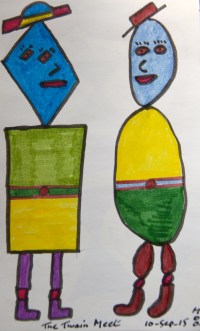
Never The Twain


IMG_0157.jpg

Never The Twain

“And never the twain shall meet.”

This was the chorus that my grandparents often chanted at me when family members started rowing with each other over one trivial incident or another.
“But what happens when the twain do meet,” I used to ask.
“Don’t be silly,” they said. “The twain never meet. Ever.”
But I know very well that they do.
I know.
I’ve seen them together.

Funny things, they are, the twain, and opposites in so many ways. But so nice, in spite of what some people, especially my grandparents, used to say about them.

Not only do they meet, but they can be happy together and very, very friendly.
“Long time, no see,” the twain say, and they often embrace quite warmly with a bunch of flowers held between them.

Mind you, the twain can also be quite awkward and occasionally very abusive towards each other. I remember my mother and father fighting “like cats and dogs” as my grandparents used to say.

Now, my grandparents had a cat. It was black and white and striped like a zebra. They called it Spot. My parents had a dog. It was an English Cocker Spaniel, gold in color, and off-spring to a famous sire, the Six-Shot Woody Woodpecker. They called the dog  Wimpy but it was by no means a wimp and fought with everything in sight, especially the cat.

So when my father and mother fought and the family cat and dog fought, I thought, quite reasonably in my opinion, that the dog (with his short hair) was male and the cat (with her long hair) was female, and that was the reason why they fought like cats and dogs. And “never the twain shall meet” as my grandparents used to say about my mother and father and the cat and the dog.

I guess it was too early to learn about the birds and the bees when, young and all too innocent, I was learning about the cats and the dogs.

And of course it’s only natural that the twain should meet. My mother and my father, like the cat and the dog, had to meet somewhere, didn’t they? How else would I be here? Now, we weren’t the sort of family that practiced contraception by throwing stones at the storks to keep the babies away.

But I could never work out why the cat always had female kittens while the dog had all-male off-spring. That was a bit too much for me, and nobody ever really explained anything I those days.


Fake News!

dsc03693

Fake News

At 10:00 AM today, Saturday, April 1, 2017, Donald Trump, the President of the USA, will sign an Executive Order reversing Galileo’s theory that the Earth moves round the Sun. As of 11:00 AM, thanks to the President, the Sun will once again move around the earth as, in the words of an unnamed source who wishes to remain anonymous, “it always has.”

Late last night the President tweeted:

Earth moves round sun? Fake News. Obama inspired scientist was wrong. SO SAD.

In addition, the President will be setting up two Commissions of Inquiry. The first will be ordered to investigate and establish the Flat Earth Phenomenon.

The President tweeted:

Obama and the Democrats are RWONG. VERY SAD. The Earths Flat. Any one can see that. Look out youre window. SO SAD.

An unnamed source said: “We have known this for a long time. Just waiting for the right moment to announce it. April 1 before mid-day felt good.”

In a third tweet, early this morning, the President asserted:

Just seen sun rise out of sea. Heading for Mar-a-Lago right now. Earth not moving. Have eyes. Can see.

The second Commission of Inquiry will look into the establishment of Coal-fired Space Travel.

Coal-fired space ships. An America Frst American First. Make America Great Again.

An unnamed source stated that “The President said he would put American miners back to work. And he’s a man of his word. Think how much coal it will take to send a space ship into space. Great President. He’ll Make America Great Again. Coal is so clean and so cheap. Democrats under Obama wasted so much money. So Sad.”

At the time of going to press, White House official staff were unavailable for comment.

So Sad.

Whisperer

dsc02478

Whisperer

The bird whisperer, bag of bread crusts in his hand, walks towards that lake I knew so well in my childhood. His friends, the ducks and geese, wait for him to arrive so they can have their breakfast. The whisperer is late today and emerges slowly from the early morning damp and mist.

The whisperer’s friends are hungry and impatient. They leave the lakeside to waddle across the road in a lengthening gaggle, fastest at the front, laggards strung out, straggling behind. When they reach him, the whisperer stops for a moment to greet them. Ducks and geese and traffic stand still as the whisperer pulls the whole world to a halt. Watching him, I remember how, when I was a child, those same sharp bills nibbled at the crusts I held in my fingers as my father rowed our hired boat over the lake’s smooth waters.

The whisperer crosses the road with his flock strung out behind him. Drivers and passengers take photos and videos on their cell phones as the battalion marches on, down the slight slope, back to the waterside where the whisperer scatters crusts and breadcrumbs and throws corn as if it were a shower of stars from the firmament.

Greying skies threaten above dark waters. At lake’s end, above the waterfall, the monument to Scott of the Antarctic pierces the gloom with its fine, white tower. Scott sailed from this city in search of new lands and adventures at the South Pole. Like me and many others he left, never to return.

I look at the bruises that decorate my wrinkled hands. Neither spots nor wrinkles were there when I left that lake behind me, was it really fifty years ago? I view the video on YouTube, shot from an I-phone in a parked car, and my eyes mist over. This was my home, this was the land of my fathers, this was the land of choirs that would always welcome me back with song … yet I no longer go back.

The video is grainy and bears grey threads that mimic the passing clouds. I gaze on that well-remembered lake: there, so many years ago, I swam in its waters, ran and biked along its winding paths, rowed around its edges in and out of the reeds, and fed the lake birds as I floated beside them. I remember all too well the warmth of spring and the joy of the returning sun that strew gold daffodils beneath budding trees.

I see myself reflected in the computer’s screen: my wrinkled skin wraps my shriveled flesh in the same way crinkly paper winds itself round an Easter egg. There is so much inside that binding, so many memories and secrets that dream their lives away inside me. I close my eyes and for a moment I am once more that youthful body flashing its jack-knife blade into those rippling waters …

Evening comes and I stand in a shimmer of moonlight at the garden’s edge, my hands held out to catch a falling star. Alas, I seize only the mutterings of snowflakes strung between the constellations. My scarecrow dream stretches out a long, thin hand and clasps bright treasures in its tight-clenched fist. Inverted, the Big Dipper hangs its question mark from the sky’s dark eyelid. A honking of geese haunts the highway high above me. I swivel from north to south to catch an impression of darkness swift and sudden that blots out the scattered grains of stars.

A finger-nail of rising moon emerges from the trees and hoists itself skywards. The moon hones its cutting edge into an ice-thin blade and the lone dove of my heart flaps in its trap of barren bone. Moonlight and starlight run twin liquors, raw, within me. Stars nearby fade in its brightness. I have built a fire inside the house. When I go back in, my goose quill pen scratches black lines in my journal as I weave words by firelight across a flickering page. Ghosts of departed constellations drown in the nearby river. Pale planets scythed by moonlight bob phosphorescent on a rising flood of memories.

Comment: This would be a “raw poem” were it not a piece of “raw prose”! I found it among my notes late last night and revised it and put it up this morning. It was based on a YouTube video of a man, the bird whisperer, feeding geese at Roath Park Lake in Cardiff, South Wales. When I was a teenager, my family moved from Swansea to Cardiff and Roath Park was a short bike ride from our new home. The Scott Memorial stands at the lower end of Roath Lake, just by the waterfall. Apparently Robert Scott sailed from Cardiff on 15 June 1910 in a converted whaler in an effort to walk to the South Pole. Like me, when I left Cardiff, he didn’t return.

Here’s a link to Robert Scott: https://en.wikipedia.org/wiki/Robert_Falcon_Scott

This is the video on which the piece is based: https://www.youtube.com/watch?v=clbbMt2sl0k

Geese

cropped-15-may-2002-pre-rimouski-020.jpg

Geese

The arrowhead precedes its shaft and leads its feathers into night’s perfection. Summer catches flight and waves good-bye to Arcturus as an obsidian knife flashes black lightning across the icy threshold of a morbid sky. Darkness, swift and sudden, blots out each scattered scat of golden grain and swallows an iris of stars. Inverted, the Big Dipper hangs its question mark from the sky’s dark eyelid.

When daylight breaks cold sunshine over broken ground, the great white geese lay their burdens down by the riverside. Pristine as they drift to the land, flake by fluttering flake, they accumulate the colors of mud daub and anonymity as they grub food from the neat ploughed fields that march their earthen armies across the land. Fallen angels, they sprawl down from heaven and abandon eternity to adopt their waddling time-and-earthbound shapes.

Now, the afternoon gropes steadily to night. Some people have built fires; others read by candlelight. Geese litter the riverbanks with their mud-stained snowdrifts. Freshet mud besmirches them — or is it the black of midnight’s swift advance? The geese step on thin ice at civilization’s edge. Around them, the universe’s clock ticks slowly down. Who forced that scream through the needle’s eye? Night gathers its darkening robes and the seabed reaches its watery arms out towards a magnified moon.

Ghosts of departed constellations drown in the river. Pale planets scythed by moonlight bob phosphorescent on the flood. I walk on the beach sensing the flesh that bonds, the bones that scarcely bind, the shoulders and waist on which I hang my clothes. Now I stand nameless in a shimmer of moonlight and listen at the water’s edge to the whispering night. I catch the mutterings of snowflakes strung between the stars.

My dream stretches out a long, thin hand and clasps bright treasures in its tight-clenched fist. The moon hones its cutting edge into an ice-thin blade and the lone dove of my heart flaps in its trap of barren bone. Moonlight and starlight run their twin liquors, raw, within me. What will I bury beneath this year’s fallen leaves?