Butterfingers

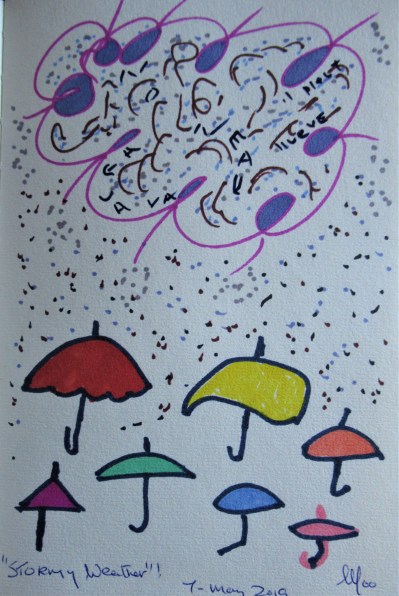
IMG_0730 (2)

Butterfingers

My fingers turn to butter, but they taste of nicotine, garlic, and soap when I bite my nails. These butterfingers encourage cups to slip, saucers to fly off, run out of energy, stall, and crash to the kitchen floor where they lie in broken pieces, resting in peace, waiting to be picked up, one by one, and buried in the waste bin.

Arthritic fingers, grown clumsy now, struggle with bottle tops and glass containers screwed up so tight they refuse to open, even when soaked under the hot tap. I stick those jars in door jambs, lid first, closing the door with one hand, and twisting the jar with the other. Sometimes it slips and crashes to the floor, often with a portion of the contents spilling out.

I hate layer after layer of plastic wrapping. Flagrant in its defiance, it wages its guerrilla war against these ageing, uncoordinated fingers. I am often forced to use a knife, but a knife can slip or twist so easily. Occasionally, blunt, it will not even penetrate indomitable, multi-folded Saran wrap. So many slips between plate, teeth, and lips. Multiple precious items drop to the floor.

I cannot always bend to pick them up, and I cannot easily grasp them, not even with my new mechanical claw.

Miracles

IMG_0790 (2)

Miracles

Waking in the middle of the night, meandering along a moonbeam, making it safely to the bathroom without tripping on the rug in the hall, managing to pee without splattering the floor, the seat, the wall, or my pajamas, climbing back into bed, staring at the stars’ diminishing light until I manage to fall back to sleep. Listening to birdsong in the morning, walking to the bathroom without bruising my left arm against the door latch, shaving without cutting my face, getting in and out of the shower with neither a slip nor a fall and without dropping the soap, drying those parts of my body that are now so difficult to reach, especially between those far-off toes that I no longer see with regularity, pulling my shirt over those wet and sticky patches of skin still damp from the shower, negotiating each leg of my pants hanging on to the arm of the rocking-chair so I won’t fall over,  tugging the pulleys of the plastic mold that allows each sock to glide onto my feet, hoping my toe-nails, uncut for so long, will not catch in the wool and that the heel will end up in the right spot, forcing swollen toes into shoes now much too small, hobbling to the top of the stairs and lurching down them, one step at a time, with my stick in one hand and the balustrade in the other … always on guard for the quick, unsuspected rush of the cat, the edge of the steps, the worn patches where my cane might catch or slip … one more step, and I’ve made it down. The first of today’s many miniature miracles.

Memory

IMG_0437 (4)

Memory

By the time I remembered your name, I had forgotten your face. Then I couldn’t recall why I wanted to talk to you. I trace dark landmarks on the back of scarred hands: blood maps, unremembered, encounters with door knobs and unseen furniture, dust covered photographs, grey, grim, anonymous, hanging on the walls, not belonging in any family album. At night I cruise among islands, emerald green against sapphire seas. Why didn’t I visit these places when I was able to? Golden sand trickles through night’s fingers and time’s hour glass trickles out as stars sparkle and planets dance in Platonic skies. My memory is gradually fading into the distance, like a sailing ship leaving harbour. Each day, I wave another couple of memories good-bye. Each morning I wake unaware of where I have been the night before. It’s not that I sleep walk, just that things pass me by in the blink of a blurred eye. I still track the sails of drifting ships. I think of them as white moths, caught in overnight traps, chloroformed into oblivion, their bodies sometimes soaked in formaldehyde. Occasionally they come to life in the morning, batter their wings briefly against my fingers, leaving them covered with the finest moth-dust, before fluttering away into dawn’s forgiving light. I give chase with pen and paper, the worst of butterfly nets for wild thoughts waiting to be caught, then tamed. I stare at the mesh of the snow-white page and strive to grasp something just beyond my fingertips, trying to decipher it and deliver its message, but I can’t quite remember what it is.

Moon Walk

IMG_0456 (2).JPG

Moon Walk
Friday Flash Fiction

Full moon over the Bay.  For the second time this month I walk along the wharf and watch the moon’s perfect disc as it creates over the bayside mountain its miracle of geometry: a golden circle balanced on a high triangle of rock.  Moonlight carves its golden pathway across the waves. I want to walk that walkway and end my earthly existence.

At night, in my boarding school, that grey stone prison where I spend interminable days and fearful nights, lying awake, I watch the moonlight as it moves across the dormitory walls.  I lie awake so I will not be caught napping by those stealthy footsteps followed by the rough, punishing hands that still haunt my dreams.

Is that a face I see in the moon?  Is that the grinning visage I see in the beer glass on the Guinness advertisements that adorn the railway tracks behind my parents’ house where I am sometimes permitted to eke out my existence? In boarding school, the masters observe me. The prefects and monitors observe me. The school bullies observe me.  But in geography class, they have never taught me that the lunar body observes me with its unwinking eye.

I watch the moon as it swims in the water.  I sense the movement of the night fish as they shimmer beneath the waves and a shiver moves a chill finger up and down my spine. The moon is the other, the other that faces me, speaks to me, reasons with me, the unfathomable other. But what am I other than one of these cold fish swimming silent beneath the waves?

It’s very quiet tonight down here by the docks. I have been in this city for six weeks now and I still have no friends. There’s always a glass barrier into which I bump at various intervals. I do not leave for another six weeks, that’s what my tickets say anyway, but I am thinking of changing that.

Here, on the wharf I stand in the shadow cast by the Customs House. I taste the bitter salt of homelessness and I know that I will never belong in this world.

I look across the water. How beautiful is the bay beneath the moon.  I look up at the hills from whence cometh my salvation.

My grandfather walks towards me over the waves. He helps me choose stones and pebbles, helps me to fill my pockets with them. He takes me by the hand and gives me courage. He and I walk down the slip way, hand in hand, and then we walk out across the moon path and into the sea.

Hair of the Dog

IMG_0040 (3)

Hair of the Dog

I awoke to the dog’s tongue licking my hand. When I moved, he jumped off the bed, ran to the door, turned and barked. The hall clock chimed six times, early for me to get up, but I did because I needed a pee. The dog followed me into the bathroom, whimpering. Street noises seemed louder than usual. The dog started barking again and a voice called out from the hall below.
“Anyone home?”
The dog clattered down the stairs woofing wildly. Still in my pajamas, I looked over the balustrade to see the milkman standing below.
“Hello,” he said. “The door was open and I just dropped in to see if everything was all right. Where’s your mother?”
“In bed, asleep,” I dug with my index finger at the sleepy crackling gathered in the corner of my eye.
“Not if I know her,” the milkman said. “She’s run off again and taken a bottle with her. You’d better get dressed.”
I scowled at the milkman, went back upstairs, and looked in my mother’s bedroom. Her red flannel nightie lay in a heap on the floor by the unmade bed, with its rumpled sheets and pillows all higgledy-piggledy. The bed felt cold beneath my fingertips and the clothes she had worn the day before had gone.
“I’ll get dressed,” I shouted. “I’ll just be a moment.”
“Sure,” the reply floated up the staircase.
“You’re right,” I said to the milkman as I met him at the bottom of the stairs. “She’s gone.” The first rays of sunshine touched the stained-glass windows above the door, and fragmented colors danced with dust motes, turning the milkman’s white uniform into a harlequin suit of lights.
“Not the first time she’s gone AWOL,” the milkman winked at me.  “She’s got quite the reputation round here. You’d better go out and find her. I bet she’s in the park with the others. That’s where she goes when the mood takes her. I see her sometimes when I’m in the milk float. I’d take the dog, if I were you. He’ll find her. He usually does.”
The dog whimpered as we got to the end of the drive. I checked my watch: 6:30 AM. The early sun slowly sliced through the morning’s damp creating rainbows in the mist. I shivered.  The milkman waggled his fingers in a silent good-bye and his electric milk float hummed then lurched out into the street with a clinking of bottles.

I stood at the roundabout at the corner and didn’t know which way to go.
“Find mum,” I said and patted the dog’s head. He wagged his tail, put his nose down, turned right, and set off down the main road towards the city center.
Shadows danced on the lower ironwork of the locked park gates. A child’s swing creaked gently in the breeze. The dog sniffed at the gates, lifted his leg on them, gave them a generous squirt, then put down his nose and tugged at the leash.
I followed the dog as he went past the gates and pulled me towards a hole in the hedge, just large enough to squeeze through. The dog whined with excitement and pawed at the gap. I followed pushing aside the bushes.
The dog whined again and tugged me towards a sort of mound that lay on the nearest park bench. Newspapers offered scant warmth to the body that they covered. A hand hung down and the dog licked it frantically. I touched that hand and the dog’s lick joined us in an unholy matrimony. Beside the sleeping figure on the bench, an inch or two of what appeared to be whisky huddled at the bottom of a forty-ounce bottle. Other empty bottles lay on the wet grass, like spent cartridges, some of them pointing at the woman’s head.
Shuffling feet had worn down the grass where the woman lay. I saw traces of blood on bandages and empty syringes. Some needles had been wiped on the pair of torn pink panties that peeped out of the grass.
The dog continued licking at the woman’s hand then stopped, pointed his nose at the sky and let out a single, piercing howl.
I shook my mother’s shoulder.
“Mum, Mum,” I called, but she didn’t move. She was locked in a land where I dared not follow her. I took out my cell phone and called the police.

They arrived with a park attendant who opened the gates and let their car in. They took one look at my mum and called for an ambulance. When it got there, the ambulance men examined my mum, said she was alive, put her on a stretcher, and carried her to the ambulance. I told them I wanted to accompany my mum to the hospital.
“Not with that dog, you don’t,” the driver replied. He got in, started the engine, turned on the siren, and pulled away.

I took the dog home, called for a taxi, and it took me to the hospital. When I got to the room in which they had caged her, she was unconscious. She never woke up.
I buried what was left of my mum ten days later, after the autopsy.


Free

IMG_0624 (3).JPG

Free
Flash Fiction

            I am as free as my father was free. He was free to walk on his walker, as far as he could go down the street. Free to walk in the wind and the rain. Free to sit on his neighbor’s wall when his legs and back got tired. Free to sit there, although it was raining, until he had recovered his strength and energy. Free to get soaked so badly that he caught a cold. And the cold was free to turn into bronchitis and the bronchitis was free to turn into pneumonia and the pneumonia was free to perform its assassin’s work as it tried to kill him. But my father was still free and strong enough to call the doctor and the doctor was free enough to call at the house and visit my father and write him a prescription for an anti-biotic that would free his body from the pneumonia that was free to leave when its time was up and it felt ready to go. Pneumonia, the old man’s friend, they used to call it, sitting there, in my father’s lungs, muttering away to him, day after day, louder at night, and my father slowly getting stronger and the pneumonia growing weaker until one day it left and freed my father from his immediate ills. Then my father was free to get up or to stay in bed. Being a free man, he chose to stay in bed all day and to listen to the radio and to read a book and when he got bored with reading he just lay there and counted the lines on the wall “one, two, three…” and “one hundred and seventy five” he told me one day when I was free to visit him, “though I have lost count once or twice and have had to start again from the very beginning. And the sun gets up at 7:03, and strikes the third line at 7:53 … and goes around the wall 33 lines a minute; and leaves that third line from the right at a 3:15 …” And there he stayed, day after day. But he was free. And sometimes the home help came and sometimes she didn’t, for she too was as free as the birds in the garden. And sometimes she remembered to buy him some food and sometimes she didn’t. And she was free to come and go, free to remember or forget. And my father was free to mumble or complain or grumble, though he rarely did. And he was free to eat, so long as there was food in the house. But I went there I often saw that the cupboard was bare and my father had neither milk, nor eggs, nor bread nor cereal, nor tea nor butter. And all those people, those acquaintances, those friends, they too were as free as the sea-gulls in the sky. But to find the time to set my father free from the hunger and thirst he seemed predestined to freely suffer, they were never free enough for that, not even at Christmas.
Neither was I.

Friday Fiction: Finding Fault

IMG_0169

Finding Fault
Friday Fiction

It wasn’t your fault. You look at yourself in the mirror and see your tear-stained cheeks. Your red eyes look back out at you and you lose yourself in them, swimming desperately as their still ponds down you with tears.

“Stop hammering at the door,” you yell at him. “Stop hammering.”

Open the door,” he shouts, stammering in his rage. “Open this door.”

Thank God you locked it is what you think. Thank heavens you kept the key. And here it is in your hand, so it can’t fall down to floor and be hooked away, under the door, so that he can open the door and come at you again. He is shaking the door handle now, rattling it, shaking it like he said he’d shake you.

“I’ll shake you till your teeth rattle,” that’s what he said. And you know he meant it. You could see it in his eyes. You were just too quick for him. That’s all. Just too quick. He raised his walking stick to beat you and you slipped away, in a flash. Just like that. He was too slow to catch you. His one chance came in the kitchen. Once you were out of there, out of that trap, you were up the stairs, into your bedroom. You shut the door, slammed it shut, and turned the key in the lock. Then you relaxed for just a second and that was enough to set you crying. Thick, heavy tears ran down your cheeks. Sobs shook your chest and rattled your bones. You heard him clumping up the stairs, one foot at a time. Clump. Clump. Then he was at the door again. A big, bad wolf, huffing and puffing.

Open this door,” he shouted. “You wicked child.”

“I’m not wicked,” you said.

“Wicked,” he shouted. “Wicked. Just like your father. You should never have been born.”

You placed the bedroom chair against the door, just under the door handle. Then you wedged your father’s sandal under the door.

Earlier, down in the kitchen, you had taken the bread knife and started to cut the bread. But the knife was blunt. So you sharpened it, scraping it up and down against another knife blade, like you’d seen your dad doing. Trying to make it sharp. Then you started to cut the bread. And that’s when he appeared screaming at you.

“Put that knife down.”

“Why? You asked.

“Because I’m telling you to.”

“That’s not a very good reason,” you said.

“You cheeky girl. I’ll shake you till your teeth rattle.” That’s what he said. And then he raised his stick. Red in the face, he was going to hit you. He wanted to hit you with his stick. Only he couldn’t. You were too quick. You went left, then right, then ducked under his outstretched arm as he lost his balance. You ran into the corridor and up the stairs.  You hear him now puffing outside the locked door.

“Open this door now, you wicked child.”

You move away from the door and move to the window. No escape there. You’re on the second floor. No way down. Where’s dad, you wonder. Where’s my dad? He went out shopping. Said he’d be back soon. Where is he? You hear the old wolf as he keeps huffing and puffing, pounding at the door.

“You’ll never come to my house again,” he screams.

“I don’t want to, grampy,” you scream back. “I hate you.”

You wicked girl. You’re worse than your father, you wicked girl.”

Just then, you hear the front door open. The old wolf backs away from the door. You feel a release, a wave of comfort sweeps over you.

“Dad,” you shout. “Dad.”

“She’s wicked,” you hear your grampy say. “Wicked. You have to beat her. Chastise her. Drive the devil out from her soul.”

“What on earth are you on about?” your father asks. “What’s happening here? Look, go down to the kitchen and make a cup of tea. I’ll talk to the little one and try and make some sense out of this.”

Wicked. She’s never coming to my house again.”

Clump. Clump. You hear his footsteps fade away on the stairs.

“Has he gone?”

“Yes. You can come out now.”

You remove the sandal, you turn the key in the lock, you open the door, you jump into your father’s arms ….
“Daddy, daddy …”

“Now tell me what happened.”

It was all his fault,” you say. “Daddy, I didn’t do anything. It was all his fault. He tried to beat me with his stick. He told me he’d shake me till my teeth rattled. I was so frightened. It wasn’t my fault, dad. Honest. It wasn’t my fault.”

Friday is Fish …

IMG_0824 (2).JPG


Friday is Fish

There was nobody at the fish stall. I stood and waited. Then another customer, a young lady, arrived. We stood and talked together.
“Is nobody serving?” she asked.
“Nope,” I said. “Ain’t seen nobody.”
“Maybe we should ask?”
“Ask away. Won’t do any good.”
“Excuse me, young man …” a store assistant rushed past, paying no attention. I stood there playing my invisible violin.
“Excuse me, miss, is anyone …” same result, store assistant vanished into the distance.
“What’s that, over there?” I pointed. The young girl turned to look, and as she did, I placed finger and thumb between my lips and let out a shrill, piercing whistle. The young lady turned to look at me, half smiling, half shocked.
“Was that you?” I asked her and she started to laugh.
Within seconds three store assistants, two men and a woman, came over at a canter.
“You two go,” the woman assistant said. “I can look after this.” She put on a pair of plastic gloves.
“Do you have any halibut cut?” I asked her. “Or do you have to slice the big one?” I pointed to the huge halibut that lay stone cold dead, trying to hide in the ice cubes. The assistant ignored me and turned to the young lady.
“Can I help you?” she asked.
“He’s first,” the young lady pointed at me and the assistant scowled as I repeated my question.
“There is some on the fish counter waiting to be cut. How much do you want?”
“About half a pound,” I answered. “Please.”
“About this thick?” She gestured with forefinger and thumb.
“Looks good.”
She walked behind the fish counter, picked up a knife and started to hack. It looked as though nothing was happening.
“This knife is dull,” she announced. “Excuse me I’ll just be a moment. I’ll go get another one,” she hurried off in the direction of the meat counter.
“A dull knife?” the young lady raised her right eyebrow and lowered her left one.
“Can’t say I’ve ever met an intelligent knife,” I smiled back.
The assistant came back a minute later brandishing an even larger knife. She again attacked the halibut, once more with no visible effect. She muttered something and rushed off again, returning with a large hammer. She held the knife in one hand and started banging downwards on the back of the blade with the hammer that she held in the other.
“Are you actually going to eat that?” The young lady looked worried.
“Not the bits she’s hitting with a hammer,” I said.
“I’m off. They must have some frozen fish somewhere. I’ll go find it.”
Five minutes, the assistant held up a halibut steak, bone in.
“I’ll take it,” I said. “Thank you so much. I’m sorry to have put you to all that trouble.”

When I arrived home my beloved met me at the door.
“Okay,” she said. “What happened?”
“I’ve brought you a lovely bit of halibut,” I said.
“That’s great. Now come in, dear and tell me all about it.”
So I did.

Flower-power


IMG_0902 (2).JPG

Flower-power
or
Why should the young kids have all the fun?

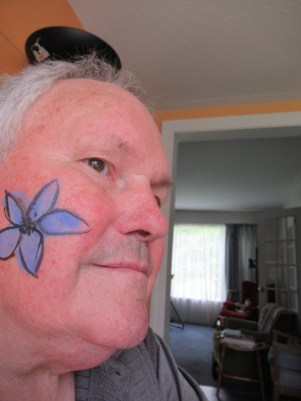
So it’s children’s day at the local supermarket. As I push my shopping cart through the door, I see the face-painter with a young girl sitting before her, getting her face painted. Behind the willing victim, several young children wait, shuffling their feet in expectation. I go out to the car park, unload my cart, and push it back to the supermarket.
As I park my cart, I see that the line-up has disappeared and the face-painter sits alone, cleaning her brushes. I walk up to her table and ask “How much?”
“It’s free,” she tells me. “It’s children’s day.”
“Will you paint my face?” I ask her.
“You’re not a child,” she looks at me in astonishment.
“No, I’m not,” I reply, “but I’m in my second childhood.”
I pull out the chair and sit down.
“I’ve got some photos on my phone, or I can try and paint whatever you would like. Would you like to see some pictures?”
“No, thanks. Just  look at me and paint what you think I would like.”
“What are your favorite colors?” she looks at me and smiles.
“I don’t have any favorite colors, but I always avoid green, yellow, and gold.”
“Oh, well, how about a nice flower?”
“Great!” I say.
One of the trolley boys who return the shopping carts in great convoys walked by.
“You need a mirror,” he says, “so people can see themselves.”
“Great idea, stay here, I’ll go and get one.”
“Don’t worry. I’ve got a mirror in the car. I’ll have a look when I get there. Meanwhile, it’s a surprise. I’ll put a photo up on my blog when I get home.”
“Promise?”
“I promise.”

IMG_0903.JPG

I gave her my blog address and I kept my promise. Unlike many people I know, I usually do.

IMG_0903 (2).JPG

Commentary: with many thanks to Emily, the face-painter, who treated my second-childhood with humor and dignity. As I said to her at the time, ‘why should the young kids have all the fun?”


Doing This for Mom

img_0161

Doing This For Mom

“I have to go pee,” Cindy got off the long-distance bus when it pulled into the lay-by on the way to Heathrow Airport airport, broke away from her mother and her grandfather, and ran to the washroom.

“What’s up with her, Tiggy?”

“I don’t know, dad. She just wants to go pee, I guess.”

“You shouldn’t let her go in there alone. Go in with her. Go on. But wait, look what I’ve got for you,” he pulled a wad of fifty pound bills out of his pocket, licked his thumb, and slowly counted them. “Eighteen, nineteen, twenty. Here: one thousand pound. Cash.”

“That’s wonderful dad. You’re very generous, but I can’t take our money. Put it back in your pocket.”

“I know things aren’t going that well for you, now you’re on your own. Take the money.” He waved the cash at Tiggy, but she pushed his hand away.

“No dad. I can’t take your money. You need it more than we do. We’ll survive.”

“Not on your own, you won’t. Not without help. Here, take it.”

“Listen, dad: I’ve seen how you are living. Hand to mouth. Why don’t you sell the car? You know you can’t drive anymore. You’ll save on the insurance. Sell now, while it’s still working. Throw in a thousand pound sterling and you can have taxis galore for the next couple of years. You can shop when you want. You won’t have to rely on unreliable friends …” Tiggy watched a tear squeeze out of her father’s left eye and slide down his cheek. “Don’t cry, dad. You know I’m right.”

“I’m not crying,” he wiped his cheek with the back of his hand. “Some dust blew into my eye. Look, there’s Cindy. Take the money for Cindy. Please. And tell her to sit beside me on the bus.”

“I’ll ask her if she wants to sit beside you,” Tiggy hesitated. “But I won’t tell her. You can’t buy her affection with money, dad. It takes more than cash to rebuild a broken family. I thought you knew that.”

“Hold this,” Tiggy’s dad thrust the money at her. “I’ve got to go to the washroom. I don’t want to go in there carrying this,” leaning heavily on his stick, he limped towards Cindy as she emerged from the rest area, but she skipped quickly away and out of his reach

“Cindy,” Tiggy grasped her daughter’s arm. “When we get back on the bus, will you sit by your grandfather?”

“No,” Cindy’s face was grey, set in stone. Her nose was a hawk’s beak, fierce in her rejection.

“Why not?” Tiggy asked.

“Grampy doesn’t love me, he hates me,” Cindy ground her teeth. “He never wants me back in the house again. He told me so. That day he banged on my bedroom door. He hates me. And I hate him too,” Cindy’s chest heaved and her breath came faster. “He was always trying to open the bathroom door when I was in the shower, and he peeped at me through the keyhole …” Cindy gulped. “He was always rattling the bedroom door and trying to get in.”

“But Cindy, why did you never tell me about this?”

“I was frightened. He threatened to beat me. Then he said he’d give me money if I was good. Is that the money?” Cindy looked down at the dollars in Tiggys’ hand. “I don’t want it.  Give it back to him. Or throw it away.”

Tiggy strode towards her father hen he returned. “It’s blood money,” she said. “Cindy’s told me everything. You’re just laundering your soul.”

The driver tooted his horn and the passengers returned to the bus. Cindy got on first and took her seat by the window. Tiggy followed her and sat beside her. Tiggy’s father, hesitated, hauled himself in, then slumped by the window in the seat on the other side of the aisle. They all gazed out of their respective windows as the bus pulled away.

About half an hour later, Tiggy needed the washroom. She picked up her purse and headed to the back of the bus. As soon as she left, her father got up and lurched into the seat next to Cindy.

“Cindy,” he tapped her on the shoulder.

“Leave me alone,” she stared out of the widow.

“Cindy, you must listen to me. Cindy, your mother’s ill. She needs an operation.”

Cindy sat, a silent stone. Then: “An operation? How do you know?

“She told me.”

“She didn’t tell me.”

“She thought you were too young to know. Families don’t tell everything, you know. Look, take this money. Not for you, for her. Keep it a secret. Give it to her when you’re on the plane. It’ll help pay the fees. Take it now. While she’s gone. I won’t offer again.”

“You hurt me, grandpa.”

“You hurt me too.”

“You were always watching me.”

“I wanted to see you. I’ve only seen you twice in ten years. What did you expect me to do.”

“Be nice.”

“I did my best.”

“It wasn’t very good.”

“It’s the medicine. I get moods.”

“Is that what will happen to mom?”

“It might. But money for the operation will put everything right. Here,” he put the money in Cindy’s lap. “Sorry.”

“You should have said so before.”

“Can we be friends?”

“No. Now go.”

“Look after your mom,” The old man struggled to his feet and stumbled back to his seat.

When Tiggy returned from the washroom, she looked for her daughter and saw her on the other side of the aisle, next to her grandfather. They were both sitting upright, very stiff, not touching, staring straight ahead into the distance. Tears shone in Cindy’s eyes and a wad of bright new fifty-pound notes bills stuck out of the pocket of her jeans. Tiggy saw her daughter’s jaws clench and un-clench but she didn’t  hear the half-swallowed, mumbled words.

“I’m only doing this for mom.”

Commentary: An old story revived and revised. Let me know if you like it.