So Sweet

IMG_1318 (3)

So Sweet

Withered I am
and soon will perish
I cherish this brief
last leaf-light bright
on tree and pond

Stark the flooded
trunks of beaver-
gnawed trees
their sails no
longer leaf-clad

Fall’s canvas
a paradise
for lost and lonely
philosopher-poets
tree-bright their light

Stored sunshine
aged in maple
birch forest oak
soaked up
in summer life
so brief so sweet

IMG_1317 (2).JPG


Sheep

IMG_1295 (2).JPG


Sheep

I wear the hide of the sheep
they slaughtered for me
twenty-three years ago
in Oaxaca, Mexico.

Like a sheep led to slaughter
I wait in the waiting room
along with other willing victims.
Heads down, silent, we clutch
open magazines, but do not
lift our heads or make eye contact.

In World War One, French troops
bleated like sheep as they marched
in tight columns towards Verdun.

They were disciplined and decimated,
one in ten shot for cowardice.
Is it cowardly to sit here, shivering,
glum faced, as we await
bad news and an uncertain fate?

I hate this uncertainty,
this inability to know what
is happening to my body.

Knowledge I can face, but
not doubt’s shadow dancing
like a will-o’-the wisp, and
leading who knows where,
keeping me awake as it did,
last night, stoking my fears
into this red-hot furnace
filled with burning coals
of fierce, fired-up doubt.

True bravery is to know fear,
to face it, and to face it down,
and to laugh in its face even
though your heart is breaking
and your gut tells you to run,
now, before it’s too late.


So sad

cropped-img_1047-2.jpg

So Sad

It’s so sad to see the flowers passing. They lose their color, dry up, fade. Seed pods rattle. Squirrels carry away the sunflower heads. Birds migrate. Speaking of birds, we have not seen many this year. Crows, oh yes. We have been invaded by crows. And by Blue Jays. They nest in a neighbor’s yard and have been irregular visitors. While the crows are here every day, the blue jays come sweeping in, four and five at a time, shrieking loudly.

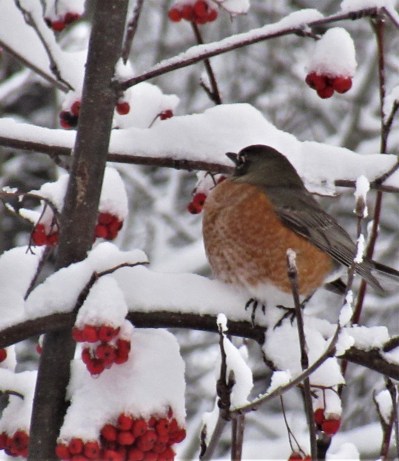
The woodpeckers have been regular visitors, downy and hairy. Not the Greater Pileated though. I have only seen one, very small, later this summer. The chickadees have been regulars, but we have seen very few sparrows and only a couple of mourning doves. No Eastern Phoebes, a few juncos, no Grosbeaks of any kind, Evening, Rose-breasted, or Pine. And scarcely a sign of swallows, martins, night jars, cat birds, cow birds … so many friends missing and passed on. Even the yellow-bellied sapsuckers seem to have neglected us. We had robins in earlier, but just passing through, an occasional American Goldfinch … very few hawks, no starlings … an occasional nuthatch …

I can remember the washing line with sixty to seventy mourning doves hoo-hoo-hooing away. This year: two. So, something is happening. Whatever it is, I don’t like it. Where have all the birds gone? 

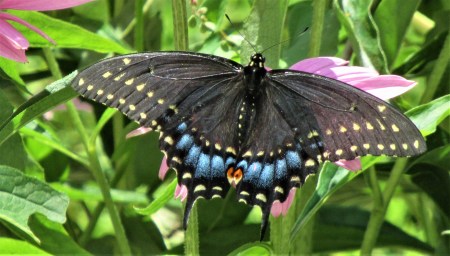
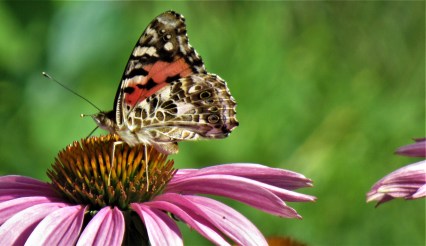
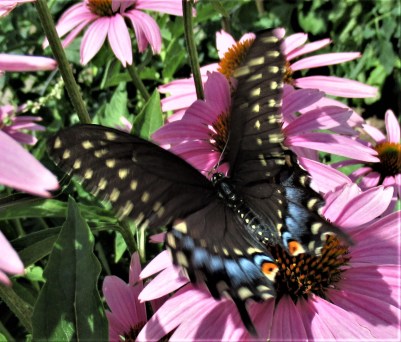
A couple of years back. we hardly saw a bee. This year we had bees, and hummingbirds. We also had some wonderful butterflies, the like of which I haven’t seen before. Here’s one that Clare caught, sunbathing. Rear-view, it looks quite frightening. Great orange eyes. Colored fangs. Wonderful. I want our world to heal. I want to see these wonderful creatures returning to visit us. I live in hopes to see them … but, who knows? Have we passed the turning point already? Who knows?

Springle Dance

IMG_1258 (2)

Springle Dance

I guess the title comes from Tolkien where the Hobbits begin an energetic dance at Bilbo’s Party. Or something like that. Mine is a Fall Girl Dance. The hand on the right points to the poor misshapen heart as it moves between fall leaves and colorful dancing sprites and spirits that help it on its way. Where is it going? Who knows where the autumn leaves go once they leave the tree? The bodies fall to the ground, obviously. We rake them into dry, crisp piles and our children and grand-children dive into those leaf-piles, scattering them everywhere so we have to rake them up again. Think of them, the children, as forming leaf angels, a bit like snow angels, but, like the broken heart, a great deal more fragmented.

Try as I might with camera and photo shop, the colors are never quite what they were when I splashed them haphazardly, like September rain and wind-blown leaves, across the page. But life is like that: memories are discolored and distorted, old photos turn sepia, old folk turn white and grey and wrinkled and fragile, like withered leaves from the tree of life. And this is life, real life. We live it every day. Each dream, a flower, each moment a leaf, and every moment the only one we ever truly experience.

So savor those moments, both the good and the bad. They are yours and nobody else’s. Your like is what happens to you. Sometimes it is bitter with salt and vinegar and lemon juice. Sometimes it is toxic and poisonous. But it is yours. It is your chalice to drain as you stand in the garden, feeling betrayed. Like it or not, this is you. Then there are the dream moments: sugar and spice and everything nice. On those days, when the sun shines, it’s away with slugs and snails, and puppy-dog tails and hello hollow world, I see you for what you are and I welcome you for what you are. And yes, you can meet with triumph and disaster, and you can treat those two impostors just the same. You are more powerful than the forces around you. Centre yourself. Find yourself. Heal your broken heart as it wanders among the springle dancers sent to bring you peace and comfort.

Look for your self. Find your self. Be your self. You and your self are stronger than any woes that may beset you. Seek the light … and you will find it.

Here

jLwRzd1BSwOGRYRVEcPwSA_thumb_2891.jpg


RrcBUdIhRESRs2CwUmEmJA_thumb_2892.jpg

Comment:

Another photo and poem from this early series (1966) while I still lived in the UK. Like Cervantes, I always wanted to be a poet. Like him, I may always be disappointed by my poetry. However, my beloved has never disappointed me.
This photo was taken at Dodman’s Point, close to where the Spanish Armada was first sighted in 1588. Dodman’s Point / Dead Man’s Point.
In 1988, a computer ran all the tides and all the times of the Armada’s progression up the English Channel, all based on those tides and the annotations of them in the sometimes seemingly haphazard English and the Spanish logs. Seemingly haphazard: because in spite of telling the time by water clocks (clepsidras) and marked candles, and in spite of the ten day calendar difference, and in spite of all the other different differences, these were real sailors and they lived and died according to the tides, the tides that the computer can track, all the way back to 1588, even as it can track the stars and their original positions when Stonehenge was first built in 3500 BCE.
I have stood on the temple mounds in Oaxaca. I have visited Maiden Castle. I have walked on Hengistbury Head and lain in the scrapes of the reindeer people. We underestimate the intelligence of our ancestors and, by extension, of many indigenous people, at our peril. And we over-estimate our own abilities as we destroy the very world in which we live.

Pax amorque

img_1092-2.jpg

Pax amorque

“Nowhere did she find peace and love
save in the dregs at the bottle’s bottom.
She solved life’s dilemmas with her whisky
aides: Johhny Walker, Glenfiddich, Bell’s.

Doctors told her that she must stop drinking,
not stoop to conquer yet another bottle.
The remedies they suggested didn’t suit her.
Family and friends lectured her in vain.

She knew she would not live forever,
no matter what the religious told her.
She opened bottle after bottle of Bell’s
Scotch whisky and hid them everywhere,

all over the house and garden so she could
always have one more before the road.
She drank until darkness overcame her.
Conquered by Shadows, she never emerged.”

Comment:
A found poem, overheard.
Pax amorque is the Latin for peace and love.

Words Overheard

IMG_0198

Words Overheard while Waiting

“Just one of those things,” an old woman whispers,
“my husband gone and me alone with all the grand
kids.” “Was it four years ago?” her friend says.

I remember his name, but I forget his face.”
“I’ll cope somehow, and the fourteen-year old,
with her belly 
starting to swell.” Silence wraps
a warning scarf around their flapping mouths.

Lives and worlds end and begin. Back turned
to their words, I listen to them talk. They chatter
about friends, family, acquaintances, giving
intimate details of childlessness from cancers
and sudden sicknesses, all laid out before me,
willy-nilly, to root and grow in my listening mind.

Never will I put a face to the girls with breast cancer,
the overweight women with diabetes, the old men
with their heart attacks, strokes, and damaged brains.

Fine dust dances in a sun ray.  Floating motes,
my lost loves, buried before their proper time.

Last Day of Summer

IMG_1247 (3).JPG

Last Day of Summer

Farewell, sweet hollyhock, you served us well. Your beauty lingered long after the warmth was done. At your best, forty, fifty magnificent blossoms.

IMG_1005 (3).JPG

But now your dried seeds rattle in the wind. You will follow the sunflowers into winter’s dark. Poor sunflowers, all have departed, even the one that greeted us from his pot at the garage door …

IMG_1225 (2).JPG

devoured by a chipmunk whose bulging cheeks and sleight of eye tell  of a late summer harvest gathered and stored.

IMG_0937 (2)

Westbury White Horse

Chaos

Westbury White Horse

Winter in Somerset. No trains from Frome.
They sit in the engine sheds, boilers frozen.

Clare drives me to Westbury, in Wiltshire,
the neighboring county. She leaves me there

and I stand on a platform as white with snow
as Westbury White Horse towering above.

People arrive, flapping their arms, stamping
their feet, walking around trying to stay warm.

Finally, to shouts, cheers, and laughter, a train
arrives, its boiler successfully thawed. People

rush forward, open doors, claim their seats.
It’s a corridor, not a compartment train.

“Is this the eight-fifteen to Temple Meads?”
I ask the porter. “Nope,” he says. “That’ll

be arriving later.” “When?” “About ten
or eleven, I expect.” “What train is this?”

“Ah, now this is the six-thirty to Bristol.
Running about two hours late. Better be quick.

The guard’s waving his flag. She’s about to leave.”
I open a door, climb on the train.  All

the seats are taken. I stand in the corridor,
shivering, all the way to Temple Meads.

Railway Yards

IMG_0681 (3).JPG

Railway Yards

The enemy came to bomb them. And they did. Tracks rooted out, twisted like spaghetti. Engine sheds burned down. Rolling stock ruined. Many children that year lived with the fear of thunder and lightning as Swansea, my home town, burned, in spite of the black out curtains and the air raid precautions. My father’s father lived by the railway yards. When I stayed with him overnight, the shuffle and clank of steam engines and the clatter of coal trucks scarred my dreams.

My mother’s father lived by the sea and each night the ebb and flow of the tides rocked me to sleep when I stayed in his house. I told the time by the tides and I knew every ship that entered and left Swansea Docks. Standing on the front step, with field glasses to sweep the bay, I could read the ships’ names, painted on bow or stern, and then check their movements in the local paper, the South Wales Evening Post.

Timetables: they ruled my life: time tables for the trains, tide tables for the ships.
When they drove me away to boarding school, I was far removed from the rail yards and the sea. I was now summoned by bells, my every activity chimed in by bell after bell. Bells: wake up, get dressed, eat breakfast, be silent. Bells for each class, for the angelus, bells for dinner, supper, bed time, and baths. Bells on the altar as we knelt before tall candles that flickered light as the tinkling bells flicked sound across the chapel. The only escape from bells came during field games. No bells then, just whistles. But bells and whistles whittled the timetables of a carefully regulated working life.

When we moved from Swansea (Abertawe) to Cardiff (Caer Dydd), our new house also backed onto train tracks and railway yards. The rattle of rolling stock lulled me to sleep. Each day, I opened my eyes to the clash and clang of early-morning shunting. Each night, at exactly 3:10 a.m., the express train to London would rattle past my bedroom window and shake me awake as I lay in my bed. The one day I didn’t hear the train, I woke up anyway, listening for its sound. When silence stalked beneath the stars, I knew there had been an accident, and I couldn’t get back to sleep. Radio and newspapers, there was little television then, screamed the news, so many people dead and injured. We mourned for the unknown dead, just like we did in the mine disasters and the bombings.

Lights out at 9:30, prefects and house masters on patrol outside dormitory doors enforced the silence that ruled the night in those inland boarding schools that I was forced to inhabit. No trains, no ships, no tides, no rattling of rolling stock, no steam whistle, no salt smell of the incoming sea disturbed my dreams, just the snoring and whimpering of lonely little boys lost in their iron-frame beds and longing for the comforts of home.