Bronze Ribbon

Bronze Ribbon

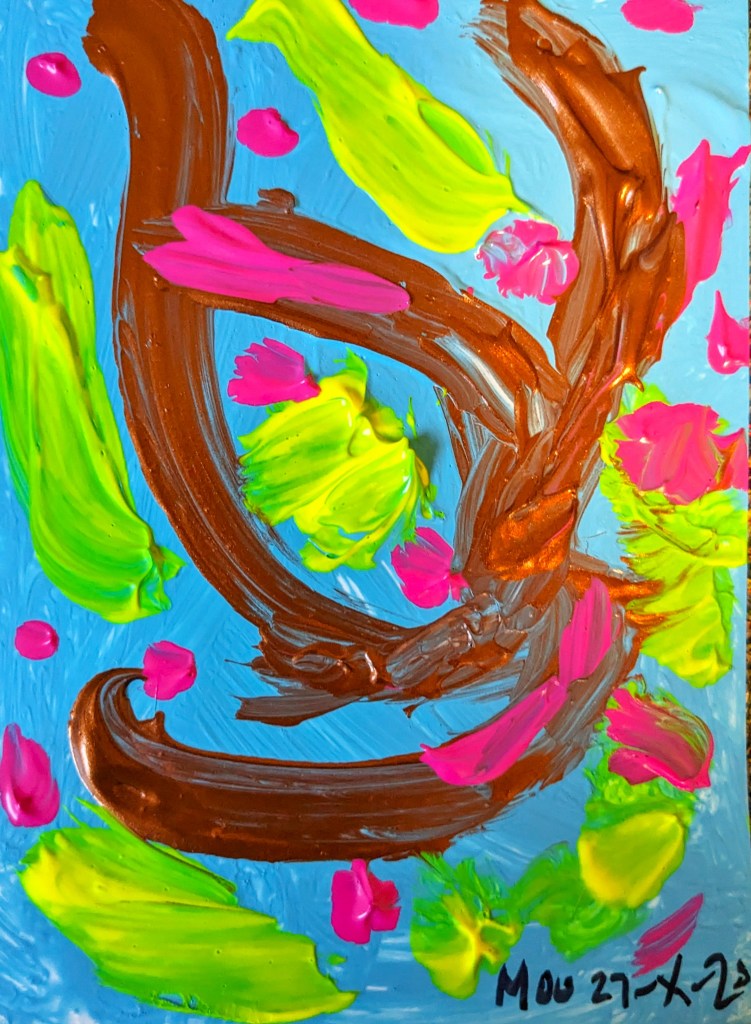
And time has ticked a ribbon round the stars.” Dylan Thomas, sort of, but a perfect title for this painting that I completed this morning. The acrylic paint is still wet! I brought it downstairs, looked at it in the light from the kitchen window, and the colors had all changed. I angled the painting, then re-angled – it was a chameleon changing color in the shifting light. Then I turned the large ceiling lights on – and this is what I saw.
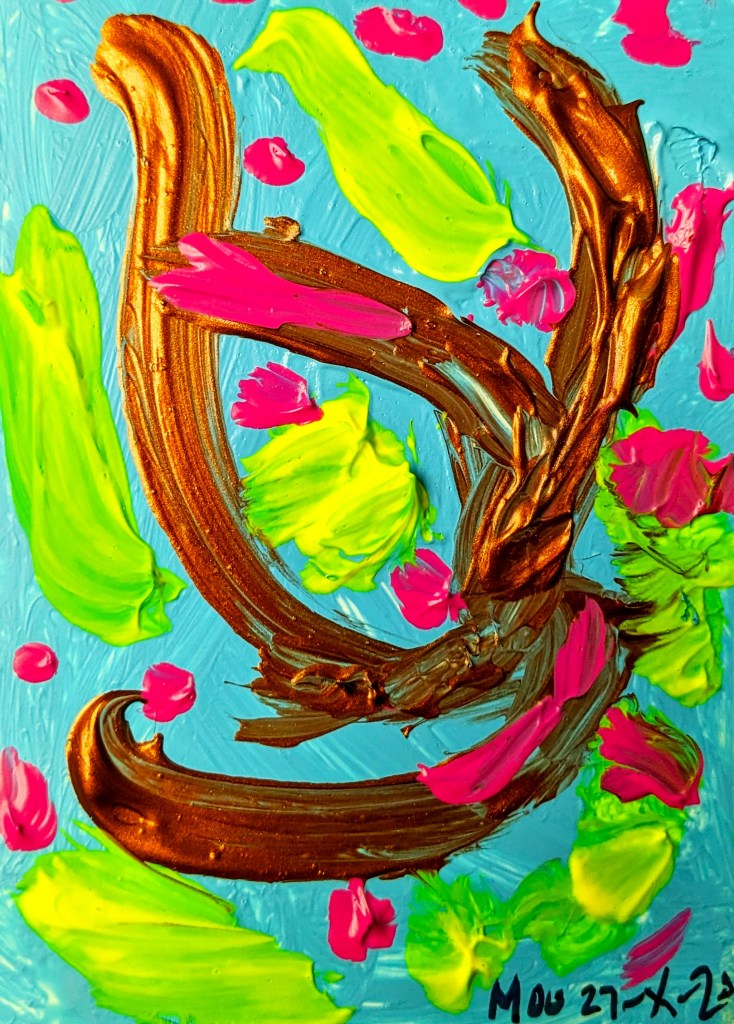
Exactly the same painting – or is it? When I was studying in Madrid, a long time ago, I visited the Prado every afternoon. Each day I would visit a different room and stay there for the duration of my visit. The tourists who flitted in and out amazed me with the brevity of their visits. A minute or two to see all the paintings by Hieronymous Bosch, for example. I sat in front of just one of them for half an hour – and I could have stayed longer.

When I visited Las Meninas, it stood in a room by itself. It had a full size mirror opposite it, on the far wall. I should add that this was long before it was cleaned and renovated. I looked at it from every possible angle. I drew close and squinted at the lace and wondered at the quality of the brush-strokes. I lay on the ground in front of it. Stood at the side. Watched it change as I changed my position. I discovered art as a living being, not a static moment in time. Imagine me, for a moment, kneeling on the ground, watching the young prince’s horse soar over the top of me, as it would have done, if it had occupied its original spot, angled above a doorway. Change the angle, change the perspective, change the painting, and watch it come alive.

I will never forget my days with Goya. His Disasters of War – wow – such an incredible sequence – took up several afternoons. And the Pinturas Negras – the Black Paintings – they still haunt me, as do the Disasters. Man’s inhumanity to man – not a dead set of etchings but living portraits of an evil that goes on and on. “This I have seen!” “And this!” Indescribable scenes. Words cannot do justice to the depth’s of the feelings generated by such works of art. When will we ever learn? I taught a great variety of students for most of my life and I know all too well that some lessons can never be learned. Like an endless loop on a news tape, people are doomed to repeat them, again and again, and again.

As the BBC Lion said as he finished his supper – “That is the end of the gnus.”
TWTWTW.
What major historical events do you remember?

Daily writing prompt
What major historical events do you remember?

What major historical events do you remember?

Interesting question, but very problematic. How do I define a “historical event”? What exactly do I mean when I say “I remember”? Max Boyce had a lovely song in which the chorus was “I wuz there.” If everybody who says they saw Llanelli defeat New Zealand in 1973 at Stradey Park had been there, there would have been 300,000 people pressed into a ground that held about 15,000. But, as Max Boyce sings, “I wuz there”. Well, in spirit, anyway, and I have seen the film several times. I also remember watching Jim Laker’s 19 wickets in the 1956 cricket Ashes. I watched that match on B&W TV. Does that count as an historical event that I remember?

How about the Battle of Hastings, 1066? In 1966, I ran in a road relay that led from Bristol to Stamford Bridge, where Harold defeated Harald Hadrada, down the main highway to The Trip to Jerusalem, where we stopped for a pint, down to Hastings, where we re-enacted the battle that saw William the Conqueror take the throne. Several of the runners wore Saxon uniforms, a couple even had long, blonde hair. We re-enacted two battles. Does that mean I remember that historical event?

Let us talk about Stonehenge. I first went there when there were no railings, no fences, and when sheep and cows could safely graze. I remember it well. And I remember creatively re-constructing, with my grandfather, the digging of the post-holes, the raising of the stones, the transportation of them, by ship and log rollers, from the Prescelli Mountains in Wales to their current resting place. As Max Boyce says, in my own mind, I was there. I was there too at the destruction of Maiden Castle. The first book I ever bought, age about six, was Sir Mortimer Wheeler’s autobiography, Still Digging. I can still feel that Roman ballista arrow going through the victim’s backbone. Does that count as a memory, as a presence, as a moment of reality?

The Conquest of Granada, the Expulsion of the Jews from Spain, the later expulsion of the Moors, the Adventures of Don Quixote, the mixing of truth and reality, the questioning of authority, the inquiry into the meaning of meaning, my mother’s sister phoning me after 9-11. “What’s all the fuss about, Roger? There were only three planes. We had them every night, over here, during the London Blitz, for two long years.” What impresses itself upon the human consciousness. How do we remember things and why? The Spanish Armada -there were actually three of them -, the Peninsular wars in Spain, the battles of Trafalgar, Vimeiro, Salamanca… Then we can move on to Vimy Ridge, Ypres – Wipers, as my grandfather called it, his days in the trenches, recounted to me, in the kitchen, day after day, in vivid, lived language that still remains with me. And he would sing – “If you want the whole battalion, I know where they are, they’re hanging on the old barbed wire.” Yes, I was there with my grandfather. I remember it well. The Battle of the Atlantic, the Hunt for the Bismarck, the Battle of Britain – I sat in the cockpit of a Spitfire, a long time ago, during the Battle of Britain celebrations, and I climbed into and walked around the interior of a Lancaster.

Memory and the reconstruction of historic events, some we actually lived, and some we just dreamed of, and some we saw at the movies. What is memory – an actual happening or a creative reconstruct? What is the meaning of meaning? And read Bertrand Russell’s book on the subject before you answer that one. As for me, I was there, standing beside Max Boyce, witnessing the game, though, as he says, “a hundred thousand in the ground, and me and Roj outside.”

What makes a good neighbor?

Daily writing prompt
What makes a good neighbor?

What makes a good neighbor?

I am not sure what makes a good neighbor, but I am learning what makes a bad one. This cheeky little fellow has taken a liking to my garage. When he finds the garage doors closed, he gnaws and nibbles at the outside woodwork and tries to chew his way in. Not a nice neighbor.

Earlier this summer, I had problems with my windshield wiper liquid. The right side squirted well, and cleaned the passenger side nicely. The left side slowed down to a dribble, and then stopped. The rear window wiper, on the other hand worked well. No problems at all. One day, both the windshield wipers stopped squirting. Press the button – no liquid at all. I checked the reservoir – half full – and topped it up. Then I tried a pin in the tiny nozzles beneath the windshield. Sometimes they clog up with dust and block the flow. Nothing.

I decided to take my problem to a professional. He raised the hood, looked inside, took one sniff and said “Mice. I can smell the piss.” He told me to leave the car with him, at his garage, and that he’d call me later. He called and drove to the house to pick me up. On the way, I asked him “Well?” “Wait and see,” he told me. “You won’t believe this.”

When we got to his garage he showed me the evidence – a huge red squirrel nest, complete with a winter supply of food, nestled beneath the hood of my car, between the hood lining and the actual engine. The squirrel had chewed his way through the plastic tubing that linked the washer fluid to the wipers. He was shaking with laughter. I was devastated. Cost to me to repair my naughty neighbor’s activities? Well, I won’t tell you – because I don’t want to shock you – but it was quite a bit of money, not enough to be covered by my insurance.

When I got back home, the naughty neighbor was sitting on the roof rafters, inside the garage, chittering at me, chattering away, and scolding me. “I’ll get you, you little varmint,” I said. But he only chattered more loudly. I saw him coming in early one morning and he fled into the woodpile along the wall. “I’ll get you,” I said, beating at the spots behind the logs where I could hear him.

I went online and sought some solutions. One suggestion was to use cinnamon. So, I dug out a packet of cinnamon powder, spread it on the garage floor, across the doorway, and waited. Within minutes, a chattering began in the trees, outside the garage. An angry, nervous chittering and chattering. Then the garden went silent.

I keep renewing the cinnamon. The garage smells lovely. I haven’t seen or heard a squirrel for days. Has this actually worked, I wonder? Watch this page if you want to know the answer to that question.

Rites of Passage

Rites of Passage

Summer slid silently away. Autumn’s
harvest is upon us. Slowly the mountain ash
is stripped of its fruit, from top to bottom.

Robins flit from branch to branch until
the whole tree shakes with bouncing birds
pouncing on the few remaining berries.

Berries gone now. Leaves will soon follow.
The Farmer’s Almanac forecasts a long, cold
winter, filled with wind, ice, and snow.

All too soon, the deer will appear, ghosting
their silent steps at wood’s edge. They’ll arrive
at dusk and wander all night, just to keep warm.

At dawn, they’ll leave, having exercised their
ancient rites of passage, the routes engraved
in their racial memory since the dawn of time.

When my time is up, I too shall follow them
into the lonely silence of that long, wintry night.
Restless, or at peace, I’ll hope for dawn’s light.

If you had a million dollars to give away, who would you give it to?

Daily writing prompt
If you had a million dollars to give away, who would you give it to?

If you had a million dollars to give away, who would you give it to?

The key word here is “who”. Who suggests an individual – children (just choose one and make the rest jealous), grandchildren (copy the above), a friend (wow, that would make the family happy). So, let us choose another set of words – If you had a million dollars to give awaywhat would you do with it? Now that’s a better question.

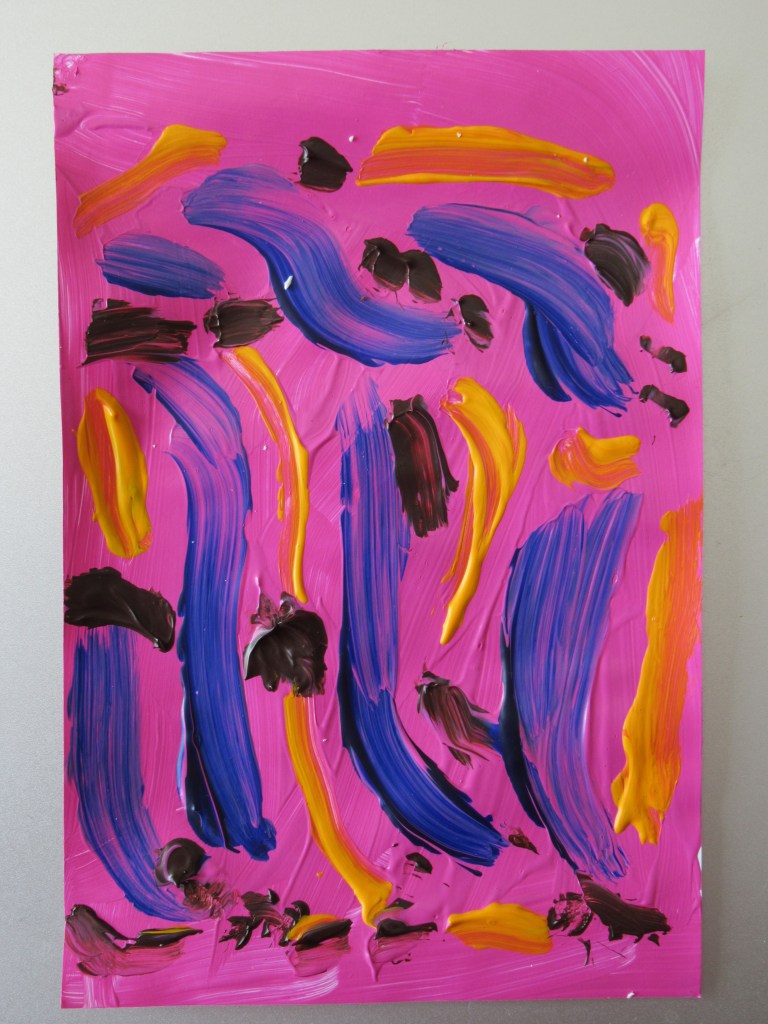
Look at the painting above. Bas Bleu was the name given to French women intellectuals who often wore dark blue stockings to show their difference. But check out Moo’s bas bleu – she has blue stockings, but not shoes. No shoes is a sign of poverty (or extreme holiness). I’ll go for the former. I would give that bas bleu and all her colleagues and lookalikes a chance at some security and a more secure intellectual future.

How? I would set up a needs-based scholarship fund for female students with special needs – indigenous women from the first nations, single mothers who need help, support, and encouragement, older women returning to the university, some of them with little or no financial support. This, I believe, is one of the most important things we need to do to improve our university system. A million dollars at invested at 5% would return $50,000 a year. That would provide five scholarships at $10,000 for five financially deserving women.

Can it be done? Of course it can. I know. I have already set the wheels in motion for such a fund to be established when my beloved and I have had our last twitch and fallen off the perch. Alas, the sum invested is a lot less than $1,000,000. I wish I had more to give. But every good thought counts and every dollar, to a person in need, is a step along the way.

What’s your #1 priority tomorrow?

Daily writing prompt
What’s your #1 priority tomorrow?

What’s your #1 priority tomorrow?

I have a couple of priorities, of course. I am not sure which is #1. Maybe I’ll ask the readers to tell me which one my top priority should be.

I guess my first priority is to wake up. That is very important at my age. A couple of my friends went to bed and never woke up. So, I guess an important priority, perhaps #1, is to actually wake up.

Having woken up, my next priority is to roll over, sit up, pull back the blankets, and actually attempt to get out of bed. This isn’t always easy. My back sometimes stiffens up overnight. Or else my hips don’t want to function. Then there’s the gammy knee I hurt playing rugby all those years ago. Then there’s the quality of the light – do I need a light on? If I do, I must reach for it without cramping up. Early morning cramp is not a good thing and really complicates the next step.

If I am in the high bed, then lowering legs, touching the floor with toes, and using arms to push up the rest of the way is relatively easy. But if I am in the low bed, I must turn sideways towards my bad knee, place my feet at an angle, and do a one handed pushup in order to find the right balance to get to my feet. That means watching out for slippery carpets. I do not want to fall. Sometimes I call on the aid of my faithful teddy bear and, by half throttling him, I manage to get that extra leverage.

Oh dear, I forgot another priority – condition of ageing bladder. All of the above activities are dependent upon the state of the union. If that is a problem, then I must call for assistance – and I hate doing that.

Next priority – the trip to the bathroom. I wish I hadn’t said ‘trip’, because sometimes I do. The effects of that can be a sudden grasp at something solid, a stubbed toe, a twisted something or other, or, worst of all, another fall. We certainly don’t want that to happen, especially if we are suffering from what Max Boyce [remember him?] once called ‘twisted legs and tails’.

Other priorities follow when we have reached the bathroom. I won’t go into those. Nor will I mention the perils of the return journey, the difficulties of getting dressed, the embarrassment when I fail with the patented sock-pull machine and have to wiggle my socks off, one by one, and then put them on again.

So, here I am, fully dressed, standing at the top of the stairs… one hand on the hand-rail, one hand on my trusty walking-stick, and down I go, hopefully one step at a time.

So: What’s my #1 priority tomorrow? You tell me. Which would you choose? And before you answer, just remember Dylan Thomas’s words ‘for whether we last the night or no, is surely only touch and go’. Touch and go, tip and run – I remember them well. And luckily I remember waking up this morning. I would hate to face the alternative – not waking up.

Bird

Bird

The bird came to me
   on the wings of Hurricane Lee.

Carried along by stronger wings
   he perched in my tree.

A new species, he was unknown to me.
   Our own power lost, the usual ways
               of searching were denied me.

He moved from the tree
   to the window feeder and gazed at me,
               eye to eye, as the hurricane’s eye
                           passed overhead.

Free. To come and go at his will,
   but there is little free will
               when the hurricane blows.

A sudden, strong gust
   whisked him away.

Unknown, and a stranger still,
   he soon was lost to me.

Comment:

All my good will and new resolutions went down the proverbial plughole when Hurricane Lee swept in, washed away one of the roads near to me, and left us without power for 52 hours. We lit candles, as much for warmth as for light, and, when dark descended outside, gathered in their flickering glow. The time has come, the Walrus said, to indulge in simpler things. Water saved in the bath upstairs and in an assortment of pots, pans, and buckets, served for the washing of hands, the flushing of toilets, washing the dishes. Food was served cold – but we indulged ourselves with perishables that needed to be finished quickly. The morning face wash and shave, in cold water, no shower, was a throwback to old times. The experience brought us closer together. Neighbors with generators dropped round with hot food and drinks, and all went well. After two days of picnics, we got a bit bored. I managed to write lots of poems though. The creativity of that experience will live on in words.

King Canute

King Canute

I imagine King Canute, sitting on his throne,
at the seaside, surrounded by his court
as he tries to turn back the rising tide.
Or is he just proving that it can’t be done?

In vain we struggle against the rising waves.
We piss into the wind and try to drown
the thunder with our pitiful, impoverished farts.

Some preachers preach that we are immortal,
but mortal we are, facing such adversaries
as wind, rain, thunder, and the rising tide.

Who nailed us to this cross of cloudy doubt?
I hear crass crows cawing for tomorrow, but
it never comes, and if it does, it becomes today.

Today we must count the cost of every footstep
that leads us again into the Darkest Ages,
and back to the Stone Age, sent there by a rain
of unstoppable destruction, unleashed in our pride.

Pilgrim

Pilgrim

“We think in eternity
but we move slowly through time.”

My daily duties nibble and gnaw.
I slowly shrink beneath their onslaught.
I feel myself diminishing, gradually,
hour by hour, disappearing into myself.

Even sunshine and silver-lined clouds
weigh heavily upon me, some days, when
my legs grow weak, my strength fails,
and my frail and feeble mind seeks out
a simpler way to continue my journey.

I favor those paths that gently slope,
downhill, preferably, and I avoid
rough, stony ground. Pilgrim through
this barren land, close to my journey’s
end, where footsteps are perilous,
stumbles lead to tumbles, I cannot risk
 a fall, for if I fall, like many who have gone
before, I may fall to rise no more.

Prophet and Loss

Prophet and Loss

I have sown so often on stony paths
and harsh roadside ways where thistles
bloom in purple patches and weeds choke
the fertile soils, closing flowers down.

Who knows what cold winds blow when
new seeds are shuffled, then cast, like bread
upon water, into the mind’s frustrated furrows?

Will flowers flourish, or will they perish,
still-born, in the depths of their stony graves?

I do not know for I cannot read the runes
the wind scatters across the sky when it shuffles
clouds and scrawls shadow-writing on the land.

Careless, I cast out word-seeds, knowing full well
that many will perish. But I also know that one
or two will put down roots. Eventually, developing
shoots will nourish my labor’s burgeoning fruits.

Comment: There is no profit in being a prophet.