Skeleton in the Cupboard: Flash Fiction


Skeleton

Skeleton in the Cupboard

Spring sunshine and I pull out my old summer coat, the one with its pockets stuffed full of memories and dreams. It hides all winter in the clothes cupboard and I free it each spring with the melting snow and the tiny tongues of grass that push through the winter debris that covers the lawn in early April.

Battered and bruised, its elbows discolored where the dry cleaner’s chemicals left disfiguring splodges, it has served me for twelve long summers. It is my constant warm-weather companion, hanging on my arm, my shoulders, gracing me with its comforting presence. Everywhere I travelled for the last twelve years, it has accompanied me.

It is shabby now and grubby. Wine from the bars in El Rincón, El Rastro, El Portalón, Casa Guillermo and many other landmarks have fallen upon it. Octopus, squid rings, mussels, clams, shrimp, goose barnacles, and various types of omelet have left their marks upon it. The English language, with its fish and chips, its bangers and mash, and its sosi, jegg and chips, all bourgeois meals, can never do justice to the pure poetry of Spanish tapas whose names roll off the tongue: pulpo, calamares, mejillones, almejas a la marinera, gambas a la plancha, percebes, tortillas españolas y vegetales. Here I spot a golden stain from riñones al jerez and there a black one from calamares en su tinta.

Weathered by wind and rain, this coat has climbed El Zapatero and walked with the transhumance herds up and down the old Roman road of the Puerto del Pico. It has followed the Ruta de la Plata, the silver trail that led from South America to Sevilla and up the Silver Road past Ávila to Madrid. It has walked through the house in El Barco de Ávila and seen the kitchen where they tore down a wall and found a walled up library, just like the one described by Miguel de Cervantes in the Quixote. It held books proscribed by the Spanish Inquisition that had been hidden away since 1556. It has walked through Piedrahita, San Miguel de Corneja, and Villatoro. It has walked the streets and squares of St. Teresa’s walled city of Ávila on multiple occasions and knelt with me, in prayer, before many a saint on many an altar.

It kept me warm in the hills around Gredos when the mists dropped suddenly down and turned warm day into freezing night. It accompanied me to the Monasterio de Yuste, where the Holy Roman Emperor, Charles the Fifth, retired to live out his days in prayer. It visited the spice towns of La Vera, and ventured into Garganta de Olla, to walk those ancient streets with me. It walked with me in the birthplace of St. John of the Cross and entered with me the depths of the earth where the verdejo is stored in huge oak barrels deep below the town of La Seca.

This old coat keeps its secrets. It remembers the moon hanging its lantern above the battlements on the Paseo del Rastro. We wandered there, she and I, arm in arm, entranced by the shadows that danced on the Medieval walls. When she shivered, I wrapped her in that coat and still it holds the perfumes of her body, the warm touch of her skin, the enchantment of those magic nights when the world stood still and we lay alone at its centre. Oh, and that green stain, there, at the back: that’s where I lay my coat on the grass in the little park under the walls by El Puerto de San Vicente, the one where the lovers go, late at night, beneath the trees, to be together in their loneliness …

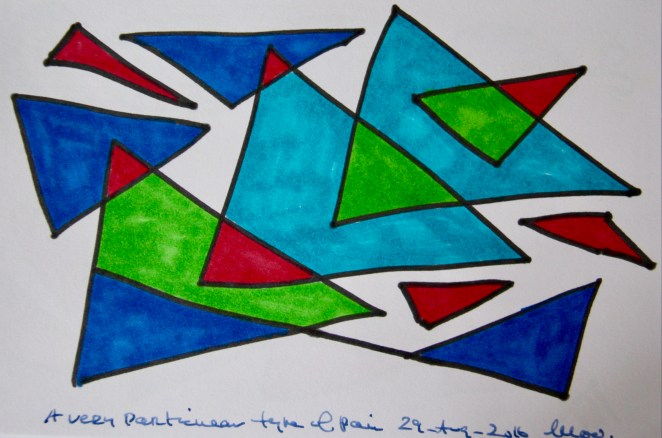
Comment: A long time after posting this story, enlightenment knocked at my door. The new cartoon that I had used to illustrate My Old Coat was called Skeleton. Surely, I thought to myself, given the story’s ending, Skeleton in the Cupboard would make a better title. And it would. And I have changed it. A little bit of serendipity at a time (+3C outside the week after Easter) when I need some sunshine in my life. Any comments on the use (or overuse) of Spanish in this story would be very welcome. Best wishes to all my faithful (and unfaithful) readers.

Scribblings

img_0186

Scribblings

Words and thoughts
and symbols and images and
metaphors and myths
and all things missing and
some present in-between sheets
lined and unlined as a line of ants
crosses the kitchen floor
in search of sugar so sweet
these dreams where truth
and lies and smiles and
sighs seize highs and lows
and the light and
dark of a life as it might
have been and was perhaps
on another planet
in my darkest dreams
and my sharpest awakenings and
if I am dreaming then let me sleep
on and on and never wake up
to what passes as reality


Sinister

IMG_0186

Sinister

What the left hand does
when the right hand doesn’t
know what it’s doing
is an attempt to re-pattern
the brain, to slow it down,
as the pencil spider-walks
its wandering way over the page
like my father’s did when,
stroke-stricken in the right hand,
he transferred his pencil to the left
and sought to-re-establish control
over tiny, manageable things,
and yes, he often cut himself
shaving, but he didn’t like beards
so he never gave in and shaved
every day, died fighting,
and did not go gentle,
and neither will I.

Comment: This is a very raw poem, in more senses than one. I fell over on Tuesday, on the back porch. One of the porch nails, forced up by the winter ice, caught in my open-toed sandal and over I went. My head had hit the deck before I even knew I was falling. It wasn’t as bad as the tumble I had when chasing the black bear and trying to photograph it, but this fall left me quite stunned. You can read about the fall HERE. The actual bruising, not the fictional ones, can be found in #3 of that sequence. I wrote the above poem, on Thursday evening, with my left hand, while my right hand was being iced. Funny how we think of one thing while doing another: I had visions of my father, stroke-stricken as I say, trying to write with his left hand. He fought so hard to do just the smallest things. Oh yes, I have a nice bump on my head, too, and as I told the chiropractor when I visited her later that Tuesday afternoon: “I think I have already had my back adjusted once today.” The other thought that comes to me: how slow we are to heal, once we pass a certain age, or, as my good friend Jan the Stoneist says, “an uncertain age.” With that latest fall, I have indeed entered into The Age of Uncertainty.

Love Poem @ 70

img_0146-3

Love Poem @ 70

1
We walk on tiptoe round the garden,
peeling free the sunlight cloud by cloud.

Sometimes, the heart is a sacrifice of feathers,
bound with blood to an ornate altar.

Petrus:
this rock cold against my chest.
Piedra:
centuries of stone carvings
come alive in your face.

If our arms were to meet
around these columns
of sun-warmed flesh and stone,
what would become of us?

2
Beneath my skin, the woad
flows as blue as this evening sky.
Your skin is bronzed
in the warmth of my gaze.

Yellow light bends
low in the fields below us,
each darkening pool
a warrior fallen
beneath time’s scythe.

The moon paints a delicate circle.
Its great round eye opens out
above the rooftops,
a cathedral window
opening on the sky.

Tonight it bears
the wisp of an eye lid
carved from  cloud.

Your teeth are diadems of whiteness
aglow in your face.

We tie shadows to our heels
and dance in triumph
to the village music
sounding in street and square.

3
Daylight bends itself round rock
and turns into shadow.
We flourish in blocks of flickering flames.

Dreaming new selves from roots and branches,
we clasp each creation with greedy fingers.

Dark angel bodies with butterfly wings,
our shadows have eloped together.
They sit side by side holding hands
at a table in the central square.

4
Church bells gild the barrio’s rooftops.
Our fingers reach to the skies and hold back light.
We draw shadow blinds to shut out the sun.
Night fills us with stars and a sudden sadness.

We dream ourselves together in a silent movie,
closed flesh woven from cobwebs
lies open to a tongue-slash of madness.

The neighbor’s dog wakes up on the azotea.
He barks bright colors as dawn declares day
and windows and balconies welcome the sun.

Can anyone see the dew-fresh flowers
growing from our tangled limbs?

Your fingers sew a padlock on my lips:
We listen to the crackle of the rising sun.

Why?

IMG_0154

Why?

Curiouser and curiouser
the vanishing smile
on the ginger cat
and wild dog dingo
grinning like a coal-scuttle,
why, oh why?

Who put the cur in curious?
Why was the dog-watch curtailed?
Cynicism, some say, and why
do we kneel before him,
heads bowed, waiting
the thumbs up, thumbs down,
of placet, placetne,
why, oh why?

Comment: Raw poem. I dreamed it up last night, but it wasn’t like this when it started. Cur: means why or what for in Latin and curs were large, mongrel dogs, bred for herding cattle in the Middle Ages. Cynicsm: because the cynics were also called ‘dogs’ partly for their shamelessness and partly for the faithful way they guarded their philosophical tenets. In Mexico, the Dominicans were often portrayed with dogs at their sides. The explanation: domini / of the Lord, -can / dog; hence they were the faithful guard dogs of the Lord. Placet: it pleases in Latin; the thumbs up sign that allowed the defeated gladiator to live, not die. “In any event, the final decision of death or life belonged to the editor, who signalled his choice with a gesture described by Roman sources as pollice verso meaning ‘with a turned thumb’ a description too imprecise for reconstruction of the gesture or its symbolism” (Gladiator: Wikipedia).

The Perfect Boiled Egg

img_0184

The Perfect Boiled Egg

two dozen
at the bottom of the pot
as hard as rocks

two dozen at the top
liquid beneath the stale bread
resurrected as toast
and used as blotting paper
to mop them up

and there
lurking somewhere
in the middle of the pot
hiding like the prize number
waiting for the winner
in a national lottery

the perfect boiled egg

Comment: School food was always a thing of wonder and I remember it only too well. If nothing else, the school sports gave me an appetite and the school food made me more or less omnivorous and gave me a cast-iron stomach. I can’t remember who said them first, but I always associate these words it with St. Trinian’s: “School fish: the piece of cod that passeth all understanding.” We sat at tables of eight and we could always find someone who would eat whatever we left … more about that (and school) later.

Daffodils 3

IMG_0141

Daffodils

For ten long days the daffodils
endured, bringing to vase and breakfast-
table stored up sunshine and the silky
softness of their golden gift.

Their scent grew stronger as they
gathered strength from the sugar
we placed in their water, but now
they have withered and their day’s done.

Dry and shriveled they stand paper-
thin and brown, crisp to the touch.
They hang their heads:
oncoming death weighs them down.

Whisperer

dsc02478

Whisperer

The bird whisperer, bag of bread crusts in his hand, walks towards that lake I knew so well in my childhood. His friends, the ducks and geese, wait for him to arrive so they can have their breakfast. The whisperer is late today and emerges slowly from the early morning damp and mist.

The whisperer’s friends are hungry and impatient. They leave the lakeside to waddle across the road in a lengthening gaggle, fastest at the front, laggards strung out, straggling behind. When they reach him, the whisperer stops for a moment to greet them. Ducks and geese and traffic stand still as the whisperer pulls the whole world to a halt. Watching him, I remember how, when I was a child, those same sharp bills nibbled at the crusts I held in my fingers as my father rowed our hired boat over the lake’s smooth waters.

The whisperer crosses the road with his flock strung out behind him. Drivers and passengers take photos and videos on their cell phones as the battalion marches on, down the slight slope, back to the waterside where the whisperer scatters crusts and breadcrumbs and throws corn as if it were a shower of stars from the firmament.

Greying skies threaten above dark waters. At lake’s end, above the waterfall, the monument to Scott of the Antarctic pierces the gloom with its fine, white tower. Scott sailed from this city in search of new lands and adventures at the South Pole. Like me and many others he left, never to return.

I look at the bruises that decorate my wrinkled hands. Neither spots nor wrinkles were there when I left that lake behind me, was it really fifty years ago? I view the video on YouTube, shot from an I-phone in a parked car, and my eyes mist over. This was my home, this was the land of my fathers, this was the land of choirs that would always welcome me back with song … yet I no longer go back.

The video is grainy and bears grey threads that mimic the passing clouds. I gaze on that well-remembered lake: there, so many years ago, I swam in its waters, ran and biked along its winding paths, rowed around its edges in and out of the reeds, and fed the lake birds as I floated beside them. I remember all too well the warmth of spring and the joy of the returning sun that strew gold daffodils beneath budding trees.

I see myself reflected in the computer’s screen: my wrinkled skin wraps my shriveled flesh in the same way crinkly paper winds itself round an Easter egg. There is so much inside that binding, so many memories and secrets that dream their lives away inside me. I close my eyes and for a moment I am once more that youthful body flashing its jack-knife blade into those rippling waters …

Evening comes and I stand in a shimmer of moonlight at the garden’s edge, my hands held out to catch a falling star. Alas, I seize only the mutterings of snowflakes strung between the constellations. My scarecrow dream stretches out a long, thin hand and clasps bright treasures in its tight-clenched fist. Inverted, the Big Dipper hangs its question mark from the sky’s dark eyelid. A honking of geese haunts the highway high above me. I swivel from north to south to catch an impression of darkness swift and sudden that blots out the scattered grains of stars.

A finger-nail of rising moon emerges from the trees and hoists itself skywards. The moon hones its cutting edge into an ice-thin blade and the lone dove of my heart flaps in its trap of barren bone. Moonlight and starlight run twin liquors, raw, within me. Stars nearby fade in its brightness. I have built a fire inside the house. When I go back in, my goose quill pen scratches black lines in my journal as I weave words by firelight across a flickering page. Ghosts of departed constellations drown in the nearby river. Pale planets scythed by moonlight bob phosphorescent on a rising flood of memories.

Comment: This would be a “raw poem” were it not a piece of “raw prose”! I found it among my notes late last night and revised it and put it up this morning. It was based on a YouTube video of a man, the bird whisperer, feeding geese at Roath Park Lake in Cardiff, South Wales. When I was a teenager, my family moved from Swansea to Cardiff and Roath Park was a short bike ride from our new home. The Scott Memorial stands at the lower end of Roath Lake, just by the waterfall. Apparently Robert Scott sailed from Cardiff on 15 June 1910 in a converted whaler in an effort to walk to the South Pole. Like me, when I left Cardiff, he didn’t return.

Here’s a link to Robert Scott: https://en.wikipedia.org/wiki/Robert_Falcon_Scott

This is the video on which the piece is based: https://www.youtube.com/watch?v=clbbMt2sl0k

Geese

cropped-15-may-2002-pre-rimouski-020.jpg

Geese

The arrowhead precedes its shaft and leads its feathers into night’s perfection. Summer catches flight and waves good-bye to Arcturus as an obsidian knife flashes black lightning across the icy threshold of a morbid sky. Darkness, swift and sudden, blots out each scattered scat of golden grain and swallows an iris of stars. Inverted, the Big Dipper hangs its question mark from the sky’s dark eyelid.

When daylight breaks cold sunshine over broken ground, the great white geese lay their burdens down by the riverside. Pristine as they drift to the land, flake by fluttering flake, they accumulate the colors of mud daub and anonymity as they grub food from the neat ploughed fields that march their earthen armies across the land. Fallen angels, they sprawl down from heaven and abandon eternity to adopt their waddling time-and-earthbound shapes.

Now, the afternoon gropes steadily to night. Some people have built fires; others read by candlelight. Geese litter the riverbanks with their mud-stained snowdrifts. Freshet mud besmirches them — or is it the black of midnight’s swift advance? The geese step on thin ice at civilization’s edge. Around them, the universe’s clock ticks slowly down. Who forced that scream through the needle’s eye? Night gathers its darkening robes and the seabed reaches its watery arms out towards a magnified moon.

Ghosts of departed constellations drown in the river. Pale planets scythed by moonlight bob phosphorescent on the flood. I walk on the beach sensing the flesh that bonds, the bones that scarcely bind, the shoulders and waist on which I hang my clothes. Now I stand nameless in a shimmer of moonlight and listen at the water’s edge to the whispering night. I catch the mutterings of snowflakes strung between the stars.

My dream stretches out a long, thin hand and clasps bright treasures in its tight-clenched fist. The moon hones its cutting edge into an ice-thin blade and the lone dove of my heart flaps in its trap of barren bone. Moonlight and starlight run their twin liquors, raw, within me. What will I bury beneath this year’s fallen leaves?