KIRA & so much more


IMG_0052

KIRA & so much more

KIRA & Kingsbrae Gardens are so much more than an outdoor adventure. They offer a journey into yourself, an exploration of your inner depths, a Jules Verne voyage into the interior of the world that you are: the artist, the creator, the truly spiritual person that you are capable of being.

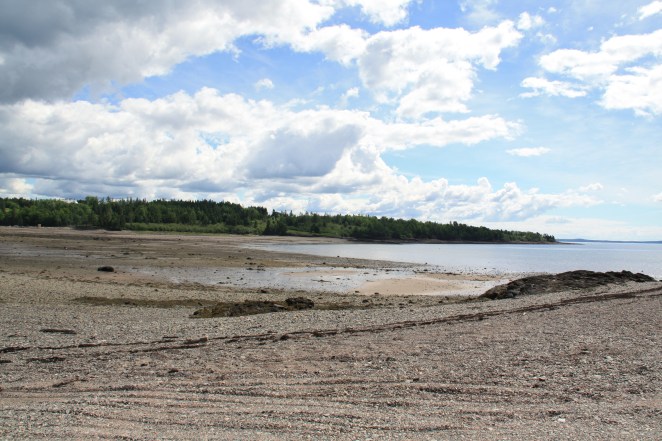
How do I know? Because I have been there. I have walked those beaches, explored those shores, got my feet dirty in the Passamaquoddy mud, climbed those hills, viewed those islands from both sides. I have been out to sea to see those whales, have crossed the Old Sow from side to side, have imagined myself as a pirate for the shortest of times, crawling my sailing ship around the whirlpool, listening to its sucking sound, watching the seals as they rose from the depths, the sea gulls as they dropped from the skies.

Within the gardens, I have touched those secret places, grasped the flowers, crushed the leaves of herbs between sightless fingers and raised those perfumes to blind nostrils. I have also breathed in the scents of salt borne on a sea wind caressing the cheek, smoothing the brow, bearing away the cares of city and suburb.

Renewal is here and now. It is the sea wind’s kiss, the suck of mud, between the toes, barefoot, the rise and fall of tides, the ocean’s life forced into our lives and floating our cares and despairs away. Nothing of the city lurks here to ambush us, unless you bring it with cell phone, computer, texting, and the dull, grey air that will soon be vanquished and whisked away by the breeze, terns, gannets, the seal’s nose breaking through the sea’s surface, the deer crossing the road, demanding their right of way.

At the end of my own residency in KIRA (June, 2017), I tried to summarize my thoughts about the experience. To read them for yourself, click on this link: Residency, June 29, 2017. I was invited by the Writers’ Federation of New Brunswick to write about my stay. To read that, please click on this link: KIRA: an intensive creative experience WFNB, August 5, 2017).

To find information about your own potential residency at KIRA, click on this site KIRA – Kingsbrae Garden or this one KIRA Boutique Writing Retreat.

 IMG_0464


Life-Long Learning

IMG_0068 (2)

Life-Long Learning
KIRA & Kingsbrae Gardens

It’s hard to believe I could be back with my friends at KIRA & Kingsbrae by the end of next month. What an honor and a pleasure to be invited to help facilitate the first KIRA Boutique Retreat on Creative Writing. Geoff, Jeremy, and me … we will make a truly creative dream team. We are working out the details as I type this.

My task will be to work with poets and short-story writers. I have just successfully completed two online courses from the School of Creative Writing at the University of Toronto, my  Canadian Alma Mater (MA, PhD). Kerry-Lee Powell offered the first course: Writing Short Fiction II, while the second course, Poetry II, found me studying with Sachiko Murakami.

Life-long learning is so important. Over my life, I am not that old at seventy-four, I have learned that it is the ability to change, to adapt, to learn new things, that marks us out as creative people. Since my escape from imprisonment in the Ivory Tower of Academia (aka retirement), I have ventured into several new worlds, including that of online learning. My two most recent online courses from U of T now stand alongside an online course from Humber College on novel writing. Alas, this course did more to confirm that I wasn’t really a novelist at heart. As we live, we learn. I have now laid aside my three embryo novels to concentrate on my stronger areas: poetry and short stories.

Along with these online courses, I have been through the give (offering) and take (participating) of multiple creative writing workshops. So much knowledge gained. I have also enjoyed several positions as academic editor, associate editor, editorial board member, of multiple national and international publications, in English, French, and Spanish. In each of these new adventures, there was so much to learn.

Now I have the chance to return some of that acquired and accumulated knowledge to others who, like me wish to practice their life-long-learning skills. The unique KIRA combination of conversations, selected workshops, one-on-one talks, round-the-table discussions, evening talks, and readings will open many horizons to writers old and new, and not least to myself. As I live, I learn.

Round-the-table discussions: The Spanish have a wonderful term for this, de sobremesa. This refers to the discussions that take place, around the dining table, when the meal is done and everyone is comfortable in each other’s company and multiple conversations flow.

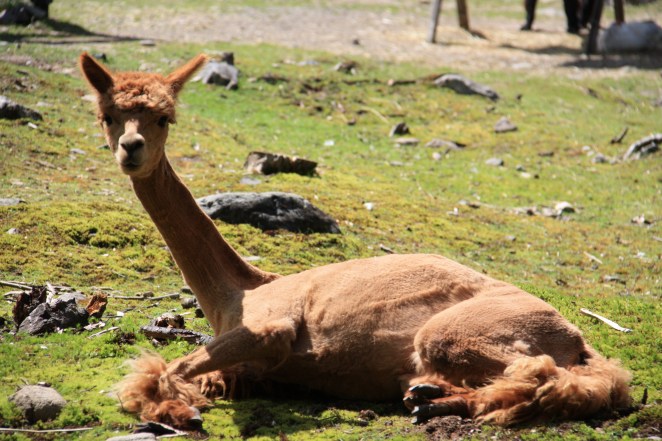
As for KIRA itself, I look forward to returning to my conversations with the land, the sea, the flowers, the birds, the statues, the alpacas … I love talking to them in Spanish … and the rowdy, old peacock who squawks his joy at evening, when the sun goes down. And don’t forget those Indian Runner Ducks: Beatrix Potter talked to them … and so did I … in fact, in Beatrix Potter’s case, one of her own Runner Ducks, possibly a distant cousin to those at Kingsbrae Gardens, became better known as Jemima Puddleduck. Who knows? Between poetry and painting, you too may find your own version of Jemima PuddleduckPaco the Alpaca, perhaps?

IMG_0124

IMG_0084

KIRA: The three standing stones, though I think of them as talking statues. I stood in the middle between them, closed my eyes, opened my mind, and listened to the magic as the breeze blew through them and sang secret songs to the music of their stone flutes. They filled me  with the sound of their ancient voices, their poems and stories, the magical mysteries of their myths. Come and visit and I’ll show you how to stand still and listen to what the stones have to say. When you allow that poetry to flow through you, you’ll never suffer from writer’s block again!

Writing at KIRA

39948917_706398923049634_3046174897211441152_o (1)

BOUTIQUE WRITING RETREAT
SUNDAY SEPTEMBER 30 – SATURDAY OCTOBER 6

This KIRA Boutique Retreat invites former KIRA Resident Artists (Roger Moore (June, 2017) and Jeremy Gilmer (July, 2018) to blend their knowledge and skills with those of the Kingsbrae Artistic Director, Geoff Slater, in a unique Artistic Retreat, tailored to the needs of each participant.

KIRA Boutique Retreats offer a series of one-on-one and small group encounters within the glorious surroundings of the KIRA Residence.

The KIRA Boutique experience includes scheduled one-on-one interviews with each of three instructors, Blue Pencil Cafés, small group workshops (according to demand), lively meal time discussions, and evening readings and talks by facilitators and participants.

The secret of these unique KIRA Boutique Retreats is the unbeatable ratio of participants to facilitators within a small, welcoming artistic community.

Your KIRA Boutique Experience may also include the wonders of whale-watching, the award-winning gardens at Kingsbrae, special events at the Kingsbrae Gardens, the beauties of the resort town of St. Andrews, and the outstanding gourmet food of the  Kingsbrae Garden Café.

As a participant, you can enjoy the solitude of your 20’ x 20’ artistic studio or you can join in the artistic discussions launched by our expert facilitators.

RETREAT FEES:

The KIRA Boutique Experience costs $750 for a six night residency.

This includes:

1. 6 nights accommodation in the beautiful KIRA residence.
2. 2 meals a day.
3. Tailor-made writing workshops (on demand).
4. Blue Pencil Cafés, one-on-one interviews with the facilitators.
5. Round-table artistic discussions at meal times.
6. Evening talks and / or open reading sessions.

Facilitators:

Geoff Slater, Artistic Director, Kingsbrae Garden / KIRA.

Roger Moore, award winning poet and short story writer, KIRA (June, 2017).

​Jeremy Gilmer, CBC finalist (short story), KIRA (July, 2018).

Please contact Mary Jones to sign up.

Phone 506-529-8281

PLEASE FEEL FREE TO SHARE THIS EVENT

Click here for the direct link to  KIRA and Kingsbrae.


Loss of …

IMG_0062.JPG

Loss of …

By the time I remembered your name,
I had forgotten your face. Then I couldn’t
recall why I wanted to talk to you.

I trace dark landmarks on the back of scarred
hands: blood maps, unremembered encounters,
dust covered photographs, grey, grim, anonymous,

not belonging in any family album.
At night I cruise among islands, emerald green
against sapphire seas. Why didn’t I visit

some of these places? Golden sand trickles through
night’s fingers and time’s hour glass, as stars
sparkle and planets dance in Platonic skies.

My memory fails. I wake each morning
unaware of where I have been the night before.
I track the sails of drifting ships, white moths.

I think I have caught them in overnight traps,
but they fly each morning in dawn’s forgiving light.
I give chase with pen and paper, fine butterfly nets

seeking wild thoughts waiting to be caught, then tamed.
I grasp at something just beyond my fingertips,
but I can’t quite remember what it is.

Comment: I first published this poem on July 31, 2018 (click here for the original post). Here it is now, in revised form. I find the revision process to be totally fascinating: the polishing of old ideas, the arrival of new ones, a different structure, a reshaping of the poem’s internal logic. So much happens in the revision process. Many great poets wrote and rewrote their poems, again and again.  I consider Francisco de Quevedo and Juan Ramón Jiménez to be poets who continually revised. A perusal of the variants to their poems (28 versions in the case of some of Quevedo’s poems) gives the reader an understanding of how the great poets think, of how they purge, intensify, sometimes simplify, usually improve their initial instincts. We lesser poets can learn so much from the greats. Above all, we can understand that poetry is a life-long practice, that it is a love of words and emotions, that it is a desire to catch and preserve the uncatchable that can never be completely caught. The critics say that the reader can never know the writer’s intentions. I agree with that, to a certain extent, as I never know why I am writing what I put down on the page. I guess I often have no intent. More important, my original intention can change as I write, and what I write is by no means what you understand I wrote when you read, for each of us processes the imagery, especially metaphors, in a different, and very personal, fashion. That said, when I rewrite a thought pattern emerges and my intentions become that much clearer, not from the words on the page, but from the footpath that led me in different directions until the final version emerged on the page.

Curse of Cursive

IMG_0004 (2)

The Curse of Cursive
Wednesday Workshop
8 August 2018

It appears we will no longer teach cursive writing in our schools. Instead, we will teach our children to print. I will not pass judgement on this decision. Quite simply, my handwriting has always been bad. Very bad. I have never worked out why, but I suspect that it is because I think very quickly and my hand tries to keep up with my brain, and the result is the scrawl that I call my handwriting.

I type with two fingers, too, and stare at the keyboard as I am doing so. I tried to follow a typing course one year. I worked at it for two months. At the end of that time, I tried my touch typing examination and managed a rate of 78 words a minute with an accuracy of  82%. I did the same test with my trusted two fingers: 114 words a minute accuracy rate 98%. Oh dear. I still type with two fingers and I still write badly and no, my thoughts have not slowed down.

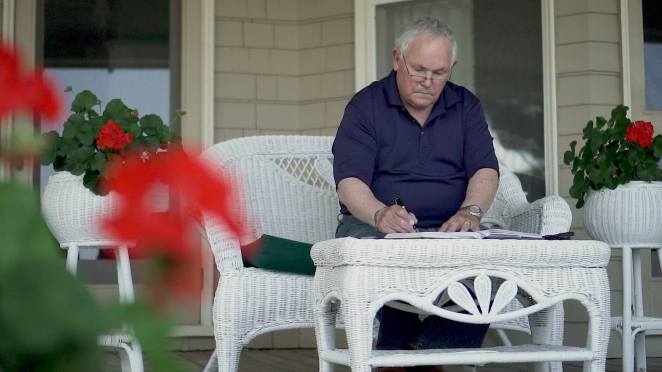
Just glance through the above photograph, taken from the journal I keep everyday. “Almas de Violeta,” it reads, “an early poetry book by Juan Ramón Jiménez, the Nobel winning poet, was first published in violet ink. I have a copy of his complete works, Obras completas, in which these early poems still appear in purple, or violet rather, to match the color of the title. He published in green ink too, but personally I prefer the purple. Bruised clouds on an evening sky, dark depths of a rainbow glow, Northern Lights singing at the deep end of their scale … or just a desire to be different … slightly different, as if that one thing, the color of my ink, might tip the scales and turn me from mediocre to celebrity with a wave of a violet wand or the click of a pair of ink-stained fingers.”

Now, wasn’t that easy! And there’s so much personality in tone and color, ebb and flow, the link of a poet to the words on his page.

Once, in a faraway library in a distant, magical land, I was studying an autograph manuscript, written by Francisco de Quevedo (1580-1645). The hand-writing began very steadily. Then I noticed a red dot or two on the page. Then a larger stain. Our poet was a notorious drinker. The letters grew large and loopy. The paragraphs sprawled. Punctuation marks and accents, slashed and splashed, and missed their targets. By the end of his evening, with his bottle surely empty and gone, I could just about make out what the good man had written.

When I turned the manuscript folio, from recto to verso, it was a new day and the original handwriting was back, small and neat. I have noticed the same phenomenon when I write late at night. Unreadable words, occasional wine splutters, spelling and grammar mistakes, disjointed readability … but the thoughts and the ideas are still there, still clear. Sure, I need a bit of hard work to interpret some things, but that’s the curse of the cursive, I guess.

Procrastination

IMG_0146

Procrastination
for my friend, Mr. Cake

It’s old age, I think:
I can manage
one thing a day,
depends on the weather,
then I forget,
then I remember,
but the weather isn’t right,
so I put it off again,
start a story,
write a poem,
the phone rings,
someone texts me,
there’s a knock on the door,
the crows in the garden
make me procrastinate,
(crass  Latin joke*),
then I remember
and feel sad,
and hair leaks from my head
like straw from a scarecrow,
and my teddy bear brain
turns to sawdust
when I scratch,
and what was I saying?
I guess I’ve forgotten,
I’ll sleep on it tonight,
and write again
tomorrow.

Note:
Crass Latin joke*
Cras is the Latin for tomorrow. Cras is also the sound, in Latin, that the crows make. Hence Pro-cras-tinate: to leave things for tomorrow, or to abandon them for tomorrow’s crows. The joke probably doesn’t belong in the poem, but darn, it’s my poem and I’m leaving it in there.

Comment:
This collection of thoughts started in a casual online exchange with my good friend, Mr. Cake. Sometimes words flow and it’s impossible to stop them. Sometimes, they hover like crows or croak at us from the tree tops where they sit ungraspable. My spellcheck tells me that’s not a word, but if it isn’t, it ought to be. Whatever: the world and its words are sometimes surreal and if you are interested in the surreal, then Mr. Cake’s blog is the place to be. Here’s the link. The site comes highly recommended. Click on it now and don’t procrastinate. Mr. Cake’s Blog.

Butterflies

img_0189

Butterflies

“Poetry gives permanence to the temporal forms of the self.”
Miguel de Unamuno.

That is what my writing is all about,
those temporal forms, fluttering and changing.
Butterflies, they live for a day or two,
perch and flourish, spread their wings,
excel for a moment, catch my attention,
then blown by a sudden gust of wind,
they tear their wings on a thorn
and perish in the blink of an eye.

Reborn in ditches, they cluster and gather,
congregate, black and yellow, on bees’ balm,
smother Cape Daisies and Black-eyed Susans.

Like shadows they shimmer, butterflies by day,
fireflies by night, terrestrial stars, lost, wandering,
floating in their forest firmament, hackmatack,
black oak, bird’s eye maple, silver birch, fir …

Impermanence surrounds us, dances beneath stars,
sings with robins, echoes the owl’s cry through woodlands,
poetry, the elemental soul, our words capturing nothing,
turning it into eternity, holding it for the briefest moment,
then letting it go. Island View, New Brunswick, Canada,
my home in the woods, my dialog with my place and time.

Losing Weight

img_0033


Losing Weight

First, you must study Nature.
It will make you aware
that trees lose weight
by shedding in the fall
their useless leaves.

Do they ever grieve
you wonder, when winter
winds strip twig and branch?

That dog who owns your heart,
he sheds his coat and shakes
away both water and fleas.
Dogs can lose weight
whenever they please.

Don’t bother to diet.
Step fully clothed
on the bathroom scales,
then shed your leaves,
twigs, branch, and fleas.
You’ll lose a pound or two.
Believe me … and try it.

Comment: This turned up on my Facebook page this morning, a one year ago today item. I don’t even remember writing it. It’s quite fun, though. So: forget those fancy and expensive diets: there’s more than one way to lose weight.


Lullaby

IMG_0124

Lullaby
Wednesday Workshop
11 July 2018

One of my close friends asked me if I would write her a lullaby. Without a moment’s hesitation, I said “Yes, of course”. Like a fool, I rushed in where no angel would ever care or dare to tread. I sat down and straightaway started to write.

The first thing I discovered was that a lullaby has to rhyme. I couldn’t write one unless it went bumpety-bumpety-bump + rhyme. I wrote several of those and they were all awful. Well, I thought so anyway, and I couldn’t imagine any young child willingly go to sleep while having an adult leaning over them and chanting at them.

The next thing I found out: it’s not easy to write poems, even a lullaby, for other people. Why not? It took me some time to understand that while I write poetry from within myself, heart, stomach, and gut, the lullaby I was writing was not written for me, but for a second person who was not me. What would this friend like to read? How would they like it to sound? By extension, there were not two people involved: I was also writing for an unknown child whom I had never seen. I didn’t know their likes and fancies, nor what would fill them with fear, nor what would successfully send them off to sleep. This three-way traffic was unnerving.

Third problem: a lullaby is a cliché and is filled with clichés. Close your eyes. Sleep, baby, sleep. I will rock you. More important, perhaps, the clichés are not just verbal, they live in the rhymes as well: sleep, deep, keep.

My telephone talks with other writers led me to the theory that rhythm was what mattered. Rhythm, comfort, rhyme, gifts, and the allaying of fears. So easy to write, so hard to fulfill, especially in an age of instant communication. As I wrote, so different formulae marched through my head. I recalled the lullabies my parents and grand-parents sang for me, apparently not very successfully, I was a terrible infant at bed-time. I have more memories of being set to bed, often without supper rather than being sang to in bed. Then there was boarding school (age 6) and the faceless matrons in comfortless dormitories where, more often than not we cried ourselves to sleep. Hush little baby don’t you cry.

So, rhythm, rhyme, nonsense words, dream worlds where everything is good. Along with traditional lullabies like All through the night / Ar hyd a nos, my head filled up with reminiscences of Dylan Thomas, and in the evening, when the sun goes down, / I ask a blessing on this town, and Federico García Lorca, La luna vino a la Fragua / The moon came to the forge.

So much happening. So much laundry passing through the washing-machine of my mind where the waters churned away and rhymes were soaped, rhythms were bleached, ideas were blended and rinsed. I wrote five. I am not sure of any of them. They certainly kept me awake most of last night, syllable counting on my white woolly sheep-fingers, that brought no sleep. I tried counting my blessings too, but that didn’t work either.

Question: does anyone actually want to read my lullabies to keep a child awake? If so let me know. You might persuade me to post one or two.