Latch-Key Kid

Latch-Key Kid

In one room in my head, I stand on a stool beside my father’s mother helping her to mix the cake she will later bake in the wood-fired oven of her black, cast-iron stove. Every time she mixes a cake, she places a small piece in a dish and bakes it just for me. As a child, I spent hours in that kitchen, watching her cook. When she boiled vegetables, she never threw out the vegetable water, but used it for boiling other vegetables or for making rich, thick, delicious gravy.

Later, with both my parents working, I became a latch-key kid. I spent all day in an otherwise empty house and cooked my own breakfast and lunch. I also prepared supper for my parents so that it would be waiting when they came home. I grew up loving to cook.

When I went abroad to spend my summers in Spain or in France, I spent as much time as possible in the kitchens, watching, listening, learning. The women always had time for a small child. Then men seldom did. Children should be seen and not heard. They just got in the way. That was the male attitude. I learned so much in those kitchens.

Later, in Santander, my landlady would place one egg, one onion, and one potato beside the stove. It didn’t matter what time I came back from a night out with the boys, my supper was there, a Spanish omelet, una tortilla Española, waiting for me to cook it. Sometimes she left me a piece of chorizo, but I preferred the omelets. I did enjoy making shapes and designs out of the chorizo – that was always fun.

Not many people knew about my cooking skills. One of my aunties always cooked for me. She told me that her husband didn’t even know how to boil an egg. The men in my family seldom cooked, except for my maternal grandfather, who learned how to fend for himself in the trenches and dug-outs during WWI. He taught me how to make stews and soups, rich and nourishing, and always better on the third day. He also told me what he put in them – and you wouldn’t want to know about what he hunted and scavenged to stay alive in those cold, dark days. Nowadays, so many of us just don’t know how lucky we are. I do know how happy and lucky I am, not to be homeless, not to be living out on the streets, dependent on soup kitchens, charity, and fighting the elements just to stay alive.
What’s your favorite recipe?

What’s my favorite recipe?

I find it hard to talk about my favorite recipe at a time when so many people in this world of ours are desperately short of food. I get regular messages from the local food bank – can I help them out? And I try to do my best. Alas, my pittance is a drop in the ocean of want and need.
Our local supermarkets have food baskets that you can add to your food bill. These will then be handed over to those who distribute food to the needy. Then there are the checkouts where I am regularly asked if I will add $2 to my bill for the food bank. I usually give $5 or $10.
I see old men sitting at the entrances to stores, a coffee cup before them with some petty cash in it. I also see homeless, workless people at traffic lights with signs held up, asking for cash.
I don’t want to start on war zones, on the accidental-on-purpose starvation of people, on the targeted destruction of homes, animals, and crops. Nor do I want to contemplate the rising prices of what used to be staple groceries and are now becoming luxury items – olive oil, meat, coffee.
While I can still afford some, but not all, luxuries, far too many people can’t. And yet you ask me what is my favorite recipe? Well, here goes –

Take one pound of charity, stir in a pound of love, add a spoon full of humanity, mix with half a pint of the milk of human kindness, sprinkle the mix with a half cup of sugar – to take away some of life’s bitterness, pepper it with ground Good Samaritanism – to add some neighborly love, and complete it with essence of humanity – to remind us that we are still human. Then distribute it, free of charge, everywhere you possibly can but, above all, not just to the needy, but to those who are capable of changing the situation, but for some reason or other, refuse to do so.
Pax amorque.

What’s the most money you’ve ever spent on a meal? Was it worth it?

Daily writing prompt
What’s the most money you’ve ever spent on a meal? Was it worth it?

What’s the most money you’ve ever spent on a meal? Was it worth it?

The real question is not, how much money did you spend, but was the meal worth it! Think hamburgers – they can vary in price from a couple of dollars to twenty or thirty dollars, each. Is a good hamburger at $2.00 worth more than a rotten hamburger at $20.00? Of course it is. However, if you get a rotten hamburger at $2.00, even those dollars seem to be a waste of money, in the stomach pains of post-gobbling regret.

The same question and answer can be applied to most things – a sweater, a suit of clothes, a dress, a diamond ring… What we are really talking about is value for money. One of the best meals I have ever eaten was at a small restaurant outside the railway station in Lisbon. I arrived early for the overnight train to Madrid, checked my luggage in the left-luggage office, and walked down the road to this wonderful restaurant. I had plenty of time.

When I arrived a plate of hors d’oeuvres appeared before. These were meant to be snacked on before I placed my order. I asked for the menu of the day and chose pork tenderloin cutlets, with patatas bravas (hot spicy fried potatoes). After this came a small omelet, with fines herbes, French style, and this was followed by a lettuce, tomato, onion salad, in an oil and vinegar dressing. A fresh loaf of bread accompanied the meal and red wine was served throughout. Dessert was half a melon, hollowed out, filled with ice cream and soaked in cherry brandy. Afterwards, came a cigar (I smoked occasionally in those days), and a glass of brandy, with espresso coffee. It was simply delicious. How do you valley such a meal? I asked for the bill and reached for my traveler’s cheques (these were indeed the old days, before the ubiquitous credit card). I was ready to pay what the waiter demanded.

When the bill came, I couldn’t believe my eyes – $25, $50, $75, $100? No such luck. $4.50 and $5.00 with the tip added on. I didn’t need my traveler’s cheques. I pulled my wallet out and gave the waiter the equivalent of $10. What a wonderful meal. Totally unforgettable.

I have eaten in five star restaurants, in Michelin recommended restaurants, in restaurants owned by the friends of friends, and I have been ripped off, left right, and centre / center – whichever way you want to spell it. I have often found that the simple restaurants, with home cooking, and a simple menu were better than the over-rated, highly expensive, glitzy showpieces.

In Santander, we used to regularly visit a small restaurant that specialized in fish. The owners had their own fishing boat. They would net fish at sea, but line fish on the way back to port, genuine trawling, the old-fashioned way. The fish they caught was fresh, unbruised from the nets, and, at their restaurant, always cooked simply and well. Family and friends, we all shared the bounty of the sea. And the prices were low, while the quality and love was high.

Discourse Analysis – look at the question. Think about the words and ask what they mean. Search beyond them (and the simple answer) for the true values by which you wish to live your life. Do you crave the $100 cigar, or the free one delivered to your table after a wonderful meal? The $100 sauces that cover up the taste of the rancid meat or fish, or the simplicity of family food, hand picked and as fresh as fresh can be?

Oh yes – and I remember waiting two hours for my meal at one restaurant, a tiny one in a small community in Northern Spain, that nestled by a fish-filled stream. The trout, fried with bacon, were on special. The owner’s son had been sent to the stream to catch them, but they were slow to bite that day. The wine and tapas were free until the meal arrived. And arrive it did, dripping wet and still wriggling slightly. Twelve delicious trout, four each between the three of us. Who’s for fast food? Not me. I want the simple life – shared with friends and filled with love – any day of the week, no matter the cost. But when you look well and seek wisely, it will not cost that much – and it will be unforgettable.

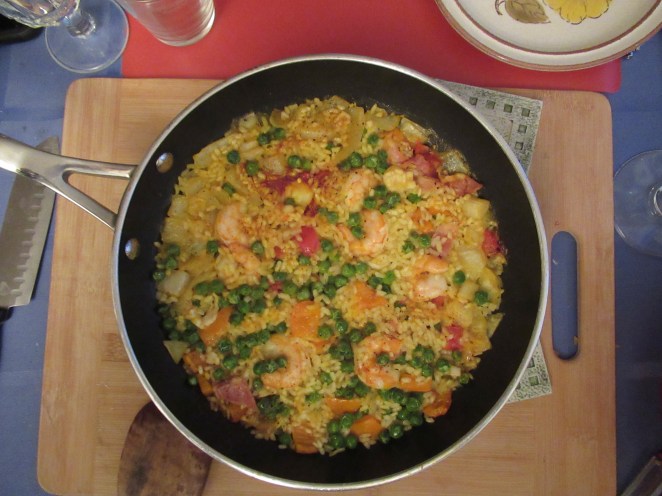
And look at the paella I made for my beloved and I – in the photo above -. Warm for supper and cold for lunch the next day. Simple, relatively quick, and four round meals (they really weren’t square) served at about $2.oo a plate. Unbeatable. Unforgettable.

On what subject(s) are you an authority?

Daily writing prompt
On what subject(s) are you an authority?

On what subject(s) are you an authority?

First, I would like a definition of an authority. Here’s what I found – 1. the power or right to give orders, make decisions, and enforce obedience – as in “he had absolute authority over his subordinates”. 2. a person or organization having power or control in a particular, typically political or administrative, sphere as in – “the health authorities”. Isolating the words enforcement, power, and control, I am delighted to say that no, I am not an authority on anything, and I have no control over anyone. Also, I am not a monarch, and I have no subjects.

What happens if we change the meaning of the words slightly and ask another question? Here is a suggestion from the online Cambridge Dictionary – searching for an answer to my question “What is an example of authority on the subject? – I found this – The phrase “authority on the subject” is correct and usable in written English. You can use this phrase to describe someone who has extensive knowledge or experience on a particular topic. For example, “Dr. Smith is considered an authority on the subject of modern psychology.”

Now this becomes a very interesting question and it can be answered from a variety of perspectives. In our two person household, I deem myself an authority on some forms of cooking. I regard my beloved wife, my better two-thirds as I call her – an authority on the forms of cooking that I have trouble with – for example, baking, cooking vegetables, boiling eggs. She does a wonderful boiled egg. I am hopeless at boiling eggs – either too hard or too soft, usually the former. But I am the authority on Spanish omelets and scrambled eggs. They are my specialities. She makes wonderful chowders. I specialize in gazpachos, sopa de quince minutos a very quick (15 minute) Spanish sea-food soup, and Cawl Mamgu and other Welsh stews.

Once we step outside our kitchen, the world changes. In a world (New Brunswick) where cricket is virtually unheard of (save in the minds and cultures of fellow immigrants) I am considered an authority on cricket. Not that I am an authority, but at least I know what it is and have a good idea of what is happening in a cricket match. Therefore, we must also consider ‘being an authority’ in the context of the audience that receives our words of wisdom. To my nine year old grand-daughter, I am an authority on several subjects. However, I have absolutely no control over her – how she thinks and what she does. I can suggest or persuade, but I cannot and will not enforce.

In the undergraduate classroom, in which I taught for 43 years, I was considered an authority on Spanish by my students. Outside the classroom (and sometimes inside it) I learned more from my students than they ever learned from me, especially in my formative years as a Canadian when I was learning to skate and to ski. Don’t go there – too many painful memories of falling only to rise again!

But when we moved from the classroom to the wider university, to the full Canadian Scene of the Learned Societies, as they used to be called, I became the learner and the authorities were to be found elsewhere, often on the podium, sometimes in the bar. Same thing when we move onto the international stage. There are very few world authorities, in my field. However, there are many wannabe’s, but for them, after careful analysis of their strengths and weaknesses, I have usually had very little respect.

So, today we have opened another can of worms and look at them, wriggling and crawling before our very eyes. Worms – one of my friends really is an authority on earth worms. She knows all about them. Another of my friends is an authority on worms in puppies and kittens. A world wide authority, known every where and often quoted? I doubt it. But certainly in my garden and the vet hospital where I take my pets, they are both authorities.

Ah, the joys of Discourse Analysis – maybe, one day, I can be an expert on that. But take my words, as always, with a large pinch of salt, and, whatever you do, don’t put salt on slugs, and snails, and puppy dog tails. On that point, we can all be authorities.

What’s the most delicious thing you’ve ever eaten?

Daily writing prompt
What’s the most delicious thing you’ve ever eaten?

What’s the most delicious thing you’ve ever eaten?

No single item of food stands out. That said, eating is a cultural thing – does one eat on one’s own, or does one eat with family and friends? What role does food play in one’s life? For me, for example, food is cultural, an occasion, not a meal. For example, a fresh, Spanish croissant, for breakfast, a late breakfast, at the bar in the Rincon, Avila. Before me, the daily newspaper, open at the page with the daily chess problem. The coffee, freshly brewed, a cafe con leche, and the croissant, waiting to be dipped in the coffee, and the resulting delight transported to my mouth. Sometimes, there are no croissants left. Then, one of the world’s best kept secrets, un sobao pasiego, a small sponge cake, from the Vega de Pas in Cantabria. It holds together when dunked and can be eaten moist or dry.

By extension, when younger, after an afternoon’s soccer on the beach – la Segunda Playa del Sardinero, in Santander – cool red wine from a porron, and selected seafood in the form of tapas, nibbled with the other players, as thirst is quenched, and the appetite that comes from running on warm sand under a hot, summer sun, is slowly sated. Seafood – this includes octopus – pulpo a la gallega – or squid – calamares rellenos en su tinta – or caracoles de mar – sea-snails – or oysters, fresh, with a squeeze of lemon – or mejillones en salsa de tomate – mussels in tomato sauce – gambas a la plancha, roasted shrimp – or gambas al ajillo, pan fried shrimp in garlic – or almejas a la marinera, clams, Spanish style – the point is to ganarse el puchero / to earn your food, by dint of hard work, and to share it with your friends.

When I think of Welsh food, once again, it is the family gatherings and the love around the table that dominates. Under these circumstances, a simple boiled egg – not everyone can boil an egg properly – with hot toast and fresh salt butter, can be an overwhelmingly delicious meal. Eggs – so supple, so creative – scrambled eggs, creamy and lightly curded – an omelette aux fines herbes, with a lightly tossed green salad – a tortilla espanola, easy to prepare, but incredibly difficult to prepare to perfection. Free range eggs, fresh from the hen house, sea salt prepared locally, olive oil from a local terroir, potatoes, also local, onions from the garden. Each of these contains within it the taste of the same earth, the same air, the same rain.

Speaking of which, to travel to the high hills in the Province of Avila, and to smell the herbs that grow in the sheep pastures, thyme, rosemary, and to know that the flesh of the spring lamb will be flavoured by the herbs it has been eating – even the lechazo, a lamb still on its mother ‘s milk, tender, so tender, and so small that it broke my heart to see it. A lamb so small that I couldn’t eat it. I watched it appear on the family table and vanish in a couple of mouthfuls, washed down by a specially selected wine. I enjoyed the company and the rest of the meal. But I’ll never forget that tiny lamb.

However, it’s never just about food – it is about the cultural content of the room, the family, the table, the friends, the joy of sharing and caring. Oh dear, and I never got around to telling you about the paella I made, the ones that appears in the lead photo!

Which food, when you eat it, instantly transports you to childhood?

Daily writing prompt
Which food, when you eat it, instantly transports you to childhood?

Which food, when you eat it, instantly transports you to childhood?

That’s an easy one – diolch yn fawr / thank you very much – and the answer is Bara Lawr / laverbread of course.

What does laverbread taste like? I must thank Wikipedia for the answer below.

Welsh Laverbread (PDO) | Business Wales - Food and drink

Welsh Laverbread is made from cooked laver (seaweed) which has been plucked by hand from the Welsh coastline. It has a unique texture and salty flavour which provides a taste of the fresh, Welsh sea. Laver or Laver porphyra umbilicalis is the only seaweed which is only one cell thick.

And click on the link for a video from YouTube on the Traditional Welsh breakfast.

Laverbread could be found all around the Gower Peninsula in my childhood. When I was very young, you could buy it at Swansea Market for three pence a pound. Later, the price went up to sixpence a pound. When I lived in Cardiff, back in the early sixties, it sold at a pound per pound. Later, as the coast around Wales became more and more polluted, the sea weed had to be imported from the West of Ireland, and that certainly drove the price up – five pound a pound in the eighties.

But laverbread has two histories – the scientific / culinary one, and the personal one. Laverbread, on the plate, looks suspiciously like a cowpat. So much so, that when the cows visited the bungalow field where we had our summer home, the cowpats were called laverbread. “Don’t step in the laverbread, dear.”

Field rolling was a childhood joy. Start at the top of the slope and roll all the way down to the bottom. Born and bred in a laverbread field, we would plot our route between the patties before we rolled. Alas, our London cousins, with their cockney accents, were city and street wise, but not laver bread wise. Down the field they rolled, without looking, right through the laverbread patches. I leave the ensuing scene to you imaginations – and remember that the bungalow had no electricity in those early days, and no running water.

I remember the first day my beloved came to visit us at home. My mother served her fresh hot laverbread. Of course, she had never seen anything like it, except genuine Somerset cowpats. She picked around her food, left the laverbread on her plate until it cooled and – “Hold on a moment,” said my mother, “your laverbread’s cold. Here – I’ll warm it up for you.” Poor Clare. I am ashamed to say, I ate her helping while my mother was looking elsewhere – just devoured the extra portion, enjoying every moment, and Clare was so happy to see it disappear.

Here, in New Brunswick, while Clare was away one weekend, Becky and I decided to make laverbread from dulse. We followed the recipes and they worked. The laverbread was delicious – but – ah yes, there’s always a but – but the house stank of the sea shore at low tide and the first thing Clare said when she got home was – “What is that awful smell?”

I remember, opening a closet to get a clean shirt, about six weeks later, and that familiar whiff of the seashore immediately assaulted my nostrils. Alas, Becky and I love our laverbread, but -there’s that word again – but making it in our house long been banned.

What foods would you like to make?

Daily writing prompt
What foods would you like to make?

What foods would you like to make?

Walking round the supermarket the other day, I was astonished by the high prices now written on labels. Meat is virtually unaffordable, especially the good cuts. Butter at $9.00 a lb is a shock to the system. Eggs are up to $6.00 or more for a dozen. Wow! So much of what I used to cook I can now no longer afford. So What foods would I like to make?

Good, wholesome, cheap, nourishing foods. Foods that could be distributed to the city’s poorest people, at very little cost. Foods that would support those who are struggling with high rentals or rapidly climbing mortgages. Foods that would give a genuine opportunity to do both, to those who are wondering whether they should heat or eat . Foods that would allow people to stay on their medication and not be forced to choose between eating, heating, or skipping their pills.

Now, with these enormous heatwaves, house-cooling is also a priority, as is clean air, and clean water. Our food preparation, sooner or later, will have to take so many different factors into account. ‘Brother, there’s a reckoning comin’ in the morning’ – the spiritual says it well and speaks true – ‘better get ready ‘cos I’m giving you the warning’.

And remember, the percentages of people who can no longer afford to live a decent, respectable life is rising, not falling. Food Banks are on the rise and more people are using them. Soup kitchens too. In the United Kingdom, now known as the Untied Kingdom, it is rumored that government is cutting sponsorship to food banks so that more people will return to their daily gigs and fulfill their duties of supporting themselves financially by seeking multiple employments at minimum wage or less. Alas, even then, with multiple jobs and moonlighting, they cannot necessarily sustain a decent life-style.

So, what foods would I like to make? Good, cheap wholesome foods that would support a maximum number of people for a maximum span of time. Pax amorque.

A Very Spanish Omelet

A Very Spanish Omelet

Spanish Omelets – I learned how to cook them in Santander, Spain, when I was attending summer school at the Universidad Internacional Menéndez y Pelayo. No – I didn’t learn at the university. My landlady taught me. She always left me an egg and a potato for supper. The first night she showed me how to cook a tortilla española. She showed me how easy it was – and from then on, she left the ingredients out for me and allowed me to cook the nightly omelet for myself.

Ingredients: splash of olive oil, pinch of salt, 1 potato (peeled, diced, or sliced), 1 egg.

Preparation: heat frying pan, put in the olive oil, let it warm, add the diced potato, add pinch of salt (to taste), fry until golden brown (or to taste) stirring all the while. Beat egg in a bowl. Add beaten egg to fried potatoes to make omelet. Turn omelet over in pan to cook both sides.

Seems simple, eh? But not so fast. Olive oil: I prefer Spanish olive oil, of a good quality. Other national olive oils will serve just as well, but they will change the taste of your omelet. Pinch of salt: now that’s easy. Or is it? I prefer pure sea salt. However, check the chemicals listed on the side of your salt box. Some add iodine, others sugar. No two salts are the same. Your omelet will change taste with the salt you choose. Gets complex, doesn’t it? Nothing complex about a potato, is there? But kind of potato will you use? The Universidad de la Papa in Peru lists approximately 80 different kinds of potato. Each kind will change the taste, and the texture of your omelet. Dicing or slicing? The cut of the potato will also change the taste of the omelet. When we took omelets to the beach in Spain, we always knew who had made the omelet according to the way in which the potato was sliced. Thin slices or squarish chunks? Regular cut or cut in irregular fashion? Sliced then chopped smaller? And as to the potato prior to frying, par-boiled or uncooked? Both ways lend a different texture to your omelet. De gustibus non est disputandum – there is no arguing about taste. There is nothing as simple as an egg – really? White shell or brown? Pale yolk or dark? Free range or battery hen? Fresh or, well, just hw fresh are some fresh eggs – “Eggs from Australia, fresh as the morning” -? Guess what – you omelet will change in taste, texture, and color according to the type of eggs that you use and the chicken that laid them. I wrote Add beaten egg to fried potatoes to make omelet – very true. But the good cooks that I copy actually add the hot fried potatoes (with as little oil on them as possible) to the whipped egg, and allow them to settle and gel together before returning the mixture to the pan. Not so simple then, this omelet cooking. Experiment. Try different methods and different blends of the four basic ingredients. When you find the blend you like best, stick to it.

Cebollista o anti-cebollista – the annual tortilla cooking competition in Galicia permits only four ingredients, as listed above, in their omelet entries. They do not permit the use of onions / cebollas. If you do wish to add an onion to the potato mix as it fries, you may most certainly do so. But the same cautions apply to onions as to potatoes. Be aware of what you are using and how you are using it. And whether you choose to use onions, or not, remember you have chosen a side in an ongoing war – cebollistas contra anticebollistas! Most people are one side or the other, rarely both.

Other things often appear in Spanish Omelets, sometimes under one name, sometimes under another. Next time, if any interest is shown in these recipes of mine, I will elaborate more on The Very Spanish Omelet.