Carved in Stone

Carved in Stone

28

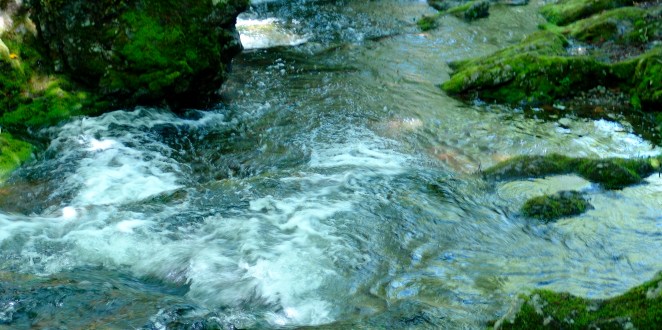
The man who cannot cry
is dry indeed,
his inner space
a wasteland without rain.

Who can now walk forty days
in a desert wilderness,
without water?

Where is that crystal fountain,
with its healing streams
flowing from the rock,
its waters flowing through us,
bringing us tears of sorrow
and tears of joy.

Water and words –
they drift through me
and shadowed waves move,
shifting shape in the changing light.

29

A rising moon,
shimmers over the bay.
It reveals the path
that leads me back
to my primal waters.

Oh, salt flow of tears,
salty the waters
of the baptismal font
washing away all stain of sin.

Immersion in water,
a new start, a new life,
and all the soul-sweet eternities
of water and the word.

Commentary:

Water – such an important commodity, and filled with so much symbolism, religious and otherwise. And our bodies, on average, are composed of 60% water. We can survive for three days without water, if we are lucky. How precious it is. How much we depend on it.

The Bay of Santander, so beautiful beneath the moon. And I remember the full moon’s circle touching a rocky triangle as it rose above Peña Cabarga. Oh, the night life of the fish as they rose in the bay and basked in the moonlight. How often was I tempted to walk out along that moon path and walk the waves to Somo and Pedreña on the far side of the bay.

Immersion in water, a new start, a new life, and all the soul-sweet eternities of water and the word. Total immersion, then, not just in languages, but also in water. Where would we be without those life-long commitments, not to mention the crystal fountain whence the healing streams do flow?

What’s the most delicious thing you’ve ever eaten?

Daily writing prompt
What’s the most delicious thing you’ve ever eaten?

What’s the most delicious thing you’ve ever eaten?

No single item of food stands out. That said, eating is a cultural thing – does one eat on one’s own, or does one eat with family and friends? What role does food play in one’s life? For me, for example, food is cultural, an occasion, not a meal. For example, a fresh, Spanish croissant, for breakfast, a late breakfast, at the bar in the Rincon, Avila. Before me, the daily newspaper, open at the page with the daily chess problem. The coffee, freshly brewed, a cafe con leche, and the croissant, waiting to be dipped in the coffee, and the resulting delight transported to my mouth. Sometimes, there are no croissants left. Then, one of the world’s best kept secrets, un sobao pasiego, a small sponge cake, from the Vega de Pas in Cantabria. It holds together when dunked and can be eaten moist or dry.

By extension, when younger, after an afternoon’s soccer on the beach – la Segunda Playa del Sardinero, in Santander – cool red wine from a porron, and selected seafood in the form of tapas, nibbled with the other players, as thirst is quenched, and the appetite that comes from running on warm sand under a hot, summer sun, is slowly sated. Seafood – this includes octopus – pulpo a la gallega – or squid – calamares rellenos en su tinta – or caracoles de mar – sea-snails – or oysters, fresh, with a squeeze of lemon – or mejillones en salsa de tomate – mussels in tomato sauce – gambas a la plancha, roasted shrimp – or gambas al ajillo, pan fried shrimp in garlic – or almejas a la marinera, clams, Spanish style – the point is to ganarse el puchero / to earn your food, by dint of hard work, and to share it with your friends.

When I think of Welsh food, once again, it is the family gatherings and the love around the table that dominates. Under these circumstances, a simple boiled egg – not everyone can boil an egg properly – with hot toast and fresh salt butter, can be an overwhelmingly delicious meal. Eggs – so supple, so creative – scrambled eggs, creamy and lightly curded – an omelette aux fines herbes, with a lightly tossed green salad – a tortilla espanola, easy to prepare, but incredibly difficult to prepare to perfection. Free range eggs, fresh from the hen house, sea salt prepared locally, olive oil from a local terroir, potatoes, also local, onions from the garden. Each of these contains within it the taste of the same earth, the same air, the same rain.

Speaking of which, to travel to the high hills in the Province of Avila, and to smell the herbs that grow in the sheep pastures, thyme, rosemary, and to know that the flesh of the spring lamb will be flavoured by the herbs it has been eating – even the lechazo, a lamb still on its mother ‘s milk, tender, so tender, and so small that it broke my heart to see it. A lamb so small that I couldn’t eat it. I watched it appear on the family table and vanish in a couple of mouthfuls, washed down by a specially selected wine. I enjoyed the company and the rest of the meal. But I’ll never forget that tiny lamb.

However, it’s never just about food – it is about the cultural content of the room, the family, the table, the friends, the joy of sharing and caring. Oh dear, and I never got around to telling you about the paella I made, the ones that appears in the lead photo!
Bay of Santander – 1963

Bay of Santander
1963

I stood there
on the sea wall
calling out to the dark
“Help!” “Save me!”

Moon hid her face
behind veiled clouds.
All hope denied
I called out to the tide,

outgoing, to take me
with it, out to sea,
past the island
and the lighthouse,

out to where the waves,
stronger than anything
I ever knew, would thrust
strong fingers under my arms

and lift me up,
then drag me down,
so I could finally rest
in peace, and drown.

Comment:
This painting is called Picking at Scars. Some scars run so deep that they are always there. When they itch, you scratch them, and they bleed afresh. The scar of loneliness is one such scar. Alone, in a foreign land, learning their language, the culture, their customs, feeling not just unaccepted, but unacceptable, and the moon at night shining on a land, a bay, a city, to which you know, deep in your heart, you will never belong. That loneliness walks with me still and, sixty years later, it still leaves me desolate.

Universitario Rugby Club, Santander

Universitario Rugby Club, Santander.

This photo just reappeared on Facebook, posted 17 October 2016. I couldn’t believe it then, and I can hardly believe it now. What an honor. What memories. Imagine: immortalized on a beer pump in the bar of a foreign-to-me-now rugby club.

“There is some far corner of a foreign bar
that is forever Canada, and Wales.
And in that bright brew,
a shadow will remain,
a memory, ghosting through,
whose stay was not in vain.”

Vanity of vanities, all things are vanity. The Olde Order changeth lest one good custom should corrupt the world. The memories fade as faces age and friends grow distant. They fade away like dreams in the early light of day.

Pepe’s Bar

Pepe’s Bar

Friday Fiction

Pepe’s bar was at the top of a steep, cobbled street, on the left-hand side. When we got there, it was crowded with men, mostly fishermen off the North Atlantic ships that cross the sea to the Grand Banks of Newfoundland. The men stay away for weeks at a time, and when they get back home, they too have a huge thirst, large and curious appetites, and money with which to indulge them. We all pushed our way into Pepe’s bar to join the crowd.
            “Phew! Let’s get out of here. The place stinks of fish!”
            “We can’t go without drinking something. You know what Pepe’s like.”
            “Let’s share a porrón.”
            And a porrón of red wine duly appeared. The porrón is designed for a small boat in the open sea. It is a glass flask of variable size, holding half a litre or a litre of bright red wine, depending upon the number of people drinking from it. It has a wide funnel at one end through which the wine enters and a thin spout at the other through which the wine exits in a fine ruby jet which the experts shoot directly into their mouths; done with skill, no lips ever touch the flask which circulates from hand to hand amidst cries of appreciation for the skilled and jeers for the careless (and the educational tourists, like me, here to learn about the language and the culture) who suddenly choke and cough as they squirt a red stream of wine up their noses and onto face, shirt, and tie. By dint of hard work, some of it done in the bath tub at home while nobody is watching, I can manage a porrón in the quiet confines of the bar; but I still don’t know how I would fare, out at sea, in an open, wind-swept boat.
I was soon going to find out.

Cave Paintings

Spotify
Don’t forget to scroll down to appropriate audio episode.

Cave Paintings
Cantabria

Who painted these pictures on the walls of night’s cave?
This grayish hand, fingers flexed, outlined in black soot,
that deer dancing, those bears, horses, bison, running?


Did they come from nowhere, plucked from nothing but
the artist’s memories of what he saw as the ice age faded
and heat and warmth returned to warm his world? Drawn
from life, without doubt. Unless these Neanderthals were
truly creating art from a literal vacuum with nothing new
invented since according to Picasso. And he should know.

Imagine them as sounds, as letters from distant relatives,
as colored vowels scored on the blocks of a child’s first
alphabet set. Sit and stare. Watch flames flitter over
sharp shapes. See life enter the drawings as flimsy
light flickers over the cave walls’ dips and bumps.

Once seen, never forgotten. Not just the paintings, but also
the clammy cave damp, the red hanky draped over a pocket torch
to imitate firelight, the drip of water, slow growth of limestone
deposits growing into stalagmite and stalactite. Such things
flit in and out of my mind like owls or bats, drop in on my sleep
wake me with predatory beaks and claws, calling for my skull’s shut
doors to open wide, to let them in, and to bring them back to life.

Comment: The picture comes from an ash-tray my parents bought at the Cuevas de Altamira, in Santillana del Mar (Cantabria, Santander as it was known then) in 1963. We visited many cave sites in Cantabria including Puente Viesgo, where we saw the sooty hands. Back then, the caves had only just been opened. At Altamira, a young lady came to greet us. We asked her if we might view the caves and she whistled loudly. Her husband came down from the fields where he was working. He took a large iron key from his pocket, opened a huge door set in the rock, and in we went. One light bulb illumined the inner chamber. Only a small segment had been dug out. We reclined on a rocky bank. He doused the electric light, took a torch from his pocket, and covered it with a red pocket handkerchief. He moved this back and forth to imitate firelight and immediately the whole wall came to life and the animals moved in the flickering light. Pure magic. Unforgettable. We were the only people there. Four of us. A few years later, you had to book an appointment and a place. Within six years, the caves were closed as the heat of human bodies raised the cave temperatures and caused the paintings to deteriorate. I was so fortunate, so privileged, to see those paintings in what was almost their pristine state. In 1991, I visited the facsimile of the caves built in Madrid. I paid my money, went in, sat down, and came out crying for all those things we had lost, for all that beauty that had been denied.

The Rain in Spain

Avila 2008 164.jpg

The Rain in Spain

The rain in Spain
stays mainly on the plain.
Except it doesn’t.

It falls on the Basque Country,
the Province of Santander,
now known as Cantabria,
on Asturias and on Galicia.

In Galicia, a native brown bear
has been seen after an absence
of one hundred and fifty years.

La Costa Verde, the Green Coast,
boasts dairy cattle, lush grass,
the best milk, butter and cheese.

Beyond these green hills,
over the Escudo and up to Burgos,
you find Spain’s meseta,
a tableland in a rain shadow area,
a veritable plain,
arid, dusty, dry,
a plain in Spain
that sees and feels no rain.

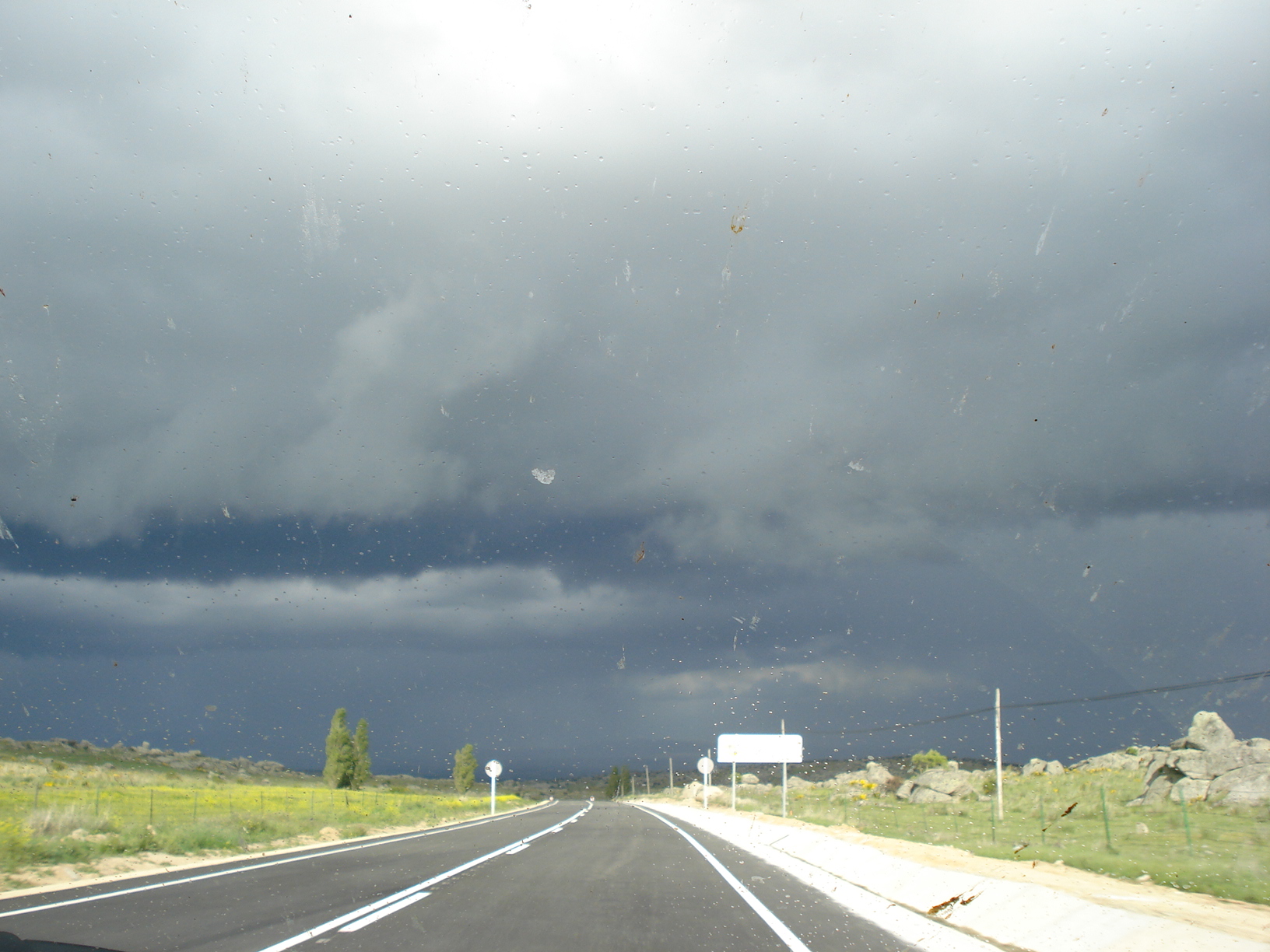
Comment: Un chubasco … a heavy downpour building on the meseta outside Avila. These severe rainstorms come out of nowhere. High winds, heavy rains, they drench you and the countryside in a matter of seconds and they go as suddenly as they come. However, the normal pattern of weather is dry and dusty. And no, the rain in Spain does NOT stay mainly on the plain. In Santander, on the Green Coast, la Costa verde, they have a saying: En Santander, en el verano, / no dejes el paraguas de la mano In Santander, in summer, never let your umbrella leave your hand. And its true: rain is constant and comes in from nowhere. They have other sayings, equally as efficacious, like Nunca llueve en los bares / it never rains in the bars. I miss Avila. I miss Santander and the Basque Country. I miss my childhood vacations, spent in Spain. But when they tell you that “The rain in Spain falls mainly in the plain” … well, just don’t believe them. Check, double-check, and then check again. As they sing in Newfoundland, about sailors and sailing ships, “A sailor ain’t a sailor ain’t a sailor anymore.” Nor, my friends, is the truth. Cum grano salis: take everything you hear with a large pinch of salt!

Avila 2008 205.jpg


On the beach

On the beach


IMG_0564 (2)

IMG_0565 (2)

Comment:

A daylight photo and a moonlit poem: I wonder how that came about? I guess we must have been beach-combing in the moonlight. It’s so long ago that I have forgotten the links between photo and poem. That said, Clare and I had spent a couple of weeks together in Santander (Spain) the previous summer, when we got engaged.

‘O bahía de Santander: tan bella bajo la luna’ / “oh Bay of Santander, so beautiful beneath the moon” as the Santander poet Gerardo Diego writes. And yes, Santander under a full moon: Mataleñas, the Segunda Playa, Jardines del Piquío, La Magdalena, the Bay of Santander itself, with Peña Cabarga in the background … there is something about beaches and midnight and moonlight which transcends the warmth of a summer’s day. It’s a sort of Midnight Magic that creates a madness of wonder in the blood. Imagine: all those silver fish, swimming their underwater roads, and rising to the surface, to ripple softly along the moon-path. Wander-lust / wonder-lust: sometimes buried words will not rise to the surface and those oh-so-precious moments of supreme poetry are lost among street lights, advertisements for this and that, street signs and the sort of stop signs that stop you and numb your mind into the dumb acceptance of daily reality: la vie quotidienne.

Memories: will they all vanish with us when we go? Of course they will. Many are fading now as we sit here at our desks, in our offices, before our computer screens. The grey screen hustle and bustle pushes memories, light and bright, back into the darkest corners. Where do I get off the bus, the train? Which number is it? Where is the office? Who am I meeting today and at what time? Did I shut the door behind me? Did I pack the children’s lunch? Did I let the cat out? And if so, out of which bag?

passionless not meaningless
the way I take your hand
tomorrow night not even we
will ever understand
the conflicts of this moonlit beach
the warmth of this sea-licked sand

PS. There, see, I told you I couldn’t read my own handwriting. Kiss / take; night / sand. Oh dear, the old grey cells are playing chess with my mind again: P-K4 / e2-e4 … whatever next? Well, I warned you!!!!


In the Cave

9_Bisonte_Magdaleniense_polícromo.jpg

In the Cave
(514-520 BC)

one goes on a journey
knows where one’s been

reality returning
one tells what one’s seen

shadows dancing
on night’s silver screen

verbal sketches
from where one’s been

speaking other languages
heard not seen

the more one speaks
the more others think
‘dream’

a dream for those
who’ve never been
where one’s been


Backstreets

IMG_0009

Backstreets

You go from the beaches turn away from the waters
and walk with your warder through this catholic prison,
through the streets of this city where innocents die
and the guilty confess to pitiless crimes
in hide-bound confessionals of dark white-washed churches
that strut in the streets and the heart-breaking alleys
with washing at windows and black widows waving
as you consciously wander through past sins and problems
forgetting remembering the squares with their fountains
with their saints and their statues in cold heartless marble,
with swords without edges and tongues sharp as grass
that cuts you with silence as it slips through your fingers
whilst bitter and bleeding you wander through labyrinths
of meaningless shortcuts leading to churches
and stationary statues that threaten with footsteps
until you come out at last to the light and the sea 

Commentary:
Another Golden Oldie, this time from my poetry book Broken Ghosts, published by Goose Lane (Fredericton, 1986). It dates from time spent in Spain (1969-1971) and recalls walking in tiny seaside towns along the north coast (Cantabria) without being specific to any single place, although Castro Urdiales, Comillas, Laredo, Santander, and Zarauz all conjure up similar visions and memories. A single sentence, the poem can be read in one breathless breath.