Court Dwarfs: Velásquez

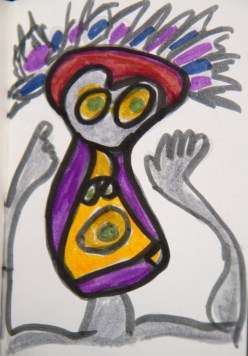
IMG_0188

Court Dwarfs

Calabacillas, the idot of Coria;
Francisco Lezano, the child of Vallecas;
don Diego de Acedo, the cousin;
and don Sebastián de Morra
in his red velvet coat:

a pride of lion-hearts,
these medieval jesters,
blown up
in some practical joke to
a full life size
that competes with their majesties
for our dialogue
with this time and place.

 Their captive souls
run the gauntlet
of their canvas jails.

Their eyes
recall those of Segismundo,
imprisoned in his tower,
drugged, then dragged
from darkness
to the palace’s brightness.

On his return to prison:
“Man’s greatest sin
is having been born,”
he cries.

Heir to a kingdom,
surviving in darkness,
rags and chains
binding his royal flesh:

 “Life is a dream,”
he sighs,
“and every dream,
a lie.”

Velásquez’s Secret

IMG_0051.jpg

Velásquez’s Secret

Two large paintings
hang on the wall,
one in front of the other:
Las meninas.

I gaze at the serving maids,
the royal princess,
the court dwarf,
the sleeping dog.

The painter,
stranded behind his easel,
paintbrush waving,
stares back at me.

I turn around.
The second painting
is not a painting:
It’s a mirror.

There I am,
standing by the princess,
one of the family.
I move my hand
and wave at myself
across the centuries.

Like the four court dwarfs
staring out from their wooden
prisons on the walls in another room,
I emerge from obscurity
and join the élite:

the painter
waves his magic wand
and
Velásquez
paints me
as I stand beside
the king and queen.

Metalanguage

Avila 2007a 157.jpg

Metalanguage I

I wonder what I’m doing here, so far from home, sitting
at the bar, with my beer before me, my face distorted
in half a dozen esperpentic mirrors, surrounded by
people half my age, or less, all smoking, cursing, using
foreign forms of meta-language, gestures I no longer recall:
the single finger on the nose, two fingers on the forehead,
the back of the hand rammed against the chin with a sort
of snort of disapproval. It’s way beyond my bedtime; yet
I am held here, captured, body and soul, by foreign rhythms,
unreal expectations of a daily ritual that runs on unbroken
cycles of time: morning coffee, pre-lunch wine and tapas,
home for the mid-day meal, a brief siesta, back to the café
for a post-prandial raising of spirits, more coffee, then back
to work at four and struggle on until seven or eight when
the bar routine begins again with pre-supper tapas and wine.
Time, divorced from this cycle now lacks meaning.
Time within this cycle is meaningless too.

El Rincón
03 VIII 2005

Metalanguage II

I wonder what I’m doing here,
so far from home,
sitting at the bar, my beer before me,
my face distorted in half a dozen
fairground mirrors,
surrounded by people half my age,
or less, all smoking, cursing,
using foreign forms of meta-language,
gestures I no longer recall:
the single finger on the nose,
two fingers on the forehead,
the back of the hand rammed against the chin
with a sort of snort of disapproval.

It’s way beyond my bedtime;
yet I am held here,
captured, body and soul,
by foreign rhythms,
unreal expectations of a daily ritual
that runs on unbroken cycles of time:
morning coffee,
pre-lunch wine and tapas,
home for the mid-day meal,
a brief siesta,
back to the café for a post-prandial
raising of spirits,
more coffee,
then back to work at four
and I struggle on until seven or eight
when the bar routine begins again
with pre-supper tapas and wine.

Time,
divorced from this cycle
now lacks meaning.

Time
within this cycle
is meaningless too.

Idlewood
24 IX 2016

Sun & Moon

IMG_0231 (2).jpg

Sun and Moon was published on Amazon and Kindle today. This is the second (revised) edition of Sun and Moon, the first edition having been published in 2000. Although this is the second edition, I have returned to and revised the original manuscript. It is clearer, stronger, and better than the first edition. Here is the description of the book as it appears on Amazon and Kindle.

“They tore down our walls,” Mono whispered, “stone by stone. A new church they built on the land they stole from us.” These opening lines begin the verbal adventure of Sun and Moon. Written in Oaxaca, Mexico, between 1995 and 1999, the poems tell some of the tales  of the voiceless, of the conquered, of the displaced, of the survivors, of the people who eat and sleep in the streets of Oaxaca, spinning their myths and legends and recalling their oral histories and memories. Sun and Moon traces the relationships between two civilizations, the indigenous and the conquerors, from the first contacts between Europeans and the people of the Oaxaca Valley up to the modern day interactions between locals and tourists. In these pages, some of the ancient ceremonies and beliefs, as described by indigenous people, are brought back to life in vivid images and colorful metaphors, so sharp, they can be grasped between the fingers and examined by the light of the sun by day and the moon by night. The multiple voices in the poems are those of human beings who, like the author, himself an émigré, find themselves in exile, lost, abandoned, and displaced. As the final character cries out in the final poem: “You do not worship at our sacred places … you don’t know even know the meaning of my name.”

Writer’s Block

IMG_0182.jpg

Writer’s Block

Every day, well, almost every day, I meet people who tell me that they cannot write anymore. They have abandoned their current project. They sit in their work space and stare at blank screens or empty walls. They have come face to face with the dreaded Writer’s Block.

While some consider Writer’s Block to be an actual illness, others flaunt it like a flag or a badge of honor:

“Don’t touch me — I’ve got Writer’s Block: I wouldn’t want you to catch it.”

“I’m having a bad week: I’ve got Writer’s Block.”

“Sorry, I can’t make the writer’s meeting, I’ve got Writer’s Block.”

According to Wikipedia, “Writer’s block is a condition, primarily associated with writing, in which an author loses the ability to produce new work or experiences a creative slowdown. The condition ranges in difficulty from coming up with original ideas to being unable to produce a work for years. Throughout history, writer’s block has been a documented problem.”

We have probably all experienced the sensation of being unable to write, unable to think, unable to continue. I have found that it happens frequently in examinations with young students whose minds suddenly go blank when faced by a white page and an awkward question. This form of Writer’s Block comes at the most unfortunate times. Students need to be switched on just when their minds switch off. And something similar happens to writers.

Examination Block can be overcome. In many cases careful preparation for an exam will reduce or eliminate examination block. These preparations may well include correct pre-examination note-taking and revision procedures, no last minute all-night study the night before the exam, a good night’s sleep, proper food, water, and appropriate physical exercises before the exam starts. All these things prepare both body and mind and free the student for that most important task: the struggle with the blank page and the awkward question.

Will a set of pre-writing preparations work for Writer’s Block?

In order to answer this question, I would rather take a different approach. Instead of seeing Writer’s Block as a physical / mental presence that stops us writing, why not look at it as an absence that can be overcome.

What can we call that absence? Personally, I look upon it as an absence of creativity. If the creativity isn’t there, then writing creatively won’t happen. So what do we do?

Let us define creativity. For me, creativity is the expression of the creative principle that dwells within all of us. It is there, within us. We may suppress it or we may let it be suppressed. We may ignore it or we may deny it: but it is still there. It is always there. Sometimes it is beaten out of us; or we think it is. But it is still there, beneath the surface, waiting to be called on. The Roman poets spoke of it as Deus est in nobis … the God that dwells within us.

Creativity, for me, is like a river that vanishes underground and then reappears: it will be back.

The most important thing in my opinion is what you do when you’re not writing, what you do when you’re faced with that wall of blackness, what you do when you stare at that blank screen and nothing makes your fingers dance on the key board.

Here’s what I do. I make up my mind not to force myself to be creative. Forget about writing. Do something else. Ignore all idea of Writer’s Block, or the End of the World, or the Imminent Disaster of not being able to write. It may take a mental effort, but forget about it.

Now do something else, something positive. Different people respond to different stimuli. Here’s what I do.

(1) I read books

I read other people in their creative moments. I love reading people who write in other languages that I speak and read, because my own mind tries to recreate their images, their stories. This re-creation is a form of creation in itself. New words, new ideas, new combinations, rise to the surface of the mind, like bubbles on a river.

(2) I color and draw

As any who have seen my drawings know, I cannot draw. However, I can take a line for a walk. And that’s what I do. Then I color the spaces I create. My friends thought I was wasting my time and I believed them until I read one of Matisse’s sayings: “My ambition: to liberate color, to make it serve both as form and content.” Voilà: I have my raison d’être. Nature abhors a vacuum. When you create a space, color and meaning rush in.

(3) I take photos

The capturing of a moment: a sunset, a new bird at the feeder, deer wandering through the garden, a black bear visiting, rain on a spider web, sunlight through a prism, a cat made out of cherry stones … the re-creation of the moment is the creation of the memory. More bubbles flow on the surface of the stream.

(4) I go for a walk, look at nature and the world around me, people too

It is incredibly important to do this. A visit to the local coffee shop, a walk around the super-market or corner store, a seat in the park on a sunny day … just be, watch, relax, look and listen, empty yourself, let the world flow back in … look at the ducks on the lake or the goldfish in the tank … more bubbles on the water, more ideas floating down the stream …

(5) I listen to music

De gustibus non disputandum … we can’t argue about taste. Where music goes, to each his or her own … the music I like fills my mind, relaxes me, flows out when it ends, takes my mind for a walk and leaves … a vacuum … into which dreams and colors, words and ideas, build like clouds …

(6) I cook

Cooking has always relaxed me. Sometimes the repeating of an old recipe helps clear my mind. Sometimes I have a need to invent something new. Hands and mind occupied, the secret, sacred underground river of creativity flows on …

(7) I sew

Last summer, an unexpected event led me to join a quilting group … oh what fun … a man quilting among a dozen women … I learned so many things … so many different ways of looking at the world … so many concepts that I would never have dreamed of on my own … Sewing runs in the family: I still have my grandfather’s sewing kit … darning and sewing needles that served him for two years before the mast … that darned his socks as he survived in the trenches of the First World War … it bears his name and I use it with pride … and what memories arise in my mind as I choose the needle … his needle … the one that will lead me into the next adventure, be it quilt, button or patch …

(8) I keep a journal

… and come hell or high water, I write in it every day and have done so since 1985. That’s 31 years during which I have scarcely missed a day. The writing maybe banal, it may be nothing but a note on the weather or a comment on a sporting event … but it’s there … a vital challenge to the idea that Writer’s Block can take me over and can win. This journal is 95% drivel … maybe more … but bobbing along the stream of words are ideas, verses, rhyme schemes, choruses, stories, flashes of inspiration, jokes, memories, magic moments, falling stars, … the secret is to catch these falling stars, to recognize these rough diamonds and to return to them and polish when the moment is ripe … and it will be, sooner or later … for bubbles are buoyant and will lift you to the stars.

(9) I believe

Through all this runs a thread of belief … belief that the black cloud of despair will not win. The Writer’s Block will go. Creativity will never be not lost. It is there, beneath the surface, always ready to be contacted, waiting to rise and take you over again. And all too soon and quite unexpectedly, one form of creativity slips into another and the creative writing (it never really went away because of the journal) comes back.

Writer’s Block: it does exist. It’s how we deal with it that’s important. Creativity rules: forget Writer’s Block and let creativity and the multiple ways back to creativity grow and flow. Sooner or later the clouds will lift, the sun will return, the block will unblock and the words will flow again.

Remember the words on the Roman sundial: Horas non numero nisi serenas … I count only the happy hours. And remember: the clouds will lift, the sun will return.

Trust me.

And believe.

Re-reading the Codices Flash Fiction

IMG0061_1.jpg

Re-reading the Códices
Bistro 22

             The Mixtec Códices, indigenous screenfold books written on deer hide, 
are Pre-Columbian pictographs that record the history of the Mixtec peoples. 
There are no words: only brightly coloured scenes containing information about rituals, gods, heroes, and ceremonies. 
Only a few very precious documents
(Zouche-Nuttall, Vindobonensis, Borgia etc) survived the ravages of time
 and the continued purges of the Spanish priests. 
The following text, self-explanatory for the main part, verbalizes typical symbols from the códices. 
Clearly, such symbols, as the poems suggest, are ambiguous 
and open to radically different interpretations.

           “Two breasts: one green, one yellow, symbolic of the hill where the church stands; the church itself bi-colored, strong stone walls, a spire. A large red heart symbolic of the love we bear for you, our masters. Two feet walking the path of enlightenment you opened before us; two hands pointing the way. The feet below the heart; the hands above the heart, like wings; and the heart becomes the body of the new place you have built for us. And in the heart is our sacred symbol: the Earthquake, a sign of leadership and power used only by those of Royal Stature and the Noblest Blood. Attached to the heart is the Numeral One which means Lord of the Earthquake; for you are Number One in our Hearts. Attached to the heart is a speech scroll showing felicitous words of praise; below it is the sacred earthworm, and beneath that the serpent head of wisdom and the flint knife promising strength through sacrifice.

            But be wary: for our symbols are double-edged.

            The colors of the hill are divided, as the hill is divided, showing strife and division. The church is on top of the hill, for the symbol has conquered the people, and the people are starving, subject, and destroyed. The feet are pointing in opposite directions, for the people are stalled. They have no forward movement, nor will of their own. For they are conquered by the sword and not by love. And the hands are pointing in opposite directions; for the right hand knows not what the left hand is doing. And the hands are reversed showing anguish and distress. The sign of the heart is the sign of the disembodied heart, torn from the heaving chest of the vanquished and thrown to the dogs. The sign of the earthquake is also the sign of movement. And that movement is a bowel movement. And one movement in the middle of the sacrificed heart is the victor excreting on the vanquished and treating them with scorn and contempt. The scroll protrudes from the nether part and says that the victors are speaking words of excrement, that verbal diarrhea issues from their lips. And the serpent has no feathers; it cannot fly. It is as a snake treacherous and bitter, crawling on the ground. The head of the serpent is two tongued and tells of treachery and of deceit. The flint is attached to a heart; it speaks of the heart that is as hard as flint, knowing no mercy.

            And at the end that heart will receive no mercy in its turn.”

Monet at Giverny 13-16 /16

“Though lovers be lost, love shall not;
and Death shall have no Dominion.”
Dylan Thomas 

Monet at Giverny
13-16 /16

13

fish aloft like birds
skimming wet sunshine

spring’s first swallow
rising from the depths
to snatch a golden note
quivering in the air

14

thunder raises dark ripples

lightning a forked tongue
insinuated into paradise

an apple tossed away
caution thrown over the shoulder
as sharp as salt

15

winds of change

that first bite
too bitter to remember

 16

timeless this tide
this ebb and flow

oh great pond-serpent

biting yourself

forever


Remembrance Day Flash Fiction


039

Remembrance Day
Bistro 20

Previously published on
http://commuterlit.com/2015/12/wednesday-remembrance-day/

            The old man watched a drop of red wine slide slowly down the side of the bottle. It was November 11, his birthday.

Seventy-three years ago, Father John had taken the boy’s ear lobe between thumb and forefinger and pinched the nail deep into the flesh until the blood ran.
“This afternoon you will go down to the bamboo grove and cut a cane. Bring that cane to me and I will bless it.”

That night, the boy woke up. Snuffles, snores, and an occasional sob broke the dormitory’s silence. The bamboo was a long, cold serpent drawn up in bed beside him.

The next day, he awoke to his seventh birthday.

Father John beckoned and the boy followed him to his cell and knelt with his hands stretched out like those of Christ on the Cross. The priest struck him with the bamboo cane six times on each hand.
“Your Savior, blessed be His name, suffered more, much more for you,” the priest sighed. “Examine your soul. Find fault with each flaw, for you are unworthy. Remember: the eye you see is not an eye because you see it,” Father John droned on. “It is an eye because it sees you. Christ sees you as you kneel there. He sees. He knows. He judges. Examine your soul with care and stay there until I return.” The priest raised his right hand and made the sign of the cross in the empty air.

The boy spent his birthday kneeling before the crucifix in prayer. He contemplated the wounds of Christ. He imagined each blow of the hammer and imagined the pain of cold nails biting into his warm flesh. He tasted bitter vinegar as it dripped off the sponge, gasped at the thrusting spear, felt the lash’s sting as it fell across his flesh. He became the flagellated Christ and knelt before the crucifix, staring at himself eyeball to eyeball in the same way he looked at himself in the morning mirror. The crucified Christ gazed back at him, his brother, his soul mate, his double.

After an hour, a red drop of paint slipped slowly from the nail hole in Christ’s right hand. The boy blinked. The red drop trembled then fell.
After two hours, Christ opened his eyes and smiled at the boy.
After three hours, salt-water formed at the corner of Christ’s eye. It glistened in a sunbeam that entered through the cell’s narrow window.
After four hours, tears began to flow down flesh and painted wooden face.
It was Remembrance Day, the boy’s birthday. He was seven years old.

Seventy-three years later, the old man sat at the table. He watched the red wine trickle down the bottle. He remembered it all and his tears flowed again.

Monet at Giverny 5-8 /16

“Though lovers be lost, love shall not;
and Death shall have no Dominion.”
Dylan Thomas 

Monet at Giverny
5-8 /16

5

wisteria and his curly blue locks
Narcissus clad in an abyss of lilies
imperial his reflection and perilous

slowly he slides to sleep
merging into his imaged dream

a vaulted cathedral
his earthbound ribs
the blood space immaculate

6

night and day and sun and clouds
leapfrogging over water

something survives
sepia tints
dreaming on and on

exotic this sudden movement
Carassius auratus flowering

 7

Clos Normand and the Grande Allée
closed to him now
folded his flowers
their petals tight at his nightfall

dark their colours
mourning for his mornings of light
fled far from him now

8

can we soften this sunstroke of brightness
le roi soleil threatening to blind us?

rey de oros
the sun glow braiding itself
an aureate palette

a susurration of leaves


Monet at Giverny 1-4 /16

“Though lovers be lost, love shall not;
and Death shall have no Dominion.”
Dylan Thomas 

Monet at Giverny
1-4 /16

1

his lily pond
a mirror shattering
shards of clouds
flames beneath the lilies
fractured fish

2

the executioner stripes evening
a+cross the sacrificed horizon

in blood we were born
in earth will we rest

our flesh turned to bread
empurpled this imperial wine
streaming with day’s death
these troubled waters

3

green footprints the lily pads
a halo
this drowned man’s beard
liquescent

like the gods
he dreamed
he walked dry over water

flowering goldfish
this thin line of cloud

4

maples flash ruby thoughts
ripples flowing outward
as heavy as a henge

this altar tumbling
downwards
through a liquid sky