Sanctuary

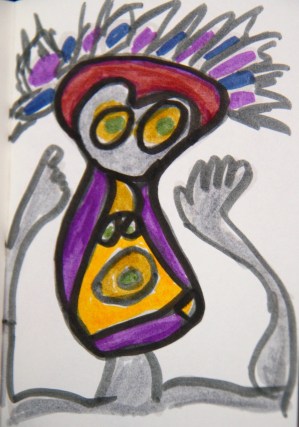
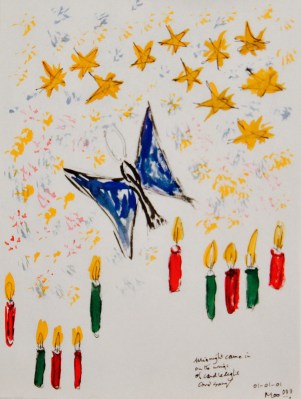
img_0136

Sanctuary

We thought for a moment that, yes, we
were angels and yes, we were dancing
together on a pinhead with so many other
angels, and all of us as bright as butterflies
spreading our wings with their peacock eyes
radiant with joy and tears sparkling in time
to the celestial music that wandered up
and down inscrutable scales that bonded
the universe and set planets and spheres
spell-bound in that magic moment …

… and I still feel that pulsing in my head,
that swept-up, heart-stopping sensation
when the heavens opened and the eternal
choir raised us up from the earth, all earth
-bound connections severed and all of us
held safe in the palm of an Almighty hand.

Blue Angels

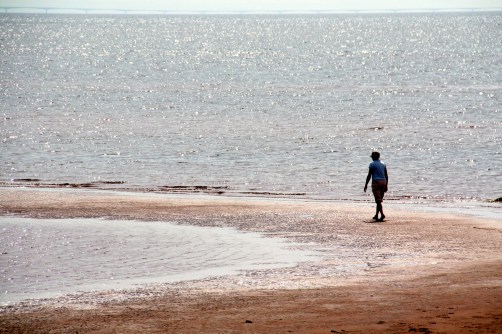
img_0003

Blue Angels

Wrapped in johnny coats we sit,
not on clouds, but harp-less, harmless,
on uncomfortable chairs, waiting.

Soon enough someone will come and call
our names, or waggle an inviting finger,
or raise a beckoning eyebrow, or just smile.

The women are naked from the waist up
beneath their coats.
They are red-breasted like robins,
with scars and lines that draw route maps
and contours across their breasts,
highroads for the rays to travel.

The men are naked from the waist down,
legs crossed, teeth gritted, grim-faced
holding on to their gathering waters …
and all of us, sitting here, waiting …

Will it be like this on Judgment Day,
sheep and goats herded together
waiting for the signal that sends us
left or right, to heaven or hell?

Fifty Years

IMG_0146 3.jpg

24 December 1966 – 24 December 2016

This what all those poems were leading up to:
Clare and I, married for fifty years today,
unbelievable.

Share the joy with us.
Blessings to all.

Roger and Clare.

“Brightly Dawns Our Wedding Day” from The Mikado

Goodrich Castle

I thought I had felt everything worth feeling
until I looked on Goodrich Castle and explored
with you its walls and towers and labyrinth
of inter-connecting corridors and rooms.

Do you recall the way its old stone bones
thrust out from that pelvis of red bedrock?
Civil War tore down its curtain walls,
fired its stables, drove horses and people mad

with fear. Sometimes at night fate mans
the pumps of my blood and sends alarums
surging through my arteries. No. I don’t want

to die before you. I don’t want to leave you
here, alone, defenseless, besieged by memories
that gnaw at you and devour your days, like flames.

In Vino Veritas

img_0149

In Vino Veritas

Last year, on the road to Pwll Ddu,
I turned the steering wheel too fast
and almost rolled the car I rented.
My mother’s ashes were in the back.

I was driving my father to the Gower
so he could scatter them on the sea,
as she had requested. “Watch what
you’re doing,” my father cried.
“You’ve knocked your mother down.”

Now, as I drink to forget her ashes
tumbling around in their plastic urn,
I call you names. Crude graffiti clings
to the wall I have built between us.

Can you forgive me? In vino veritas,
said the ancient Romans, but truth from
a bottle is a double-edged sword cutting
both striker and person struck. My love,
I sense stark darkness within you. I see
black stars exploding to flood blue skies
with their inevitable ink. Can you feel
the instant hurt behind my eyes, like I
sense yours? Here, in one of our secret
gardens, give me the pardon I never gave
my parents. Heal the harm I’ve done.
Forgive me. Break the cycle. Set us all free.

Love the Sorcerer

img_0200

Love the Sorcerer

“What sorcery love must be
to make such fools of men.”

There’s more to love than the magic
conjured from chemistry as eye
meets eye or flesh makes secret
contracts, body to body, in free
trade agreements that are remade,
over the dinner table, day after day.

Hands that plug in the kettle,
pour boiling water on the tea,
poach or fry the breakfast eggs,
brown the early-morning toast,
write out the weekly shopping list,
flick the switch on washer and dryer,
peg wet laundry to the outdoor line,
pack the children’s lunch boxes
and get them ready for school
day after day:
such love is truly a magician.

My cartoon speaks
not three words
but a thousand.

Ties that bind:
what more can I say?

Lover

img_0051

Lover

Love, what little boys
dwell in grown men’s hearts,
struggling to break free.

I want to spend the day in bed,
buried beneath the blankets.
I want to call out for attention.

Will you boil me an egg?
Bring sweet, sugared tea?
Cut my toast into tiny soldiers
so I can march them through
the boiled egg’s yolk?

Upstairs, downstairs, I want
to keep you running all morning.
Will you straighten my blankets?
Will you tuck me in so only
my eyes and nose are showing?
Bring me my dog: let her lie
beside me, warmth and comfort
in her wet tongue washing me.

Suddenly, my world’s caved in
and there’s so much missing.
Lover: be a mother to me.

Anniversary Poem

img_0195

Anniversary Poem

“Hoy cumple amor en mis ardientes venas
veinte y dos años, Lisi, y no parece
que pasa día por el.”

Francisco de Quevedo

“For twenty-two years my captive heart has burned.”
Christ, what crap that is. The only heart burn
I have known came from your cooking: African
Nut Pie, as detailed in the cookbook I bought you
for Christmas on our first wedding anniversary,

remember? And do you remember the ride to Kincardine
on the train? A dozen coaches left Toronto and one
by one they were shunted away until only you and I and an
elderly man ploughed through the snowstorm in the one
remaining carriage. Deeper and deeper piled the snow.

You looked through the window and started to weep:
“What have I done?” you cried in shock and grief. Outside:
Ontario lake-effect snow. Headlights from two waiting
cars lit up the station. We drove to the homes of people
you didn’t know, third generation cousins of mine.

You’re the only bride I know who was carried to church
in the arms of the total stranger giving her away
in place of the father she never knew. The snow lay six
foot deep (eighteen inches fell on your wedding day
alone) and you, with a white wedding dress and black boots

up to your knees. Cousin Walter carried you to the altar:
how they laughed as they chanted that old song to us.
Later, when they tapped the glasses and fell silent
at the meal, I didn’t know what to do. And you, my love,
standing up, kissing me, married after six days in Canada.

Balancing the Books

DSC03693.JPG


Balancing the Books

I knew that I did not have the strength and stamina to make a living as a writer. I knew too that I could not put my beloved and my family through the strain of maybe, or maybe not, making it as a creative writer. And I wanted to be an artistic writer, a poet above all, not just a commercial writer, writing adverts for a living, or pandering to the lusts of a baying multitude.

So: the most difficult thing for me would be look after my family and balance the books. Rather than writing full time, I chose a career in academia. My career as an academic led to 90 research articles in my various fields, 70 book reviews, the publication, in book form, of part of my doctoral thesis, and an online bibliography, now turned into a searchable data base. Add in unpaid, voluntary overload teaching to maintain a small program in a small university, overseas travel programs for students, a relatively successful coaching career at club, provincial, regional, and national levels, and a commitment to various editorial positions, in 14 local, regional, national and international journals, and my creative writing career has understandably suffered. In spite of that, I published 10 poetry books, 11 poetry chapbooks, 12 short stories and 130 plus poems in 20 Canadian (and other) journals, and won several writing awards. Indeed, to have been a full time creative writer and to have maintained a house and a family and a second career would, in my opinion, have been impossible.

Now that I have retired from university teaching, I can finally write full time. In my part-time creative writing career, maintained while I worked in academia, I kept a journal and made sure I spent at least one hour a day writing creatively, even if I had to get up early to do so. This resulted in a couple of poetry books with small presses and later a series of self-published poetry books that doubled with various festivals and other writing sequences. My poetry books did not sell well, and there is very little money in poetry anyway, so I started to give the books away to friends and well-wishers who were interested in what I was writing.

In retirement, I discovered CreateSpace and I now have eight books up on Amazon and Kindle. I am working on my ninth. What do I love best about Canadian Culture and Creativity? That it allows a person like myself, born in Wales, and speaking English, French and Spanish, to live and write in Canada about Wales, England, France, Mexico, Spain, and my adopted homeland. However, the literary and cultural industry boasts of our international character while totally ignoring me and writers like me. We ignore the self-published (calling them adherents to the vanity press) and we put down those who have not progressed in the ways that the literary societies accept.

Do I care? Of course I care. That is why I am writing this and why I will continue to write. Will anyone read this and take any notice? I doubt it. Will anyone take any action as a result of this tiny pebble cast into a Great Canadian Lake? I really, really doubt it. I can see the shoulder shrugging now as the eye-brows raise themselves slightly and the reject pile beckons. Will literary Canada keep staring at its own belly button and congratulating itself on its wonderful cultural opportunities for self-expression in writing? I guess it will. Will things change for artists on the periphery, for struggling artists, for artists like myself who with great difficulty have fought throughout their lives to balance the books? I doubt it very, very much indeed.

But I am here, as others are here. We have a voice. A very powerful voice. A voice that has been side-lined by the establishment and the institutions. But we are many. Very many. And one day, we will be heard.

A brief commentary:

The Writers’ Union of Canada (TWUC) invited its members to contribute a piece on their Canadian Writing Experience to Canadian Heritage, a group interested in gathering comments by Canadian Writers about their experiences. I thought about it for a while, penned this piece, and submitted it for their consideration. I was very pleased to have it accepted and it has attracted some attention.
 

Baby Angel

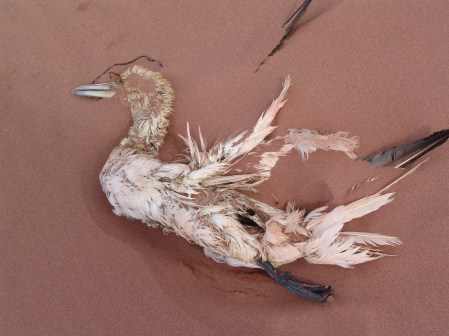
IMG_0012.jpg

Baby Angel

yesterday a baby angel
lay dead beside the road
the trees
caught their breath

the air stood still
a red fox
tore from the woods
a runaway leaf
so quick so silent
a shadow across the road
melting away to hide in the forest

I can still see the occupants of the stricken car
standing with their cell phones in their hands
punching urgent numbers

the mother deer’s dead eyes
gazed at them from inside the windshield
shock had rounded the driver’s snow white
lips into an O for Operator

Christopher Columbus

IMG_0141 2.jpg

Christopher Columbus

leaves foot prints,
wake to his imagined ships,
dark, in the snow,
the unusual snow,
the snow they haven’t seen
in Granada city centre
for forty years.

It settles on roofs,
forms dark ridges
where the sun catches it
and turns it into
wet, dripping snow.

The Alhambra:
a wonderland of stiff,
white starched buildings,
stands out against
the mountain’s mass.

We click our cameras
and say “Just like home!”

We don’t realize
we’re repeating history
for it snowed then,
as it snows now
and Columbus
walked these streets
like any Canadian tourist,

short of breath,
short of cash,
the seams of his boots
letting in the cold,
wet snow,
you know how it is
on Yonge Street,
Main Street,
any street,
any town
in Canada.

And then the miracle:
he’s walking away,
leaving it all behind,
when the messenger
catches up to him and says:

“The war’s over:
there’s money now.
She says ‘Go for it!’
The ships you want,
the dream, the world,
they’re all yours now.”

Christopher Columbus
fell on his back,
flapped his arms,
and created winged shapes:
dream-angels,

white-sailed ships
sailing in the snow.