Rolling Stones

IMG_1159 (2).JPG

Rolling Stones

I have counted down the days, hours, minutes,
one by one, each tock of my grandfather clock
linked in pen and ink chains of endless words.

From arrival to departure, time’s fickle finger has
pointed me onwards into my future or backwards
into a delusional past that never was as I recall it.

Packed bags, backpacks crammed full of snacks,
ammunition against the hunger wars soon to be
upon them, they commence their long journey home.

Grown ups, some in their second childhood, bemoan
ties that bind, tides that rip us apart, tearing hearts,
swinging us in and out as, cockle-shell heroes, we man

our coracles and consult wide-ranging horoscopes that
never fail to comfort, the future’s wild words, written
in pitiless skies to guide and inspire all earthly creatures

born into sadness and death. No heroes in this house.
Just two old people, grey-haired, broken, contemplating
this soon to be silent home, knowing the Rolling Stones

were right, that rocks in motion don’t gather no moss,
that each lost moment is a finger-nail torn from flesh,
that today of all days could verily be ‘the last time’.

Commentary: Here for such a little while and gone already. Two years since they were here and two more years before they come back again. The silence is overwhelming. Only CNN with its endless cacophony breaks into the conscious mind, though that mind is unconscious now of words and their meanings. Images of emptiness, empty nests, this empty nest, these empty nests fill the vacancy of space. The heart is a black hole in the chest, sucking everything out of the light and into that dark, vacant space.

IMG_1112 (2).JPG

Ghosts

IMG_1055 (2)

Ghosts

My grandfather would wheeze, then cough, as he leaned on the old black dresser in the Welsh kitchen with its vast, cast iron fireplace. “As black as the hobs of hell,” he would say, and “as warm as our kitchen.” It was full of nooks and crannies where pasties and pies could stay warm, soup cauldrons could hang from iron chains, and copper kettles could whistle wild tunes and call us all to endless cups of tea. Sergeant-major tea: so strong and filled with so much sugar that a tea-spoon could stand upright and never fall over. Gassed in the First World War, my grandfather was always out of breath and each time he coughed, he brought up a tiny part of his lungs. “One day,” he announced between wheezes, “there’ll be nothing left.”
Twice a day, my grandfather would roll up the newspaper and brandish it like a conductor’s baton. The first time would be when I came home from school and it was time to do my homework. The second time would be after supper when it was time for me to go to bed. Each time he rolled up that newspaper, he would tap it gently on the dresser to get my attention, and then he would speak those famous words: “Let battle commence.” I would fight to escape to the street to play with my friends. I would fight to stay on my feet and I never, never wanted to go to bed. I hated to be entrenched alone, upstairs, in the cold shadows of that ghostly no-boys-land where I could hear mice and rats scuffling behind the dugout walls and smell the sour smells of old age and illness that stalked my dreams.
“Up the wooden hill to Bedfordshire,” my grandfather would sing, conducting with his baton and pointing to the stairs. I was never afraid of him. He was dark, strong, tall, and very gentle, a great man in his own right, one of those tall men who would always stoop to help a little child. If I was too troublesome, he would start to cough. And if he started to cough, the pink phlegm would come and he’d spit it into the red and blue polka-dot handkerchief he always carried. The pink phlegm caused consternation and in the ensuing panic, I would bolt for the stairs, go up to my room, undress, put on my pajamas, and bury myself in the vast double bed I shared with my grandmother. My grandfather’s bed was in the middle room downstairs. I didn’t realize then, as I do now, that he could no longer climb those stairs up which I scuttled.
After a while, I left of my grandfather’s house and went back to live with my father. One day, my grandfather, as he prophesied, coughed too much and that was the end of him. After the funeral, my father took me back to see my grandmother. Aunties and uncles, cousins, family friends that I didn’t know, neighbors known and unknown, spilled over the house in an invasion of tears and grief. After the friends had gone, my father and I decided to leave and the family gathered on the doorstep to wave us goodbye. I waved back to them all. “Goodbye,” I shouted. “Goodbye aunties, goodbye uncles, goodbye grandmother.” I paused. My grandfather stood there waving to me. “Look: there he is. I knew he couldn’t have gone.” I pointed and waved. “Goodbye grandfather!”
“Don’t be stupid. He’s not there,” my father said. “He’s dead.”
“I can see him,” I said. “He’s there. I can see him.”
“He’s not there. He’s dead.” Tears ran down my father’s face.
Sitting here, writing these words, I can still  see my grandfather, standing on that doorstep, waving goodbye. And I can still feel my father’s long dead, shadowy hands reach down, grab me by the shoulders and shake me, shake me, shake me, until I too am crying and the ghosts of my milk teeth are again rattling in my head.


IMG_1063 (2).JPG


Things

18581930_1306791786107970_4016640231053970709_n-1

Things I carry with me

            That old black cast-iron stove, wood-fired, that baked the best ever breads and cakes and warmed the bungalow on cold, summer mornings. The Welsh dresser with its age-blackened rails that displayed the plates, and cups, and saucers. The old tin cans that ferried the water from the one tap located at the end of the field. Full and wholesome, its weight still weighs me down as I carry it in my dreams. The Elsan toilet from the shed by the hedge and the shovels that appeared, every so often, as if by magic, as my uncle braved the evening shadows to dig a hole on the opposite side of the field, as far from the bungalow as possible.

            The outhouse at the end of the garden. The steps down to the coal cellar where they went when the sirens sounded, to sleep in the make-shift air raid shelter, along with the rats and mice that scurried from the candles. The corrugated iron work shop in the garden where my uncle built his model ships, the Half-Penny Galleon and the Nonesuch. The broken razor blades I used to carve my own planes from Keil Kraft Kits, Hurricanes and Spitfires, an SE5, and once, a Bristol Bulldog. Twisted and warped, they winged their ways into nobody’s skies, though once we built a paper kite that flew far away in a powerful wind and got tangled in a tree. The greenhouse from which I stole countless tomatoes, red and green. Kilvey Hill towering above the window ledge where the little ones sat when there were more guests than chairs in the kitchen. The old bombed buildings across the street. The bullet holes in the front of the house where the Messerschmidt strafed us.

            The old men spitting up coal dust from shrivelled lungs. The widows who took in lodgers and overnight travelers. The BRS lorries, parked overnight, that littered the street. The steep climb upwards into those lorries. The burrowing under dirty tarpaulins to explore the heavy loads, and many other things. The untouchable, forbidden drawer where the rent money waited for the rent collector’s visit. The old lady, five houses down who, when the shops were shut, sold warm Dandelion & Burdock and Orange pop for an extra penny a bottle.  The vicious, snub-faced Pekinese that yapped fierce defiance from the fortress of her lap. The unemployed soccer referee who on Saturdays walked five miles to the match and five miles back just to save the bus fare, his only financial reward. My father’s shadowy childhood. His first pair of shoes, bought at five years old, so he wouldn’t go barefoot to school.

            Wet cement molded onto the garden wall, then filled with empty bottles to be smashed when the cement set solid. The coal shed where the coal man delivered the coal: cobbledy-cobbledy, down the hole. The outside toilet with its nails and squares torn from yesterday’s newspaper. The lamp-lighter who lit the lamps every evening as the sun went down. The arrival of electricity. The old blackout curtains that shut in the light and shut out the night. The hand rolled fabric sausage that lay on the floor by the door and kept the heat of the coal fire in the kitchen. The kitchen itself with its great wooden chair drawn up by the fire. That chair: the only material possession I still have from that distant past.

Alphabet

Chaos

Alphabet

So everything is now as yellow as the yellow alphabet.
Bellow below cello, above fellow, saying “Hello,” jello,
always yellow, nobody eats orange jello, mellow, sello
or sellotape, tellow, as in “Tell old salt …” pronounced
“tellow salt” … so many verbal adventures, scales falling
from young eyes, and old ones as wello,
and the melody of music in tone,
on tongue, wonder in the eyes of everyone,
golden yellow, hair high-lighted in the early morning sun.

Commentary:

An endless jumble of words, all joined together rhythmically and linking one thought to another in a succession of jumps that wander from here to there and back again. Team tag: each one of us chosen for a moment, teased, played with, abandoned, picked up again, delight in each adventure.
My party tricks are e-cards, typing on the computer, her name, my name, the alphabet, her mother’ name, another name, and then another. Coloring is my trick too, and finding empty pages that can be followed with color and scrawl and everything that turns the blank page from a wilderness to a new world covered in endless manufactures of meaningful, meaningless scratches.
Joy in small things.  Albert Camus’s theory of the absurd present in almost every moment of the day. Moments that stretch into eternities, eternities seen in a grain of sand. Dw i mwynhau … what do I enjoy? These timeless moments, these glimpses back into my family’s past, Dych chi mind am dro? … these walks into my DNA’s future. Nach ydw: no, I will not be here. But tiny segments of my existence, words and phrases of my Welsh grandfather’s DNA and language, they will be here. Recycled. Again and again. Somehow. Somewhere. Forever. What more could I ask?

Yellow

IMG_0617

Yellow

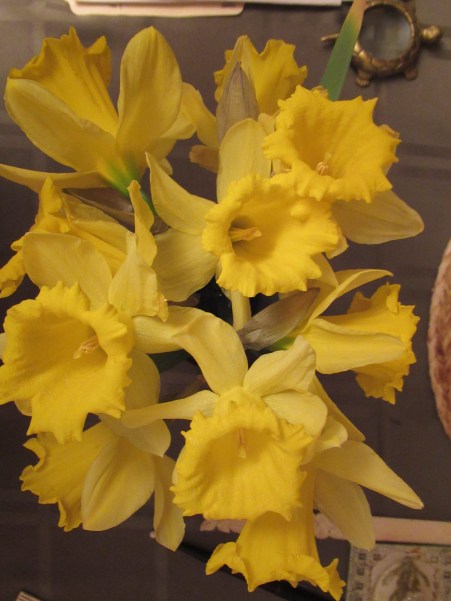
Sunshine and daffodils: my grand-daughter
paddles in the kitchen sink. Her mother
washes feet and dishes. “Sit,” Finley says,
and “stand,” following the words with actions.

“Yellow,” she says, “yellow,” as daffodils
fill the computer screen to shine in that
far-off kitchen five hundred miles away
by road, but immediate by I-Pad.

“Yellow,” Finley repeats, “yellow.” Soon
in that distant province where spring arrives
so much earlier than here, she will see
daffodils dancing their warm weather dance,

tossing their heads to gold and yellow trumpets,
fresh, alive, and young in the soft spring breeze.

Commentary: Not a large vocabulary, back then … yellow … yellow hair, yellow jello, yellow dog, yellow cat, yellow daffodils, well, we got that one right anyway. So, she is here now, yet again, with an enlarged vocabulary and two feet taller. She comes shopping with me, swings on the shopping cart, runs everywhere, will not sit still, slips and slides like stones in a slate quarry. She takes my cane, I call it a walking stick, and thwacks it in the air, a danger to sundry and all. Knows what she wants: not this, not that, no, yes, THIS … and points with a sticky finger at whatever it is that has caught her fancy.

She runs away from me, and I cannot catch her. I stand there quietly, waiting for her to return. And she does, with a squeal and a shriek and cries of joy after even a brief absence. We talk magic. I say I am invisible, and she cannot see me. She says she is invisible, but I poke her in the ribs with my index finger and she squeals again. Magic, she says, you can do real magic. I nod. Me too, she says. And she is the real magician for she is four years old and has me bewitched.

Finley at Two

IMG_1058 (2).JPG

Finley at Two

Blood of my blood, my daughter’s daughter,
I live too far away to watch each day the laughter
on your lips, the sparkle of your eyes.

I see them when we Skype. Such a miracle
this magic machine that reduces distance
and time and brings you here to me.

I see you trying to stand, to understand,
to hold my image in your mind, to figure
out these moving shadows on the screen.

Words, born from poetry in my heart
and music on my lips, sometimes fall short,
and fail. Perhaps I should carve you a Welsh

love spoon. But time is not on my side. So brief,
this life: I wonder if we will ever meet again.

Commentary: Seeing Finley again, now aged four, has made me question all my earlier poems about her. I am overwhelmed by her energy, her interests, her concentration. I am bowled over by her flexibility, her strength, her joy in simple things. The above is not a new poem: it is a rewrite of an older poem, one that no longer served its purpose. I reshaped it as a sonnet, not traditional, but a sonnet none the less. I doubt that I will have much time on my own over the next two weeks in which to write. I guess I will pick away at this blog, adding a little something every so often, when the energy runs down and tranquility descends. Bear with me: I’ll be back.


Carousel

Carousel

carousel.png

Around and around a roundabout! I love it when the painted wooden horses open their mouths and rock up and down, and the little children hold out their hands to watching parents and grandparents, and big sisters and brothers hold them tight and keep them from falling off and the world passes by in a blur and open mouths are black holes in faces sucking the carousel in as it spins past in triumph.

And never forget the dodgem cars, weaving in and out, never dodging anything, but jousting like armor-clad knights of old, bumper to bumper, and ready, steady, charge! Or the old swing boats, twin-roped, non-mechanical, lifting us up to the skies and dropping us back to earth with that stomach-churning fall from stardom to the loss of innocence as the wooden break grinds, our thruppence is spent, and the ride is over.

Those days are as forgotten as one a penny, two a penny, or the tuppenny loaves that the elephants dropped, or the sing a song of sixpence where the twenty-four blackbirds descended like clothes pegs to devour the bread and honey and peck off the nose of the open-eyed innocent who never tired of the joke until the ultimate childhood squeal as his or her freckled or un-freckled nose was pinched and stolen away. So much lost, so much forgotten.

For two weeks now I have tried to photograph the hummingbirds, colibris, who visit the hollyhocks. Tonight, after a hundred or more photos, I managed to catch one in the fish-net of the camera. What joy: success after days and days searching for that delicate flash of red and green, only to find nothing there. Oh hummingbirds, I weep to see you, to capture you in the camera’s eye, to preserve you … for such a short, brief, moment of time.

IMG_1033 (2).JPG

Wanderer

Wanderer
El Árbol de Tule

caminante.png

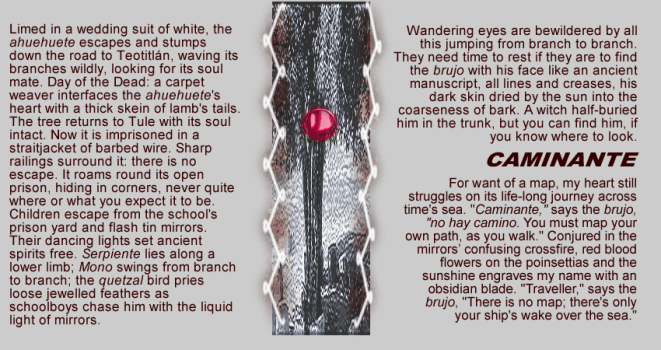
So many tales are told about the árbol de Tule, that thousand year old tree standing outside the city of Oaxaca. Hernán Cortés is said to have sat beneath it when he came to Oaxaca in 1525, or thereabouts. And it was old then, and famous in folklore. The tree is also famous for the pictures that nestle in trunk and branches. For small change, the little boys, released early from school, will point their mirrors up, into the tree, and spotlight with reflected sunshine the features that you seek. A thousand years, or more, have produced a thousand images, or more. Even the face of  Hernán Cortés himself is said to be captured somewhere along the tree-trunk’s art gallery, if you can only find it.

Like Borges’s eternal library, your own portrait can be found there, somewhere. You must search patiently for it, staring into the tree bark until it takes on your features. Then you can move on, knowing that whatever happens you will be caught forever in the life of one of the world’s wonders: el árbol de Tule. But beware of imitations and avoid the plastic imitations and the photos from cheap camera’s that will trap your soul forever, leaving no trace of you in the real world. Ignore these warnings at your peril, or you too will be locked into your cell phone and sentenced to life imprisonment within those digital walls.

Don’t hold your breath

IMG_0718 (2).JPG

Don’t Hold your Breath 

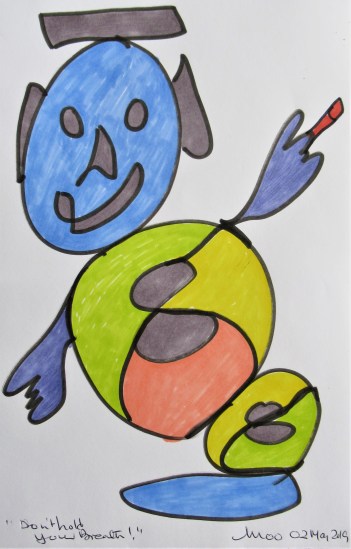
    Two small gnomes camped last night, one in each of my lungs. All night long they played their squeeze-box, wheeze-box concertinas, never quite in unison. Sometimes they stamped their feet and my body rattled with their dance. Their wild night music caught in my throat and I coughed unmusical songs that spluttered and choked, while I lay awake counting sheep and window panes and struggling with my future and my past.

    An east wind rattled my window whistling a sad song as it herded flocks of stars from one constellation to another. Wind and stars followed the westering moon’s slim finger nail as it scratched at the sky. The planets danced to the rhythms of the accordion music playing in my chest, and the sky’s planetarium folded and unfolded its poker hands of silent cards marked with my fate.

    Black jack, bright jack, one-eyed jack: what do I care when fate’s cards tumble onto the table and I count their spots. Forty card baraja, fifty-two card standard, Tarot, or any of the many others, what do we believe and why? I pluck runes from a velvet bag and shuffle and cut multi-colored cards. I survey the skies, cast dice and I Ching pennies … The fault is not in our stars, but in ourselves, that we are underlings, I mutter, not believing a word of what I say.

    I look in the mirror and see myself as I am. Grey, ageing, diminished, withering … yet proud of who I am and where I’ve been. Upright, in spite of all my failures. Proud because of all the small things that I have achieved. Who am I? What have I done? Where am I going? The eternal questions thrust at the shadows in my silvered morning mirror. Silent, it grins grimly back.