I didn’t have a photo of a cow, let alone a Welsh cow from Gower, so I included a photo of a Kingsbrae Garden alpaca instead.
Laver Bread / Bara Lawr
… and we would all go down to the bungalow, at Pyle Corner, in Bishopston, and we would play funny games and we would roll in the fields, but we Welsh boys watched where we rolled, because we knew the cows came in and left cow pats … and we called the cow pats laver bread, because they looked like laver bread, bara lawr, the sea weed we eat that comes from Penclawdd, where the cockles come from … and wonderful it is, though it sticks between your teeth, and my London cousins rolled down the field, faster and faster, and then they couldn’t stop and they rolled right through the laver bread and were covered from top to toe in laver bread and we laughed so much, we local boys, who knew where the cow pats were, and when to stop, we laughed so much we cried, and then we were sick and the London boys, all covered in laver bread, had to change their clothes and be washed and bathed, and they were beaten soundly and called rude names and had to go to bed early … and I hope none of them are reading this … or they will be calling me rude names and I wouldn’t want that at my age … and perhaps they have forgotten all about this … but I haven’t … and oh! … there are so many memories in the Olde Curiositie Shoppe that is also known as my mind …
Fish weirs in Fundy Poles in Passamaquoddy anonymous local artist
… and speaking of fish, there are the fish nets on their poles stretched from horizon to horizon, at low tide, and the fishermen in their waders walk out to the nets where the mud is squishy from the sewage system which dumps all the sewage in Swansea bay, but the tide was younger then, and stronger, and there weren’t so many people, so the beach was always swept clean in those days by the tide, and the sewage was always swept out to sea … and the fish were nice and fat and healthy and you could buy a couple of whiting or flounders, dirt cheap, and bring them home, if you asked nicely, and plaice and sole, well, they’re all flat-fish, really, and our cousins from London could never tell the difference between them, but we can, and I’d tell you, but it’s so long ago, that I’ve almost forgotten, and it’s partly size and partly colour, and partly spots, and I forget so many things now … but I don’t forget the sea as it licks at your toes, and you standing there, early in the summer, as white as an ice cream, and the sea climbs up to your ankles, and then your knees, but on Swansea Sands, at the Slip, or at Brynmill, you have to walk miles and miles before it reaches your waist … especially when it’s out and low … but you have to be careful for there can be deep holes and the mud can be slippery … though nobody ever falls down, oh, we were so much cleverer when I was young, … but there are rumours of quick sands out there at low tide, out beyond the fish nets … out where the banana boats ride … out where the bright lights are seen at midnight … the flashes and flares … the mysteries of the unidentified flying objects, saucers and the like, that visit us in Swansea, to learn to speak Welsh, or so the locals say, so that later they may n=mingle among us, and eventually take us over … once upon a time, when I was young, and the world was all new-born, that was not a conspiracy theory … and it was not fake news … maybe that’s why we moved to Cardiff …
To be Welsh on Sunday in a dry area of Wales is to wish, for the only time in your life, that you were English and civilized, and that you had a car or a bike and could drive or pedal to your heart’s desire, the county next door, wet on Sundays, where the pubs never shut and the bar is a paradise of elbows in your ribs and the dark liquids flow, not warm, not cold, just right, and family and friends are there beside you shoulder to shoulder, with the old ones sitting indoors by the fire in winter or outdoors in summer, at a picnic table under the trees or beneath an umbrella that says Seven Up and Pepsi (though nobody drinks them) and the umbrella is a sunshade on an evening like this when the sun is still high and the children tumble on the grass playing soccer and cricket and it’s “Watch your beer, Da!” as the gymnasts vault over the family dog till it hides beneath the table and snores and twitches until “Time, Gentlemen, please!” and the nightmare is upon us as the old school bell, ship’s bell, rings out its brass warning and people leave the Travellers’ Rest, the Ffynnon Wen, The Ty Coch, The Antelope, The Butcher’s, The Deri, The White Rose, The Con Club, the Plough and Harrow, The Flora, The Woodville, The Pant Mawr, The Cow and Snuffers — God bless them all, I knew them in my prime.
Comment: When I lived in Wales, a long time ago, there were twelve counties and each one of them voted whether or not to allow open pubs and hence drinking on Sundays. The ‘dry’ areas did not permit drinking, but the wet areas did. Hence there was mass migration from dry to wet every Sunday, especially after Sunday morning chapel. I dedicate this piece to every dedicated Welsh boy who fled his dry county to quench his thirst in a wet one! NB This piece should be read out loud, fast, in a Welsh accent and also in a single breath! Mind you, I find that hard to do nowadays.
sitting in the kitchen crouching by the coal fire hands quite warm back quite cold checking the windows peeling back the curtains blackout curtains frayed and old looking at raindrops sliding down the windows chill greasy raindrops grey and cold
wondering who wants me wondering who loves me wanting my teddy bear longing for my pussy cat wanting my little dog longing for his tail wag so much missing my nose so cold
now I am seventy everything has changed changed town and country changed clime and weather everything is different nothing is the same longing for my childhood longing for my home land watching the ocean that comes rolling in
ocean of waters ocean of memories ocean of people now long departed
Comment: Rhythm is everything here. I have just re-read The Sing-song of Old Man Kangaroo from Just So Stories (Rudyard Kipling). My mum and dad gave me copy when I was seven years old. Did they really think I could read it and understand it at that age? Whatever! The rhythms have stayed with me all my life and today I tried to reproduce them. My soul and my fingers danced as I thought of old man kangaroo and how he lost so much to gain so much. And what of the Elephant’s Child with his insatiable curiosity? I lost so much when I came here to Canada but I gained so much from this wonderful country. I tore my world apart then put it back together. How to explain it? It may not be explicable.
Royal Doulton Some nights I woke up during the night, needing to pee. At night, I slept with my gran. I never liked using the Royal Doulton chamber pot that squatted coldly beneath her huge brass bed, especially if she was in the room. We had no indoor plumbing, nor running water. Apart from the rainwater the only tap was at the far end of the field, a long way away. Rainwater, caught in a bound, wooden barrel, was the only water we didn’t need to fetch. The cows that wandered through our yard at night really frightened me. We would meet them in the lane some times, a noisy, dusty, flowing, multi-colored tide that flooded the pathway and forced us walkers into the next field, if there was a gate close by, or to climb high into the hedge, if there wasn’t a gate. One cow, with a crooked horn, had gored our neighbor’s dog. She had also broken a young girl’s leg. Vicious when, isolated from the herd, she often meandered around on her own. At night, when I wanted to pee, I walked outside, to the outhouse. I would grope my way out of the bedroom and slide back the bolts on the door. Then I would half-open that door and peep out, listening carefully for any sound of the cows tearing out the grass with their teeth. I would sniff the night air, and if I caught the sweet breath of a cow in the vicinity, I would pee through the narrow crack of the open door and swear in the morning, when someone found the little puddle, that it wasn’t me, that it must have been one of the cows. One quiet night, I walked bravely out into the dark and stepped right into a fresh, warm cow pat. It sifted upward between my toes and rose to assault my nose. After I had gone pee, I wiped my foot again and again in the long grass beside the outhouse, then placed it beneath the water-spout from the rain barrel, trying to flush it clean before I crept back into bed. That was the night I left the back door open. Next morning, Nana woke us all up with a series of long, loud screams. The black and white cow had wandered through the open door and ended up in the kitchen where my grandmother had come face to face with it in the early morning light. I still have dreams, nightmares, really, of a herd of cows invading my bedroom, breaking down the doors, climbing in through the windows, and me all alone, trapped in my bed, shivering ferociously, squeezing myself, trying desperately not to go pee.
Stuffy, you said. I can’t breathe. Early morning mist scratched pale finger nails down your bedroom window. Grey foggy faces glanced in, grimaced and scowled. Damp and slippery, the window frame, when I opened the sash. What time is it? Before I could answer, you demanded more milk for your tea. I left you there, in bed, went downstairs to the kitchen and brought back milk. Then you wanted more sugar. Shut the window, you said. It’s cold. I’m shivering. Puppet on a string, I raised my cord-bound feet and danced at your command. Then I went downstairs, fetched more sugar, came back, and left the morning paper on your bed. On the front page, a picture of the last passenger engine, green and rusty, from the GWR (Great Western Railway). It used to carry passengers from Swansea to Cardiff to Paddington in London. Now it pulls a line of filthy coal trucks. Covered in dirt, rain, steam and dust, I couldn’t make out the name or the number. Passengers on trains speeding to different destinations, we never had time, time for talking, time for understanding, time to think, time to be heard. Laden with baggage, our minds followed different tracks. Platform lights blazed in the night, a Van Gogh blaze of starry fires. We flashed past towns, stations where we’d never stop. Windows glowed in deserted waiting rooms, shattering the darkness, their full moons reflected in the double glass of a locked carriage door. We rattled over cross-tracks, never knowing why, yet I have never forgotten the rhythm of the wheels, slowing, accelerating, running at full speed, the telephone wires looping, cattle in fields grazing peacefully, wondering why … We rarely talk. I guess we have little to say. We leave big questions to float in the wind. We don’t tell our nightmares, our stories or our dreams. Trivia is too trivial. Serious issues cut too deep, unspoken, unanswered to this day. We bury our noses in the daily paper. We gloss our lives away. We flash past so many signals with their pointed mechanical signs. When your train finally stopped, I disposed of your body in Thornhill Crematorium, opposite the Ffynnon Wen, the White Well Restaurant and Bar where we celebrated our last supper together.
Comment: An old story, resurfacing from the Archives in which I found my old, dusty Cambrian Chronicles. It’s also a story I have reworked many times, as poem, flash fiction, philosophical statement, personal memoir … I guess such moments, such memories, are very hard to come to terms with. They lie just out of sight and gnaw at us at night, surfacing when least expected and packing a powerful punch of helpless hopelessness. And no, there is nothing we can do about such things except stare blank-faced into our moon-faced morning coffee and blink back the tears we were unable to shed at the time.
I guess, deep down, it’s all about grieving and how we grieve. In some cultures, it is all about manhood and stiff, upper lip. In others, it is letting the tears flow and the emotions run riot. It differs with each and all of us for we and our circumstances are all unique. I look at the current state of the world and I keep thinking that, no, it’s not a case of one size fits all. Not everybody is the same, and each one of is special, and needs something special, especially in these difficult times. Keep safe, keep well, and do not provide, if you can avoid doing so, any reason for your loved ones to mourn for you.
“Write about that chair,” Margie said,
and I wondered what was in her head.
How can I write about that chair
when those who sat in it are not there.
Before the coal fire my grandfather sat,
snoring away, on his lap slept the cat.
At three years old, I climbed that chair,
and blew on the bald spot in his hair.
So many things we no longer know:
my grandpa did the same thing, years ago,
and years before that, his own grandad
did just the same to make his old man mad.
Now I, in my turn, when I drink deep,
like to sit in that chair for a little sleep,
and my grand daughter, there’s no grandson,
climbs up that chair, as others have done,
and sees the bald spot in my hair
and blows and blows as I snooze there.
The years roll back and I see the smiles
of generations woken by a young child’s wiles.
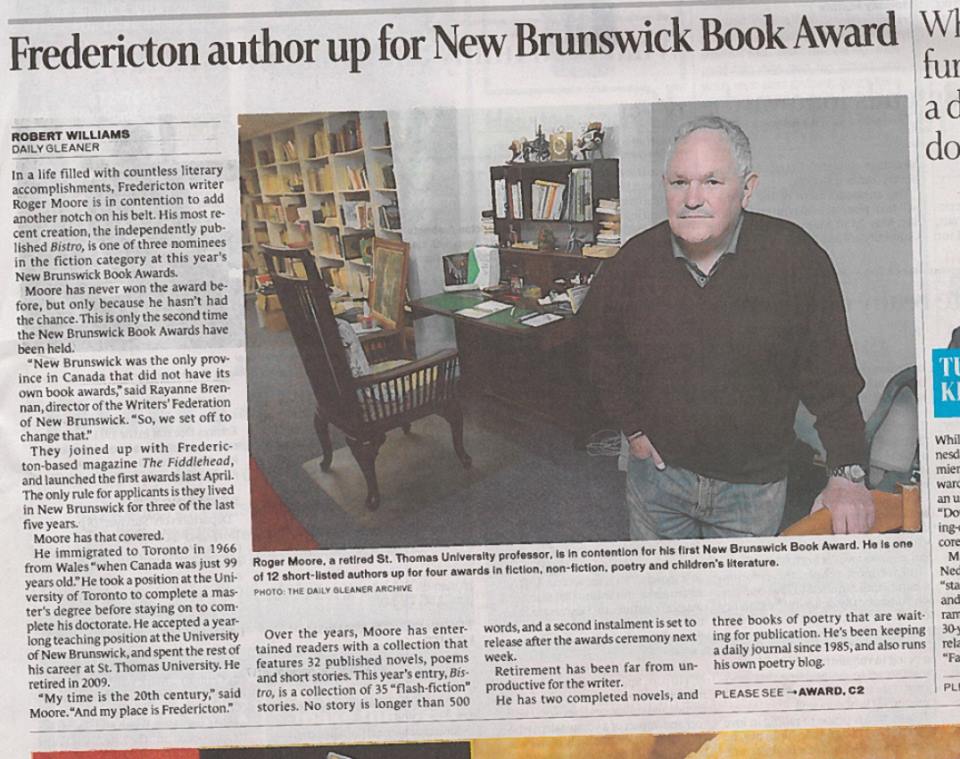
Comment: Talking the other day, I mentioned my grandfather’s chair, the only piece of furniture rescued from my parents’ house, and Margie said I had to write a poem about it. So, last night I did. The result is something very different from what I normally write. This is what in Spanish is called an occasional poem and it celebrates a specific occasion, a specific set of circumstances. Thus, it is written under different rules, rhyme, rhythm, stanzas. It is always an adventure to write something suggested by someone else. Poems like this cross the boundary between poetry of play (which this is) and occasionally enter the realm of poetry that expresses the authenticity of being which, to a certain extent is present in this poem too. The above photo, from our local newspaper, The Daily Gleaner, is the only one I have of the chair which resides in the basement where I keep my books. The article is an old one (2017), but the photo is nice!
Every day I learn something
about myself and my upbringing.
It’s not the need to talk
so much as the necessity
of diving into myself
and mining my memories.
Brynhyfryd / Mount Pleasant.
Ty Coch / the Red House.
Pen-y-Bryn / the Top of the Hill.
This latter the house
in which I was born.
No room in hospitals
for war time babies.
All of my wartime family
born in the same in-the-country
Gower bed.
Three of my brothers
did not survive
those rough, household births.
I still bear the forceps’ scars.
And I still bear the scars
of carrying my brothers
with me all my life.
A long and difficult
and very private history.
But it’s mine
and I embrace it
and I love it,
with all its warts.
Comment: The photo is of the dragon in Kingsbrae Garden. I think of it as a Welsh dragon … Y ddraig Coch … the Red Dragon of Wales, but of course, it isn’t. Anyone can write easy poems: Twinkle, twinkle, little star … it’s the hard, gut-wrenching stuff that’s hard to put down on the page. My close friend, Margie Goldsmith, encouraged me to write this. Thank you, Margie. Thank you for caring. This is indeed my life ‘… with all its warts …’ It’s easy to wear rose-tinted glasses and see everything as ‘for the best in the best of all worlds’. However, it’s more difficult to grovel on your knees, in the trenches, and to come face to face with the stark realities of who we are and where we come from. Thank you, Margie, for helping me and encouraging me to do just that.
“What is this sound?” “It is your own death sighing, groaning, growing while you wait for it to devour you.”
“What is this feeling” “It is the itch of your own skin wrinkling and shrinking, preparing to wrap you in the last clothes you’ll wear.”
“What is this taste?” “It is the taste of your life, bottled like summer wine once sweet tasting, now turning to vinegar.”
“What is this smell?” “It is waste and decay, the loss of all you knew and of all that knew you.
“That carriage outside?” It is the dark hearse come to carry you to your everlasting home.”
“Look on us in our darkness, help us to seek and see the light. Keep us strong, keep us brave. Mithras, always a soldier, help us to die aright.”
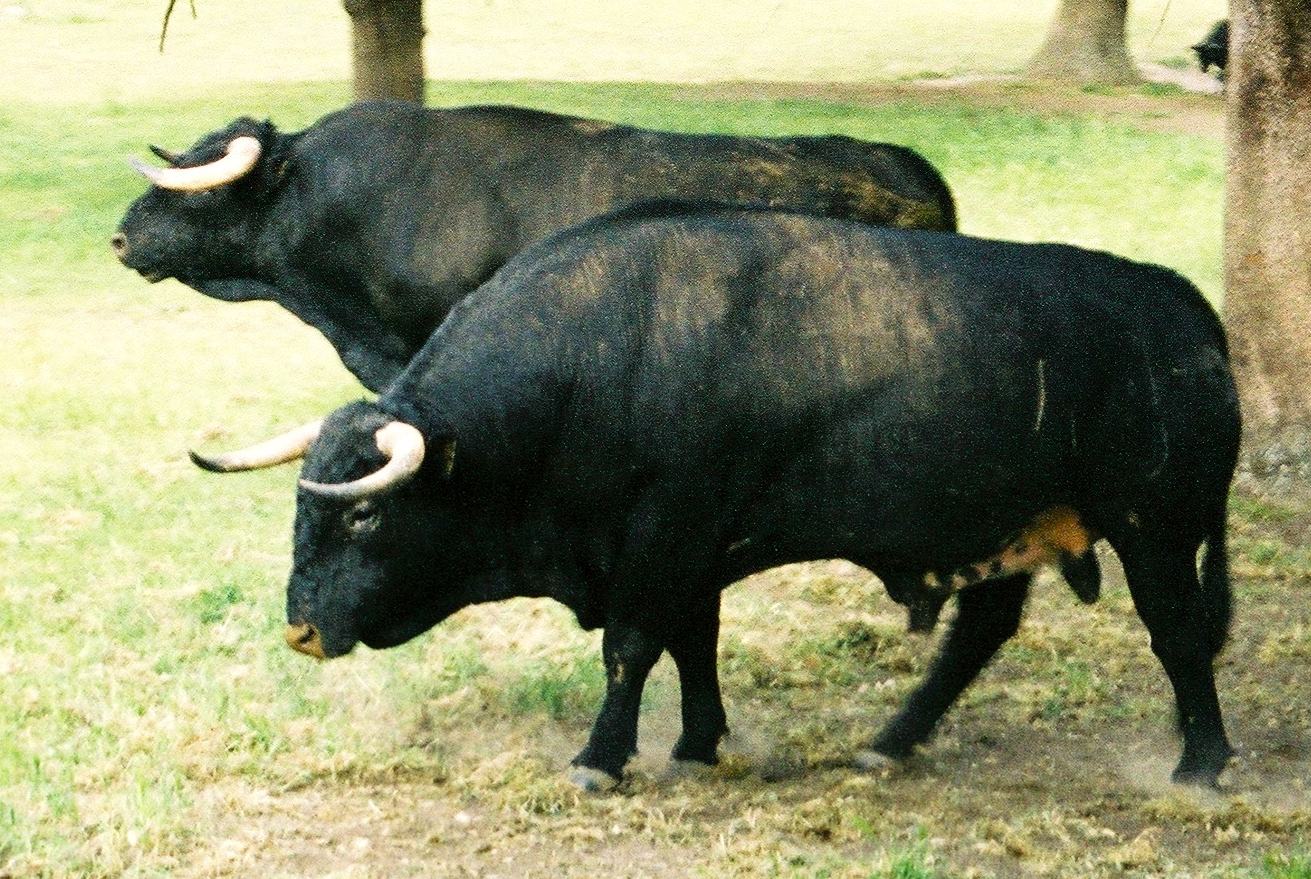
Comment: I am re-reading Puck of Pook’s Hill (Rudyard Kipling). It was given to me for a Christmas present (1955) by my father’s younger brother, my Uncle Frank. His signature is there, on the fly leaf, and his hand writing is as I always remember it. As I write these words, I can still hear his voice. The Song to Mithras, on which this poem is based, can be found on page 191, my edition (MacMillan, 1955), as a prelude to The Winged Hats. Without these clues, the poem operates in another space, more personal and more morbid, perhaps. The rites to Mithras were associated with the sacrifice, at midnight, of the black bull. The upper photograph shows one of the Bulls of Guisando (Los Toros de Guisando), which have stood in the province of Avila, in Spain, since time immemorial. So old are they, that the Roman legions left their mark on them in Latin, as you can see from the photo, when they conquered Spain after the Carthaginian wars. The lower photo shows fighting bulls on a bull farm in Salamanca, Spain. Born from generations of fighting stock, these animals have been bred for thousands of years to die in the bull ring, as the bulls dedicated to Mithras were bred to die in the Roman temples. This is not a defense of the cruelty of bullfighting or the sacrifice of animals. It is rather a statement regarding the longevity of cruelty, of sacrifice, of the natural flow that leads men and women from birth, through childhood, to maturity, and on to old age, and death. My father is long gone now, as is his younger brother. Who will have access to these memories of mine when I go? Who will remember my family when I am gone?
The world is on fire.
Someone, somewhere
lit a match.
The world exploded.
A match in the lungs.
the whole world burning.
Someone, somewhere
sneezed into their sleeve.
the world collapsed
in a fit of coughing.
“It isn’t the cough
that carries you off,
it’s the coffin
they carry you off in,”
said the talking head,
scientific boffin.
2
Intelligence, give me
the exact name of things:
corona virus, vaccine,
air that’s pure,
drinkable water,
a new, fresh world
for my daughter
and her daughter.
I wish I could spare them
from all this slaughter.
Comment: The echoes in here are obvious to me, but to how many others? Octavio Paz strolls through the first stanza while Juan Ramón Jiménez patrols the second one. How many people read their poems now? Polvo seco de tesis doctoral / dry dust of a doctoral thesis, as my friend José María Valverde once wrote. He, too, passed and will all too soon be forgotten like the rest. And time: what is it? How does it function? Is it linear or circular and repetitive? It twists and turns, like we did last summer, but not like we’ll do this one. My old arthritic bones will allow me to twist no more. Vingt-et-un, quatre-vingt- et-un: twist and bust. Yet time flows by, like water under Le Pont Mirabeau and days blend into days. 79 days of lock down now, all voluntary, or is it 80? El tiempo aquí no tiene sentido / time is meaningless in here, as my friend and mentor, José Hierro wrote, so long ago. And yes, these memories linger on, as time lingers on, as life lies heavy around us, and time limps by with its lame, old feet, yet looking back, it has raced passed like a spring river in spate. And the leaves are back, and the flowers are coming up, and the spring birds and bees and butterflies are arriving … and, in spite of everything, perhaps even because of it, life is as lovely as it ever was. Keep safe, keep well!






 rogermoorepoet