Which food, when you eat it, instantly transports you to childhood?

Daily writing prompt
Which food, when you eat it, instantly transports you to childhood?

Which food, when you eat it, instantly transports you to childhood?

That’s an easy one – diolch yn fawr / thank you very much – and the answer is Bara Lawr / laverbread of course.

What does laverbread taste like? I must thank Wikipedia for the answer below.

Welsh Laverbread (PDO) | Business Wales - Food and drink

Welsh Laverbread is made from cooked laver (seaweed) which has been plucked by hand from the Welsh coastline. It has a unique texture and salty flavour which provides a taste of the fresh, Welsh sea. Laver or Laver porphyra umbilicalis is the only seaweed which is only one cell thick.

And click on the link for a video from YouTube on the Traditional Welsh breakfast.

Laverbread could be found all around the Gower Peninsula in my childhood. When I was very young, you could buy it at Swansea Market for three pence a pound. Later, the price went up to sixpence a pound. When I lived in Cardiff, back in the early sixties, it sold at a pound per pound. Later, as the coast around Wales became more and more polluted, the sea weed had to be imported from the West of Ireland, and that certainly drove the price up – five pound a pound in the eighties.

But laverbread has two histories – the scientific / culinary one, and the personal one. Laverbread, on the plate, looks suspiciously like a cowpat. So much so, that when the cows visited the bungalow field where we had our summer home, the cowpats were called laverbread. “Don’t step in the laverbread, dear.”

Field rolling was a childhood joy. Start at the top of the slope and roll all the way down to the bottom. Born and bred in a laverbread field, we would plot our route between the patties before we rolled. Alas, our London cousins, with their cockney accents, were city and street wise, but not laver bread wise. Down the field they rolled, without looking, right through the laverbread patches. I leave the ensuing scene to you imaginations – and remember that the bungalow had no electricity in those early days, and no running water.

I remember the first day my beloved came to visit us at home. My mother served her fresh hot laverbread. Of course, she had never seen anything like it, except genuine Somerset cowpats. She picked around her food, left the laverbread on her plate until it cooled and – “Hold on a moment,” said my mother, “your laverbread’s cold. Here – I’ll warm it up for you.” Poor Clare. I am ashamed to say, I ate her helping while my mother was looking elsewhere – just devoured the extra portion, enjoying every moment, and Clare was so happy to see it disappear.

Here, in New Brunswick, while Clare was away one weekend, Becky and I decided to make laverbread from dulse. We followed the recipes and they worked. The laverbread was delicious – but – ah yes, there’s always a but – but the house stank of the sea shore at low tide and the first thing Clare said when she got home was – “What is that awful smell?”

I remember, opening a closet to get a clean shirt, about six weeks later, and that familiar whiff of the seashore immediately assaulted my nostrils. Alas, Becky and I love our laverbread, but -there’s that word again – but making it in our house long been banned.

What notable things happened today?

Daily writing prompt
What notable things happened today?

What notable things happened today?

One of my best friends passed away today at approximately 2:30 pm. She had been rushed into the Hospice and perished within days of being admitted. Such things are never easy, especially when the deceased person is younger than you.

My friend was a wonderful cook. To mark her passing, I made a traditional Welsh leek and onion dish for my beloved, who pronounced it good. Concentrating on the cooking enabled me to come to terms with a loss that is not only mine, but belongs to her family and the larger writing community as well.

My friend wrote prose, but was a poet at heart. Her creativity went beyond the written page and entered into her life, her relationships, and her cooking. A ray of sunshine in the kitchen, she brought the sunshine of her life to her guests when she presented the gifted poems of her food.

The title of the prompt includes the word “things”. A mutual friend contacted me with news of her passing. I contacted two more mutual friends and we shared happy memories – horas non numero nisi serenasI count only the happy hours.

Covid came between so many of us, especially the older generation. It drove a wedge between friends, shut out mutual meeting places, destroyed regular reunions and contact. This passing of a loved one, beloved to many of us, helped us reconstruct the spider webs of friendship, allowed us to share our grief, and enabled us to see the world in a slightly different light – one of joy and happiness – joy in the love we all shared, happiness in recalling the best of those moments.

Vis brevis, ars longa.
Requiescat in pacem.
Pax amorque.

And no, Latin is not a dead language.

Son Spots

Sun Spots

A painting and a poem dedicated to an only child who, in spite of all his achievements, was never good enough to earn the love of his parents.

Emptiness

The emptiness of air
          leaves the birch standing there,
framed by a space
          that will fill with chatter
and a flock of birds.

When evening comes,
          darkness frames the ash.
It sparkles
          with the gold dust of stars,
that swim through space.

Beneath snow’s empty page,
          grass and flowers root.
They will grow green tongues
          and rage next spring
at the coverlet
          keeping them in place.

A touch of warmth.
          Tiny flowers start to show.

What language do they speak
          as they spread their petals
and let fresh spring words flow?

My head fills with emptiness.
          My mouth is a silent space.

I sit and wait for words
          to break like sea waves
and create, who knows what,
          when they fill that empty place
within my heart and head.

What does freedom mean to you?

Daily writing prompt
What does freedom mean to you?

What does freedom mean to you?

When I look at that one word, alone on the page, I think, above all, of the multiple meanings attached to such a word, then I think of how it can be twisted in so many ways to make it mean whatever the speaker wants it to mean. So, let me begin by asking, what does freedom mean, in general, not in my own specific case.

Freedom – “the power or right to act, speak, or think as one wants without hindrance or restraint.” Interesting – no mention here of right or wrong, of truth or lies, of harassment or of perjury. Freedom – speech with no hindrance or restraint.

Freedom – the “absence of subjection to foreign domination or despotic government.” Wow! The first is very interesting but the second is extremely problematic. We need a definition of despotic and of government. We also need further clarification as to who decides what governmental despotism means. If beauty is in the eye of the beholder and if there is no arguing about taste, is the definition of despotism purely subjective? Who shall guard the guards? Does a despot consider himself or herself to be despotic? Do his or her followers? Or is it only the people who suffer and become victims of the despot’s hands, feet, orders, laws, commands, bullies, or general conduct?

Freedom – “the state of not being imprisoned or enslaved.” This is certainly much clearer. Thank you.

But consider where this very brief analysis has led us. And we haven’t even started on the Biblical meanings of freedom – “freedom from sin” – “and the truth shall set you free” – and here we are only scratching the surface of the possible religious and philosophical meanings of what the Spaniards call libre albedri’o, or free will.

What does freedom mean to you?

And now we move into the personal and the personal circumstances will change for each one of us. In my own case, freedom is my new Nexus 3 Rollator. It allows me to put aside my canes and walk around the block, something I have been unable to do for several years now. Wow – freedom to walk on my own, just leaning on my wheeled walker. Freedom to talk to my old friends, many of whom I have not seen or spoken to for a long time. Freedom to meet and talk to new neighbors, many with their lovely children and wonderful dogs. Freedom to breathe in the fresh air of early spring and to visit the flowers as they start to grow. Freedom, for me, is also the ability to see with my own eyes. Last month, I had my lenses laser-polished and now I can see again with 20/20 vision. Wow – that is really freedom, to to be able to read all but the tiniest print, without needing to use glasses. Freedom, for me, is also the ability to be able to cook, shop, move, live, without excessive pain. My new powers of walking have helped me with that. Long may it continue. It is also the good fortune to have enough money and strength to live in my own house and not to need a care home or regular home help.

Freedom – Such a magic word – such a powerful word – such a personal word. The freedom to choose to be myself, dependent on nobody else – and long may that freedom continue.

What is your career plan?

Daily writing prompt
What is your career plan?

What is your career plan?

“Pull the other one, it’s got bells on,” as the comedian said on our old black and white TV back in the late fifties when the television shows first started. My grandfather bought that TV in 1953 in order for us to watch the Coronation of Elizabeth II. I was nine years old at the time. Now I am – hold on – “How old am I? Let me count the days” – as Shakespeare might have written, if he had actually written his own plays and poems. Or were all those glorious words written by a conspiracy of authors who then had their work claimed by some else aka Willy the Shake? Snake oil, all of it, or as they say in some parts of Wales – blydi hel.

I wonder how many of my readers know how to play Tute, a Spanish card game, slightly akin to whist? Well, in it you score by singing – Canto las veinteo canto las cuarenta – well, I am well on my way to winning my game of Tute because Canto las ochenta!

So, at eighty years of age, after fifteen years in retirement, what sort of career plan can anyone have? Plan – is it a detailed proposal for doing or achieving something? Or might it be – an intention or decision about what one is going to do? As for career – is it an occupation undertaken for a significant period of a person’s life and with opportunities for progress?

So, in my retirement, what opportunities are there for progress when I seem to be regressing most of the time? And what plans can I make when the unplanned knocks on my door at irregular, uncomfortable intervals?

And that’s the problem with prompts and life in general – one size designed to fit all and I do not fit in. Never have. I no longer have a career. I no longer have any plans. I drift with the winds and the waves “as idle as a painted ship upon a painted ocean.”

I guess my only plan is to stay afloat for as long as possible and to avoid, if I can, that deadly dive down, down, down, into Admiral Brown, and down to Davey’s Locker.

What do you do to be involved in the community?

Daily writing prompt
What do you do to be involved in the community?

What do you do to be involved in the community?

Covid started a long period of isolation for many people of my age. We started by washing everything that came into the house – beware of touching things, they might carry the Covid virus. Then it was wear a mask and avoid crowds. Then it was telephone calls, parcels of groceries left on door steps, groceries ordered online and then picked up by car, no visitors, avoid crowded places…. At times, it bordered on hysteria.

That was 2020. But Covid wasn’t over. I have cut my own hair since 2019 and I still avoid crowds and wear a mask. As I emerged less and less, I saw fewer and fewer people. Old friends faded away, some, the less fortunate ones, permanently. Most ceased to visit. Gradually communications ceased.

2024 – May -01 – I purchased a new Rollator – a Nexus 3. For a week now, I have been out walking with it. Thirty minutes a day. I go round the block. I also visit the local park and walk the trails. Life is still out there, waiting to be lived. When I walk round the block, neighbors come out from their houses and talk to me. I have a little seat on the Rollator and can sit and chat with them for as long as they want. Old friends have returned.

Yesterday, I met some new friends. “We haven’t seen you around here before. Are you new?” A boy and his mother. The boy took a liking to my Rollator – he was three years old. He climbed on it, sat on it, tooted a non-existent horn, rang a non-existent bell, and brum-brum-brummed a non-existent engine. What fun we had. I told his mother I was an author and asked her if she would like a copy of Teddy Bear Tales to read to her boy. She said yes and when I see her next, I will give her one.

So, back to the question – What do you do to be involved in the community? I walk around the block and now I carry copies of my poetry books and short stories in my little carry bag. When I meet people, I offer them gifts of poetry and prose. Sometimes they say yes – and that is how I get myself involved with the community – as the Island View Bard.

A Broken Heart

A Broken Heart

What does a broken heart look like? Good question – and I, for one, don’t know. Maybe my artist friend, Moo, does. He painted this image of a Fragmented Heart the other day. Not that his heart was broken. He told me he was interpreting the words and feelings of a close friend (who shall remain nameless) who has been having the feelings associated with a heart that was actually breaking. Tough times, eh?

Rejections get me down and annoy me, but they don’t break my heart. I submitted a short story to a magazine on January 4, 2023 and got a rejection letter yesterday, May 6, 2024. It was a form letter, 16 months after submission, just to say “no”!

Of course, the few acceptances that I actually do get make up for the many rejections, as is always the case. However, there seem to be fewer of these acceptances as my thoughts look inwards and I turn from ‘poetry of play to poetry that expresses the authenticity of being‘ (Johannes Pfeiffer). In this day and age, I fear that readers seek entertainment and distraction and prefer the light-hearted to the heavy hand of deep thought and poetic authenticity. And remember, I do not distinguish between poetry and prose, as many do. For me, poetry is writing, be it in poetry or prose.

But back to the theme of the broken heart. Here are three linked poems.

Old Wounds

“The slow wound
deepens with the years
and brings no healing.”

The Minister by R. S. Thomas

How deep time’s wounds
have cut and carved,
not just in flesh and bone,
but in the embers
of that slow-burn fire
 they call the heart.

Memory and mind
have also played their part.

Some days, those wounds
don’t ache at all.

But there’s no real healing,
and a moment of madness
or a knife-edged finger nail,
careless, in the dark,
opens them up again
to bleed afresh
and remind us
of the frailty of the flesh.

I Remember

“I remember so well how it was back then.
I was lonely, my heart so broken I couldn’t
count the pieces, nor put the puzzle together,
 although I tried so hard to make it whole again.

I still bear scars, trenches dug so deep,
lines gouged into my body. I can’t always sleep.
Nightmares pave a crooked, cobbled way to day.

Some nights, I wake up suddenly from a dream
and scream the way that stuck pigs scream
when, hot, their blood comes steaming out.
Other nights, in pain and panic, at shadows I shout.

I search for someone to care for me. I want them
to understand my grief and help me forget the thief
who stole my joy and left me this life of disbelief.”

Signs of Age

What is pain, but the knowledge
that we are alive, and relatively well,
and still on the green side of the grass.

Long may it last. For when the pain is gone,
we shall soon follow. And this is age,
and age is this pain, and the painful
knowledge that we are no longer young,
can no longer bend the way we bent,
or touch our toes, or even see our toes,
some of us. The golden arrow pierces
the heart. Fierce is the pain. But when
that arrow is withdrawn and the heart
no longer feels alive, why, how we miss
that pain, how we weep to find it gone,
perhaps never to come back again.

Pain, like rain, an essential part of the cycle
of the seasons, of the days and the weeks,
and all the months and years that walk us
around the circadian circle, in time with the earth
and its desire to open its arms, and welcome us,
and greet us, and bring us our rest, from pain.

So much wisdom sewn into the wrinkled skin,
the gap-filled grin that glows with humor,
the crow’s foot signals of old age,
or merely those we associate with ageing,
and the knowledge that, yes, many
have walked this wobbly way before,
and many more will follow in our footsteps.

Take your pick – ‘poetry of play to poetry that expresses the authenticity of being‘ – but I know which I prefer and ‘still I live in hopes to see poems of authenticity.”

What is the last thing you learned?

Daily writing prompt
What is the last thing you learned?

What is the last thing you learned?

I watched Doc Martin last night, Season 1, Episode 1 – Going Bodmin. And here’s the painting of the excellent state of Bodminism. Offers of less than $10,000 for the original will be turned down. As for me, I think I am slowly going Bodmin. And why shouldn’t I? A merry road, a mazy road, that night when we did tread, all the way to Bodmin Moor, by way of Beachy Head.

So, what is the last thing that I learned? That I too am “Going Bodmin” – slowly, bit by bit, and having such great fun along the way. I have drawn the portraits of some of my fellow Bodminists whom I meet along the way. Maybe you can recognize one or two of them.

I guess going Bodmin is like going on a pilgrimage, to Santiago de Compostela, say, or like the Medieval Trip to Jerusalem. This modern pilgrimage can start anywhere in the UK as long as it ends in Nottingham, in one of Olde England’s oldest pubs, a spider-web-filled cavern known, of course, as The Trip to Jerusalem. This was, once upon a time, the start of the pilgrimage to the Holy City. Now it is the end of the pilgrimage from Bristol City.

Well, that was the road I ran back in 1966 when we ran a road relay from Bristol University Students’ Union to Stamford Bridge, down to Hastings, and back to Bristol. King Harold Marched from Stamford Bridge (where he defeated Harold Hard Loki) to Hastings (where he was conquered by Willy the Conker) in 1066. Alas, I don’t think the Trip to Jerusalem was open then, so he couldn’t stop in for a quick one on the way down. Might’ve won the battle if he had. Caught looking up to see where the spider webs were, I guess.

So, the last thing I learned was that I am going Bodmin! Did you learn anything from this blog? If you did, let me know what it was, and remember, it’s a long way to Tip-a-rary, but it’s a merry road and a mazy road when you’re heading for Bodmin Moor.

Hope Springs Eternal

Hope Springs Eternal

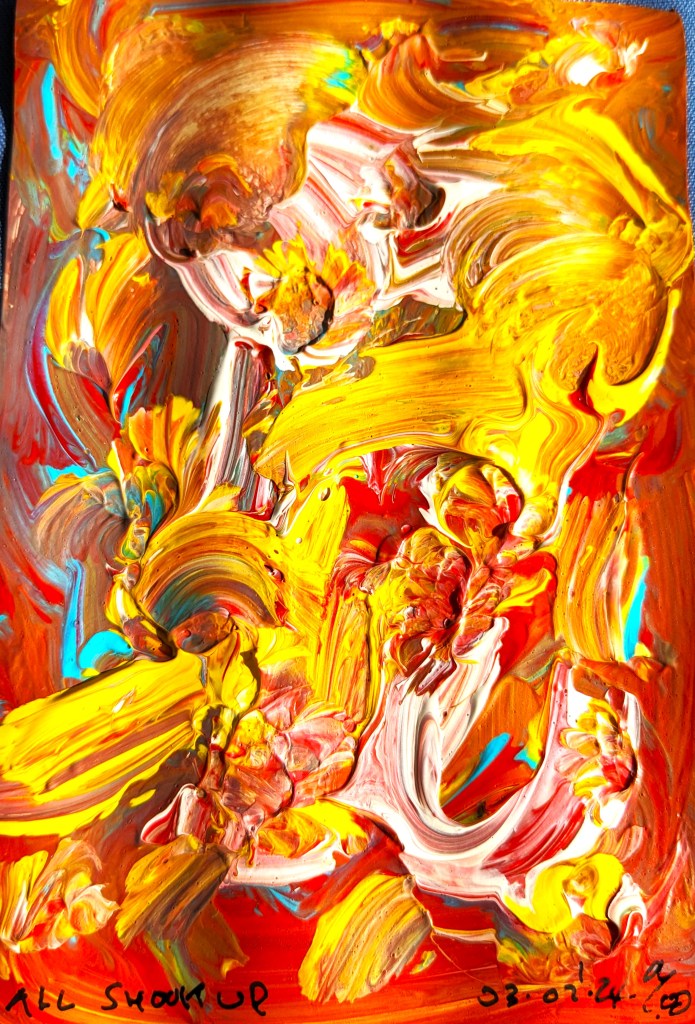
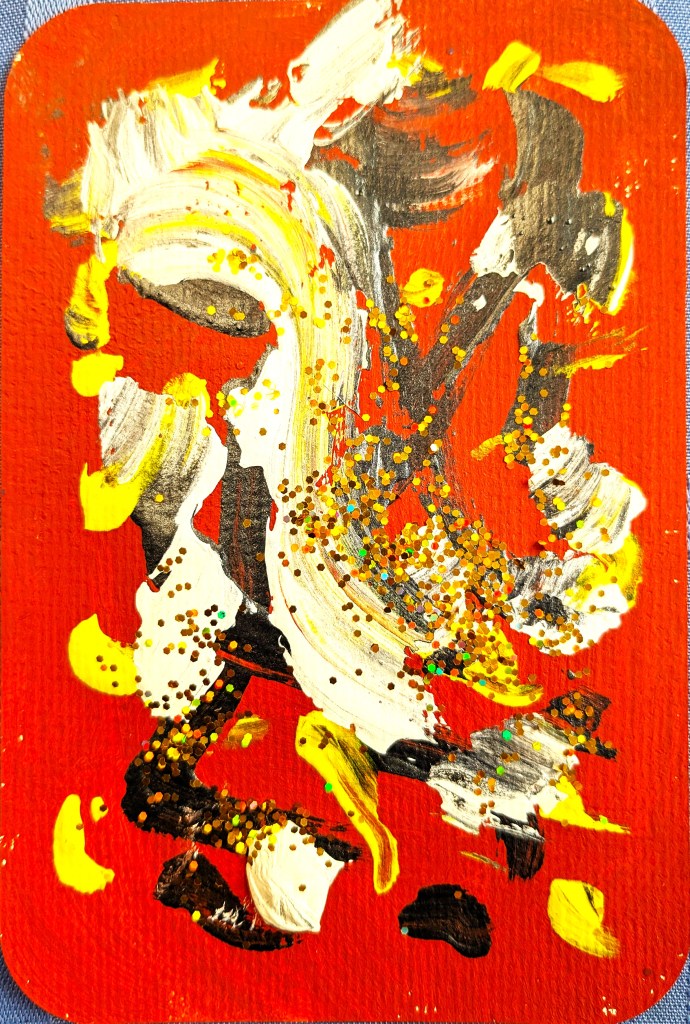
And it does, as you can see from today’s painting. Well, last night’s really. I left it drying overnight and this morning it was almost ready. Not even signed as yet. Oh dear. Still, I lay claim to it. And it’s definitely my style, with a few neat little changes. A change of palette, too. And manner of application.

“Paper your wall with rejections.” This is what Stephen King tells me to do. And I do just that. More rejections, and even more. Yet still I submit my poems and stories, and till they come back, rejected. Mainly form letters – but with an occasional helpful nudge like. “Nice writing. Not for me / us. Try somewhere else.” It used to get me down, but I am now so used to the negative that it is just water off a duck’s back. Splish, splash, and so what.

What really ruffles my feathers is the submissions that fall into the deep pit of silence. Not even a rejection slip with which to paper my walls. Not that I can do much with an e-rejection anyway. And I refuse to waste paper by printing them out and papering.

Still, who knows? One of these days, somebody may say “yes – we love it, and we’ll publish it.” As they say, “Hope springs eternal.” Maybe it does. But my time is beginning to run out.

“Who? Me?”

“Who? Me?”
The above is a self-portrait done at 3:00 am on the morning of my birthday. The full title is – “Another birthday? Who? Me?”

This is so much easier than writing a whole dog’s body tale of who I am, how old I am, and what I am / was feeling at the time.

If a picture is worth a thousand words, then I have just saved four pages of paper at 250 words a page, double-spaced. that’s the equivalent of a branch from a small tree.

As I tell my young friends and acquaintances – “Don’t grow old. But if you have to, never lose your sense of humor.”

Of course, sooner or later you may lose an awful lot of your senses – but keep that one, if you can!