Describe your life in an alternate universe.

Daily writing prompt
Describe your life in an alternate universe.

Describe your life in an alternate universe.

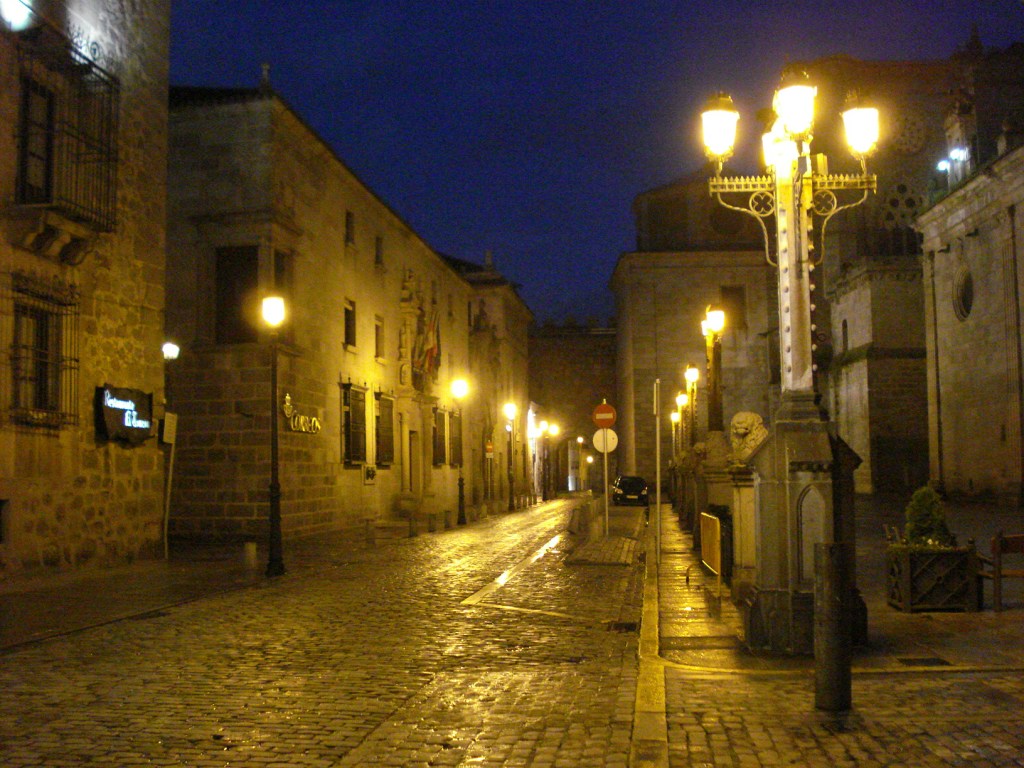
Ávila: A Brief Tour of the City

            Ávila is both a city and a province. The city may be new (walls constructed in 1058), but the province, like the city site, is old; it is older by far than the Romans, much older than the Christians, much, much older than the Muslims and Jews who once lived here. Blessed with water, it has a constant series of fountains and wells, some sealed, some flowing still, in streets and squares. More: it is a secret city, one of earth’s sacred places. The Celts built here, and here they worshipped their wild, pantheistic gods of tree, stone and sky.

            I came here by chance, drawn by the saint’s name as if I were a kite being reeled in from the skies. Often, in former days, I hurried past the city, heading to Santander in search of sun and sand with Ávila’s walls a blur as the train sped past. Then, when I finally had time to stop, I stayed and found sanctuary. There is a silence here, even among the voices; a truth that is built in the stone, not with the stone: a belief in water and rock that transcends Christianity and all the wonders of cloister and cathedral.

            This sequence of poems starts outside the walls of Ávila, in the surrounding countryside. Here there are mountains and valleys, bulls and cattle graze, mist hangs high on steep passes, and the tinkle of bells is heard among dry rocks as the tame goats scramble and the wild sheep climb ever higher. Outside the walls there are valleys and rivers, Roman roads, trade routes which have survived when the names of the tribes are long forgotten, their buildings tumbled down, their wives and children perished. Sometimes the land is magnificent; sometimes it is harsh and dry, the skeletons of older dwellings, their bones picked clean, now structured into newer homes. In places, a harsh, dry countryside holds a single tree, shaped like a parasol, with cattle standing in its shade. Dry stone walls march across the land, dividing field from field, tying the countryside down like a parcel. It is a land of boulders and saints, fought over for thousands of years with each stronghold tumbled down by the latest victors, then built again.

            When I came to the city, I was frightened by the mass of stone. I needed air and light and so I escaped the walls and discovered la ronda antigua. Here, overlooking el Valle del Amblés, I sat and studied the airfield from where, according to local legend, Von Richthofen’s planes took off in 1937 to bomb Guernica. I sat beneath the walls, in the sunshine, on the benches and watched the day’s cycle: the sun moving from left to right, the shadows changing position, the benches moving into and out of the sun, and everywhere, the swifts, knitting the sky with their wings, baptising the tourists from on high, and twittering in and out of the stonework. Above them all, the glory of storks, their wings motionless, hanging like kites just beneath the clouds, or soaring suddenly, borne away on the breeze. Beneath the wall walk, red roofs, grey stone, slates and tiles, cobbled walkways, fields turning into streets and houses as the builders build and the city grows outwards.

            Inside the walls, there are people and slowly but surely I came to know them. I knew the  barmen first, then the waiters and the serving girls, then the shop-keepers and the pharmacist, the policeman on duty, the workmen pulling up the cobbles. Then I met the painters and the poets, the artists who (re)create, again and again, the images on which I feed. I talked to the men and women who walk their dogs and follow them with tissues so the streets will not be stained. I praise the cocker spaniels, the great Dane, the wrinkled Shar-pei who guards the second floor balcony and woofs down at the world, the golden retriever, the English pointer, well-bred dogs, all of them. They are the finest that money can buy, and most are immaculately groomed. Finally, I make friends among the teachers and the walkers, the sitters and the families, the people who visit the same squares as I do, who shop in the same shops, eat and drink at the same restaurants and bars, the citizens who see what I see and take an interest in what I find so entrancing.

            Just outside the walls, but extending through them and into the inner city is La Plaza Grande, also known as La Plaza de la Santa. This area has been rebuilt recently and new buildings stand beside the old. This vast and open space is the training ground for young footballers who play soccer back and forth between the benches as their elders sit and sip coffee or meet for conversation on the benches around the square. During the World Cup, the youngsters act out their roles as super stars, galácticos as they are called by the followers of  Real Madrid. The players dribble, run, defend, attack, centre, corner and shoot at goal. They weep, cry out, appeal, fall to the ground, dive and roll on the stones, banking their shots and passes off trees and walls. Older men, formal and distinguished, sometimes stop to catch a stray ball then burst suddenly into a trot, demonstrate a pass curved with the outside of the foot, shedding twenty years as they do so, smiling, until called back to reality by the stern voices of the wives. Meanwhile,  the old women, arms linked, move through the players and their game, like ships in full sail skirting a harbour full of flotillas of smaller craft as they sail on, undisturbed, in their feminine armadas.

            The cathedral in Ávila is unique. It forms part of the fortifications and is built in and up as part of the city wall. Above the cathedral, on its pointed towers and battlements, a colony of storks looks down at the inferior world of human beings. Once upon a time, the storks returned to their nests  in the spring, raised their families, and departed at the end of July or the beginning of August, to avoid winter’s cold that creeps down from the hills to besiege the city. Now, however, the storks have found the garbage dump outside the city and forage there, long after their departure time, some of them remaining all winter as the world gets warmer. Tourists in the cathedral square strain their necks, looking upwards towards the storks who reign above them. Hawks fly in and out among the nests, young chicks duck down, and pigeons seek the protection of nook and cranny as the predators fly by.

Surrounding the cathedral is the cathedral square, La Plaza de la Catedral. Entering the cathedral itself, you must rub the polished toe of San Pedro, and make a wish. It usually comes true, but take care, the wise men say, with what you wish: fulfillment of the wish does not always bring the joys expected. Exiting from the cathedral, the Calle de la Vida y la Muerte is the narrow street on the left. Here, beneath a rugged, wooden cross, duels were fought, the winner returning home or fleeing into exile, the loser lying in the dust, staining the cobbles with his blood. On either side of the cathedral door, chained lions, and the wild and leafy green men of the woods stand guard.

            Down the hill from the cathedral, past the temple of Nuestra Señora de las Nieves with its wood and metal seat, is the Plaza de la Constitución which changes names according to the age and political commitment of the local inhabitants. Some call it the Plaza de la Victoria; others, the Plaza del Ayuntamiento; still others, the Plaza del Mercado Chico, or simply, El Mercado Chico. According to some, this was the central square of a Roman legionary camp; according to others, the Romans never lived here. Either way, on Fridays, a street market holds sway. Fruit and vegetables, pots and pans, soap and perfume, and, above all, the marvelous spices of the region and beyond: saffron and the various styles of pimentón de la Vera. Here, close to the Puerta del Rastro and the Sanctuario de la Santa where St. Theresa was born, is the emotional heart of the city. Here, within the four walls which surround the square, one can hear the buzz of El Zumbo, the great bell that deeply hums when it is gently rubbed. Here and in its near vicinity are small bars and restaurants, pavement cafes, pedestrian walkways, gift shops, clothing stores, cobbled streets, shop windows for window shopping, art galleries, tiny ultramarinos with their collections of wines, foods, fruit, bread, and cheeses, patisseries, florists, newsagents, churches, and schools, everything that makes the hub of a city strum with life.

            Next door to the Mercado Chico is La Plaza del Medio Celemín, also known as La Plaza de Zurraquín. Here, in one small corner of this smallest of squares, which is actually shaped rather like a trapezium, nestles the Hostal-Bar-Restaurante known as El Rincón. The Rincón is typical of all that is good in that older Spain which survives from my childhood memories: bars laden with tapas,  the richness of tortillas, the tang of queso manchego, tablas ibéricas with chorizo, salchichas, jabugo, and jamón serrano, and beyond that, a variety of tapas and tid-bits: percebes, langostinas, gambas, caracoles de tierra y mar, pulpo, calamares, sepias, and meats of all sorts: costillas, riñones, and callos. But El Rincón is not just a symbol of food. It is a genuine neighbourhood bar filled with local people who run the full gambit from knowledgeable, wise, witty, and well bred to bad-tempered (when the national team loses), ecstatic (when it or the local team wins), disappointed (when someone from Ávila gives ground in the Tour de France or La Vuelta de España), tolerant of friends and intolerant, as people usually are, of idiots and fools. It is a bar of breakfasts and lunches, of mid-morning coffees, of suppers and tapas, of cigarette smoke and lottery tickets, of gambling machines and cigarette machines, and of people with voices so loud that the cares of the day are all drowned out. 

            But El Rincón is much more than a bar. At night, when the guests retire to bed, the rooms of El Rincón are filled with dreams. These dreams knock at the windows and clamour at the doors. Sometimes the city’s secular saints appear, visitors from the past and guests from the future. These include the spirits of the place, the spirits that the Celts worshipped three thousand years ago. They are there in the wells, in the water supply, flitting between the walls, and settling on the head of the bed. The water of the wells attracts them, for, more than anything, they are spirits of water and rock who speak in dreams and talk of wisdom’s ways: how to sit in silence,  how to watch moss grow, how to feel the stone’s blood circulating far beneath its surface, how to sense the hands of the men who carved the stones, how to sit and look in the mirror and watch one’s hair turn white, one’s mind turn in on itself, and time walk slowly by. Not the time on the hands of the clocks, but the centuries of slowness that go into the making of seekers and saints, people like you and me, who drop in for a moment and are caught for a lifetime; people like you and me who turn off the television and listen to the sound of rain and snow, of water flowing, of the slow acceleration of dust as it sparkles in sunlight and gradually grinds down granite.

            Listen carefully. Sometimes at night you can hear the waters slowly rising and filling the well, that deep well within us, where dwells the wellness of spiritual being, the growth of spirit, the slow search, inwards always inwards, for the light that lives at the centre and fills us, slowly, like the gathering water, with love of living and joy of life. This is the love that can watch the sun move round the world outside and inside the walls; this is the joy that can be taken from a falling leaf, from a stork rising into the sky, from birdsong, from cattle grazing under a tree, from the silent dance of leaves, from the sticks of the stork’s nest, from children playing, from the voices that wake us from the very dreams they weave for us as we daydream or sleep.
Revisions

Revisions

Very little in the creative life turns our perfect first time through. That’s why we revise – revision is necessary. Here is my revision of Heartbreaking. Click here for the original version. Can you spot the difference between the two?

Heartbreaking

How many have broken their hearts,
reading what I have written, as I have
broken mine, reading what others wrote?

My words reach out, naked, stripped
of false trappings, fake images,
my flesh and blood damp on the page.

Who knows where my words will land,
on fertile ground, on desert sand, or will
they lie on dry, stony paths, infertile?

So many people now scorn living words,
preferring those dull, dry, three-word chants,
that hypnotize as fists are raised and clenched.

Beauty, love, life coffined in a tiny box,
outside of which, they can no longer think.

This is my revision of Rebirth – click here for the original version.

Rebirth

“El mundo nace
cuando dos se besan.”
Octavio Paz

A new world is born
when two people kiss.
The hummingbird sips
at the hollyhock’s lips.
Bee enters the blossom
and, sated, comes out.
A butterfly perches,
flutters its wings.

The sun enters a cloud:
radiance is born.
Silver linings
morph to gold.
The sun’s needle stitches
the world together.

Oh to be a part of Eden,
Paradise born anew,
in the moment when
lip meets lip and the tongue
is a twister, touching down.

Two hearts in a whirl,
their world aflame,
new shapes are born.
Wild flowers swaying
in an age-old dance.
Life’s journey renewed,
not always by chance.

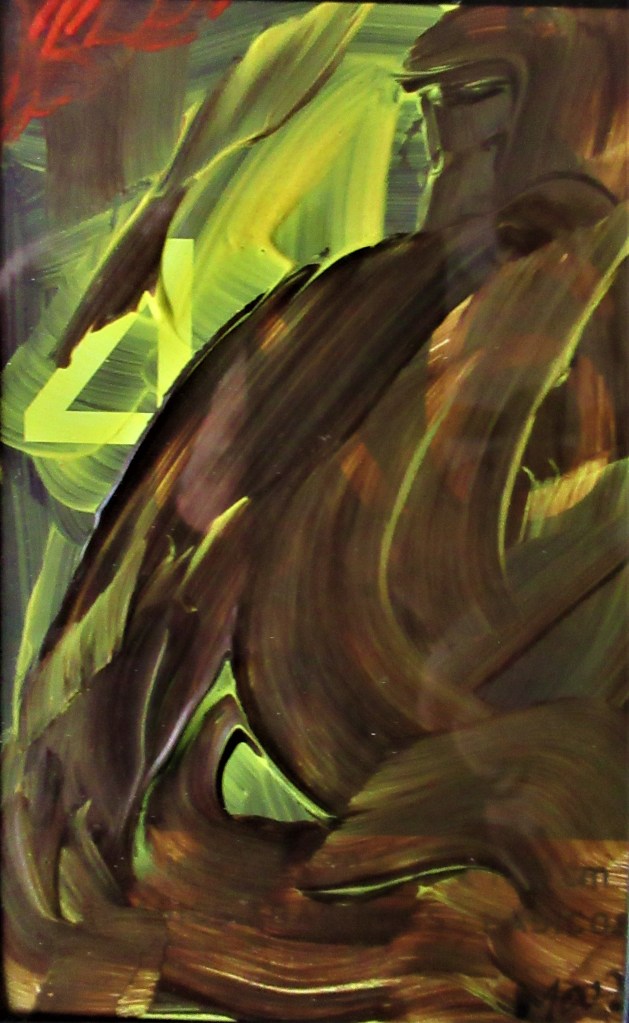
Fascinating things revisions, as you can see from my revisions to the painting which opens this post. Now you can spot the differences

30 things that make me happy!

Daily writing prompt
List 30 things that make you happy.

List 30 things that make you happy.

The first thirty dots I add to a dotty painting. As we all know, pointillisme drives one dotty. So, start counting each little dotty – when you get to thirty you can stoppy – and you’ll be as happy as a poppy. I do hope poppies are happy. I know poo-pees are. They wag their tales when they are hippy, happy, hoppy.

Oh yes, counting the ten toes on my feet when I have a double-trouble bubble bath. Then counting the ten toes on my grandson’s feet – that makes twenty. Then counting the toes on my other grandson’s feet. That makes thirty. Bubble, bubble, toil and trouble, hard to see those toes when the bubble baths bubble. Pinch each bubble, make them pop. When you get to thirty you can stop. Okay, okay, I hear you laugh – and that’s the joy of a bubble bath.

Apologia

Apologia
pro vita mea

The fairground’s distorting mirrors distort.
I change as I walk past one and then another.

Rage, rage against that hump-backed shape
that looks back at me from the bottle-glass.

Magic: eye of a newt, eye of a toad, cat’s
eyes at night lighting the road to bed.

Bedlam all around me. Absurd this world,
gone carnival mad in the blink of an eye.

I need a white stick to walk through
this fog that clings to my clay-bound soul.

This wine I drink, these thoughts I think,
life’s fountain pen soon runs out of ink.

Watch the tides as they ebb and they flow.
When your time runs out, pack up, and go.

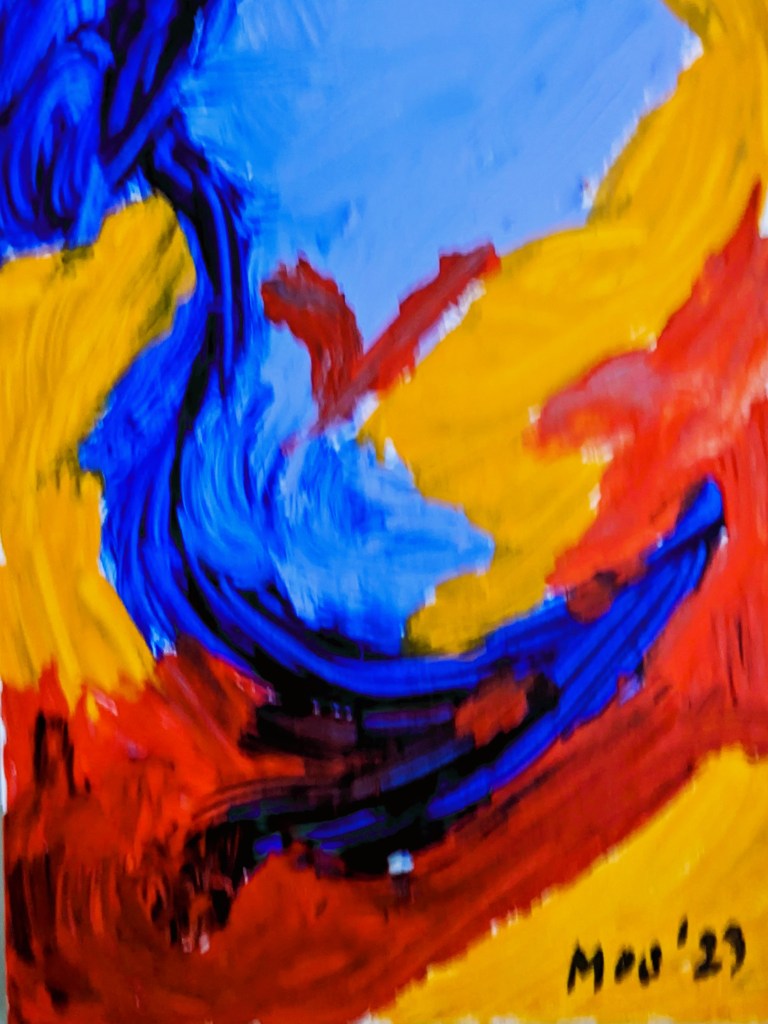
Comment: My friend Moo did himself proud with the above painting. What is it? I asked him. Dunno was his reply. I have shown it to several friends and speculation is rife: the dancer and the dance, dancer and diver, a blur of three figures, headless mermaid (I love that one). And yes, life is absurd (Albert Camus), a carnival (Bakhtin) in which knowledge is power and civilization is mad (Foucault).

Originality and imitation – how many genuinely original ideas are there? Very few. And the same goes for poetry – original poems are very rare. Most of our ideas come from elsewhere, even if we do not know it. The title of the above poem comes from Petrarch. It’s structure is traditional – a sonnet. Its ideas are borrowed from Camus, Bakhtin, Foucault. And yet, shuffle the cards (Cervantes) throw the dice (Mallarme’) and this poem and this post have both achieved a kind of originality and uniqueness by linking disparate ideas in a new unity.

Describe one habit that brings you joy.

Daily writing prompt
Describe one habit that brings you joy.

Describe one habit that brings you joy.

Creativity. I was told, a long time ago, that genius is 99% perspiration and 1% inspiration. When I started creating – poetry, mainly – I waited for the muse to arrive and lamented when she didn’t. Then I tried to force her to visit me – and that didn’t work either. Then, in 1985, I started a journal. I wrote in it every day that year and, as I wrote, I realized that most of what I was writing was gibberish. But – and it’s a big but – a few literary gems gleamed out from the rubbish. The question then became – how to recognize them. The answer to that has come more easily, the longer I have worked at writing. It’s not the muse who needs persuasion, it’s the artistic eye and mind that need to be trained so that they can see the creative art in the surrounding world.

Now, after 38 years of regular journaling – and I try not to miss a day – I can distinguish easily between art and rubbish. My poetic creativity, often via a streak of surrealism, has wormed its way from poetry, into poetic prose (short stories and novels), and from there into my style of quasi-surrealist, quasi-expressionist paintings.

Where is the joy? The joy lies first, in the work itself, the contemplation of the blank page, then the slow tidal flow of words that fill the empty spaces. Then comes the joy of recognition, followed by the joy of selection, followed by the joy of polishing, and eventually, the joy of publication. The same is true of painting. Here, the empty canvas, like a beach with the tide coming in, fills up with color and shape and, like Matisse, I try to make meaning out of those colors and shapes. Am I great artist? Of course I’m not. I’m a dibbler and a dabbler, unknown and unrecognized, but joyous in my joy of creating something that will stand, for a little while, against time’s rising tide.

Qué será

Qué será

Peace in the Peace Park,
here on the headland,
where cool grass slopes
down to the water’s edge.

Geese have nested close by
and gifted us with goslings.
Golden balls of fluff, they walk
on the land right now,
but soon will take to the water.

A thin, yellow line, they will
paddle behind their parents,
webbed feet invisible
beneath the water’s flow.

And I, in the metal coffin
of my over-heated car,
sit and watch them, envying
their freedom of movement,
waiting for whatever will come.

My beloved draws near.
I sense as much as see her,
as I covet her strong steps,
the ageless sway of her body.

Alas, I am growing old,
and not with any grace,
but fighting it all the way,
and qué será, será
is all that I can say.

Rebirth

Rebirth

“El mundo nace
cuando dos se besan.”
Octavio Paz

A new world is born
when two people kiss.
The hummingbird sips
at the hollyhock’s lips.
Bee enters the blossom
and, sated, comes out.
A butterfly perches,
flutters its wings.
The sun enters a cloud:
radiance is born.
Silver linings
morph to gold.
The sun’s needle stitches
the world together.
Oh to be a part of Eden,
Paradise born anew,
in the moment when
lip meets lip and the tongue
is a twister, touching down.
Two hearts a-whirl,
their world aflame.
Their world reshaped,
new shapes now born.
Wild flowers swaying
in an age-old dance.
Life’s journey renewed,
not always by chance.

Write about a random act of kindness you’ve done for someone.

Daily writing prompt
Write about a random act of kindness you’ve done for someone.

Write about a random act of kindness you’ve done for someone.

Sir Alex Ferguson, one of soccer’s greatest managers, once said that it wasn’t the victories he remembered, but the defeats. So it is with my own coaching career – it’s the losses I recall. Same thing with random acts of kindness. There have been many, too many to count. I will not paper my e-walls with glowing memories of past kindnesses. But what about those random acts of kindness I failed to do? Here’s one of them.

            Crave More: I hate those words. I always choose a cart with the shop’s name on the handle. I can handle that. I can’t handle a shopping cart that screams Crave More at me every time I stoop down and place another item in the wire grid. If stores were honest, they would inscribe their shopping carts with a sign that said Think More, Crave Less, and Save Your Money. I bet that would quickly cut into profits.

            Anyway, there I was, in La-La-Land, leaning on my cart, still half asleep, when this ghost drifted towards me. “Help me,” it said. “I’m hungry. I need food.” I woke up from my dream, looked at the ghost, tall, skeletal thin, cavernous eyes and cheekbones protruding, gaps in the teeth, grey face drawn and lined. The single word “Sorry” came automatically to my lips. Then I felt shame. I looked at him again. “I only carry plastic.” The excuse limped heavily across the air between us. I saw something in his eyes, I knew not what, and I turned away.

            Then, as I walked away, I added 100 lb of muscle to the scarecrow frame. Took forty years away. Filled his body with joy and pride, and remembered how he played when I used to coach him, hard and fast, but true. I ran my hand through the card index of former players that I had coached. I knew their moves, and attributes, the way they played the game, their stronger / weaker side, their playing strengths, their weaknesses. I remembered him holding up the Champion’s Cup. But I couldn’t remember his name.

            I pushed the cart all over the store in a frantic search for him. I went to the ATM and took out cash. I could hand it to him. I could tell him he had dropped it. I went through a thousand scenes. I could invite him to the snack bar. I could tell him to buy what he needed and follow me to the check out lane where I would add his purchases to my cart. I looked everywhere. He was nowhere to be seen.

            A single opportunity. One chance. That’s all we get. Miss it, and we blow the game. Take it, and we win the Championship and hold up the Cup.

How would you describe yourself to someone who can’t see you?

Daily writing prompt
How would you describe yourself to someone who can’t see you?

How would you describe yourself to someone who can’t see you?

Well, that would depend on why they couldn’t see me. “Those who have eyes, but cannot see.” Many have stood beside or before me, looked into my eyes, as I looked into theirs, and never saw me. “The most difficult role in the play is that of the fool,” said Don Quixote, “for he who would play the fool must never be one. So many people saw me deliberately playing the role of the fool and forgot the above quote. They also forgot what Antonio Machado wrote: “The eye you see is not an eye because you see it, it is an eye because it sees you.” And there you have it: why would I bother describing myself to people of that ilk, so stupid and blind with their own limited wisdom, that they couldn’t see me anyway.

Keenan’s Well, by Seamus Heaney, is a wonderful poem. It tells us about Rosie Keenan, his blind from birth neighbor, who played the piano and sang all day. She let them touch her books, like books of wallpaper, and feel the letters of braille by means of which she was able to read. They allowed her to touch their faces with her oh-so-sensitive fingers, and she said she saw them, as well as knowing them by their voices. When he read her a poem about Keenan’s well, she told him that she, blind from birth, ‘could see the sun shining at the bottom of it now.”

How would you describe yourself to someone who can’t see you? I wouldn’t waste my time and energy trying to do so.