Transitions

Meditations on Messiaen
Quartet for the End of Time

4

Transitions

Modes of limited transitions,
moods of time tapped in time
to time’s rhythmic piano.

Scales fall from the listener’s eyes.
A transitory awakening,
this glimpse of the composer’s vision,
each note a new version
extracted from abstracts
perceived in color,
each note a hue, and chords
a rainbow spectrum of light
glimpsed darkly through
a raindrop’s lens.

Birdsong and sunshine.
Notes perched
on the matinal branch,
each in tune with the other,
at times discordant,
yet the morning chorus
diluting the day
with the liquidity
of light and sound.

Click on the link below for Roger’s reading.

Transitions

The End of Time

Meditations on Messiaen.
Quartet for the End of Time.

3

The End of Time

A thin violin crying
its cat-gut heart out
in tears of sound, falling,
rhythmic raindrops,
down a grey-streaked face
tight with stress and pain.

Such concentration,
such soulfulness packed
into each mindful note.

An audience of one,
I sit, head bowed,
meditating on the meaning
of meaning and nothingness,
the nothingness of being condemned
to oblivion yet oblivious
of the how and when.

Each note a hammer-blow,
then, the piano hammering nail
after nail into this coffin body
I drag through the motions
of extracting meaning
from this meaningless life.

Click on the link below for Roger’s reading.

The End of Time

Dark Angel

Meditations on Messiaen.
Quartet for the End of Time.

2

Dark Angel

He will come, the dark angel,
and will meet me face to face.

He will take all that I own,
for it is only temporary
and all my possessions are on loan.

My house, my wife, my car,
my daughter, my grand-child,
 my garden, my trees, my flowers,
They are not mine.
I do not possess them.

I only own this aching heart,
these ageing bones,
this death that has walked beside me,
step by step, every day
since the day I was born.

That indeed is mine,
and nobody else’s.
That is my sole possession.
That is the only thing I own.

Click here for Roger’s reading.
Scroll down to appropriate episode.
Dark Angel

A Stone


Meditations on Messiaen.
Quartet for the End of Time.

1

A Stone

I cast a stone into the sea.
A round, flat stone,
it skipped from wave to wave
and refused to sink.

My heart sank within me
as I counted each bounce:
five, six, seven…
then the stone sank
bearing with it
my seven deadly sins
and I wept no more.

I, who have lost all that I had,
mother, father, brothers,
land of my birth,
I laid them all to rest
and I dried my tears,
forgot my fears,
and counted my blessings
as I walked, no longer alone,
along the shore.

Click on link below for Roger’s reading.

A Stone

Waiting

Waiting

I remember pushing
my father around the ward.
Two weeks we had together.
He sat in his wheel chair
and I wheeled him
up and down.

“Cancer, ” they told me.
“But it’s kinder not to let him know.”

In those days, it was better to die,
without knowing why.
Did I betray him by not letting
him know what I now need to know?

One day, he begged for help
and I lifted him onto the toilet.
He strained and strained
but couldn’t go.

“Son,” he said, sitting there.
“Will you rub my back?”
How could I say no?

That strong man,
the man who had carried me
on his back,
and me standing there,
watching him,
trousers around his knees,
straining, hopelessly,
and me bent over him,
rubbing his back,
waiting,

for him to go.

Click here for Roger’s reading of
Waiting.

Carpe Diem

Carpe Diem

Seize the day. Squeeze this moment tight.
Nothing before means anything. Everything
afterwards is merely hope and dream. 

A tiny child, you chased wind-blown leaves
trying to catch them before they hit the ground.
Elf parachutes you called them and trod with care

so as not to crush the fallen elves as they lay leaf-bound.
I stand here now, a scarecrow scarred with age,
arms held out, palms up, in the hope that a leaf

will descend, a fallen sparrow, and rest in my hand.
When one perches on my shoulder and another
graces my gray hair, my old heart pumps with joy.


Comment:
Coming soon to a garden near you!

Listen to the podcast
Carpe Diem

True Love

True Love

True love flows so much deeper
than an exchange of body fluids
or a handing over of ritual rings.

Our advancing lives are no longer
ruled by nature’s primal urges.
Our bodies have been taken over
by old age stiffness, aches, and pains.

Some nights, I wake up to find
she no longer breathes. I reach out
in panic, touch her gently, and when
she breathes again, I heave a sigh
redolent with love and relief.

Listen to podcast here.
True Love

Pianissimo

Pianissimo


            You sit at the piano, my old piano, still extant in my father’s house, yet soon to be given away, though we don’t know that yet. It’s an upright, iron-frame Bechstein, a piano that I was given when I was the same age as you are now. Handel’s Largo, the Harmonious Blacksmith, hours and hours of scales. They locked me in the front room, my mum and dad, and there I stayed for an hour, two hours, or more. I came to hate music. As soon as I could, I gave up the piano, I rejected piano practice, I turned my face away from the discipline of the lock up.
            Now, I listen to you. Your untaught fingers tickle the black keys, then the white keys, one after another. You are six years old. You’ve never had a lesson, but you have music in your blood and some residual instinct latches on to rhythm and sound. Your fingers are long and supple and your touch is light, so much lighter than mine used to be, and now, on the deep bass notes of the left hand, your stronger hand, you pound away, awakening the dark ghosts of soul music that pour through my memories awakening echoes in this piano.
            I think of you as a jazz musician. Thelonius Monk, perhaps, a tinkle here, a light touch there, now a chord or two, inexplicable, and who would want to explain. It is a joy to sit here, to see your smile of absolute absorption. Mood music you call it, and today your moods are as dark as the shadows that tug at my heart, and as light as the sunlight that floats through the windows and makes the dust motes sparkle. It also frames a halo round your head. You hum to yourself as the morning sunshine fragments into colored gems and you sculpt your rainbow of sound.
            “Stop that noise. You’re driving me mad,” your grandfather, my father, stumbles into the room. He has taken his last cigarette out of the packet and the white cylinder hangs down from his lips, like an extraneous chalk outcrop hanging from the lip of an errant teacher. He pats his pockets. “Where are my matches? Has anyone seen my matches?”
            “They’re on the table in the kitchen,” I reply. “Where you always put them.”
            “I thought I left them in here,” my father leans on his stick then turns and stumbles out of the living room and into the kitchen.
            You hop off the piano stool, take the matches from your pocket, and carefully place them on the arm of your grandfather’s favorite chair.
            “Sssssh!” you say, putting a finger on your lips. Then you skip back to the piano and start playing pianissimo on high notes that float like tiny raindrops of sound produced by miniscule angels.          
            Your grandfather returns, glances round the room, spots the match box, and pounces upon it, a caged tiger finally served his red meat.
            “That’s funny,” he mutters. “They weren’t there a moment ago.” He takes out a match, strikes it, lights up his cigarette, inhales a lungful of smoke, then exhales it in a great locomotive puff of cloud. He grimaces at you through a haze of smoke.
            “There’s nice music you’re playing.”
            Your young lungs, unaccustomed to a house of smokers, can’t cope with this thin, grey, choking cigarette waste. You stop playing, put a hand over your mouth, and start to gag.

Listen to the Podcast here:
Pianissimo

Blood and White Wash

Blood and Whitewash
A Thursday Thought

2-September-2021

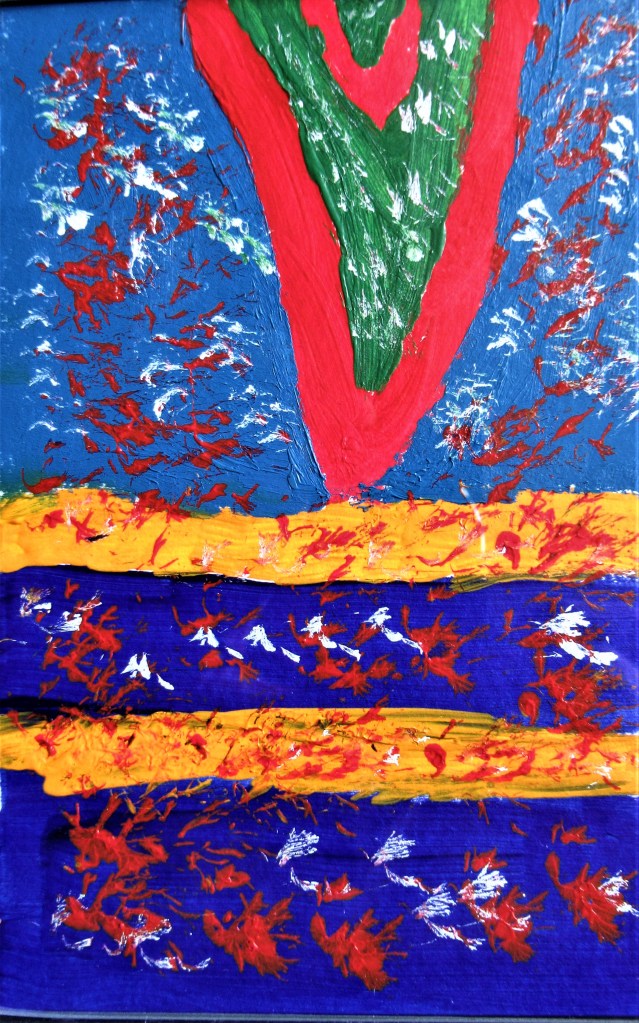
Blood and Whitewash is the title of this painting. It has a subtitle: My Plan of Attack.

The origins of the title, and hence of the painting, go back to the Goon Show, with Spike Milligan, Peter Sellers, and of course / wrth gwrs, Harry Secombe, the Swansea Comedian and Master Singer. Away in boarding school back in the late fifties, one of my greatest pleasures was listening to the Goon Show on one of the dormitory’s transistor radios. As a teenager, I found the jokes and the accents incredibly funny. Still do. That’s why I painted this painting. Alas, it is silent, and you cannot hear the accents.

The following snippet of dialog occurred on one such Goon Show, I cannot remember which.

“What are we going to do?”
“Well, this is my plan of attack.”
“That’s not a tack, it’s a nail.”
“No it’s not. It’s a tack.”

So above you have my painting of My Plan of Attack, resurrected after all those years. I throw my mind back to the First World War.

The General:
“He’s a cheerful Cove,” said Jimmy to Jack,
as he walked to Arras with his pack on his back.
But he did for them both, with his plan of attack.

And there in essence is the history of the painting. First, the plan of attack, then the failure and the blood-letting, and then the white-washing of the whole history, a white-washing that turns failure into success, defeat into victory, and loss into gain. But in WWI, it was the poor Tommies who bore the burden, and all the other front line troops who obeyed orders, went blindly over the top, and charged unbroken wire with fixed bayonets.

“If you want to find the sargent,
I know where he is, I know where he is,
If you want to find the sargent,
I know where he is.
He’s hanging on the old barbed wire.”

“If you want to find the chaplain,
I know where he is, I know where he is,
If you want to find the chaplain,
I know where he is.
He’s hanging on the old barbed wire.”

“If you want the whole battalion,
I know where they are, I know where they are,
If you want the whole battalion,
I know where they are.
They’re hanging on the old barbed wire.”

Singing as they marched to their deaths, obeying orders, like sheep, and nipped on by the eternal sheep dogs. Things were so bad at Verdun that instead of singing, the men marched, bleating, like sheep. “Sheep unto the slaughter.” There was so much ill-feeling and rebellion in the face of orders and certain slaughter, that French regiments were decimated, one man in ten shot for mutiny, as they marched bleating, instead of singing, to their deaths.

“Oh, we’ll hang out our washing on the Siegfried Line,
have you any dirty washing, Mother dear?”

“Those who do not learn from history are condemned to repeat it.” So, tell me, “where have all the young men gone, gone to graveyards everyone, when will they ever learn, when will they ever learn?”

And that, dear friends, is my thought for today: The History of My Plan of Attack. When, indeed, will we ever learn?
The Art of Narrative

The Art of Narrative

            Art has almost always told a story, even though, as in the case of the Cave Paintings in Altamira, Puente Viesgo, Lascaux, and elsewhere, we may not know exactly what that story is. On the other hand, many of the great paintings of the Spanish Golden Age (1525-1680) have a hidden narrative that we can often work out. Take, for example, Vulcan’s Forge (1630), painted by Diego Velázquez after his first trip to Italy (1629). On the surface, this is a painting of a typical Spanish Forge of the seventeenth century. Ordinary workmen labour away at their daily tasks, but, and there is always a but, the figure on the left is adorned with a god-like halo. Why? Because he is the bearer of a message. Vulcan’s wife, Venus, has been having an affair with Mars, the god of war. Vulcan has forged a net of fine, golden chains and placed it over the bed where they will loiter. Now, Mars and Venus are trapped in that net, caught in the act, so to speak. No wonder the mouths of Vulcan’s helpers are open in wonderment.

Bisonte Parado: Cenicero de Altamira.

            Before the arrival of photography, painting was the only way to record the world, to make a picture of what was happening, to tell a story in paint. That is why a picture is worth a thousand words. I have retold the narrative of the painting of Vulcan’s Forge in 128 words. There is, of course, a great deal more to tell about his and other paintings and how they represent the artist’s narrative reality. The advent of photography changed the artist’s vision of the world. As photography developed and became quicker, faster, and offered what some might consider to be a more accurate version of reality, so artists rethought their role. Was it to capture, in paint, the world as they saw it, with a single visual entry point, and a constant perspective? Or was it to catch the way light fell upon objects (Monet), or to offer multiple entry points (Braque), or to paint the turmoil of the inner mind (Picasso, Miró, Pollock)? Artists could do such things. Until recently, with the advent of the computer, it was much more difficult for the camera to do so. The camera recorded, but artists created and re-created their own narratives of the world around and inside them. Now we can enter photoshop and the equivalent and play around with out own photos of reality, distorting them and twisting them as we please.

Verbal to Visual to Verbal

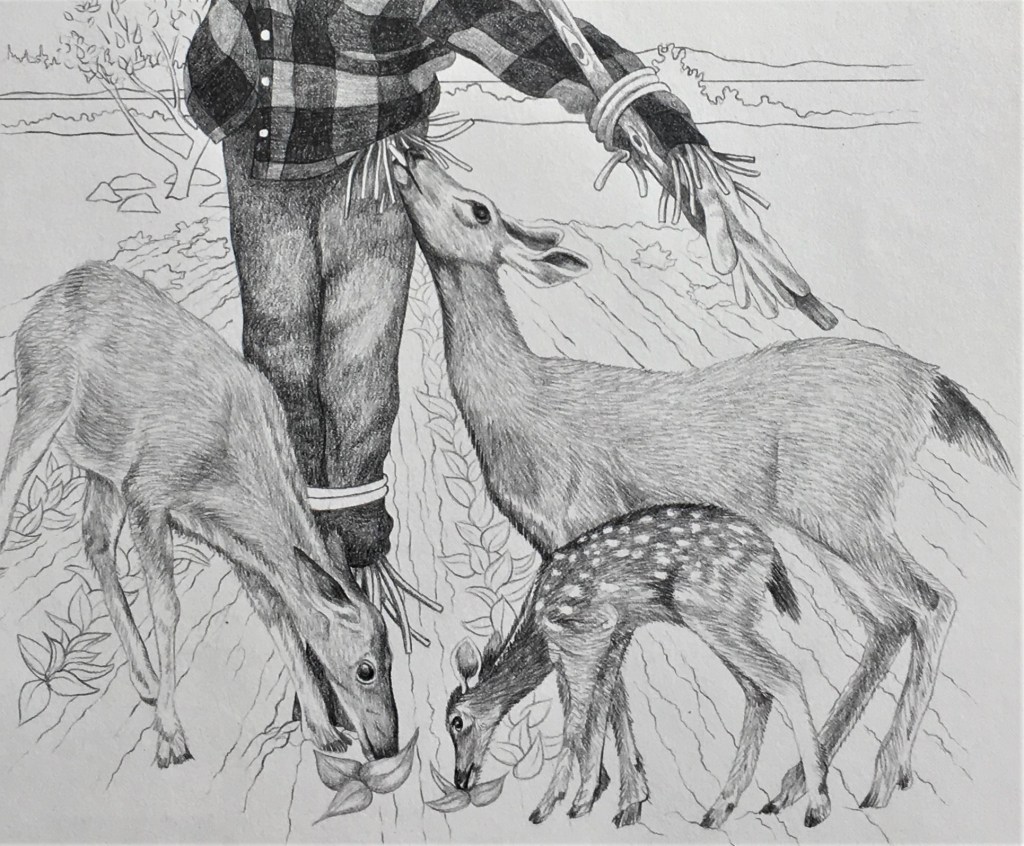
            Which came first, the chicken or the egg, the verbal or the visual? Or was there a sort of spontaneous combustion? In the case of Scarecrow, the artistic collaboration between myself, the author, and Geoff Slater, the artist, the words came first: “In the beginning was the word.” He heard me reading my story, started to sketch the characters, and within six months we had produced an illustrated book.

Wonderful drawings. Thank you, Geoff.

Words and narrative first, then an artist’s rendition of key moments in the narrative. However, in the case of Twelve Days of Cat, our second artistic collaboration, Geoff sent me 12 drawings of a cat and I looked at them and worked out a narrative that would join them together in a symbiotic relationship. Scarecrow is an illustrated narrative in prose. Twelve Days of Cat is a narrative in poetry based on what was once an independent series of charcoal sketches. Who cares which came first, verbal of visual, when the results are so pleasing to ear and eye.