Mayday, Mayday, S O S, this is a plea for help, I guess.
Dit-dit-dit- dat-dat-dat, the world lies dying and that’s a fact.
Add another dit-dit-dit and that’s morse code for we’re in deep shit. What can we do to get out of it?
Very little, as I see it, if the world can’t be bothered to see it.
Another half country of forest gone, right whales diminishing, they won’t last long. Rivers flooding, forests on fire, what have we done to earn Gaia’s ire?
Human beings long-forgotten, but profits are up, maybe that’s what’s rotten. We’re near rock bottom I would guess. Mayday, Mayday, SOS,
We’ll soon be gone our works forgotten. No more humans, the world in a mess: Mayday, Mayday, SOS.
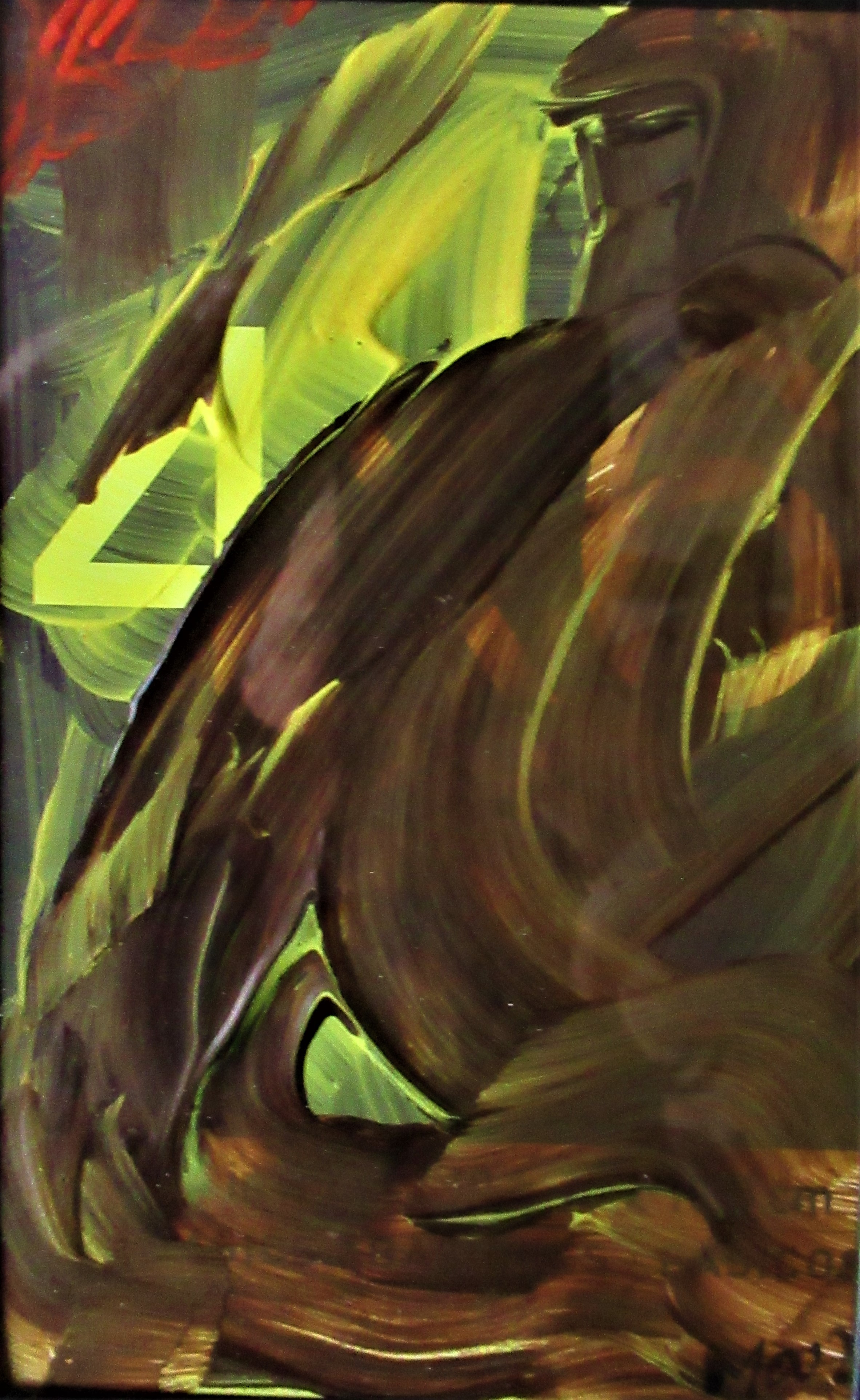
Comment: Well that’s how I see it some days and this is just one of those mournings. Say it in paint, say it in rhyme. Nobody’s listening most of the time.
Rant, I say, rant and rage away, rage, rage against the death of friendship, and loathing built now on what was once holy oath and undying love. This is a blood sport where even the spectators are spattered with the refined frenzy of friends turned into fiends and foes, and this is a protest, a rant against love that doesn’t last, that doesn’t stand the test of time, against families that break up, against a society that breaks them up, driving wedges and knives between people once bound by the puppet strings of love, against relationships that can no longer continue, against the rattling of dead white bones in empty cupboards where skeletons dance their way into legal daylight and the spectators call for more: more blood, more money, more blood money, and the engagement diamond is a blood diamond now, a tarnished garnet, and where is the Little Old Lady of Threadneedle Street, that spire inspired needle that will stitch their world back together, and stitch you back together when you’ve been shocked out of your own ruby-sweet rose-tinted world and torn into little bits in their oh-so-bitter one, the biters bitten and those bitten biting back in return, a new world this world of snapping turtles, turtles standing on the back of turtles, and turtle after turtle all the way down until this carnival world puts down its dead clown mask and turns turtle in its turn.
Comment: My thanks to Brian Henry for publishing this on Quick Brown Fox.
Sometimes you wake up in the morning and you realize that you can do no more. What is it about family split-ups, the ugliness of a disputed divorce, the glue coming unstuck in an already unstable marriage, a financial settlement that satisfies nobody and impoverishes both sides of a divide?
And how do you bridge that divide when you are friends with father, mother, children and the wounds are so deep that everyone wants out, whatever the costs and whatever it takes? And what is it about the deliberate wounding of each by the others, leaving permanent scars that will never heal over, no matter how hard one tries?
And what is it about lawyers, when too many guests gather around the Thanksgiving turkey and knives are out for everyone to take the choicest cuts leaving nothing but a skeletal carcass, no flesh on the bones, and the guests all hungry and their empty bellies rumbling for more, more, more.
My thanks to Brian Henry for publishing this on Quick Brown Fox.
They divided us into houses, Spartans and Trojans, and encouraged us to compete with each other, single combat, and then team against team, house against house, eternal, internal civil war.
We divided ourselves into Cavaliers and Roundheads, Monarchists and Parliamentarians, Protestants and Catholics, and we continued those uncivil wars that marred the monarchy, brought down the crown, and executed the Lord’s anointed.
We fought bitterly, tribe against tribe, religion against religion, circumcised against uncircumcised, dorm against dorm, class against class, territorial warfare. We defended our bounds, bonding against all outsiders to guard each chosen ground.
With it came the denigration of the other. Not our class. Scholarship boy. Wrong end of town. Wrong accent. We don’t talk like that here. Speak the Queen’s English, you… and here … we inserted the appropriate word of vilification.
Our wars never ended. We carried them from prep school to junior school, to senior school, sometimes changing sides as we changed schools or houses, always clinging grimly to our best friends, protectors, and those we knew best.
After school, all those prejudices continued to hold us down, haunted us through university, red-brick or inspired spires, Trinity Oxford, Trinity Cambridge, or Trinity Dublin, each gilded with the white sniff of snobbery that gelded us.
Alas, we carried them, piled in our intellectual rucksacks, through university, into grad school, out into the wide world, infinitely small minds based on prejudice and pride, continuing our tribal warfare, unable to understand anything at all, other than us or them, shoulder to shoulder, divide and conquer.
Comment: My thanks to Brian Henry for publishing this on Quick Brown Fox.
Septets for the End of Time ~ Why do the people? by Roger Moore
1
Divide and Conquer
They divided us into houses, Spartans and Trojans, and encouraged us to compete with each other, single combat, and then team against team, house against house, eternal, internal civil war.
We divided ourselves into Cavaliers and Roundheads, Monarchists and Parliamentarians, Protestants and Catholics, and we continued those uncivil wars that marred the monarchy, brought down the crown, and executed the Lord’s anointed.
We fought bitterly, tribe against tribe, religion against religion, circumcised against uncircumcised, dorm against dorm, class against class, territorial warfare. We defended our bounds, bonding against all outsiders to guard each chosen ground.
With it came the denigration of the other. Not our class. Scholarship boy. Wrong end of town. Wrong accent. We don’t talk like that here. Speak the Queen’s English, you… and here … we inserted the appropriate word of vilification.
Our wars never ended. We carried them from prep school to junior school, to senior school, sometimes changing sides as we changed schools or houses, always clinging grimly to our best friends, protectors, and those we knew best.
After school, all those prejudices continued to hold us down, haunted us through university, red-brick or inspired spires, Trinity Oxford, Trinity Cambridge, or Trinity Dublin, each gilded with the white sniff of snobbery that gelded us.
Alas, we carried them, piled in our intellectual rucksacks, through university, into grad school, out into the wide world, infinitely small minds based on prejudice and pride, continuing our tribal warfare, unable to understand anything at all, other than us or them, shoulder to shoulder, divide and conquer.
2
Rage, rage …
Sometimes you wake up in the morning and you realize that you can do no more. What is it about family split-ups, the ugliness of a disputed divorce, the glue coming unstuck in an already unstable marriage, a financial settlement that satisfies nobody and impoverishes both sides of a divide?
And how do you bridge that divide when you are friends with father, mother, children and the wounds are so deep that everyone wants out, whatever the costs and whatever it takes? And what is it about the deliberate wounding of each by the others, leaving permanent scars that will never heal over, no matter how hard one tries?
And what is it about lawyers, when too many guests gather around the Thanksgiving turkey and knives are out for everyone to take the choicest cuts leaving nothing but a skeletal carcass, no flesh on the bones, and the guests all hungry and their empty bellies rumbling for more, more, more.
3
Reconciliation
Rant, I say, rant and rage away, rage, rage against the death of friendship, and loathing built now on what was once holy oath and undying love. This is a blood sport where even the spectators are spattered with the refined frenzy of friends turned into fiends and foes, and this is a protest, a rant against love that doesn’t last, that doesn’t stand the test of time, against families that break up, against a society that breaks them up, driving wedges and knives between people once bound by the puppet strings of love, against relationships that can no longer continue, against the rattling of dead white bones in empty cupboards where skeletons dance their way into legal daylight and the spectators call for more: more blood, more money, more blood money, and the engagement diamond is a blood diamond now, a tarnished garnet, and where is the Little Old Lady of Threadneedle Street, that spire inspired needle that will stitch their world back together, and stitch you back together when you’ve been shocked out of your own ruby-sweet rose-tinted world and torn into little bits in their oh-so-bitter one, the biters bitten and those bitten biting back in return, a new world this world of snapping turtles, turtles standing on the back of turtles, and turtle after turtle all the way down until this carnival world puts down its dead clown mask and turns turtle in its turn.
Roger Moore is an award-winning poet and short-story writer. Born in the same town as Dylan Thomas, he emigrated from Wales to Canada in 1966. An award-winning author, CBC short story finalist (1987 and 2010), WFNB Bailey award (poetry, 1989 & 1993), WFNB Richards award (prose, 2020), he has published 5 books of prose and 25 books and chapbooks of poetry.
Over 150 of his poems and short stories have appeared in 30 Canadian magazines and literary reviews, including Arc, Ariel, The Antigonish Review, theFiddlehead, the Nashwaak Review, Poetry Toronto, Poetry Canada Review, the Pottersfield Portfolio and The Wild East. He and his beloved, Clare, live in Island View, New Brunswick, with their cat, Princess Squiffy, but they live on the far side of the hill from the St. John River, with the result that there is not an island in view from their windows in Island View. Visit Roger’s website here.
Water: such a precious commodity, and more than a commodity, the very substance of life. Without it, we shrivel and die. Vegetation struggles to survive, the desert shifts its boundaries outwards, and a high tide of sand rises to engulf the cultivated land.
In Oaxaca, Mexico, the Atoyac, the Green River, often runs dry. When it does, women kneel on the sand and pebbles and dig little holes into which the water seeps. They wait for the holes to fill and use little cups to pour that water into their buckets. These water holes are also used to wash their clothes and they hang them out on the riverbank bushes to dry beneath a burning sun.
Twice I have been in Oaxaca when the rains have not arrived. I have seen the reservoirs sink lower and lower as the sun laps up the precious liquid and no rain falls. Oaxaca, with or without rain, is a land of dry toilets, chemical toilets, chemicals to put in the tap water when you wash and peel fruit and vegetables. You drink only bottled water. It is sold to the households in forty litre bottles and hawked round the street by boys on tricycles who cry out their wares.
In Oaxaca, almost every house has its own supply of water. The flat roof, azotea, catches the rain when it falls and channels it into large internal cisternas that trap the water and keep it cool. Water to waste is a luxury that few can afford and most water is recycled when possible in one way or another.
The rules are strict: drink nothing direct from the tap; do not clean your teeth in tap water; beware of ice cream and ice cubes; drink only water delivered from trusted hands. In addition: eat food only from establishments with running water and a reputation for safety. Avoid street vendors, especially the little ladies in the street who cook over open fires and and change their babies’ nappies only to return to their cooking with unwashed hands … There are so many things you learn if you want to be safe and streetwise. Above all, close your nose to the delights of those wonderful street side cooking smells.
Peragua
Water seeks its final solution as it slips from cupped hands. Does it remember when the earth was without form and darkness was upon the face of the deep?
The waters under heaven were gathered into one place and the firmament appeared. Light was divided from darkness and with the beginning of light came The Word, and words, and the world …
… the world of water in which I was carried until the waters broke and the life sustaining substance drained away throwing me from dark to light.
The valley’s parched throat longs for water, born free, yet everywhere imprisoned: in chains, in bottles, in tins, in jars, in frozen cubes, its captive essence staring out with grief filled eyes.
A young boy on a tricycle bears a dozen prison cells, each with forty captives: forty fresh clean litres of water. “¡Peragua!” he calls. “¡Super Agua!”
He holds out his hand for money and invites me to pay a ransom, to set these prisoners free.
Real water yearns to be released, to be set free from its captivity, to trickle out of the corner of your mouth, to drip from your chin, to seek sanctuary in the ground.
Real water slips through your hair and leaves you squeaky clean. It is a mirage of palm trees upon burning sand.
It is the hot sun dragging its blood red tongue across the sky and panting for water like a great big thirsty dog.
Mitla is a sacred burial place in the Oaxaca Valley. The caves in the hills above the town are said to lead directly to an underworld from which demons and devils emerge at night and by means of which humans can communicate with the souls of the dead. Mitla, in fact, is often called the city of the dead. Legend has it that if you embrace a certain magic column in the Palace at Mitla, the time left for you to live can be measured by the distance between your fingers as they reach round the pillar and almost touch. The pillar, they say, grows and shrinks according to the length of the seeker’s life. Petrus, a rock, in Latin, evolves into piedra, a rock or stone in Spanish: upon this rock will I build my church.
1 We walk on tiptoe round the garden peeling free the sunlight cloud by cloud
sometimes the heart is a sacrifice of feathers bound with blood to an ornate altar
petrus this rock cold against my chest piedra centuries of glyphs alive in your face
if our arms meet round these all too human columns what will become of us?
2 beneath your skin the woad lies as blue as this evening sky yellow light bends low in the fields below us each darkened pool a warrior fallen beneath the scythe
the moon paints a delicate circle its great round open eye stands out above the rooftops tonight it bears an eye lid carved from cloud
our teeth are diadems of whiteness we tie shadows to our heels and dance in triumph through street and square
3 daylight bends itself round rock and turns into shadow we flourish in blocks of fire
dreaming new selves from roots and branches we clasp each resurrection with greedy fingers will the moon rise again tonight and will we watch?
dark angel bodies with butterfly wings our shadows have eloped together
we can see them sitting side by side bumping knees at a table in the zócalo
4 church bells gild the barrio‘s rooftops our fingers reach to the skies and hold back light we draw shadow blinds to shut out the day night fills us with stars and silhouettes
we dream ourselves together in a silent movie closed flesh woven from cobwebs lies open to a tongue-slash of madness
the neighbor’s dog wakes up on the azotea he barks bright colors as dawn declares day and windows and balconies welcome the sun
can anyone see the dew-fresh flowers growing from our tangled limbs?
your fingers sew a padlock on my lips “Listen to the crackle of the rising sun!”
I just received this. One of my best friends reading Fundy Lines along the Fundy Shore. Thank you so much.
The Messenger
Clarity is essential now: the cycle of seasons, the will and willingness to change. Nothing can alter this flow: rain and river, pond and sea, the moon pull of the tide.
Each half-truth glimpsed through the helmet’s slotted visor as we charge in the lists, knee against knee, spear against spear, knight against knight.
On the shore at the earth’s edge, a new planet mapped in miniature: each grain of sand, a speck of dust, light upon the palm, yet the whole beach, in unison, weighing us up, weighting us down.
This world, immanent, renascent, growing more solid through its thinning veil of mist.
Freckled the water, as the wild man sculls towards us, over the waves, over the sand, a fisher of what kind of men?
Was he without guilt, he who cast that first stone?
The pond’s water-mask, reconfigures in ever-widening circles traveling who knows where o lap at an unseen shore.
Light bends like a reed. Liquid are the letters dancing, distorted, on speckled waters and the white sand undulating under the rising waves.
“I met a traveler from an antique land who said: “Two vast and trunkless legs of stone stand in the desert. Near them, on the sand, half sunk, a shattered visage lies, whose frown, and wrinkled lip, and sneer of cold command, tell that its sculptor well those passions read which yet survive, stamped on these lifeless things, the hand that mocked them and the heart that fed. And on the pedestal these words appear: “My name is Ozymandias, king of kings. Look on my works, ye Mighty, and despair!” Nothing beside remains. Round the decay of that colossal wreck, boundless and bare the lone and level sands stretch far away.” [Percy Bysshe Shelley]
Comment: Not my poem – I only wish it was – but certainly it expresses some of my sentiments at the current time. What on earth is happening? Who do we think we are? What do we think we’re doing? Where do we think we are going? ‘Vanity of vanities – all is vanity.’
X marks the spot where the energy ran out, the moment when the tide turned and water ebbed instead of flowing.
A place… a time…the sudden scent not of presence, but of absence. The absence of movement, noise, of that other body that once walked the rooms, floors, opening and shutting doors, windows, a robin’s whistle, a thrush’s trilled song… gone now, gone, all gone.
We drift through silent sadness, avoid each other’s eyes, sit with our heads in our hands or knit our fingers together in desperate gestures that express our emptiness, the emptiness of an empty nest…







 rogermoorepoet