Writing Memories 5


39948917_706398923049634_3046174897211441152_o (1)

A stitch in time

Banality, stupidity, or just old age: how did the knife slip from its intended path and end up slicing through my finger? Looking back, a year later, I seem to have lost the thrill of that shock. No sensation of pain. Blood oozed, squirted sluggishly, then flowed freely between the fleshy cliffs of the wound. I went to the fridge, took out an ice-cube. Blood all over the fridge door, the floor, dripping off my fingers. I went to the sink, ran the cold water, doused my hand in well water and ice. I could feel it then, a chaotic shrill pain, running through my hand in short, sharp electric shocks. I glanced at my little finger and saw white bone.

I tore a sheet from the paper towel roll: blotting paper to red ink. It sopped up the blood and overflowed in seconds. Another sheet. I bound it round the ice cube and tried, one-handed, to tighten my hanky round the paper. Impossible: the ice cube kept slipping. I looked at the floor: more blood. I looked at the telephone: neighbor? Police? Ambulance? I grabbed the hand towel, folded it in four, and bound it tightly round my hand, clutching the loose end in my fingers. I hurried to the door. Looking back, I saw a trail of blood spots and the cat, nose down, busy licking them up. Left hand held high to try and slow the bleeding, I drove to emergency.

Triage: the first nurse tossed the blood-soaked kitchen towel into the garbage can. “You won’t want this any more,” she grimaced. She took off my amateur dressings, and the blood started flowing again. “Are you on blood thinners?” “No.” You must have cut a vein.” “This will hurt,” she said, and sprayed some ‘stuff’ on my hand. It hurt. I tried not to wince. She tied my finger up tight, put my arm in a sling with the hand held high, and sent me back to the waiting room,

An overweight white male sat there, grinning at me. “Hurt?” he asked. “Yup.” “Much?” “It’s okay.” He stood up, put his hand in his jeans’ pocket, and turned his back on me. I could see the crack of his buttocks over the top of his pants. They bowed and bagged at the knees. He hoisted them up, the crack disappeared, the pants slipped back down, and the vertical crack smiled out at me again. “Here,” he showed me a packet, half concealed in his hand. “Try these. They’ll take away the pain.” “No thank you.” “They’re good. I take them. I get them off the street.” I took notebook and pen from my pocket and started to write. The guy shrugged, put whatever it was back in his pocket, and started to whistle.

The waiting room smells were different from the those of the triage room. In with the nurses, I had sensed their body warmth, their sweat at the end of a long day and at the beginning of an even longer night. I could feel energy, happiness, though I cannot explain what they smelled like. The air seemed to throb with positivity, good will, bustle, hope, and determination.  Perhaps it was the cleanliness, the medicinal smells, the disinfectants, the cotton swabs, the fresh, clean bandages, he sense of teamwork and companionship. It smelled and felt good in spite of the occasional unwholesome odor drifting out from the plastic bag where my blood-soaked hand-towel languished along with pads and bandages bearing witness to my loss of blood.

Outside in the waiting room: a different world. A sense of boredom and hopelessness filled the air. Bodies slept slumped over in chairs. The room smelt of stale sweat, dank clothes. An old man, isolated in the corner, reeked of urine. Some sipped coffee as they waited their turn, its bitter acidic odor similar to that of morning drinks on an overnight transatlantic flight with the same sour stench of too many bodies cooped up in too small a space. Sandwich wrappers and discarded gum packets littered the floor and rustled when disturbed by shuffling feet. Distant babble of nurses and attendants. A TV high on the wall tuned to the 24-hour news on CBC muttered its words quietly from on high. One lady had brought an orange with her and, as she peeled it, its bitter-sweet perfume made my mouth water and I was forced to swallow my own saliva.

Luck was with me and I didn’t have to wait long. A nurse called my name and her arm swept me into another surgery where a young man washed his hands, dried them on a paper towel, and encouraged me to sit down. He took my hand, placed it flat on the table between us, and began stripping off the dressings. When he came to the last one, I started to bleed again. “This should have stopped,” he said. “Tell me about it,” I replied. His eyes sparkled. “I’m sorry, he said, “but this will hurt a little bit. I am going to have to freeze your finger before I sew it up.” “Do it,” I said. He opened a sterilized packet, took out a needle, shoved it into a small bottle. “You’ll feel a little twinge, but the needle carries its own anesthetic, and it won’t take long to bite.” It didn’t. I flinched at first, but by the time he pushed the needle into my finger a second time, I couldn’t feel a thing.

He peeled back the skin, began dabbing and squeezing, and quizzed me again about anticoagulants. He chatted away, happy as a budgie on a perch, and I soon warmed to him. “This might hurt,” he said, as he inserted the needle, and threaded my laceration with a thin, blue thread that he knotted, then snipped. But it didn’t hurt. I couldn’t feel a thing at all. “Is your anti-tetanus up to date?” “I don’t know.” “This might be the tough one,” he said, referring to the third needle. It wasn’t.

I walked out of the hospital and drove home, elated. When I opened the door, I looked for bloodstains on the floor. Not one. The thin, pink, sand-paper rasp of the cat’s tongue had cleaned them all up. And there she sat, in the middle of the corridor, eyes glowing, licking her paw, waiting for me.

Commentary: I revisited Triage once again. My memories, a year later, are clearer, yet more distant. Have I managed to capture that experience in A Stitch in Time? I very much doubt it. So what have I captured? I just don’t know. What I do know is that the whole process of remembering, rewriting, re-configuring has been fascinating. That original setting down in words has been the starting point for four different departures, four different journeys back into the past. One of them took place last Sunday, verbally, as I was recounting the experience to those who were with me in the Saint John Free Library. Memory: what does it mean? How do we change it? How does it change us? Are our memories ‘real’, in the sense that they are accurate and permanent, or do they change as we age and color them, sometimes with a rose-tinted hue, sometimes with the deepest shades of grey and black? I cannot answer those questions. I do not have that particular skill set. But I can ask them of myself and I can set them before other writers so that they, too, may set out on similar journeys and enjoy themselves and their past as I am doing.

IMG_0290

Writing Memories 4

image2 (6).jpeg

Writing Memories 4

Module 2.1 : Accidents

Like it or not, accidents happen at our age. We trip on the rug, slip on the ice, fall in the bath, so many little things can happen, none, hopefully, serious, but every one of them annoying. In my case, my beloved traveled to Ottawa to visit our family then and I stayed to look after the cat (and have my favorite chair vomited on by the monster). I played contact sports for years, no stitches. My beloved goes away and two or three days later, I slice myself up sharpening a kitchen knife. Everything is fodder for creation. Here’s the poem.

Triage
A stitch in time

1

Banality, stupidity, or just old age:
how did the knife slip from its intended path
and end up slicing through my finger? Blood

everywhere, oozing then pumping, flowing
freely, deep ugly, red, between fleshy
cliffs, the wound’s edges. Chaotic, shrill pain,

short, sharp shocks, cold water flowing, flushing
out the sudden gulley, cleansing, thinning
my life’s liquid. Little finger, left hand,

right down to bright bone. Instant recall, first
aid course. Sheet from paper towel, staunch, press
down, pressure, find gauze, bandages, scarlet

ink, my blood, not royal blue. Take bathroom
towel, run down corridor to garage,
leaving fresh blood spoor, the cat following,

sniffing, licking my blood fresh off the floor,
one hand clumsy on steering wheel, the other
held high as I drive to emergency, fast.

2

Three nurses attend me. The first completes
the triage, stops the bleeding, bandages
my hand, gauze pads press down, sends me to wait.

Second nurse inserts needles, kills the nerve,
cleans the wound, sews my little finger up.

Six stitches. A tubular dressing. Time
now for third nurse, anti-T-jab, checks me
for PTSD, smiles sadly, sends me home.

Commentary: The poem summarizes the instant well. I think the most horrible and outlandish thing of all was looking over my shoulder and seeing the cat following me, licking up the blood trail that I left spotted across the floor. I remember her squatting there, licking her lips: little horror. So, for Sunday’s session, I turned that moment into prose.

Triage [Pose 1]
A stitch in time

1

Banality, stupidity, or just old age: how did the knife slip from its intended path and end up slicing through my finger? Blood oozes, then squirts, then flowing freely, deep ugly, red, between fleshy cliffs, the wound’s edges. Chaotic, shrill pain, short, sharp shocks, cold water flowing, flushing out the sudden gulley, cleansing, thinning my life’s liquid. Little finger, left hand, right down to bright bone. Instant recall, first aid course. Sheet from paper towel, staunch, press down, pressure, find gauze, bandages, scarlet ink, my blood, not royal blue. Take bathroom towel, run down corridor to garage, leaving fresh blood spoor, the cat following, sniffing, licking my blood fresh off the floor, hand clumsy on steering wheel, horn tooting, driving to emergency, fast.

2

Three nurses attend me. So many questions. The first completes the triage, stops the bleeding, bandages my hand, gauze pads press down, sends me to wait. Second nurse inserts needles, kills the nerve, cleans the wound, sews my little pinky up to the sound of thread pulled through flesh, then knotted, and snipped. Six stitches. A tubular dressing. Time now for third nurse, anti-T-jab, checks me for PTSD, smiles sadly, sends me home.

Commentary: Nothing wrong with that. From poetry to prose poem. But is it lacking something, some bite, the feeling of panic, a sense of shock? Alas, it is missing so much. “Every attempt / is a wholly new start, and a different kind of failure / because one has only learnt to get the better of words / for the thing one no longer has to say, or the way in which / one is no longer disposed to say it.” And that is so true. What was true for me then, battered, bruised, bleeding, in shock, no longer comes through the words I left on the page. I wondered if I could warm them up a little. Here goes.

Triage [Prose 2]

A stitch in time
1
Banality, stupidity, or just old age: how did the knife slip from its intended path and end up slicing through my finger? Blood oozes, then squirts, then flows freely, ugly, red, between deep, fleshy cliffs, the wound’s edges. Chaotic, shrill pain, short, sharp shocks, cold water flowing, flushing out the sudden gulley, cleansing, thinning my life’s liquid. Little finger, left hand, right down to bright bone. Instant recall, first aid course. Sheet from paper towel, staunch, press down, pressure, find gauze, bandages, scarlet ink, my blood, not royal blue. Take bathroom towel, run down corridor to garage, leaving fresh blood spoor, the cat following, sniffing, licking my blood fresh off the floor, hand clumsy on steering wheel, horn tooting, driving to emergency, fast.
2
Three nurses attend me. So many questions. The first completes the triage, stops the bleeding, bandages my hand, gauze pads press down, sends me to wait. Second nurse inserts needle, kills the nerve, cleans the wound, sews my little pinky up to the sound of thread pulled through flesh, then knotted, and snipped. Six stitches. A tubular dressing. Time now for third nurse, anti-T-jab, asks me questions, gazes into my eyes, checks me for PTSD, smiles sadly, sends me home.

Commentary: Not much has changed yet now I seem to have lost the thrill, the shock, of that moment. I never even mentioned the feeling of achievement that warmed me when I got home, the knowledge that I had hurt myself and had got myself repaired without having to call my neighbors or emergency. I didn’t add that the first nurse tossed the blood-soaked kitchen towel into the garbage can and that she was unable to stop the bleeding. The second nurse managed that, after he injected me. He also gave me extra bandages in case the cut re-opened during the night. It didn’t. Looking back now, and remembering, I recall the hospital smells, the sense of the needle slipping into my flesh, the gradual loss of all feeling, the smell of the surgery, the scent of the anesthetic, the taste of the saliva in my  mouth. Revisiting the scene, so much later, I can begin to see all that I missed. As a result, Eliot’s words ring out truer than ever. Clearly, I will have to revisit this poem, this prose, this memory sketched into my life. This commentary, written on the spur of the moment, may help me do just that. Clearly I need to move from visual expression to visceral experience and taste and smell may just do that. Yes, I tasted my blood (so did the cat), and my saliva, and  I remember how the taste changed, oh so subtly, with each injection (there were three). I also remember the smells, all different of each of those rooms. Oh dear, so much work still to do.

Suggestions for the writing exercise included in each module:

Write a prose memoir, just reminiscing.

Use 1st, 2nd, or 3rd person narrative.

Choose 6-12 words from the reading and expand on them using associative fields.

Write from an image or a metaphor.

Journal style: automatic writing, but try to select the gems.

Letter style: write to a friend.

image2 (7).jpeg


Writing Memories 3

image5 (6).jpeg

Writing Memories 3

Module 1.2 Disasters:

Last Sunday, the first module was titled Triumphs and Disasters. I have separated them here. My first thought for Disasters came in the form of a poem.

Age of Spillage

Fingers turn to butter, permit cups to slip,
flying saucers to take off, to stall and crash,

their broken bodies resting in peace and pieces
on kitchen floor, waiting to be picked up and buried.

Worse: bottle tops screwed up tight refuse to open.
Plastic wrapping, flagrant in its defiance,

wages its guerrilla war against ageing,
uncoordinated arthritic fingers.

Tongue-twisters twist tongue and tones and speech,
filling mouths with glottal stops and threadbare words.

The rib cage is a cupboard barren and bare.
So many slips between palate, teeth, and lips.

So many precious things dropping to the floor.
I cannot always bend and pick them up,
not even with my new mechanical claw.

Commentary: Nothing wrong with this as a poem. It’s fun to experiment, though, and poetry takes up more space than prose. This is the prose poem, or prose passage, or flash fiction piece, take your pick.

Age of Spillage [Prose 1]

Fingers turn to butter, permit cups to slip, flying saucers to take off, to stall and crash, their broken bodies resting in peace and pieces on kitchen floor, waiting to be picked up and buried. Worse: bottle tops screwed up tight refuse to open. Plastic wrapping, flagrant in its defiance, wages its guerrilla war against ageing, uncoordinated arthritic fingers. Tongue-twisters twist tongue and tones and speech, filling mouths with glottal stops and threadbare words. The rib-cage is a cupboard barren and bare. So many slips between palate, teeth, and lips. So many precious things dropping to the floor. I cannot always pick them up, not even with my new mechanical claw.

Commentary: I liked this transcription. The changes came easily and are very few. A little expansion there and there, but not much. The challenge for me then became the desire to reach out from my private world to the world of the workshop. I felt that to do that, I needed to add some material, specifically I wanted to highlight and intensify some sensations.

Age of Spillage [Prose 2]

    Fingers turn to butter but taste of nicotine, garlic, and soap when I bite my nails. My fingers encourage cups to slip, flying saucers to take off, to run out of energy, stall and crash, their broken bodies resting in peace and pieces on kitchen floor, waiting to be picked up, one by one, and buried in the waste bin. Arthritic fingers grown clumsy now struggle with bottle tops and glass containers screwed up so tight they refuse to open, even when soaked under the hot tap. I stick those jars in door jambs, lid first, closing the door with one hand, and twisting the jar with the other. Sometimes jars slip and crash to the floor, often with a portion of the contents spilling out. I hate these onion style plastic wraps, gathering together in layer after layer of wrapping. Flagrant in their defiance, they wage a guerrilla war against these ageing, uncoordinated fingers. I am often forced to use a knife, but a knife can slip or twist so easily. Occasionally, blunt, it will not even penetrate indomitable, multi-folded Saran wrap. On the telephone, names and numbers turn into tongue-twisters that twist tongue, tone and words, filling my mouth with glottal stops and threadbare speech. At times like these, my rib-cage becomes a Mother Hubbard’s cupboard, barren and bare, empty of all feelings, save panic. I reverse my numbers, putting them the wrong way round, calling by mistake so many unknown people. So many slips between plate, teeth, and lips. Multiple precious items drop to the floor. I cannot always bend to pick them up, and I cannot easily grasp them, not even with my new mechanical flexi-claw.

Commentary: This is the version I read on Sunday. I quite liked it at the time, but I now find the telephone passages at the end to be intrusive. I may  well cut them out and concentrate on touch. I wanted the telephone ‘in’ to exemplify sound, but on second thoughts it should probably be a fresh piece on its own. I could easily incorporate sound, the crash of the jar, the splintering of breaking glass, and even smell, the rich scent of the jar’s contents, into the touch section.

“We have no time to stand and stare” but true art demands that we sit, stare, look, listen, think, re-think, write, re-write. Remember too that some results are delayed and that impatience is the worst enemy of art. Don’t transport your paintings while the pain is still wet and don’t pull your carrots up early to see if they are actually starting to grow.

Addendum: Participaction … don’t think about it, do it.

Fingers slip across the telephone key board, pressing the wrong numbers or punching them in in the wrong order. Strange voices reply from the other end. This morning a woman spoke to me in a language I didn’t understand, Then a man came on the line and yelled at me in broken English to “Go away! Go away! Leave alone!” I imagined him tearing the telephone from his wife and berating her for this call from a foreigner. Often, I am too clever for my own good. I think I recall the right number for a friend, but when  punch it in, I find I have reversed two of the figures. I hear other people doing that when they call me: “Sorry, I say. I think you have the wrong number.” “Is that 472 …?” they query. I say that it isn’t and they say sorry and end the call. Then they call me back immediately and get the same answer. I hate running through my list of callers to get to the name that I want to call. But that’s what I have to do most days now. At least I don’t run into so many wrong numbers. And as for answering the phone … well … I am tired of robot calls, especially around election time. I am fed up with telephone surveys. I am driven crazy by the little men, I assume from their voices that they are little, who call me in the middle of the night or wake me early in the morning to tell me that my computer needs repair. “Suh, suh, we have discovered a werry nasty wirus [sic, or should that be sick] on your computer. Give me your password and let me in to your computer and I will repair it instantly. ” I have had calls from the telly-phony tax men who tell me the RCMP are about to knock on my door and arrest me if I don’t immediately give them my VISA Card number, passwords, and send them, right now, the $7,200 I owe them in taxes. I have grown to loathe the harbor boat hooter that announces I have won a cruise from Florida to Mexico on a super cruise ship …. that is probably a rusty tug boat that will take me twice around the harbor, be declared un-seaworthy, and leave me stranded miles from anywhere and paying a fortune to get myself home … and all I have to do is … Click! I think it’s the marketing surveys that really get my goat though. I am no expert, but I have read up on surveys and designed some myself. What I love-hate about telephone surveys is the lack of real choice, the forced direction in which they push you, the pre-determined result on which the designers are fixated. I know it’s a waste of time, but I occasionally indulge: “On a scale of 1-5, where 5 is good and 1 is poor, how would you rate … ” I explain that the question and the ratings do not work, but they are adamant that I must answer from 1-5. Yes, they understand that it can’t really be done, but yes, it must be done, because that’s what they are paid to do. O tempora o mores … “O tempora o mores” is a Latin phrase that translates literally as Oh the times! Oh the customs! but more accurately as Oh what times! Oh what customs! or alternatively, Alas the times, and the manners (Wikipedia). Oh boy, what an enjoyable rant. “Enough, no more. It is not as sweet now as it was before.” (Shakespeare).

Commentary: And that is another way to create. You find the splitting point in an already written narrative and, realizing that you have two narratives, not one, you divide the passage, rewrite the offending portion, and come up with something equally original, slightly different, and, in this case, hopefully funny. I leave that to the reader to judge the effect of the humor. The writing technique, however, is well worth recognizing, studying, and pursuing. One further point: sometimes it is necessary to be cruel to be kind. Splitting the earlier piece (oh cruel world) leads to the creation of two quite neat pieces (oh happy days).

By all means use these pieces and ideas as a prompt for your own memory writing. If you do, remember the suggestions I made earlier (and copy below). And, above all, have fun.

Suggestions for the writing exercise included in each module:

Write a prose memoir, just reminiscing.

Use 1st, 2nd, or 3rd person narrative.

Choose 6-12 words from the reading and expand on them using associative fields.

Write from an image or a metaphor.

Journal style: automatic writing, but try to select the gems.

Letter style: write to a friend.

image3 (6).jpeg

Writing Memories 2

image5 (5).jpeg

Writing Memories 2

Thoughts and exercises on the role of memory as we grow and age.
“We are not just writers, we are re-writers.”

“Every attempt
is a wholly new start, and a different kind of failure
because one has only learnt to get the better of words
for the thing one no longer has to say, or the way in which
one is no longer disposed to say it.” (T. S. Eliot, East Coker)

Module 1.1: Triumphs

I began this section with a poem, quiet short. When I wrote it, I liked it. I revised it a couple of times. Here it is.

Triumphs

Waking to birdsong in the morning,
making it safely to the bathroom
without tripping on the rug in the hall,
shaving without cutting my face,

getting in and out of the shower
with neither a slip nor a fall,
drying those parts of the body
that are now so difficult to reach,

especially between my far-off toes,
pulling my shirt over wet and sticky
patches still damp from the shower,
negotiating each leg of my pants,

tugging the pulleys of the plastic mold
that allows my socks to glide onto my feet,
forcing swollen toes into undersized shoes,
hobbling to the top of the stairs

and lurching down them, cautiously,
one step at a time … on guard for the cat,
the edge of the steps, the worn patches
where my stick might catch or slip …
one more step, and I’ve made it down.

Commentary: Triumphs in our daily lives. That is the theme for this first module. For many of us, at our age in life, just surviving from day to day is a triumph. I welcome each dawn. I am happy to get out of bed. I love my early morning sit at the computer, my first cup of de-caffeinated green tea, my breakfast. However, I did not know how many of you, if any, wrote prose rather than poetry, so for the purpose of this workshop, I turned my poem into a prose poem by eliminating the line spacing and running the lines together. This is the result. At first it doesn’t seem that different, but really the pieces are now miles apart.

Triumphs [Prose 1]

Waking to birdsong in the morning, making it safely to the bathroom without tripping on the rug in the hall, shaving without cutting my face, getting in and out of the shower with neither a slip nor a fall, drying those parts of the body that are now so difficult to reach, especially between my far-off toes, pulling my shirt over wet and sticky patches still damp from the shower, negotiating each leg of my pants, tugging the pulleys of the plastic mold that allows my socks to glide onto my feet, forcing swollen toes into shoes now much too small, hobbling to the top of the stairs and lurching down them, cautiously, one step at a time … on guard for the cat, the edge of the steps, the worn patches where my stick might catch or slip … one more step, and I’ve made it down.

Commentary: In many ways, it’s the same piece. However, I have eliminated a word or two and expanded on a couple of things. “The olde order changeth lest one good custom should corrupt the world.” (Tennyson, The Idylls of the King, I think. Memory sometimes fails me). Does the poem function as a prose piece? I didn’t think so and I decided to change it.

Triumphs [Prose 2]

    Waking to moonlight in the middle of the night, making it safely to the bathroom without tripping on the rug in the hall, managing to pee without splattering the floor, the seat, the wall, or my pajamas, climbing back into bed, staring at the stars’ diminishing light until I manage to fall back to sleep. Waking to birdsong in the morning, walking to the bathroom without bruising my left arm against the door latch, shaving without cutting my face, getting in and out of the shower with neither a slip nor a fall and without dropping the soap, drying those parts of my body that are now so difficult to reach, especially between those far-off toes that I no longer see with regularity, pulling my shirt over those wet and sticky patches of skin still damp from the shower, negotiating each leg of my pants hanging on to the arm of the rocking-chair so I won’t fall over,  tugging the pulleys of the plastic mold that allows each sock to glide onto my feet, hoping my toe-nails, uncut for so long, will not catch in the wool and that the heel will end up in the right spot, forcing swollen toes into shoes now much too small, hobbling to the top of the stairs and lurching down them, one step at a time, with my stick in one hand and the balustrade in the other, … always on guard for the quick, unsuspected rush of the cat, the edge of the steps, the worn patches where my cane might catch or slip … one more step, and I’ve made it down. The first of today’s tiny triumphs.

Commentary: Which version is best? Does each version improve upon its model? I think that the answer to those questions will vary with each writer / reader. The author of this piece must choose between poetry and prose, between a brief prose version or a longer one, between a fairly straight-forward version and one that employs layered rhetorical techniques.

The most important thing is for the writer to be aware of the possibilities inherent in each of the three versions. Equally important is for the writer to know that s/he can experiment, write, revise, rewrite. In the workshop, I read the third version and invited the participants to write about triumphs in their own lives. I also suggested that they experiment with different forms of writing. Here are some examples.

Suggestions for the writing exercise included in each module:

Write a prose memoir, just reminiscing.

Use 1st, 2nd, or 3rd person narrative.

Choose 6-12 words from the reading and expand on them using associative fields.

Write from an image or a metaphor.

Journal style: automatic writing, but try to select the gems.

Letter style: write to a friend.

It is easy to experiment with pieces such as these. I have used first person singular [I]. Try using the second person [you]. Try using the third person [he or she]. Change the person, change the point of view. Each writer will say something different and add something different when observing from a different position. And it’s fun to take out the personal and add in things that are more objective.

“You awoke to moonlight in the middle of the night. You made it safely to the bathroom without tripping on the rug in the hall. You manged to pee without the sound of floor splatter. When you came back to bed, your pajamas were still dry. When your head hit the pillow, you went straight back to sleep and  started to snore. I lay there staring at the stars, hoping to be visited by sleep.”

The observing “I” creeps in at the end, but it doesn’t have to. Different story, different people. But remember: Plus ça change, plus c’est la même chose. And remember, too, that writing is fun. If there’s no fun, there’s no future.

image2 (5).jpeg


Writing Memories 1

image5 (3).jpeg


Writing Memories 1
Saint John Free Public Library
10 March 2019

Subtitle: Thoughts and exercises on the role of memory as we grow and age.

Remember: we are not just writers, we are re-writers.

About Words:

Words strain,
crack and sometimes break, under the burden,
under the tension, slip, slide, perish,
decay with imprecision, will not stay in place,
will not stay still. (T. S. Eliot, Burnt Norton)

About Effort:

That was a way of putting it—not very satisfactory:
a periphrastic study in a worn-out poetical fashion,
leaving one still with the intolerable wrestle
with words and meanings. (T. S. Eliot, East Coker)

About Revision:

Every attempt
is a wholly new start, and a different kind of failure
because one has only learnt to get the better of words
for the thing one no longer has to say, or the way in which
one is no longer disposed to say it. (T. S. Eliot, East Coker)

Introduction:

As promised, I will present here, over the next week, my thoughts and comments on the writing workshop that took place in Saint John on Sunday, 10 March 2019. The workshop began with the above words from T. S. Eliot. They can be used for contemplation about the difficult art and craft of writing. They can also be used as prompts from which writers can develop their own creative and poetic philosophy.  There is more indeed, much more, than the simple splashing of ink upon the page. Yet we all begin with that first splash of ink, that first letter drawn with finger from the computer keyboard, or thumbed on the I-Pad.

Where do writers go next? That is the question. In this workshop, with its series of thematically linked writing models and prompts, I will try and answer some of those questions. More important, perhaps, all participants will have time to think, time to write, and time to read what they have written to a sympathetic audience.

The workshop’s structure is simple: five modules of 30 minutes each. After the third module, there will be a ten minute break. The last two modules will be followed by a question and answer session that can be prolonged for as long as participants wish.

Alas, I am not familiar with the writers in this group and therefore have not prepared individual exercises for each person’s needs. Forgive me for this lapse. What I have done is to draw up some generic hints and some typical models from which participants are free to select what suits them best. But first some notes on the writing you will be asked to do.

Suggestions for the writing exercise included in each module:

Write a prose memoir, just reminiscing.

Use 1st, 2nd, or 3rd person narrative.

Choose 6-12 words from the reading and expand on them using associative fields.

Write from an image or a metaphor.

Journal style: automatic writing, but try to select the gems.

Letter style: write to a friend.

Writing Levels:

Since I am unfamiliar with you as individual writers, here are four generic writing levels. Choose one and write from within that level. By all means work your way through the levels, if you wish to do so, one level per module.

Beginning Writers: Just write, using the prompts to help you get your own words and experiences and memories on the page. Don’t be afraid to ask me, or more experienced writers in the room, for help.

Intermediate Writers 1: Try and concentrate on writing about one or two senses within each exercise.

Intermediate Writers 2: Try and combine two or three senses within each exercise.

Advanced Writers: Use the prompts as you will and concentrate on imagery, metaphors, letting the language doing the work, and combining or mixing the senses. Also, please share your experiences (positive and negative) with other writers in each mini-group.

Reading and discussion:
         NB Change tables and seek new people in mini-groups after each module. Ideal size of mini-groups is 3-4 people.
We need to learn how to share, and how to accept very diverse opinions, some of which may be good and some of which may be bad.
Don’t just talk to old friends: discover and make new ones.
Listen to the comments and accept them or reject them after you have thought about them. Don’t argue. Don’t explain. Don’t defend your writing. Just listen and see how others read and see and understand your work.
As you read and listen, learn from the other writers, how they write, how they read, how they express themselves.
We are all in search of our own very personal and elusive voice: you won’t find your voice unless you use it. Remember: use it or lose it.

Invitation and Reminder:

By all means comment on this workshop and its modules. Module 1, with some polishing and though, will appear tomorrow.

image3 (5).jpeg


Triumphs

IMG_0198

Triumphs

Waking to moonlight in the middle of the night, making it safely to the bathroom without tripping on the rug in the hall, managing to pee without splattering the floor, the seat,  the wall, or my pajamas, climbing back into bed, staring at the stars’ diminishing light until I manage to fall back to sleep. Waking to birdsong in the morning, walking to the bathroom without bruising my left arm against the door latch, shaving without cutting my face, getting in and out of the shower with neither a slip nor a fall and without dropping the soap, drying those parts of my body that are now so difficult to reach, especially between my far-off toes, pulling my shirt over those wet and sticky patches still damp from the shower, negotiating each leg of my pants hanging on to the arm of the rocking-chair so I won’t fall over,  tugging the pulleys of the plastic mold that allows each sock to glide onto my feet, oping the heel will end up in the right spot, forcing swollen toes into shoes now much too small, hobbling to the top of the stairs and lurching down them with my stick in hand, cautiously, one step at a time … on guard for the cat, the edge of the steps, the worn patches where my cane might catch or slip … one more step, and I’ve made it down. The first of today’s miniscule triumphs.

Lament

IMG_0004.jpg

Lament

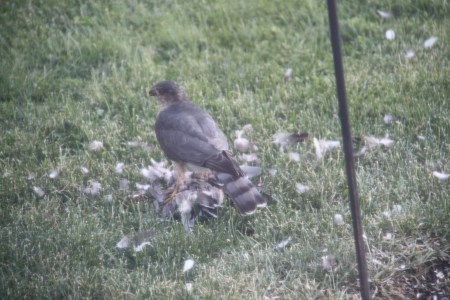
I remember the hawk well. One moment the garden was empty, next he was there, on the ground beneath the feeder, feeding, or rather, fed. I didn’t see the kill. I walked past the window on my way through the kitchen from somewhere to somewhere, and there he was, perched upon a pile of feathers. Whatever the victim was, all edible evidence had disappeared and only the feathers remained. I guess the hawk saw me, sensed, or caught the sound of the camera. Within a second, between click and click, he had flown.

IMG_0007.jpg

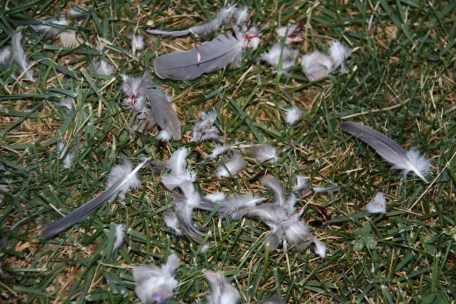
I went outside to look at the wreckage of what had once been alive. Feathers and blood. The grim reality of avian life in my Little World of Island View. Between cats and hawks, a great deal of destruction is handed on from generation to generation. But although I have witnessed nature ‘red in tooth and claw’, I have seen nothing like the devastation caused by the avian flu. We tried to follow all the appropriate instructions, but the passerines all vanished and they never came back. We still have a couple of mourning doves grubbing around on the porch and back step, but I can remember counting, one day, sixty or seventy perched in a cluster on the clothes line. Pine grosbeaks used to swarm, now to see one is a big event. We still get the occasional evening grosbeak, but the grey jays have vanished, as have the swallows who used to nest in our garage. We know of a pair of cardinals in the neighborhood, but they rarely visit us. We can hear a Greater Pileated Woodpecker in the distant woods, but they no longer dance and play among our trees. A few years back, we had a garden full of bees balm, but no bees. Last year we saw very few butterflies, though they used to be regular visitors. Our hummingbirds have become occasional visitors, and I do miss seeing them.

I long to see again all those beautiful creatures, the cat bird with his endless imitations, the orioles with their songs, even the sparrows seem fewer and further between. As for the garden, the crows have taken over. A family of seven caw in the trees and visit regularly. They are sharp, wise creatures and I am always bemused by their aerial manoeuvres. They still sit on the garbage cans once a week and announce their triumph to the world. But woe betide if you leave a plastic bag alone at the roadside. They make short work of it with their shiny beaks ad the bag’s interior is soon strewn all over the road for you to pick up and everyone to see.

Monte Alban

Southern platform2.png

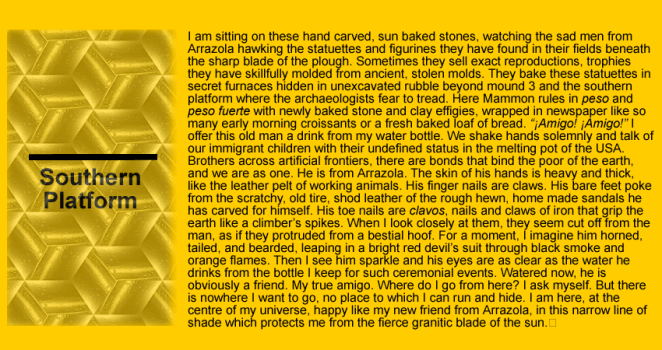
Funny things, photos. When I updated my I-Mac, and I-photo became Photo, I lost some 10,000 photos, or more. Thanks to some hard work over the weekend by one of my good friends, we re-established contact with the missing photos. Skimming through them, I found this one, my words and Clare’s  computer art. I wrote it a long time ago, sometime after 1995, when I first visited Oaxaca. This piece records a visit I made, with Hayden Leaman, another good friend and an Oaxacan savant, to Monte Alban.

Under a hot sun that weighed us down and struck us like a hammer on an anvil, we wandered around the archaeological site and met with many vendors, some of whom seemed to have genuine artefacts, while others obviously offered us fakes. I couldn’t believe how the old men first discovered and then sat in the thin lines of shade emanating from a post, an edge, or a corner, la grata sombra / the welcome shade, as they say in Spanish. This one gentleman, who told us he had walked over from Arrazola,  some six kilometres or so away, asked us for nothing, chatted with us, and proved to be a wonderful source of local information. It was a pleasure to share our water with him. He was the possessor, he assured us, of a genuine green card, and didn’t believe in illegal immigration.

The words in the picture above summarize my thoughts at the time. I asked Hayden later where he wanted to go. He looked around at the temples, the monuments, the tombs, the ball court, the observatory … “Who wants to go anywhere?” he replied. “I am happy right here.”

I visited this and other sites later with Clare. She too proved to be very adept at finding the shade and just sitting still. Look and listen carefully: you too may be able to see and feel the beauty and the silence.

IMG0040_1

My Favorite Pen

IMG_0395.JPG

My Favorite Pen

This is my oldest Mont Blanc fountain pen. I must have bought it in 1986 when I traveled to London to attend a Spanish Golden Age seminar at one of the university colleges. I can’t remember which, though I do remember the seminar was on someone called Francisco de Quevedo. We met like spies, my pen friend and I, on the steps of the British Museum. I had never met him before, so he carried a specific book under his arm, one of Quevedo’s I think, by which I would recognize him. We lunched together at an Italian Trattoria, whose name also escapes me, and we discussed the ways of that ancient Hispanic world and our own research upon it. I paid for our lunch from my travel funds. I had a sabbatical that year and had arranged a short tour of four or five British universities in my search for knowledge. After lunch, he took me back to his London college and I sat and absorbed wisdom from 2:00 until 5:00 pm.

After the seminar, walking back to the nearest tube station, I passed a shop that had this Mont Blanc in the window. I went in and bought it. On the spot. No second thoughts. Then I caught the tube to Paddington station. While waiting for the train back to Cardiff, I sat in the station bar and ordered a pint of beer. A well-dressed man, slightly older than me, asked if he could join me. I said yes. He sat down and began to talk. He told me how to commit suicide by slashing my wrist with a knife.  There were many incorrect ways to do it, he explained. But only one right way, if you wanted to be successful. He rolled up his sleeve and showed me his collection of scars that ran crisscross and welted over his left wrist. Failed attempts, he said. But I’ll get it right next time. I wouldn’t want you to make the same mistakes as me, if you decided to try it.

Must go, I told him. My train’s about to leave. I left the remains of my pint on the table, looked back, and watched him finishing my beer. Good job I didn’t spit in it, I thought. Then I realized that I probably had, one way or another. I boarded my train and 90 minutes later I was back in Cardiff. No more post-war, coal and steam engines, a diesel this, powerful, fast, and smelly. It reduced the former four hour journey to much, much less than two. Cafeteria style, the train carriage offered a table top for every four seats. I opened my new pen and wrote in the pocket journal I had bought for the trip.

So many memories. But I don’t remember the names of either of these two men. I do recall those scars, though, deep and ridged, crisscrossing like railway tracks. Every time we clicked over a junction or a cross track I shivered and my writing wiggled on the page.

IMG_0396

Trains (2)

IMG_0032


Another Kind of Train

Stuffy, you said. I can’t breathe. Early morning mist scratched pale finger nails down your bedroom window. Grey faces glanced in, grimaced and scowled. Damp and slippery, the window frame, when I opened the sash. What time is it?  Before I could answer, you demanded more milk for your tea. I left you there, in bed, went downstairs to the kitchen and brought back milk. Then you wanted more sugar.

Shut the window, you said. It’s cold. I’m shivering. Puppet on a string, I raised my cord-bound feet and danced at your command. I went downstairs, fetched more sugar, came back, and left the Western Mail on your bed. You never opened it. On the front page, a picture of the last passenger engine, green and rusty, from the GWR (Great Western Railway). It used to run from Swansea to Cardiff to Paddington in London. Now it pulls a line of filthy coal trucks. Covered in dirt, rain, steam and dust, I couldn’t make out the name or the number.

Passengers on trains speeding to different destinations, we didn’t have enough time, you and I. We were always tied up our separate thoughts. As we flashed by, platform lights blazed in the night beneath fiery stars, scarce glimpsed in the artificial lighting. Windows glowed in deserted waiting rooms, shattering the darkness. Sometimes we stopped at these stations, watching as other passengers came and went.

We rattled over so many cross-tracks, without ever knowing why, yet I have never forgotten the rhythm of wheels on tracks, slowing, accelerating, running at full speed, the telephone wires looping up and down, the cattle in the fields grazing peacefully, then occasionally looking up as we passed. We rarely talked. I guess we had so little of substance to say. The trivia was too trivial and the big questions went unspoken, unanswered to this day. Noses in the Dandy or the Beano or Woman’s Weekly, we flashed past so many railway signals with their pointed mechanical warnings.

High Street Station, Swansea. The terminus ad quem. The nec plus ultra. The Great Western Railway’s Pillar of Hercules. In my dreams, I stand by the buffer stops, alone, knowing that you will never be aboard any train I may go to the station to meet.