My stamp album, of course. I am old enough to remember the joy of receiving letters from friends and pen-pals in far-away places with strange sounding names and oh, the joy of those colored squares of paper stuck in the top, right hand corner of the envelopes.
Then there were stamp dates, and stamp parties, where we gathered and swapped stamps, each trying to improve his or her collection. Not that I remember many young ladies saving stamps in those days, it seemed to be a boys only sport, like Conkers. I guess that was because those games were all dependent on one-up-man-ship. And yes, we have boycotts (some of them even open the batting for England), but I have never heard of girlcotts or one-up-woman-ship. I guess there are flaws in the language, all languages. Ceilings as well, probably – the height of linguistic folly.
Then there were stamp competitions when we could take our collections, more or less specialist, and show them off to our friends, admirers, and bitter rivals, hoping to gain fame and fortune. I for one never did. But I learned so much about the world, the rapidly changing world, as maps changed, borders changed, kings and queens changed, countries changed their names, divided their borders and morphed into something else.
Don’t forget those FDCs – First Day Covers – with their postal histories, not to mention the little booklets with the tear-out pages telling us all about Peter Rabbit, Flopsy Bunny, Mrs. Tiggy Winkle. and a dozen other tales. And then there were the special stamps – the penny blacks with their multiple Maltese Crosses, the Queen Victoria 9d green (mint), the Sea Horses, the French Painting Series, the Spanish Civil War stamps, issued on, and by, both sides of the conflict, and you mustn’t forget my own face as it appears on a Mexican do-it-yourself stamp, photo taken in Oaxaca, and the stamp sent back to Fredericton, NB, Canada, just for the fun of it.
My own stamp collection now sits in a cupboard, all covered in dust. I guess it is worthless. Nobody sends or receives letters anymore. Nobody collects stamps. Used stamps are now so much rarer. And those pristine new issues, so bright and cheerful, have never felt the lick of a lover’s tongue. And those envelopes have never borne the imprint of our secret messages – SWALK – PHTR – ICWTSY – and so many other little joys of a life that is long past, but never forgotten.
First, I want a definition of leadership. Here’s one – Leadership is the ability of an individual to influence and guide followers or members of an organization, society, or team. Leadership often is an attribute tied to a person’s title, seniority or ranking in a hierarchy.
Let us begin with the last sentence. Leadership often is an attribute tied to a person’s title, seniority or ranking in a hierarchy. I am without a title, I have no seniority and, furthermore, I do not belong in any hierarchy. So, having nothing onto which to hitch my leadership, I am clearly not a leader. In addition, I can say, in all honesty, that I have no followers. Where on earth would they follow me? I have no wish to go anywhere, let alone to lead other people into the wilderness that so often surrounds us.
So, what am I, if I am not a leader under that definition. Am I a follower? I doubt it. I cannot remember following anyone in thought, word, or deed. A maverick, then? Possibly. All in all, I have always felt that, rather than ‘belonging’, I was outside the hierarchical cultures in which I found myself and was merely an outsider, looking in through the window and watching and observing others as they boldly led, or meekly followed.
So being neither a leader nor a follower, what might I be? Well, I am a creative person. I see the world in a very different light. I also encourage others to see things differently and to present different points of view while embracing their own authenticity. I see myself as an innovator. I see myself as a problem solver. But my solutions have all too often come up against the red taped inhibitions that bind those hierarchical cultures into their unbending, iron strangleholds that limit or deny fresh visions of truth and beauty.
I always remember a story my grandfather told me about one of his experiences during WWI. “See that pile of sand over there?” “Yes, Sarge.” “Well, move it over here.” “Yes, Sarge.” “Right. Well done. Now move it back again.” “Yes, Sarge.”
Ah yes, leadership. And in those days to disobey a direct order was to volunteer yourself for ‘forty days in prison’ or ‘back to bread and water’ or, even worse, to qualify you for a blindfold and a firing squad.
This is buy a book by a New Brunswick Author time, sponsored by the Writers’ Federation of New Brunswick (WFNB). Alas, so many New Brunswick authors are almost faceless to the wider world beyond the Province and the Maritimes. It gives me great pleasure, therefore, to highlight one of the books that I dearly love from a New Brunswick author, Jane Tims.
Here is my review of Jane’s book, first published (the review) on Brian Henry’s Quick Brown Fox (14 March 2021). Thank you, Brian, for the work you do in assisting and developing writers all across Canada – and beyond – and a special thank you for all you have done to help me over the years.
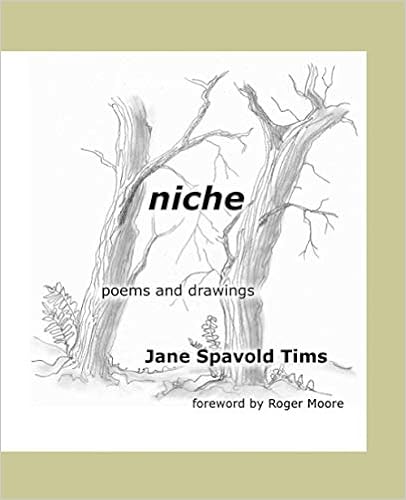
Niche, poems and drawing by Jane Spavold Tims, reviewed by Roger Moore
Independently published. Available from Amazon here.
Niche, the fourth poetry book published by Jane Tims, is a neat configuration of six segments that elaborate and illustrate the poet’s original definition of the multiple meanings of her title word niche.
It is difficult to separate the author from the act of narration as her keenly observed and skillfully executed drawings, together with their verbal representation on the page, are so autobiographical and so much an extension of her artistic and professional abilities that the objective separation of writer and text is scarcely possible. It is hard to forget that Jane Tims was, and to a great extent, still is, a highly competent professional botanist. The harnessing of the professional botanist, with her unique drawing skills and scientific knowledge, to the poet and auto-biographer is a key factor in the reading and interpretation of this text in which acute observation blends with an intimate knowledge of the observed botanical world, both flora and fauna, and this allows the poet, in her role of poetic narrator and lyrical voice, to weave a network of poems that are, at one and the same time, objective and intensely subjective.
The author emphasizes this when she writes in the Preface that “In biological terms, the niche is the quality of a space occupied by a living thing, the sum total of physical, nutritional, biological, psychological and emotional needs gathered together in one place.” She also reminds us that in human terms “niche can be a metaphor for home, community or personal space” and it is within these metaphoric spaces that the poetry text is elaborated. The text becomes a linked mixture of visual drawings, iterative thematic imagery and associative fields, all centred on the multiple meanings of niche. These terms are both biological and human in nature and the poet’s named world meets at this juncture between the human and the natural.
The section occupying space (1-19) bears the subtitle satisfying need and begins with a setting out of what this means in the following 12 poems and 4 accompanying drawings. The poem ‘apples in the snow’ with its companion drawing stands out for me.
The section strategy, subtitled solidifying position (21-43) outlines in poetic terms, how plants, animals, and humans ensure their own survival.
The section praying for rain, subtitled, avoiding danger and discomfort (45-68), offers views on discomforts and dangers. It also opens the discussion—relocate or stay where we are?
The section mapping the labyrinth or places I have occupied (69-83), which contains the wonderful sentence “When I get lost on the road ahead, I look to the road behind me,” throws open the multiple meanings of home.
The section new ways for water, subtitled coping with change (85-98), offers a double landscape, first, external, the things seen, touched, examined, remembered and described, and then the internal landscape that reflects upon them and is reflected in them.
Finally, forgetting to move, with its subtitle getting comfortable (99-111), presents an autobiography that links observer (the twin personage of author and narrator) to observed (nature, both flora and fauna, and the added element of autobiography and self) via the symbiotic relationship of botanist to botany.
Two moments stand out for me. (1) Sadness is in seeking the space that is never found. (2) Loneliness is in trying to return to a space once occupied but no longer available. The whole concept of the Welsh word hiraeth is summed up in these two lines. Carpe diem, Jane Tims’ poetry indeed seizes the day and, with its minute, intense observation, it preserves so many precious moments. It also pays attention to that which has been lost, those moments that are irretrievable. They will vary for each reader, but hopefully, like me, you will take great pleasure in discovering them for yourself.
Jane’s interview with Allan Hudson, another excellent NB author, can be found by clicking this link – South Branch Scribbler. The work of all NB authors should be celebrated over the first weeks of this month. Allan, thank you for supporting us – and you, too, Brian Henry. Living in NB, we need all the enthusiastic support we can get.
My friend Allan Hudson re-posted this blog entry yesterday. It is always wonderful to be remembered by my friends. Allan does a great job with the South Bank Scribbler – and he is one of the best. Long may he and his blog work continue to support New Brunswick writers.
I look forward to working again with both Allan and Jane. Best wishes and many thanks to both.
Click on the link below for Allan’s interviews with Jane and I. And don’t forget to go down all the rabbit holes that appear in Allan’s articles. There is a great deal of information within those little burrows.
I have sown so often on stony paths and harsh roadside ways where thistles bloom in purple patches and weeds choke the fertile soils, closing flowers down.
Who knows what cold winds blow when new seeds are shuffled, then cast, like bread upon water, into the mind’s frustrated furrows?
Will flowers flourish, or will they perish, still-born, in the depths of their stony graves?
I do not know for I cannot read the runes the wind scatters across the sky when it shuffles clouds and scrawls shadow-writing on the land.
Careless, I cast out word-seeds, knowing full well that many will perish. But I also know that one or two will put down roots. Eventually, developing shoots will nourish my labor’s burgeoning fruits.
Where have they gone, the old days, the old folk, the old ways of doing things?
I search for them, day after day, but my cell phone isn’t the old-fashioned circular dial, nor the pick-up phone with the shared party line, when everybody listens in.
The garage is a mad hatter’s maze of a workshop, in which things grow legs and walk this way, that way every way to Sunday, constantly getting lost.
I think I can hear them. chittering, chattering. but I cannot see them nor hold them, even though I would like to clutch them tight.
Bats in the belfry, and in the attic mislaid items, pens, ink, paints, a tuck box, with keys, a cricket bat, cracked and yellow, abandoned, and forgotten.
What was the last thing you searched for online? Why were you looking for it?
The last thing that I searched for online was a prompt that I wished to be prompted by, but I promptly lost it before I could respond to it. Then I went looking, but still couldn’t find it, even though I searched everywhere I could think of.
I grow forgetful as I age, and now I can’t remember what the prompt asked for, and that’s a pity because I remember that I had a lovely answer. Now I can’t remember my answer either. So I am stuck in a sort of one-way street, going in the wrong direction, as I draw near to a roundabout that will lead me back the way I came.
I am afraid some Minotaur or other will seek me out, because I am lost in a labyrinth without the thread of Theseus to lead me out. And its no good searching online, because I no longer know what I am looking for. And that’s a bit like my life at the present time – a pointless search for meaning as I wander, amazed, through a baffling maze of days, seeking, I know not what, and never finding it. I don’t want to give up on it yet, because I know that the answer lies just around the corner, lurking like the last sardine in a sardine can, or the last piece of squid, cowering blackly in its own ink, in the tin, not wanting to be eaten.
Life leads me a merry dance, as king-like, a one-eyed man in the kingdom of the blind, I rule my world. For, en el reino de los ciegos, el tuerto es rey / in the kingdom of the blind, the one-eyed man is king. And no, I didn’t search for that online. It came to me in a sort of dream because, as Goya says, el sueño de la razón produce monstruos / when reason sleeps, monsters are born. And now I see them everywhere, those monsters, and I search online for solutions, but none appear. And so I continue on my merry-go-round way, leading my ragamuffins around those ragged rocks.
My ideal home looks exactly like the one I am living in right now. In the country, surrounded by trees, with blossoming crab apples in the front garden and a mountain ash in full view from the kitchen window, what more could I ask for? Blossoms in the spring, a gradual flowering throughout the summer, and now, as fall approaches, the fruit ripening.
Verde, que te quiero verde. – Green, for I love you green. But what exactly is green? I sit on the front porch in the cool of summer, and look out on a sea of greens – green grass, green leaves, light green, medium green, dark green, and all kinds of shades and hues as the sunlight filters a subtle dance of colors through the leaves. The eye distinguishes so many different shades of green. Alas, I do not have the vocabulary to distinguish verbally what I see visually. Ah, poor poet, linguistically damaged, and writing with one hand tied behind my back, I suffer from an ability to feel and an inability to express. Terminological inexactitudes, Winston Churchill called them. But in my case, they are the lies I must create when the truth overwhelms me with its beauty.
And in winter, when the cold winds blow, and the leaves lose the safety of their trees to be blown hither and thither at the wind’s will, what then? A blanket of whiteness, shadows shifting beneath the moon by night, and a million brilliant sparkles beneath the sun by day. And the visitors, every night the deer come, stay awhile, then vanish, only to reappear the next day. At midnight, in the moonlight, I watch them from my window as they dance on their hind legs and nibble the hanging fruit that the mountain ash reserves, just for them, so that they will survive, as they have done for millennia, in this paradise that surrounds my ideal home.
Only the pendulum clock disturbs the silence as the slow stars circle and the moon hides its face beneath seven excluding veils.
Tranquility finds me, seated here, head in hands, contemplating the complicated dance steps of a terra-centric universe where planets weave an intricate back and forth to justify the falsehoods of misguided mistakes.
Men, confident in their wisdom, know that all is well, that their faith in the old gods, the old books, the words that were written, in stone, before the modern world began, need no rethinking.
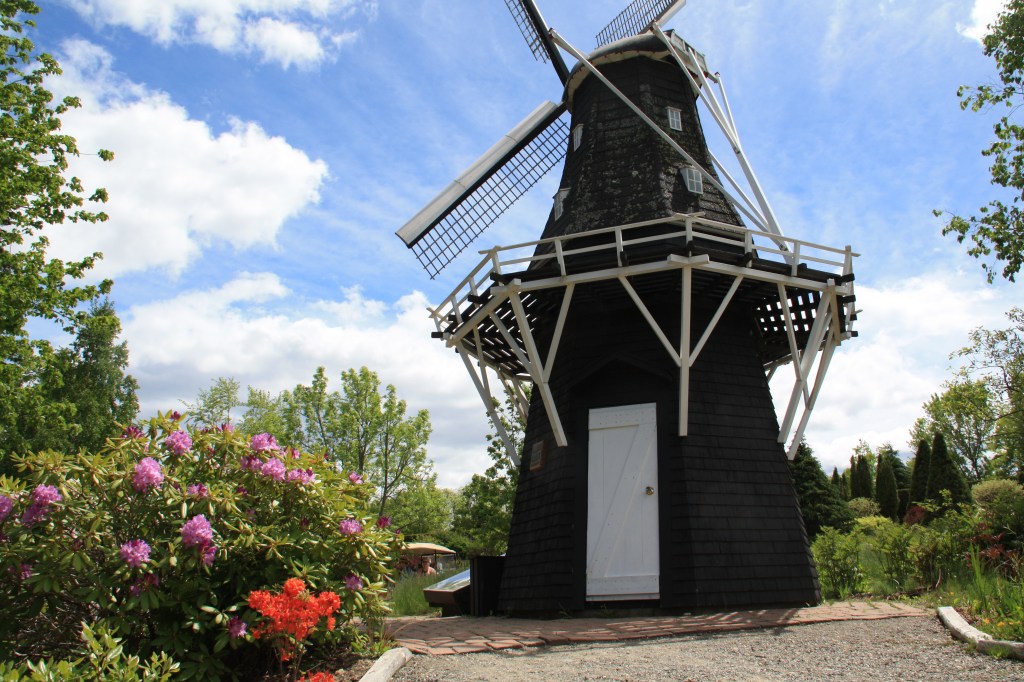
Those whirling sails, imprinted on the questing mind, are a giant’s arms, those sheep an enemy army cloaked in dust, coats of arms visible only to the far-sighted whose eyes defy vision’s laws.
Right, they were then. Right they are now. Nothing changes. Nothing can possibly change. Sheep are the enemy and windmills wait to invade the unsuspecting mind.
Comment: The history of Don Quixote and its reception in Spain is quite interesting. I was very sorry to read that Cervantes’s language is now considered so antiquated that interpreters are needed. I actually have a cartoon version of his quests – a picture reader, so to speak, very brief, because each picture is worth a thousand words. I have not yet seen the simplified text, rewritten with today’s reader in mind.
Don Quixote still holds many lessons for this modern world of ours and is definitely worth re-reading for, as Soren Kierkegaard (1813-1555) wrote: “There are two ways to be fooled. One is to believe what isn’t true; the other is to refuse to believe what is true.” Don Quixote, the character, threads a narrow path between those two extremes, as do many of the other supporting characters, some of whom use metatheatre for their smoke and mirror Wizard of Oz trickery. And remember, or forget at your peril, nihil sub sōle novum – there is nothing new under the sun. And yes, history does repeat itself, as you will see if you read (or re-read) Cervantes’s master piece.
Pictures and memories play hide and seek. They hunt the slipper that hides in the words that slither and slide across my page.
They long to emerge, fully formed, and to step, without effort, into your mind. They want to linger there, to baffle, taunt, and haunt you.
Digging through the verbiage, a thought, a metaphor, a grouping of words will join and rejoin. This is the grit that the oyster slowly shapes into the pearl of great price that glows so bright.
Consider the opal. Plain at first sight, yet changing color, shimmering in sunlight, a chameleon adapting to mood and shadow, its moon dance hovering, a butterfly over burgeoning blossoms.
Who could ever forget, once seen, star light illuminating the bay, the moon gilding the sea, those summer nights, our secret love flowering.
The veiled will unveil itself and tease its way, its path over the sparkling waters of the bay. Knock and it will open. Seek and you will find.
Comment: I had a specific, named place in mind when I first wrote this poem. Then I realized that my secret place was not necessarily the remembered place of other people who had undergone similar experiences. So, I removed the specific and made it generic.
I know you have been there, to your own special place. A warm summer night. Star light over a bay. Or maybe it was an estuary, or perhaps a river bank? The moon appearing, lighting up the waters. Walking, perhaps, hand in hand. Or sitting, as I remember it so well, in a late-night café, watching the night lights on the fishing boats, as the moon spread its golden carpet over the bay.





 rogermoorepoet