A sharp-edged double sword,
this down-sizing,
this clearing out of odds and ends.
Library shelves emptying.
books disappearing, one by one.
So many memories
trapped between each page,
covers, dust-bound now,
dust to dust and books to ashes.
Sorrowful, not sweet, each parting,
multiple losses, characters
never to be met again,
except in dreams.
Heroes, thinkers, philosophers, poets,
their life work condemned to conflagration.
Alpha: such love at their beginnings.
Omega: such despair,
with Guy Fawkes celebrations
the means to their ends.
Word-fires:
the means of forging
those book worlds that surrounded us.
Bonfires:
the means to end them.
Steadfast, the book-fires,
flames fast devouring
all but an occasional volume
snatched by burning fingers,
from the flames.
Comment:
Funny things, book burnings. Why would anyone burn anything as innocent as a book? Good question. Yet people do. And people always have.
I think back to Don Quixote I, 6 and the Scrutiny of the Library. The Priest and the Barber go through the mad knight’s library and one by one examine the books of chivalry and either spare them, or cast them into the flames. This, in itself is a parody of some of the judicial actions of the Spanish Inquisition. In particular, any book that they considered to be unsafe or heretical went into the flames. Our Spanish Knight, of course, went mad through reading too many books of chivalry – and his brain dried up so that he totally lost all reason.
It is very interesting to read which books were spared and why. Equally interesting to find that many were burned on aesthetic grounds – they were not well written, or they were boring. Fascinating.
Fascinating too the book burnings that took place in Mexico during the Conquest of that country by the Spanish Conquistadores. Many pre-Columbian codices were burned. Priceless treasures and histories lost forever. Some, I think the Vindobonensis, still bear the marks of the flames when they were pulled from the fire in an effort to save them.
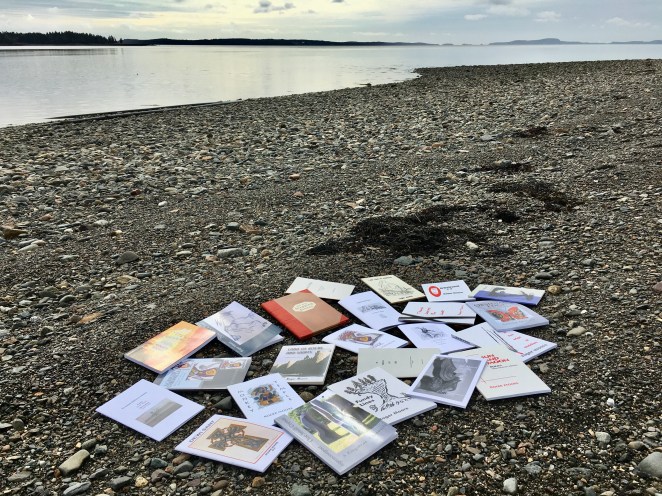
Moo tells me that my books will never be burned. And I am thankful for that. I asked why they wouldn’t be and he replied that nobody reads them anyway! Not such a comforting thought. So, in an effort to keep me happy and to preserve my books from the flames, another of my friends laid them out on the beach at Holt’s Point, New Brunswick. They certainly won’t burn when the tide comes in.
More important, I see that junk from Canadian Beaches, dated about 1960, has just arrived on the shores of the European continent, sixty plus years later. So – a floating book, a message, perhaps, in a time-bottle, destined to achieve immortality and live for ever. What a comforting thought for those of us who believe in the time and the tide that wait for no man! But they both might wait for his books.
 rogermoorepoet