Do you ever see wild animals?

Daily writing prompt
Do you ever see wild animals?

Do you ever see wild animals?

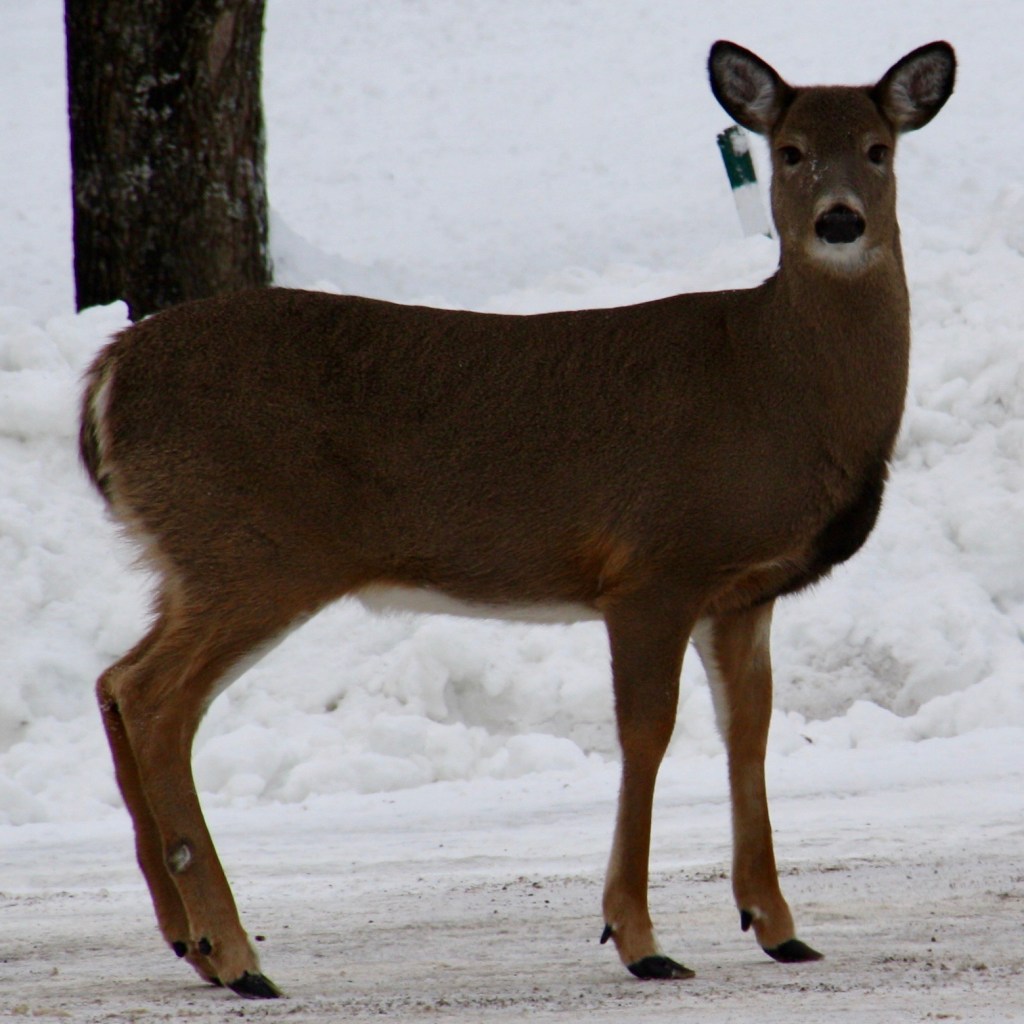
Indeed I do. And sometimes, just like this Wapiti, or White-Tailed deer, they see me as well. Some are camera shy. But this one, caught one morning walking past my garage door, heard the click of the first camera shot, stopped, turned towards the sound, then kindly waited until I had shot him, in the only way I would ever shoot a wild animal, with my camera. Isn’t he a handsome fellow – very photogenic.

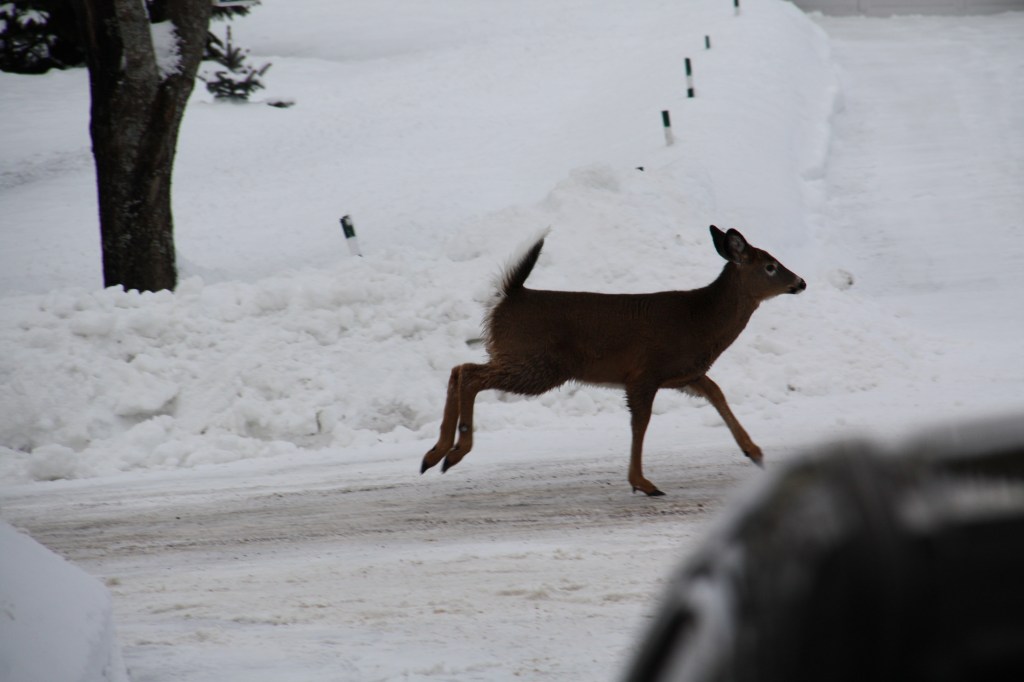
Some of the animals that pass through our yard do not seem that wild. This one lay down for a little rest about forty feet from the house. Early morning light, not easy to shoot, but he sat there and waited for me. Alas, I was using a camera with a laser focus and the red flash of the light disturbed him. I didn’t mean to do so. Whoops – there he goes, tail-up and now you know what they mean when they say ‘high-tailing it’ out of the woods and up the road.
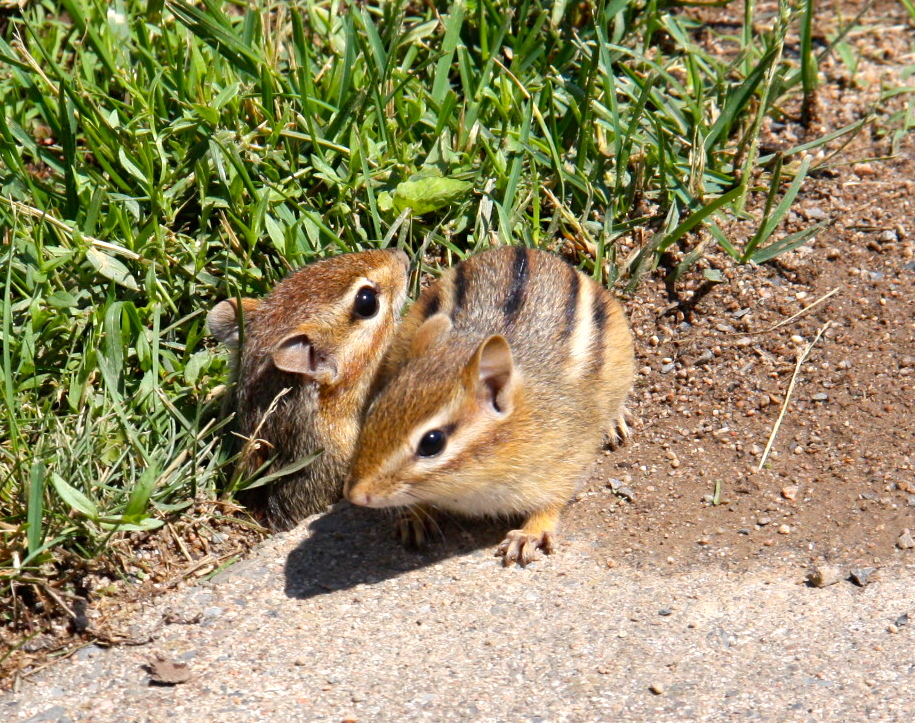
And what about the chipmunks, and the squirrels, and the skunks, and the raccoons, and the jack-rabbits, and the porcupines? They all drop in from time to time. Look at this happy couple. Aw! Aren’t they sweet?
And don’t forget the birds – but give us another prompt – all about our feathered friends -and we’ll talk about them next time
Do you have a favorite place you have visited? Where is it?

Daily writing prompt
Do you have a favorite place you have visited? Where is it?

Do you have a favorite place you have visited? Where is it?

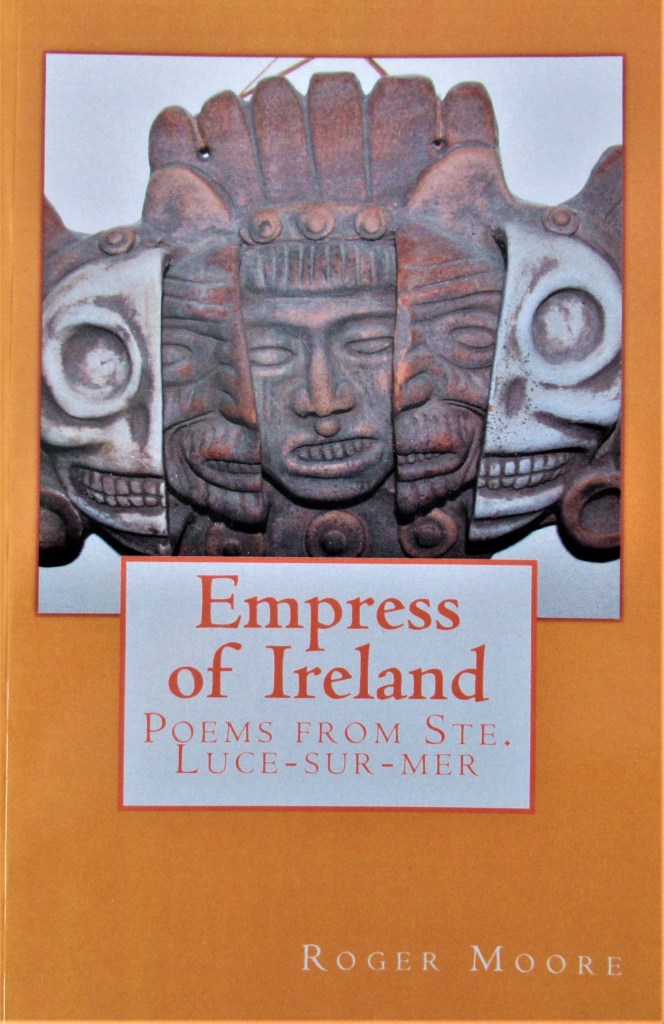
Just one place? So difficult to choose. I have been very lucky in my travels. I haven’t gone far, but I have tried to go deep, returning to the same places again and again. One place I often visited was St. Luce-sur-Mer in Quebec. It is a wonderful little town on the banks of the St. Lawrence River. The sunsets are sheer marvels and the views of the Northern Lights across the bay are just outstanding. Site of the wreck of the Empress of Ireland, it is filled with mystery and memories, as is the nearby Rimouski. Ste. Luce sur Mer would be my third choice.

Oaxaca, Mexico, would be my second choice. The city itself, capital of the state, is packed with history. I taught there for a couple of weeks (maximum six) every year from 1995-2001 and every time I returned I found something different and more mysterious. The dancing and music in the capital, the cascades of fireworks flowing down the facade of a church, the Christmas Cribs that grew day by day as people added to them, the incredible food, and above all the people – dancing in the Zocalo on Sundays to the music of the State Orchestra, crowding the markets with color, and the markets themselves, the scents of peppers, coffee, chocolate – to visit Oaxaca, in those days, was to visit the heart of Mexico. Imagine sitting beneath the tree that Hernan Cortes had sat beneath when he visited Oaxaca just after the Conquest of Mexico City – Tenochtitlan – and talked to the Mixtecs and Zapotecs of the Oaxaca Valley. And the codices – wonderful – I cannot say enough in praise of Oaxaca.

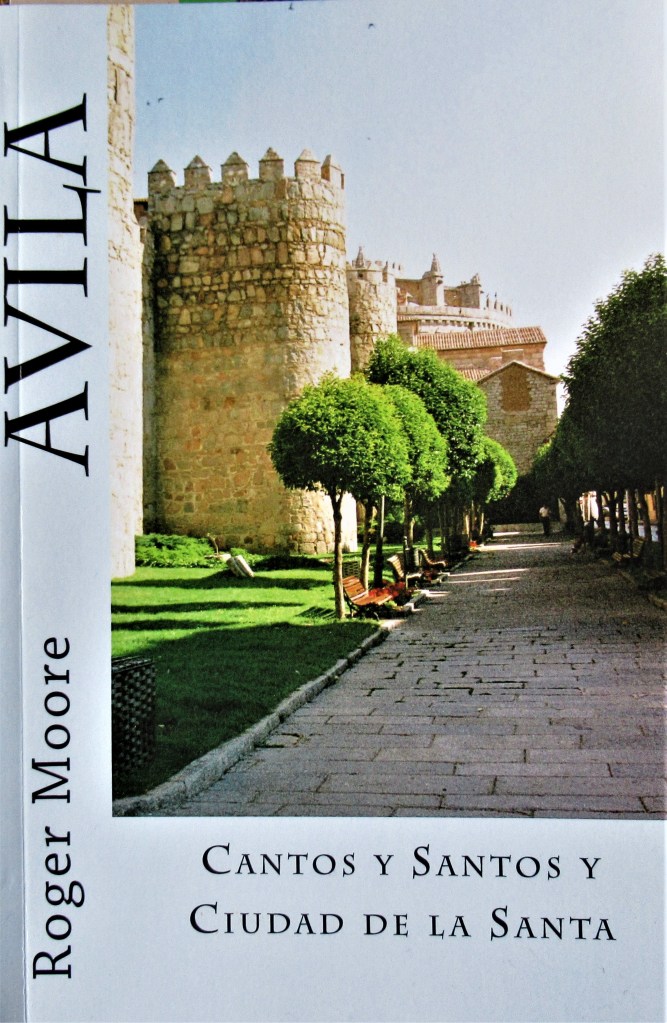
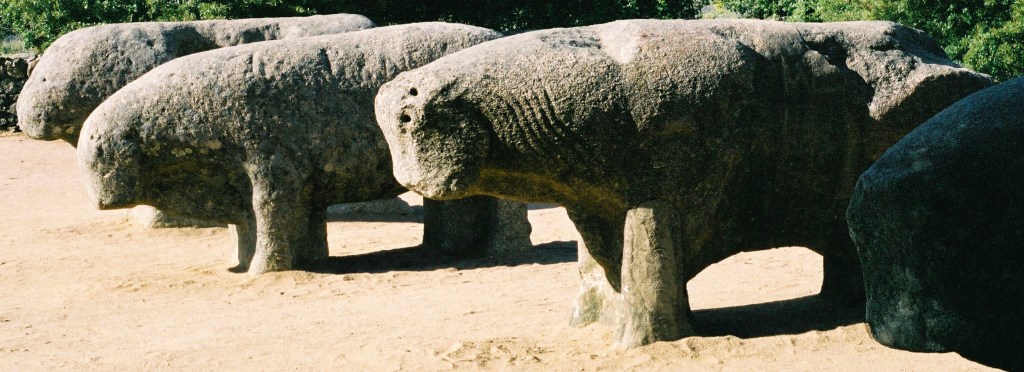
My number one choice: Avila. The lead photo shows the Toros de Guisando. Pre-dating Christianity, these four stone bulls – verracos – were often used as boundary markers by the Vettones who lived there before the Romans. One of these four bulls bears, carved into its side, the marks of one of the Roman Legions that passed this way. The countryside around Avila has to be seen to be believed. The walled city itself is a wonderland – three kilometres of walls, 9 gateways, a Cathedral that shows an enterprising mixture of styles, museums, libraries, squares, and a welcoming people who make you one of the family. I visited here for four summers, 2005-2008, staying for between 6 and 8 weeks on each visit, and always residing in the same place, El Rincon, close by the Mercado Chico.

The Banks of the Seine

Banks of the Seine

Gnawing at the carcass of an old song,
my mind, a mindless dog, chasing its tail,
turning in circles, snapping at the fragment
of its own flesh, flag-flourished before it,
tournons, tournons, tournons toujours,
as Apollinaire phrased it, on a day
when I went dogless, walking on a mind-leash
before the Parisian bouquinistes who sold,
along the banks of the Seine, such tempting
merchandise, and me, hands in pockets,
penniless, tempted beyond measure,
by words, set out on pages, wondrous,
pages that, hands free, I turned, and turned,
plucking words, here and there, like a sparrow,
or a pigeon, picks at the crumbs thrown away
by pitying tramps, kings, fallen from chariots,
as Eluard wrote, and me, a pauper among riches,
an Oliver Twist, rising from my trance, hands out,
pleading, “Please, sir, can I have some more?”

Comment:
This is a fusion / confusion, if you like, of The Kingston Trio’s song – The Seine – with a quote each from Guillaume Apollinaire – Alcools – and Paul Eluard – Il ne m’est Paris que d’Elsa, and Francisco de Quevedo’s – El Buscon – and a tip of the old chapeau nouveau to R. S. Thomas and Charles Dickens. Fools rush in, I am afraid, where angels fear to tread. Go on. Rush right in. Sort it all out. I double-dog dare you – and thank you for that one, Jude.

The Seeker

The Seeker

Weaver of words, I wander my weary way
across a field of snow, careful as I go
not to slip and fall into the depths that wait below.

I know them of old, those man-trap mine-shafts
where darkness dwells, hand in hand with despair.
I know only too well the weight of coal dust,
fine and thin, polluting lungs with unfiltered air.

How long will I have the courage and strength
to survive so deep beneath the surface
and to explore those depths at greater length?

Who would now, willingly, plunge, or dig
and delve so deep into the mines underground?
Ony the searcher, the seeker who knows that
in dark pits wondrous gems can still be found.

Comment:
I don’t really know why, but my thoughts are now appearing (more or less) in rhyme and often in sonnets. Well, Milton Acorn’s Jack Pine Sonnets, straggly and wild, like the Jack Pines of Canada’s East Coast. Sometimes I think that this is a new format for me. And then I realize it’s where I started so long ago – a rhyming poet. “In my beginning is my end.” I have indeed returned to my roots. But now they are Jack Pine roots, well settled here in this wonderful Maritime Province of New Brunswick, amid Jack Pine, rock, and winter snow.

Doubts

Doubts

At midnight,
when that dark owl calls,
I sip a bitter wine.

The thoughts I think
are not my thoughts,
how could they ever
be mine?

And yet they are
the thoughts I think,
and round and round
they twine.

They wrap me in
a thousand threads
and none of them
are mine.

Whose are they then,
these thoughts I think?
They do not come from me.

And yet they make me
double think
this person that is me,
and who I am,
and what I am,
and where I’m going to be.

Comment:
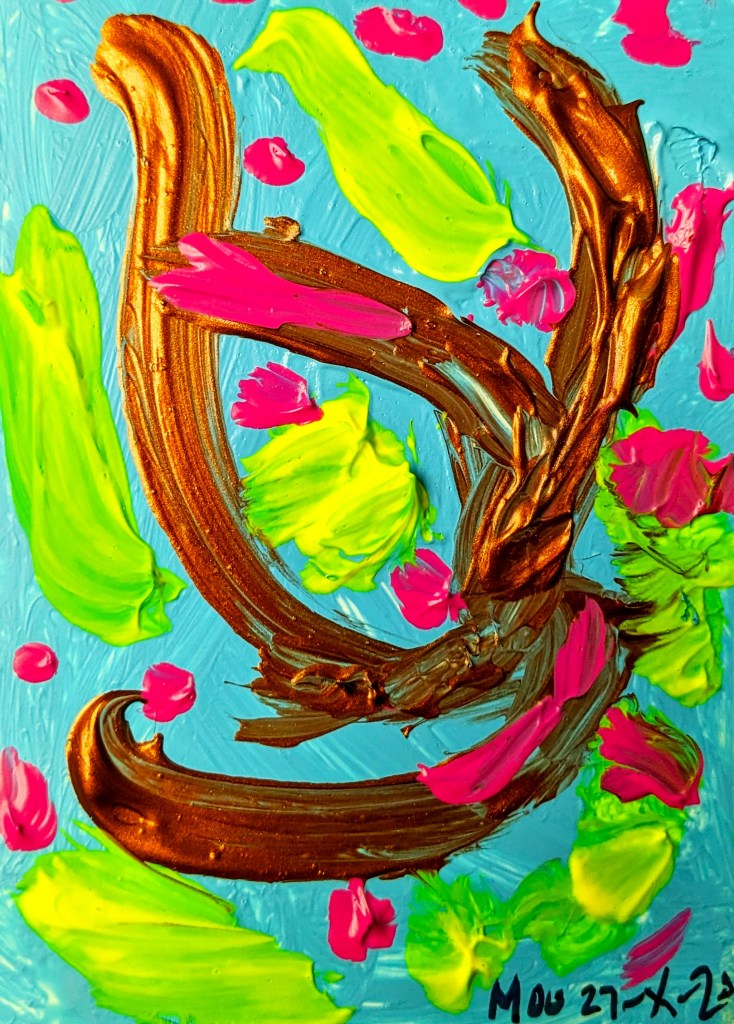
I guess that’s what happens when you finish your bottled sunshine (sol embotellado) before going to bed. The painting and the poem match up nicely though, ribbons of dark thought streaming through an empty head. Guessing and double-guessing, thinking and double-thinking, doubting and finding yourself inside that great cloud of unknowing in which you rarely know where you are going. Still, if you don’t know where you are going, any road will take you there. Pen-y-Bont, anyone? Or Abertawe, Cas Newydd, Llandeilo, Caerfili, Rhiwbina, Treorci, Trebanog

Old Wounds

Old Wounds


“The slow wound
deepens with the years
and brings no healing.”

The Minister. R. S. Thomas

How deep time’s wounds
have cut and carved,
not just in flesh and bone,
but in the embers
of that slow-burn fire
 they call the heart.

Memory and mind
have also played their part.

Some days, those wounds
don’t ache at all.

But there’s no real healing,
and a moment of madness,
a knife-edged finger nail,
careless, in the dark,
opens them up again
to bleed afresh
and remind us
of the frailty of the flesh.

Comment:
The opening quote, from the Welsh poet, R. S. Thomas, made me aware of so many sad things that have happened in my life. Usually they lie dormant, asleep like an ancient volcano. Occasionally they erupt, and memory’s hot lava breaks through to the surface and spills like blood. Hard as I may try to control those moments, they are, in essence, uncontrollable. The scars itch. I scratch them with sharp finger-nails, and the old wounds open and bleed again.

Magnolia

Magnolia

She stands there, at the garden gate, waiting for me.
I can see the scene, the flower beds, the magnolia
bleeding, in Wales, its soft, spring snow of ivory pearls.

Some fall on her head, crowning her with a beauty
more precious than frankincense or myrrh. Petals
also perch their pure, ermine cape on her shoulders.

She walks towards me, eyes shining, arms open.
Then, the vision fades and she drifts away, leaving me
alone, my face bathed in the tears of her passing.

For pass each other by, we did. Ships in the night,
trains rushing through a tunnel of darkness, bathed,
for an instant, in the constellation of a station’s light.

Now, when I try to go back and to recreate that scene,
I find an empty garden, fallen leaves, and winter’s cold.

Comment:
I have been struck recently by the number of published articles that speak of post-Covid loneliness and the difficulties of re-establishing old friendships that fell by the wayside, let alone establishing new ones. It seems to get harder and harder, as we age, to leave our post-Covid isolation, to get out of our new comfort zones – sometimes so limited and limiting – and to make new friends. As we age, our minds go backwards and we return to earlier days and happier memories. Yet all too often those memories are tinged with the sepia sadness of old photos, from a non-digital age, faded and stained.

Bay of Santander – 1963

Bay of Santander
1963

I stood there
on the sea wall
calling out to the dark
“Help!” “Save me!”

Moon hid her face
behind veiled clouds.
All hope denied
I called out to the tide,

outgoing, to take me
with it, out to sea,
past the island
and the lighthouse,

out to where the waves,
stronger than anything
I ever knew, would thrust
strong fingers under my arms

and lift me up,
then drag me down,
so I could finally rest
in peace, and drown.

Comment:
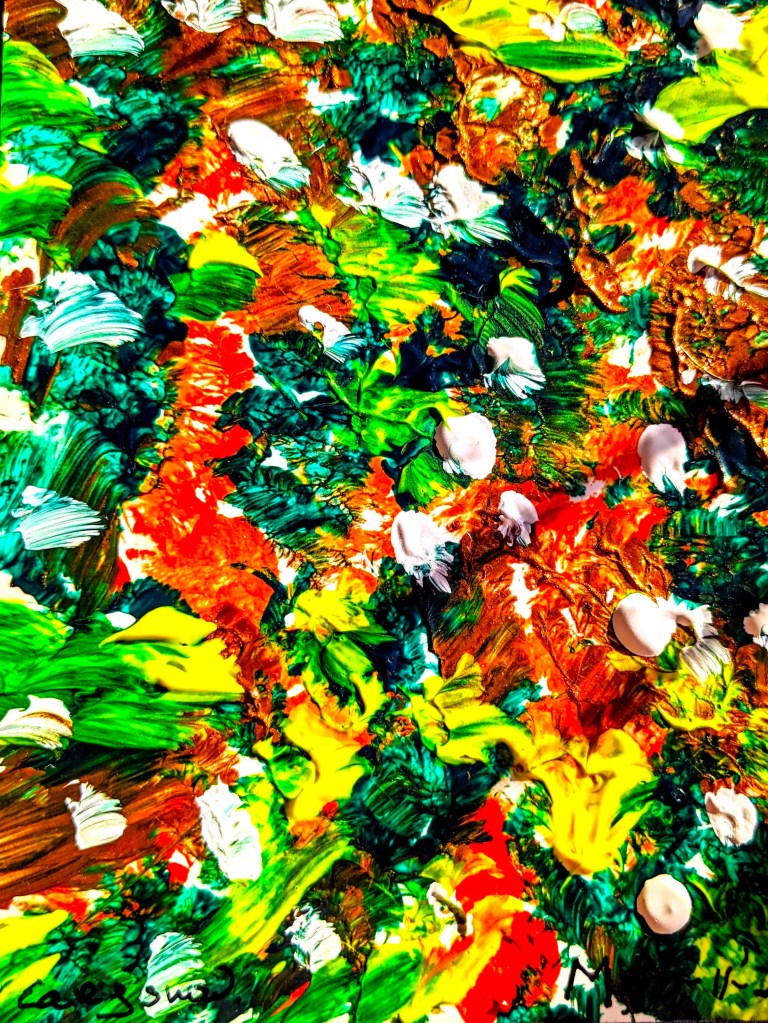
This painting is called Picking at Scars. Some scars run so deep that they are always there. When they itch, you scratch them, and they bleed afresh. The scar of loneliness is one such scar. Alone, in a foreign land, learning their language, the culture, their customs, feeling not just unaccepted, but unacceptable, and the moon at night shining on a land, a bay, a city, to which you know, deep in your heart, you will never belong. That loneliness walks with me still and, sixty years later, it still leaves me desolate.

Limbo

Limbo

I live with my head in the clouds.
What clouds you ask – Alto-Stratus,
Nimbus, Cumuli-Nimbus?

No, I reply, none of those.
At one level I build cloud castles,
in Spain, as they say in French.

But, at another level,
I find myself lost in the medieval
cloud of unknowing, this mental limbo.

Here, grey mists weave spider-webs
of doubt that glisten with dew, and sparkle
with the two-edged sword of thought.

Here, I feel my life-web tremble
and I realize that I alone can walk
this way and try to understand

how frail threads catch small flies,
how words tell stories, but not the story
of all I know, nor where my world will go.

Comment:
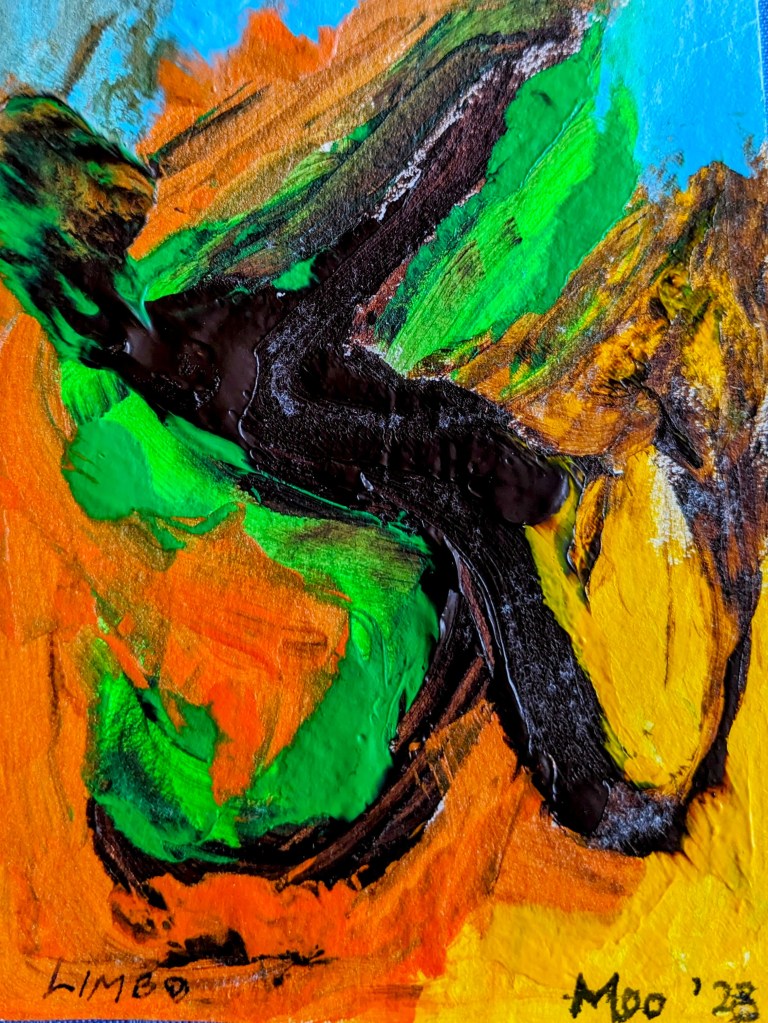
Once more I have linked verbal and visual images. Moo’s painting above – thank you, Moo, – called Limbo, depicts a limbo dancer while my poem expresses the reality of that internal space in which creative spirits sometimes find themselves. It is a sort of Limbo of the mind, in which thoughts appear, dance along the frail threads of the mind’s web, yet never really materialize into formal verse or poetic patterns. This is also the lost world of the dreamer. But remember, the dreamers of the day are dangerous people, because sometimes they make their dreams come true.

On Writing Poetry

On Writing Poetry

I sit here writing poetry
and, head in hands, I cry
at all the things I’ve left unsaid,
and then I wonder why
I wasted so much time on things
that perished before my eye.

Outside the night is dark and cold
and shadows flit and filter by.
I know that I am growing old,
that soon my story will be told,
and when it ends, I’ll die.

I know that death is not the end,
yet I do not want to die.
I want to paint the autumn trees,
the clouds that float on high,
with evening lights that stain the sky.

But rhyming is not all I do.
I’ often write in prose, with words
that wound and sow dark seeds
that root and flourish, grow like weeds,
and nourish other people’s needs.

Alas, I know not what I do,
nor yet what I have done,
nor when, nor where, the seeds
were sown, nor if they aided anyone
to turn away from the dark inside
and walk in the light of the sun.