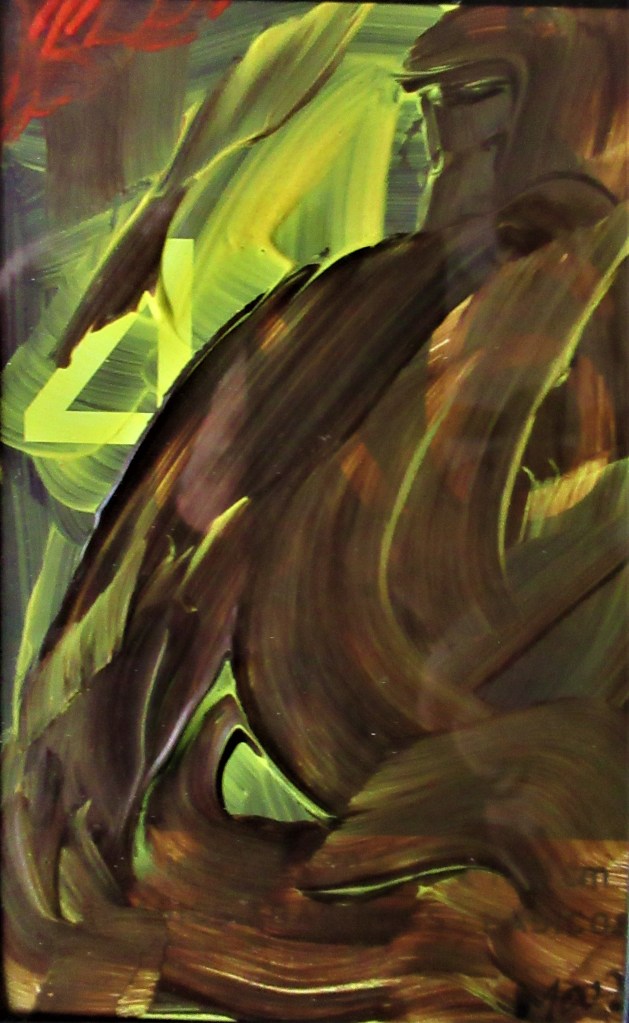
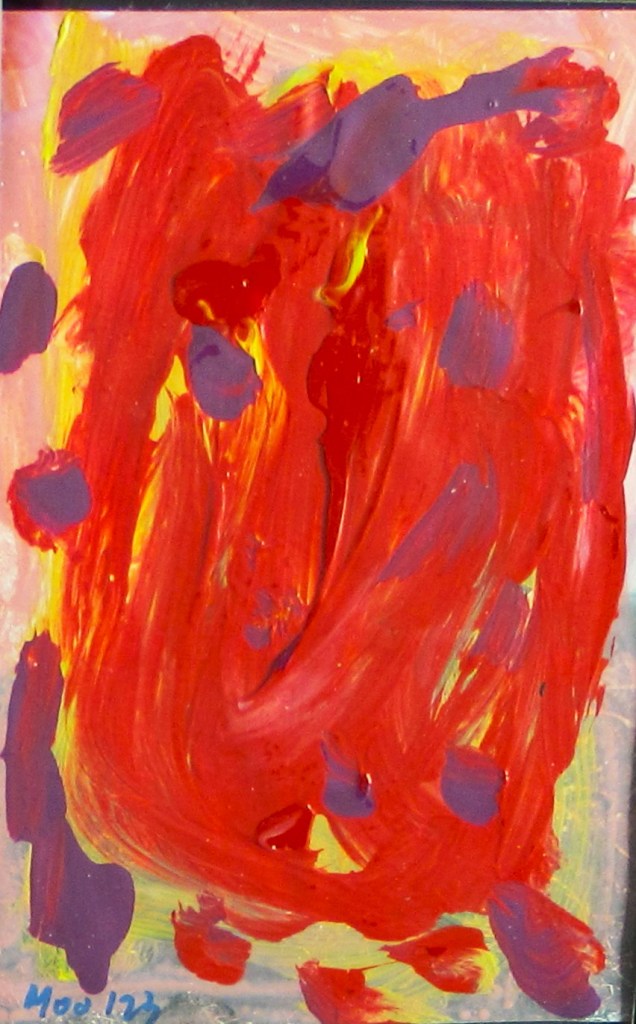
The world has become such a dark place over the last three weeks or so. At times, I have despaired, lost hope, lost my faith, lost my creativity. Words have not come knocking on at my door. The eyes in my head have seen nothing to paint. Darkness, bleakness everywhere. And yet, light breaks where no light shines, as Dylan Thomas once wrote, and last night I started a painting. This morning I finished it and gave it a title: Rage, rage against the dying of the light.
Yesterday I managed to complete a couple of poems. I attribute this new found creativity to moving my muse out of my office and placing it in my bedroom where it can inspire me at night. It seems to have worked. My muse is a small carving placed between four pyramids. Pyramid power and the muse’s inspiration have brought light back into my world, the light of creativity.
We must band together, we creatives. We must inspire ourselves and then go on to inspire others. We must let the light of our creativity, our faith, our belief spill out into the darkness that surrounds us. Together we must stand united and our light will be a lantern that will enlighten the world, not with chants, slogans, and cults, but with the inner faith and the total belief that genuine creativity brings to the world.
Creatives of the world, unite. Rage, rage against the dying of the light. United together, we can, and will, restore that light.
This is buy a book by a New Brunswick Author time, sponsored by the Writers’ Federation of New Brunswick (WFNB). Alas, so many New Brunswick authors are almost faceless to the wider world beyond the Province and the Maritimes. It gives me great pleasure, therefore, to highlight one of the books that I dearly love from a New Brunswick author, Jane Tims.
Here is my review of Jane’s book, first published (the review) on Brian Henry’s Quick Brown Fox (14 March 2021). Thank you, Brian, for the work you do in assisting and developing writers all across Canada – and beyond – and a special thank you for all you have done to help me over the years.
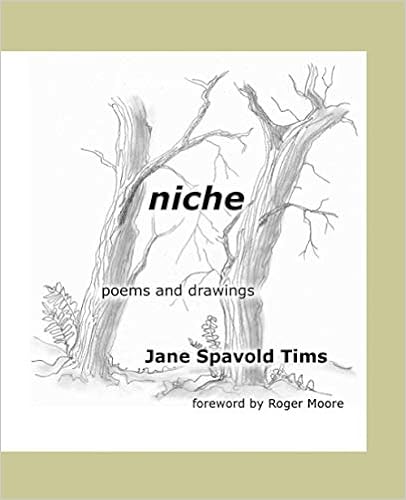
Niche, poems and drawing by Jane Spavold Tims, reviewed by Roger Moore
Independently published. Available from Amazon here.
Niche, the fourth poetry book published by Jane Tims, is a neat configuration of six segments that elaborate and illustrate the poet’s original definition of the multiple meanings of her title word niche.
It is difficult to separate the author from the act of narration as her keenly observed and skillfully executed drawings, together with their verbal representation on the page, are so autobiographical and so much an extension of her artistic and professional abilities that the objective separation of writer and text is scarcely possible. It is hard to forget that Jane Tims was, and to a great extent, still is, a highly competent professional botanist. The harnessing of the professional botanist, with her unique drawing skills and scientific knowledge, to the poet and auto-biographer is a key factor in the reading and interpretation of this text in which acute observation blends with an intimate knowledge of the observed botanical world, both flora and fauna, and this allows the poet, in her role of poetic narrator and lyrical voice, to weave a network of poems that are, at one and the same time, objective and intensely subjective.
The author emphasizes this when she writes in the Preface that “In biological terms, the niche is the quality of a space occupied by a living thing, the sum total of physical, nutritional, biological, psychological and emotional needs gathered together in one place.” She also reminds us that in human terms “niche can be a metaphor for home, community or personal space” and it is within these metaphoric spaces that the poetry text is elaborated. The text becomes a linked mixture of visual drawings, iterative thematic imagery and associative fields, all centred on the multiple meanings of niche. These terms are both biological and human in nature and the poet’s named world meets at this juncture between the human and the natural.
The section occupying space (1-19) bears the subtitle satisfying need and begins with a setting out of what this means in the following 12 poems and 4 accompanying drawings. The poem ‘apples in the snow’ with its companion drawing stands out for me.
The section strategy, subtitled solidifying position (21-43) outlines in poetic terms, how plants, animals, and humans ensure their own survival.
The section praying for rain, subtitled, avoiding danger and discomfort (45-68), offers views on discomforts and dangers. It also opens the discussion—relocate or stay where we are?
The section mapping the labyrinth or places I have occupied (69-83), which contains the wonderful sentence “When I get lost on the road ahead, I look to the road behind me,” throws open the multiple meanings of home.
The section new ways for water, subtitled coping with change (85-98), offers a double landscape, first, external, the things seen, touched, examined, remembered and described, and then the internal landscape that reflects upon them and is reflected in them.
Finally, forgetting to move, with its subtitle getting comfortable (99-111), presents an autobiography that links observer (the twin personage of author and narrator) to observed (nature, both flora and fauna, and the added element of autobiography and self) via the symbiotic relationship of botanist to botany.
Two moments stand out for me. (1) Sadness is in seeking the space that is never found. (2) Loneliness is in trying to return to a space once occupied but no longer available. The whole concept of the Welsh word hiraeth is summed up in these two lines. Carpe diem, Jane Tims’ poetry indeed seizes the day and, with its minute, intense observation, it preserves so many precious moments. It also pays attention to that which has been lost, those moments that are irretrievable. They will vary for each reader, but hopefully, like me, you will take great pleasure in discovering them for yourself.
Jane’s interview with Allan Hudson, another excellent NB author, can be found by clicking this link – South Branch Scribbler. The work of all NB authors should be celebrated over the first weeks of this month. Allan, thank you for supporting us – and you, too, Brian Henry. Living in NB, we need all the enthusiastic support we can get.
My friend Allan Hudson re-posted this blog entry yesterday. It is always wonderful to be remembered by my friends. Allan does a great job with the South Bank Scribbler – and he is one of the best. Long may he and his blog work continue to support New Brunswick writers.
I look forward to working again with both Allan and Jane. Best wishes and many thanks to both.
Click on the link below for Allan’s interviews with Jane and I. And don’t forget to go down all the rabbit holes that appear in Allan’s articles. There is a great deal of information within those little burrows.
What is the most important thing to carry with you all the time?
Things I carry with me
That old black cast-iron stove, wood-fired, that baked the best ever breads and cakes and warmed the bungalow on cold, summer mornings. The Welsh dresser with its age-blackened rails that displayed the plates, and cups, and saucers. The old tin cans that ferried the water from the one tap located at the end of the field. Full and wholesome, its weight still weighs me down as I carry it in my dreams. The Elsan toilet from the shed by the hedge and the shovels that appeared, every so often, as if by magic, as my uncle braved the evening shadows to dig a hole on the opposite side of the field, as far from the bungalow as possible.
The outhouse at the end of the garden. The steps down to the coal cellar where they went when the sirens sounded, to sleep in the make-shift air raid shelter, along with the rats and mice that scurried from the candles. The corrugated iron work shop in the garden where my uncle built his model ships, the Half-Penny Galleon and the Nonesuch. The broken razor blades I used to carve my own planes from Keil Kraft Kits, Hurricanes and Spitfires, an SE5, and once, a Bristol Bulldog. Twisted and warped, they winged their ways into nobody’s skies, though once we built a paper kite that flew far away in a powerful wind and got tangled in a tree. The greenhouse from which I stole countless tomatoes, red and green. Kilvey Hill towering above the window ledge where the little ones sat when there were more guests than chairs in the kitchen. The old bombed buildings across the street. The bullet holes in the front of the house where the Messerschmidt strafed us.
The old men spitting up coal dust from shrivelled lungs. The widows who took in lodgers and overnight travelers. The BRS lorries, parked overnight, that littered the street. The steep climb upwards into those lorries. The burrowing under dirty tarpaulins to explore the heavy loads, and many other things. The untouchable, forbidden drawer where the rent money waited for the rent collector’s visit. The old lady, five houses down who, when the shops were shut, sold warm Dandelion & Burdock and Orange pop for an extra penny a bottle. The vicious, snub-faced Pekinese that yapped fierce defiance from the fortress of her lap. The unemployed soccer referee who on Saturdays walked five miles to the match and five miles back just to save the bus fare, his only financial reward. My father’s shadowy childhood. His first pair of shoes, bought at five years old, so he wouldn’t go barefoot to school.
Wet cement moulded onto the garden wall, then filled with empty bottles to be smashed when the cement set solid. The coal shed where the coal man delivered the coal: cobbledy-cobbledy, down the hole. The outside toilet with its nails and squares torn from yesterday’s newspaper. The lamp-lighter who lit the lamps every evening as the sun went down. The arrival of electricity. The old blackout curtains that shut in the light and shut out the night. The hand rolled fabric sausage that lay on the floor by the door and kept the heat of the coal fire in the kitchen. The kitchen itself with its great wooden chair drawn up by the fire. That chair: the only material possession I still have from that distant past.
Creativity. I was told, a long time ago, that genius is 99% perspiration and 1% inspiration. When I started creating – poetry, mainly – I waited for the muse to arrive and lamented when she didn’t. Then I tried to force her to visit me – and that didn’t work either. Then, in 1985, I started a journal. I wrote in it every day that year and, as I wrote, I realized that most of what I was writing was gibberish. But – and it’s a big but – a few literary gems gleamed out from the rubbish. The question then became – how to recognize them. The answer to that has come more easily, the longer I have worked at writing. It’s not the muse who needs persuasion, it’s the artistic eye and mind that need to be trained so that they can see the creative art in the surrounding world.
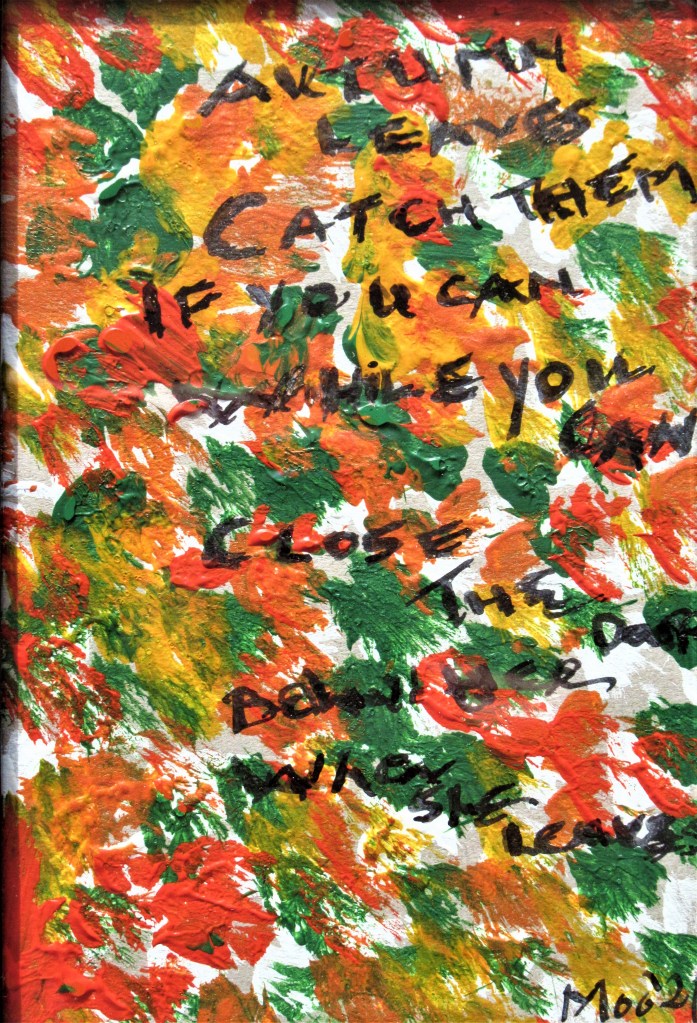
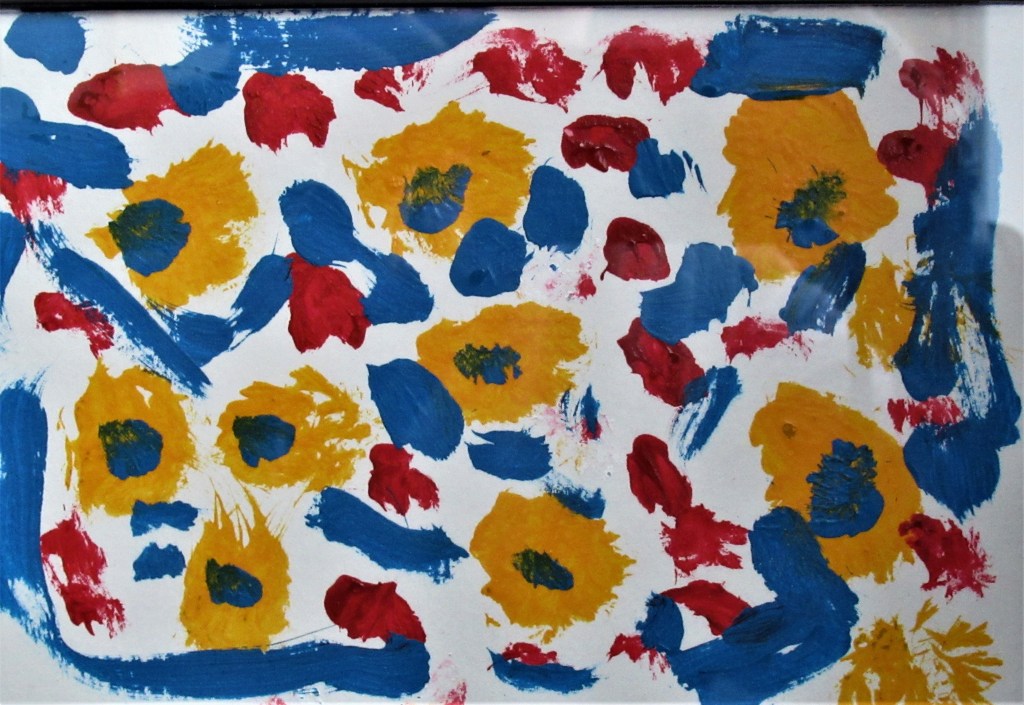
Now, after 38 years of regular journaling – and I try not to miss a day – I can distinguish easily between art and rubbish. My poetic creativity, often via a streak of surrealism, has wormed its way from poetry, into poetic prose (short stories and novels), and from there into my style of quasi-surrealist, quasi-expressionist paintings.
Where is the joy? The joy lies first, in the work itself, the contemplation of the blank page, then the slow tidal flow of words that fill the empty spaces. Then comes the joy of recognition, followed by the joy of selection, followed by the joy of polishing, and eventually, the joy of publication. The same is true of painting. Here, the empty canvas, like a beach with the tide coming in, fills up with color and shape and, like Matisse, I try to make meaning out of those colors and shapes. Am I great artist? Of course I’m not. I’m a dibbler and a dabbler, unknown and unrecognized, but joyous in my joy of creating something that will stand, for a little while, against time’s rising tide.
What strategies do you use to maintain your health and well-being?
Covid changed the world and my outlook on the world. Since the first rumors in 2019, I cut my own hair and stopped eating out. I avoided crowds, left home as little as possible, wore a mask everywhere, and maintained as much distance as possible between myself and other people. I stopped inviting people around to the house, and, as a result, we have hardly had a visit or a visitor in the last four years. We got regular shots and boosters. So far, with those precautions and a little bit of luck, we have avoided Covid.
My health care deteriorated during the Covid period. I had very few visits to my GP’s office, and most business, like prescription renewal, was done over the phone. Consultations were by telephone as well. I missed out on the regular blood tests that my urologist / oncologist had been scheduling for me, after a bout with prostate cancer. These picked up again in late 2021, and were resumed in 2022 and 2023. Things seem to be moving well currently. Thank heavens.
I interpret well-being as my state of mind, rather than my state of body. I would say that my well-being suffered from my lack of human contact, although I have slowly developed a series of online support groups. In this way, I was able to continue my writing, for example, in Zoom sessions. I also missed my family visits. I no longer travel well, and due to Covid restrictions, I did not see my daughter or my granddaughter from 2019 to 2022. Clearly, we all missed the family closeness and we were all affected. However, we are used to isolation from family. Boarding schools, travel abroad in the summer, emigration to Canada, saw our family connections broken. That said, the advent of social media, Skype, Zoom, Messenger, texting, free phone calls, have all lessened the miles between us and maintained a contact that we never had, post migration, with our parents and grandparents, and extended family. The isolation and loneliness have been hard. They are hard upon all ageing, isolated people. We have suffered less than most.
As for strategies, I really have only three: 1. to adapt 2. to survive 3. to create beauty via my writing and my painting. Painting, prose, and poetry – these I can share with my friends. Vita brevis, ars longa – life is short, but art endures. Pax amorque – peace and love.
While I was actually working, although I never called it work, because I thought of it as a vocation, I listened to the complaints of the administration (often about my way of work). I also listened to my students (all too often their complaints about the system and the way they were being taught and treated). And then I listened to the problems that were daily laid before me in my office by these same students. These, problems and students, were many and varied. One day, I designed a label for my door that announced: Office of Creative Solutions. And yes, I provided many innovative and creative solutions to problems that, to young people, especially my students, seemed almost impossible to resolve.
Then I retired. At least, like an ageing horse, or an unwanted donkey, I was put out to grass. And in that clover-filled meadow, I grazed at leisure and worked no more. But I did have time to write and so I became a creative writer. At first, when I started creative writing, I forced my characters into the roles that I had chosen for them. Sometimes they complained. Then, one day, or maybe it was one night when I was dreaming, a host of my characters, minor and major, came knocking on my door. They carried a big arrow that had, written upon it, Office of Creative Solutions. They pointed it at me and began to complain about how I was treating them. I remembered the poem I had memorized as a child – The owl, he was a wise old bird, the more he spoke, the less he heard. The less he spoke, the more he heard. There never was such a wise old bird.
I remembered how I had listened to my students and how, by listening, I managed to find creative solutions to their problems. So, I listened to those characters as they yammered away. One by one, they told me their woes, and their problems. Then, the following day, I rewrote everything I had written previously and wrote the stories down in their own words, instead of mine. When I listened to them, I allowed my characters to tell their own stories, and to speak for me and through me.
Sometimes, when I run out of voices that come in the night and tell me what to say, I cannot write. Then I take a paint brush, and I start to paint. What do I listen to when I paint? I listen to the brush as it moves itself over the canvas. I listen to the colors as they demand attention and tell me where to place them. I listen to the paint as it says ‘just here, not too thick, not too thin, a swirl please, gently now.”
Now, when I am not working, I listen to flowers, trees, the wind in the willows, the songs of the falling leaves, and the voices of birds.
Your face: a landscape luminous in the darkness, a mapa mundi in the light, your heart spread out.
My eyes trace the contours, follow the ups and downs of your existence, track crows’ feet, crinkling by your eyes.
Time has carved, molded, sculptured your features. Wind, snow, wet weather, sunlight, each has left its mark, a wrinkle when you frown, a dimple when you smile.
My eyes want to rest here for a while, take in the tracks, pause at the passes, climb hills, descend into valleys and dales.
Such beauty spread before me. Such a joy to contemplate the way you are able to show the paths I have walked of late.











 rogermoorepoet