Don’t tell me

IMG_0624 (3)

Don’t tell me your troubles …

… words wrapping themselves around your neck, the tune a loose scarf, brilliant in the sunshine, and so warm, flapping as you walk the street … people see frayed ends … wave back at you … the sun picking out gold spots in your hair … all’s well with the world … a marching song … the world walks over the hills … and far away … you march to work or play … every day is a new day … blood stirring with this call to arms … to alarms … everything up for grabs … tunes in your head … words wrapped around you  … warming you …
… a sad song … rain drops falling … mist or mizzle … you walk through damp, low clouds … you are sad … but comforted … wrapped warm in a verbal comforter … the sun breaks through … throws its arms around you … hugs you …. until raindrops radiate … gathering on eye-lash … at leaf’s end … twinkling an abundance of radiant flowers …         … a Nor’easter … snow in the air … on the trees … on the ground … a steady accumulation … you know how it is, East Coast Canada … down by the Fundy …  a fire in the fireplace … warm heart … warm hearth … no travel today … books and computer beckon … a time to read … to write … to remember the old ways … the old days … those memories … a warm scarf wrapped around the neck … and the comforter … so comforting … so much to wrap around you … so much to wrap your head around …

Morning in Island View

IMG_0262

Morning in Island View

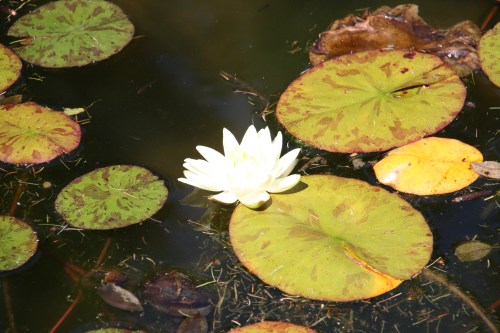
             Morning in Island View and I dream of warm lips rising from stone cold waters. Somewhere, the early sun floats petals across a lily pond. Framed among lilies, my beloved’s face drifts through a watery space. So sweet, her embodiment: she lies languid among the lilies, beside herself in bloom after bloom, each flower gigantic in its frame beneath a wooden footbridge.

            I envision her as she was, this lily who will toil not, nor spin, and who sighs with the morning breeze that ripples her smiling countenance into a thousand fragments. She lies cushioned amid the lily pads, a work of wonder in a liquid impression of fragmented light.

            Fortune rattles its poker dice and they fall haphazardly, here and there, wherever they will. Once thrown, like the spoken word that can never be recalled, they lie there, still on the table’s green baize. They fall, but not by chance and chance itself blossoms with their falling. Like Venus born from the waves, my beloved rises from the waters, born in a conjurer’s trick of blossom turned flesh and pulled from the stream’s dark sleeve to flash her mysterious magic in a thicket of flowering water.

            Now, I see her everywhere: a model in a window, languid in a pavement puddle where raindrops ripple her eyes, couched among the floating clouds as evening steals color from the day. Dusk’s shadows draw their curtains across street and square and now she becomes my lily of the lamplight and I frame her anew in the streetlight’s afterglow, night’s figment dreamed alive beneath distant stars. I walk with her, hand in hand, at noon, when the cathedral wears its strawberry suit, and again in the late afternoon when a blueberry blush descends with bells.

            One evening, in a fit of hope, or is it despair, when my heart pants for a cooling stream, I tread the lily pad path across the pond’s untroubled waters. Dark bells ring out their jug-o-rum chorus as I seek the light of her countenance. Dusk is a violent bruise, scoured purple and red across the waters as I try to become one with my lady of the lake.

            I still don’t know what drew me out. But when I emerged, I sensed that all had changed and that nothing had changed more than I had, the viewer, that once-young man, now old and arthritic, typing away, one finger at a time, battering my key-board to recreate the wanderlust of those day-dreams wrought sous le Pont Mirabeau, along the banks where the Seine flows, or up by the bouqinistes where bridges span the river, words bounce off the page, and painted lilies in the Marché aux Fleurs bewitch the viewer with a staring madness that mirrors pondweed and drifting hair. Now my beloved’s face floats through the cathedral’s eye that ripples in the river. I see the great rose window of Notre Dame, and I seek her once again in those dark waters where she holds out her hands, a place mat for my un-drowned heart.

The Journey

IMG_0681 (3)

The Journey

I sense the rust in her mind’s clockwork
clogging her brain, slowing down thought.

I watch her search for words, stumbling through
sentences.  “Wind up the flowers,” she says
handing me the key for the grandfather clock.

When she says “water the clock” I receive
the plastic watering-can meant for the flowers.

Fellow travelers, we journey side by side on life’s
train. I watch her as she looks out of the window
at the passing countryside with its tiny stations.

She frets as she clasps her weak hand in her strong
one and I realize she’s worried because she no longer
knows when, where, or how the journey will end.

Comment: I wrote this originally in memory of my grandmother. However, as I have been involved in the rediscovering / revision / rewriting of older poems, I have come to realize that, as our visions change,  our poems become more accessible to a wider audience. In other words, given what is happening right now with the pandemic, none of us know when, where, or how the journey will end. This leads directly into the twin themes of the fragility of life and the nature of memory. What do we remember? Why do we remember a particular incident? Did it happen just as we remember it or have we already doctored our memories, re-creating them, so to speak.

I have a clear memory of seeing Sir Frank Worral batting at St. Helen’s in Swansea, when I was about 11 years old. A close friend of mine, an outstanding cricketing historian, checked the details in Wisden and told me that Frank Worral wasn’t playing in that match, so I couldn’t have seen him batting. And then there was Sir Everton de Courcy Weekes: I swear a saw him score a century at Bristol, yet, again according to my friend who checked the records, he only got fifty in that game! Games: what mind games the mind plays with us as we age. So, do I go with the fantasy land of my memories in which much has been (re)-invented? Or do I go with the world of truth and checkable reality? As an academic, I lived in the latter world: research, check, double check, avoid expressing personal opinions, facts, facts, facts, and exact dates. As an ageing poet, I would much rather live in that former world where truth and reality march hand in hand with fairy-tale and fiction, a little bit of one and a smattering of both.

How far is from fairy-tale and fiction to the dream world we inhabit at night? Just a short step, I reckon. Sometimes I remember my dreams and write them down when I wake up. Sometimes they vanish and I can only recall some vague feelings of joy and anguish. And what is life, that fragile, dream-like reality? Is it really a dream, as Segismundo tells us in Calderón’s La Vida es Sueño? Or is it a real world? And if it is real, do we create that reality or do we dream it? And if we dream it, do we sleep walk, sleep talk, sweet talk our way through it? Or do we portray it just like it really is, with no creativity, just a factual repeat of reality as we know it?

¿Qué es la vida? Un frenesí.
¿Qué es la vida? Una ilusión,
una sombra, una ficción,
y el mayor bien es pequeño,
porque toda la vida es un sueño,
y los sueños, sueños son.

What is life? A frenzy.
What is life? An illusion,
a shadow, a fiction,
and the greatest good is small,
because life is a dream,
and dreams are nothing
but dreams, after all.

 

Empty

IMG_0228 (2)

Empty

Empty now the house, clean the floors where she
spattered food and scattered her toys, polished

the tables, grubby no more, where small hands
clattered fork and spoon, her breakfast not wanted.

Empty the bathroom, the tub where she bathed.
Dry the towels, full the toothpaste tubes she

emptied in ecstasy. Where now her foot
-prints, her laughter and tears, the secret

language she spoke that we never understood?
Empty too my heart where, a wild bird, she

nested for the briefest time, then flew, yet
I possess her still, within my empty hands.

Commentary: The lead painting is the one Finley painted for me. I received it as a Christmas present, a couple of years back when she was 3 or 4. When asked if she wanted to add some more to the painting as the canvas wasn’t full, she replied: “No, it’s finished. That’s just how I want it.” Picasso once said that he spent the first half of his life learning to paint and the second half learning to see again as children see. Sometimes we complicate our art so much that we kill our inspiration and our vision. Some poets necessitate a dictionary in order for a reader to understand their words, yet when the meaning emerges, we find that the poem is convoluted, stilted, almost meaningless and even emptier than it was before.

Question: why do we try to gild the lily? Why do we lead to the slaughter the gift of the goose who lays the golden eggs? Are we writers or assassins? Are we not capable of putting meaning on paper with the directness and simplicity of a child? Good questions all. Sometimes I think that poets are like the existentialists of Albert Camus’s novels: they are the assassins of language and the murderers of direct and clear writing. And who are the victims? The words, images, metaphors, feelings that are strangled in the cradle or forced into captivity behind prison bars of jumbled lines and scattered thought.

Original ideas? No, not at all. This is the basic argument that Francisco de Quevedo (conceptismo) had with Luis de Góngora (culteranismo) in the Spanish literary salons of Madrid between 1613and 1627. The literary insults they wrote to each other are still a scandalous joy to read. These two seemingly separate styles of writing, which are actually very similar on many levels, eventually blended together and led to a total renewal of the Spanish literary language.  This in turn was bastardized by second-class imitators who did not have the skills of the original ‘super’ artists. And thus the pendulum swings: innovation > standardization > parody and satire of a worn out language > fresh inspiration and innovation.

As for me: how I would love to regain the clarity of vision and the joy of words that I experienced when I was a child. Back then, the world was a magic place, the pen and pencil were magic wands, and the empty page was a blank canvas to be filled with wonder. Alas: then I was sent to school. Rules were set. Bars were installed. Blinkers were inserted. Doors and windows were locked. Creativity ended. I will say no more.

KIRA Creative Quarantine

image1 (53) - Copy

KIRA Creative Quarantine

The Kingsbrae International Residencies for Artists (KIRA) requested its alumni to consider creating a ten minute video of themselves offering an instructional lesson based  on themselves working in their specialist areas. You can click on the above link to see all the creative videos currently available. Note that two more are added each week. Here is a link to my own video on Writing a Poem. It is designed for people of any age and I hope that anyone who sees the video will enjoy it and be inspired to start putting together their own poems.

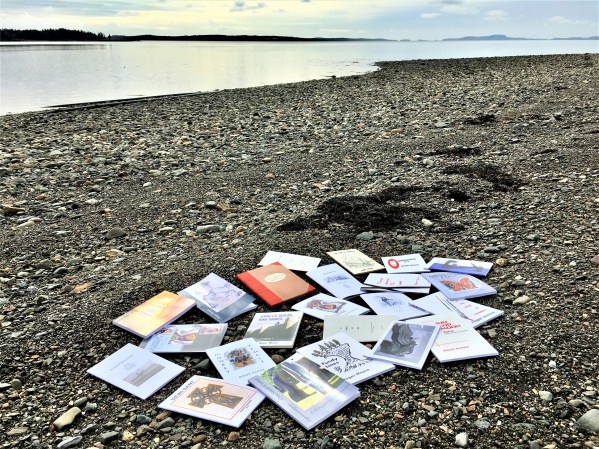
The photo above was taken by Geoff Slater, the Artistic Director at KIRA. He placed a selection of my books on the beach at Holt’s Point and Bingo: instant art from a master artist. My book Fundy Lines now sunbathes on a beach that has ready access to the beautiful Bay of Fundy.

Downsizing

image1 (53) - Copy

Downsizing
Francisco de Quevedo

I chose each book, held it in my hands for
one last time, then placed it peacefully in
its cardboard coffin. Old friends, they were
but I broke that friendship and set them
free to fulfill their promised after-me-life
on another person’s shelves. I used to love
to listen to their lilting speech, to hear sage
thoughts with open eyes and mind. I replied
to their wisdom: words penned on each page.

Mind to mind, though they had lived five
hundred years ago, I strove to engage them
in a lively conversation, Bakhtinian dialogues
within our shared time and space, and
that space my basement library with its books.

One day, a man from the university drove up
in a hearse and bore them all away. Released
to a wider world beyond my walls, they will
nourish younger minds than mine. I hope their
new owners will bless them, welcome them,
cherish them, as I have done throughout my life.
Blind now, with tears, my eyes that devoured
their words. Deaf now, these ears of mine that
heard dead men’s words, for I can listen no more.

Comment: “Escucho con mis ojos a los Muertos / I listen with my eyes to the words of the dead.” Francisco de Quevedo (1580-1645). It was a hard thing to do, that disemboweling of my library, but it had to be done. I am grateful to the Harriet Irving Library at the University of New Brunswick for taking pity on my plight and redeeming my books. Hopefully they will have all gone on to a better life. It was sad to walk past them, to watch them slowly gathering dust, like a book on a shelf, as Elvis used to sing. It was even sadder to know that I would ever be able to peruse them all again, let alone read them from from cover to cover, certainly not in this life time.

And is that my own fate, to be reduced to words on a page, to become a dusty book lying forgotten on a shelf? Pobre poetas de hoy,  wrote my friend and fellow academic poet, José María Valverde, destinados a ser polvo seco de tesis doctoral / Poor poets of today, destined to become the dry dust of doctoral theses. So: my thought for today … rise up and resist. Take an old friend off the shelf. Dust him or her off. Open the pages. Settle down for a moment or two. Breathe deep. Begin your conversation with your long lost friend. We may not be close in the flesh, distanced as we are by lock downs and separation, but we can become closer in our minds. Pick up one of my books. Dust me down. Read me. Begin that conversation. Now. Before we too are gone, swept down stream by time’s river and lost in the mists that curtain the sea.

And, just in case you thought that last line was very good and very unique and original, here’s the conversation it came from: Nuestras vidas son los ríos / que van a dar en la mar, /  que es el morir / our lives are the rivers that will flow down to the sea, which is death (Jorge Manrique, 1440-1479). I had that conversation with Jorge Manrique in Santander in the summer of 1963. His Coplas was on the pre-university reading list at Bristol University, placed there, I believe by Salvador Bacarisse who was related to a long line of Spanish musicians and poets. If memory serves me well, our first essay, in our first week, in our first year of Spanish, entailed writing a commentary on the Coplas and how to read and understand them.

Si jeunesse savait, si vieillesse pouvait / If youth knew how, if old age was able to (Voltaire). I wish I knew then what I know now. And I wish I could do now, some of the things I could do back then. Meanwhile, do not despair: pick up one of my books or browse my blog for a poem, and have a short and hopefully profitable conversation with me as you listen to my failing voice with your younger eyes.

Bleeding Heart

IMG_1338 (2)

Bleeding Heart

White moths
wing their snowstorm,
pale stars through the night.

A candle flickers in the darkness.
Hands reach out to grasp me.
A feathered shadow flies
frail fingers across my face.

Butterflies
stutter their eye-lash kisses
against closed cheeks.

Awake,
I lie anchored by what pale visions
fluttering on the horizon?

Eye of the peacock,
can you touch what I see
when my eyelids close?

Black rock of the midnight sun,
blocking this day’s dark cave,
when will I be released
from my daily bondage?

Last night, the planet
quivered beneath my body
as I felt each footfall of a transient god
who mapped in runes
the ruins of my bleeding heart.


IMG_0811 (2)

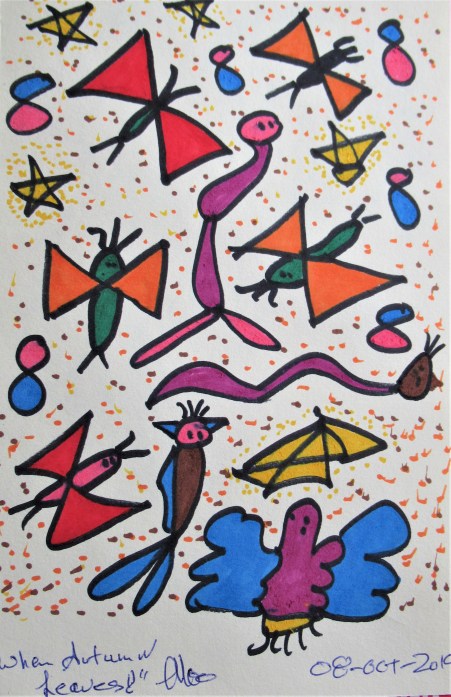
Comment: Another Golden Oldie, also dug out from the rejection / dejection of striations. I tinkered with it this morning. Funny what a shift in structure and a twitching of the metaphors will do. New lamps for old: indeed, and why not? We are not just writers, we are re-writers and some thoughts can be reworked to rise again in the shadows of the adopted children that are our poems. This bleeding heart plant vanished a couple of years ago. We dug up the flowerbed, inserted a rockery, and watched and waited. After two years, the bleeding heart plant resurrected itself from within the stones. Survival, renewal, faith, hope: key words nowadays. Who locked that plant down? Who let it rise up again? When we have gone, how will our gardens get on without us? Very well, in all probability, but they may be more of a tangled garden than a cultivated one. And what’s wrong with a tangled garden? Why, nothing at all, my friends, absolutely nothing at all.

image5

Garbage Day

image1 (17) - Copy.jpeg

Garbage Day
(1789 AD)

all the dustbins
dancing down the street
trying no doubt to achieve
a spring time copulation
so they can give birth
to even more dustbins

you can’t have a revolution
without dustbins
dusty … dusty … filthy
dusty dustbins
a sadistic way to look at
dustbins full of sawdust
heading off down the street
between potholes
and blowing bins
a right Danse Macabre
conducted by
St. Vitus

me sitting there knitting
Montreal Canadians
this Red Cap
I keep flying high

even though I stand
upon Gibraltar’s Rock so fair
not to mention Paris
the Place de la Bastille
with tumbrils rattling

Old Moll in a Moll’s Cap
toothless fairy
at a Goblin Party
watch out
for toad s’tools
[sick this poem
this joke

and all that’s in it]

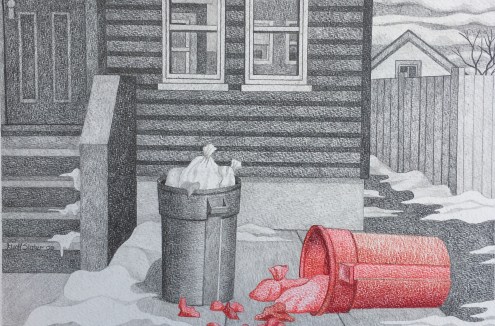
Comment: A wonderful drawing by my friend, line painter Geoff Slater. The poem, of course, represents the garbage in (and out of) the garbage can. 1789 is the date of the French Revolution. I found this poem in my discard file, so it was one of those that didn’t make it anywhere. Maybe it shouldn’t have made it here either. But it takes all sorts to make a world and Geoff’s red dustbin reminds me of the red caps knitted by the old women beneath the scaffold and the guillotine. Funny things, guillotines: invent them and they drop on you when you fall out of favor. There are so many allusions in this poem that I am ashamed to say I remember them all, and not all of them are pleasant. Mind you, few things are pleasant nowadays and remember: it is better to leave your dustbins out to roam the streets and be plundered by the crows and swept away by the high winds than to leave them festering and smelling bad and all cooped up in the locked down garage.

Daffodils

IMG_0617

Daffodils

My daffodil day-dreams carry me back to Wales, that Land of Song where every valley conducts choirs of daffodils and their pale, brass voices are raised in an annual springtime hymn of hope. Beneath the trees, in Bishopston Valley, between Pyle Corner and Pwll Ddu, sheltered bluebells tinkle sweet tunes, lilies-of-the-valley bloom, and primroses raise their faces to the sky while hearkening to those springtime airs that sound where’er you walk. In Blackweir Gardens, the Feeder Brook flows into the castle moat and the castle’s central keep stands on the mound the Normans dug when they converted into a motte and bailey the old Roman camp that was built on an earthworks constructed by the Silures long before that countenance divine shone forth upon these clouded hills and long before the Roman came to Rye or out to Severn strode. Generation after generation, all those who witnessed the birth of these flowers and strove to be the first to hear the cuckoo’s call, come alive again in this floral tribute. Oh, Land of Song: the bluebells may have gone, the larks may sing no more, cuckoo and cowslip may have fled the valleys, but all is not lost, not while the daffodils still toss their heads in sprightly dance and spring breaks out its freckled sunshine.

Comment: Win some, lose some. Survival is all. At the same time as I mourn everything  that is lost, I also celebrate all that survive. The grosbeaks have left us, moving further north as the weather warms. They have left more room for cardinals and hummingbirds have moved in to replace them, as have turkey vultures. Turkey Vultures, Zopilote, The Trickster, in Oaxaca, the bird that flew high up into heaven, stole the fire of the gods, and brought it back on his wings, now flies over the St. John River Valley, having moved up here with the warmer air from the south.

“The olde order changeth lest one good custom should corrupt the world” … indeed it does. And we must mourn and celebrate the olde order while preparing for, and celebrating, the arrival of the new. For the world has changed and is changing as I sit here and type these words and it will have twitched and changed again by the time you read them. Who knows exactly what is coming? How do we prepare for the unknown? How do we open our arms and embrace an uncertain future? Good questions all. I cannot answer them for anyone but myself, but I must ask them. Many of them were discussed today by Suzanne Moore in an article entitled: The way we once lived is now redundant. We must reinvent ourselves. Read it and start thinking about how we can be strong, daring, caring, and best prepare ourselves, not for our own extinction, but for our own reinvention.


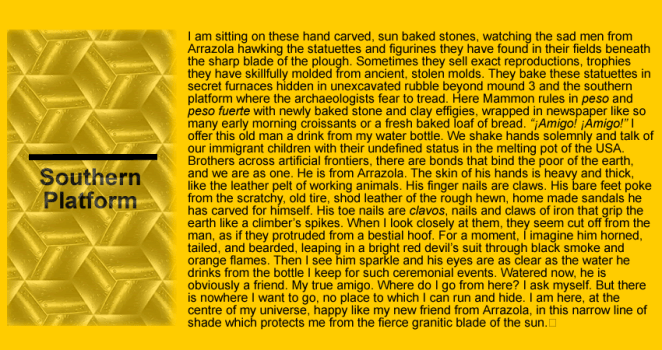
Southern Platform

Southern platform2.png

Comment: The wind that whistles through Island View today carries snowflakes and ice pellets that pitter-patter across the window. The wind brought in clouds, grey wisps of drapery that curtained the sky. When the wind falls silent, the trees continue to wave and thereby fan the air into action and the wind starts up again. Yellow sunshine, warmth, the sun in Mexico, in Oaxaca, in Monte Alban where the danzantes dance in stone and my friends and I wander at will among sunshine and shadow. On grey days like these when I crave the sun, I conjure images of Oaxaca, its warmth and its mysteries of mescal, that early-morning spinner of inner myths, word music, and magic metaphors.