Rats

Rats

Black clouds build over the Bristol Channel, threatening to cross the Severn from Ilfracombe to Brandy Cove and climb inland to rattle our windows and bounce rain off our corrugated roof.
            We run out to the lane, looking for the dog, calling his name. Hoping to get him in before he gets soaked. The rubbish dump outside the gate sits on a concrete stand and dominates the lane. Tall and stinky, the red-brick structure rustles with scavenging, skirmishing rats. Pinned to the dump, a hand-written notice: “Please do not light this dump.” We smile as we read it. Our neighbours will put a match to this dump, one dry night, on the way back from the pub.
            Kim, Nana’s Wire-haired Fox Terrier, spends his days at the dump in an effort to achieve his life’s desire: the elimination of every worrying, scurrying rat that ever inhabited the planet. When he tires of killing rats, he will bring their bodies home to the bungalow. Sometimes he lays them in rows outside the backdoor: rats, mice, field mice, voles. Sometimes he brings them inside and places them on the concrete base beneath the old cast-iron stove. Every day Kim sacrifices to my grandmother, his Gower Goddess, and lays the victims out on her altar.
            The rain is close. We run back down the lane to avoid the storm that is now upon us. Violent and short-lived, like so many summer storms in Wales, raindrops will thump against windows and roof. Lightning will flash, thunder roll its celestial drums, and the wind will whip its lash round the chimney. We sit at the table and sip hot cocoa. No sign of the dog.
            Later, when the storm has passed, we wander up to the lane, avoiding the deeper runnels of muddy water, and stepping from high point to stony high point. We scurry hurriedly past the dump and listen to the rats. They will survive for another night. Nobody will be able to light the dump after rain like that. Back in the field, we fill up the water can, take a handle each, and carry the precious liquid back to Gran.
            We walk to the back door. Our neighbor is standing there, crying.
            “I didn’t see him,” she stammers. “He ran out from the dump as I drove round the corner,” she points to Kim, laid out on the back step, his broken body wet and bloody, the last rat he would ever catch still clasped tightly in his jaws.

Forget-me-not

Forget-me-not

sitting in the kitchen
crouching by the coal fire
hands quite warm
back quite cold
checking the windows
peeling back the curtains
blackout curtains
frayed and old
looking at raindrops
sliding down the windows
chill greasy raindrops
grey and cold

wondering who wants me
wondering who loves me
wanting my teddy bear
longing for my pussy cat
wanting my little dog
longing for his tail wag
so much missing
my nose so cold

now I am seventy
everything has changed
changed town and country
changed clime and weather
everything is different
nothing is the same
longing for my childhood
longing for my home land
watching the ocean
that comes rolling in

ocean of waters
ocean of memories
ocean of people
now long departed

Comment: Rhythm is everything here. I have just re-read The Sing-song of Old Man Kangaroo from Just So Stories (Rudyard Kipling). My mum and dad gave me copy when I was seven years old. Did they really think I could read it and understand it at that age? Whatever! The rhythms have stayed with me all my life and today I tried to reproduce them. My soul and my fingers danced as I thought of old man kangaroo and how he lost so much to gain so much. And what of the Elephant’s Child with his insatiable curiosity? I lost so much when I came here to Canada but I gained so much from this wonderful country. I tore my world apart then put it back together. How to explain it? It may not be explicable.

Hot Water Duck

Canada Geese at Mactaquac

Hot Water Duck

The worst punishment of all was to be sent to bed early.  You climbed upstairs by candlelight, if you were lucky, or groped your way upwards in the dark, if you had been really bad. You entered the cold, dark, damp of the bedroom and punishment was not to have supper, and not to have a warm hot water bottle or a warm baked brick to keep you warm in bed. I loved that hot brick, baked in the oven or by the fireside, then wrapped up in a towel. Bricks and bottles: they banished damp from the bed and kept you warm for a while, or burned if the wrapping fell off. The hot water bottles: they were made of tin not rubber, and once, I remember a cast iron duck, that my grandmother baked in the oven, then wrapped in swaddling clothes, like a little baby. But if the grown-ups said you had been naughty, or nasty, or cheeky, or just plain wicked, then you were given nothing to keep you warm, and you lay in bed and shivered until you cried yourself to sleep.

Canada Geese and Fall Foliage at Mactaquac

Royal Doulton

Trying not to …

Royal Doulton
            Some nights I woke up during the night, needing to pee. At night, I slept with my gran. I never liked using the Royal Doulton chamber pot that squatted coldly beneath her huge brass bed, especially if she was in the room. We had no indoor plumbing, nor running water. Apart from the rainwater the only tap was at the far end of the field, a long way away. Rainwater, caught in a bound, wooden barrel, was the only water we didn’t need to fetch.
            The cows that wandered through our yard at night really frightened me. We would meet them in the lane some times, a noisy, dusty, flowing, multi-colored tide that flooded the pathway and forced us walkers into the next field, if there was a gate close by, or to climb high into the hedge, if there wasn’t a gate. One cow, with a crooked horn, had gored our neighbor’s dog. She had also broken a young girl’s leg. Vicious when, isolated from the herd, she often meandered around on her own.
            At night, when I wanted to pee, I walked outside, to the outhouse. I would grope my way out of the bedroom and slide back the bolts on the door. Then I would half-open that door and peep out, listening carefully for any sound of the cows tearing out the grass with their teeth. I would sniff the night air, and if I caught the sweet breath of a cow in the vicinity, I would pee through the narrow crack of the open door and swear in the morning, when someone found the little puddle, that it wasn’t me, that it must have been one of the cows.
            One quiet night, I walked bravely out into the dark and stepped right into a fresh, warm cow pat. It sifted upward between my toes and rose to assault my nose. After I had gone pee, I wiped my foot again and again in the long grass beside the outhouse, then placed it beneath the water-spout from the rain barrel, trying to flush it clean before I crept back into bed.
            That was the night I left the back door open. Next morning, Nana woke us all up with a series of long, loud screams. The black and white cow had wandered through the open door and ended up in the kitchen where my grandmother had come face to face with it in the early morning light.
            I still have dreams, nightmares, really, of a herd of cows invading my bedroom, breaking down the doors, climbing in through the windows, and me all alone, trapped in my bed, shivering ferociously, squeezing myself, trying desperately not to go pee.

My Grandfather’s Chair

18581930_1306791786107970_4016640231053970709_n

My Grandfather’s Chair
For Margie Goldsmith

“Write about that chair,” Margie said,
and I wondered what was in her head.
How can I write about that chair
when those who sat in it are not there.

Before the coal fire my grandfather sat,
snoring away, on his lap slept the cat.
At three years old, I climbed that chair,
and blew on the bald spot in his hair.

So many things we no longer know:
my grandpa did the same thing, years ago,
and years before that, his own grandad
did just the same to make his old man mad.

Now I, in my turn, when I drink deep,
like to sit in that chair for a little sleep,
and my grand daughter, there’s no grandson,
climbs up that chair, as others have done,

and sees the bald spot in my hair
and blows and blows as I snooze there.
The years roll back and I see the smiles
of generations woken by a young child’s wiles.

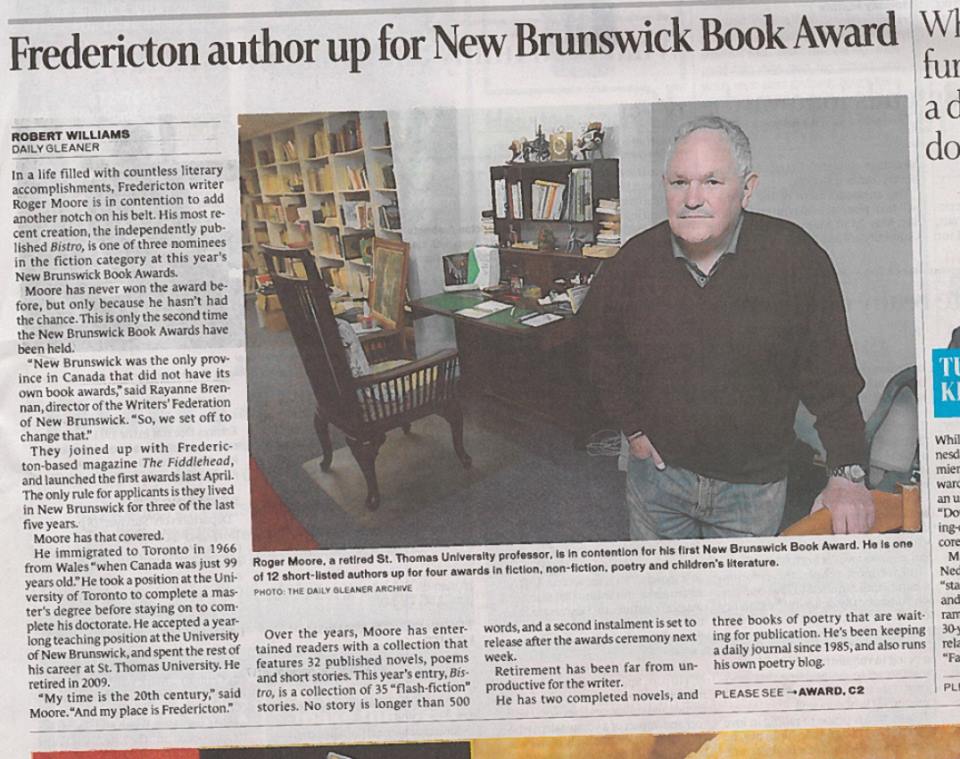
Comment: Talking the other day, I mentioned my grandfather’s chair, the only piece of furniture rescued from my parents’ house, and Margie said I had to write a poem about it. So, last night I did. The result is something very different from what I normally write. This is what in Spanish is called an occasional poem and it celebrates a specific occasion, a specific set of circumstances. Thus, it is written under different rules, rhyme, rhythm, stanzas. It is always an adventure to write something suggested by someone else. Poems like this cross the boundary between poetry of play (which this is) and occasionally enter the realm of poetry that expresses the authenticity of being which, to a certain extent is present in this poem too. The above photo, from our local newspaper, The Daily Gleaner, is the only one I have of the chair which resides in the basement where I keep my books. The article is an old one (2017), but the photo is nice!

Brân

IMG_1063 (2)

Brân

Golden in the starlight, moon carved mountains and valleys, taut the skin, treacherous to the touch.  Heavy he is, glowing. He and his children. We carry them to the dark beneath the trees. Locate the secret, sacred place. Dig deep, bury him with the hoard.
We all know the place. Have measured it with footsteps. None will reveal it. Not under torture. Rather our lives than darkness eternal.
My mother limps beside me. Back-bent and broken. A crone in the moonlight. She’s been here before. Much too often. That’s how she bore me. Caught by the heathen. Captured and taken and twenty times taken.
Me, the blond son. Son of sea-raiders. Not black like my brothers. But never forsaken.
Head of the household, her man rejected her. Called for the Druids with mistletoe and magic, herbs and fragrance, scourging their medicine.
She would not drink them. Said she would keep me. Her biggest baby. Blond. To take vengeance.
Behind us, the villa in flames, there in the distance. Smoke rises heavenwards. Blots out the stars. “We should have fought,” my brothers say. “You would be dead,” my mother replies.
Brân, the white crow. King Arthur revenant. I fly the land, my brothers behind me. Black-haired, black-feathered. Strong as the crow flies. We travel at night. Fast now and furious.
My long bow penetrates. Shatters oak shields. Kills at a distance. None can withstand it. Daylight finds us grouped in the forest. Close to the place where the dragon lies buried. Close to my mother, the place where she sleeps.
Oh yes, they hunt us. But they don’t dare find us. Swift is their fate if they come close. Frightened they are, feared by the finding, wordless and dumb at the swift ending.

Comment: It’s an ill-wind, they say, blows nobody any good. So, ipso facto, some good must come from even the worst of things. Maybe, like Charles Dickens, I should write: ‘These were the worst of times, these were the best of times.’ The worst, because we have been under lock down, first voluntary, then involuntary, and now voluntary again, for 83 days. The worst, because we know that many people are dying and that many, many more are suffering. The worst, because we see some people, who think they are above the law, flouting the law and getting away with it while putting other innocent people at risk. The best, because we have seen extraordinary sacrifices made by the humblest people, many of whom, shop clerks, garbage collectors, street cleaners, bus drivers, taxi drivers, nurses, care-workers, house cleaners, were seen, if they were seen at all, as cheap labor to be exploited. However, thanks to CV, we now see them for what they are: the keys to making our lives and our economies function. The best, because where precautions have been taken the death toll has dropped and so have the infections. The best, because once again, we are free to move around so much more. However, many of us, after so long, no longer want to.

For me, safely distanced among the trees in my ivory tower, these have also been the best of times. I have made many new friends online. I have restructured the ordering of my acquaintances. I have gone into my computer files and found things that I cannot even remember having written. One such is Brân, the white crow, who is said to be King Arthur, still alive, and flying everywhere, ready to protect his from the evils that beset them. I do not know when I wrote this piece. Nor do I remember where the ideas came from. In what secret fold of the mind were they born? I do not know. But I do know that I have seventeen manuscripts, many of them rediscovered during this Dickensian ‘best of times / worst of times’, and all of them awaiting publication. This one is from a 67 page manuscript called A Cambrian Chronicle. 67 pages … and I don’t remember writing any of them.

On Learning Welsh


IMG_0094

On learning Welsh

Welsh
is a key to my childhood.

Every day I learn something
about myself and my upbringing.

It’s not the need to talk
so much as the necessity
of diving into myself
and mining my memories.

Brynhyfryd / Mount Pleasant.
Ty Coch / the Red House.
Pen-y-Bryn / the Top of the Hill.

This latter the house
in which I was born.
No room in hospitals
for war time babies.

All of my wartime family
born in the same in-the-country
Gower bed.

Three of my brothers
did not survive
those rough, household births.

I still bear the forceps’ scars.

And I still bear the scars
of carrying my brothers
with me all my life.

A long and difficult
and very private history.

But it’s mine
and I embrace it
and I love it,
with all its warts.

Comment: The photo is of the dragon in Kingsbrae Garden. I think of it as a Welsh dragon … Y ddraig Coch … the Red Dragon of Wales, but of course, it isn’t. Anyone can write easy poems: Twinkle, twinkle, little star … it’s the hard, gut-wrenching stuff that’s hard to put down on the page. My close friend, Margie Goldsmith, encouraged me to write this. Thank you, Margie. Thank you for caring. This is indeed my life ‘… with all its warts …’ It’s easy to wear rose-tinted glasses and see everything as ‘for the best in the best of all worlds’. However, it’s more difficult to grovel on your knees, in the trenches, and to come face to face with the stark realities of who we are and where we come from. Thank you, Margie, for helping me and encouraging me to do just that.

Rain Again

The rain in Spain
does not stay on the plain

Rain
              When it rained in South Wales, it rained everywhere soaking rich and poor alike. There was no escaping the eternal wetness of Welsh Rain. Whenever we traveled, especially by bus, to another part of Swansea Town, it would be raining there too, but, as my auntie used to tell us when we came back home: “Smile now. Look happy. And remember: we had lovely weather all day. The sun was shining over there where we were. Raining here, at home, all day, was it? What a pity. You should have come on the bus with us!” I remember her smiling, all wrinkles round the eyes, her false teeth shining white, as she flashed a horse’s collar coal-scuttle of a grin, absolutely shameless. But we’d back her up. We’d all smile happily and laugh, and dance, and jump up and down, basking in the joy of the falsified sunshine of her wonderful smile, her shining false teeth. And she was right: where we had been together, the sun had shone all day, in spite of the umbrellas, our wet, cold feet, and all the undoubted evidence of a day of rain.


Bath Time

62074164_10157302392400522_2936552509885382656_n

Bath Time

              My grandfather took a bath once a year, On New Year’s Eve, so he could be ready, so he said, washed and clean, for the New Year. His bath day / birthday was a family event. If we wanted a bath, well the bath water didn’t stay hot for long in the bath-tub at the top of the house, under the rafters, so an old tin bath was dragged into the kitchen and a black, iron kettle was placed on the hob, and water was boiled. One by one, we were immersed, and scrubbed, to emerge pink and glossy. All this happened in the kitchen in front of the fireplace, where we sat up wrapped in bath-robes and blankets, drinking hot cocoa so we wouldn’t catch cold. But my grandfather took his bath at the top of the house, under the rafters, in the old chipped enamel tub with its lion-claw feet, water-stained sides, and its old brass taps. He walked up there fully clothed, walked into the bathroom, and shut the door behind him, drawing the bolt with a finality that shut us all out. He sang the great choruses from Aida, and Nabucco, and we imagined him, wallowing there, in the warm water, with all his clothes on, for it was hard to imagine my grandfather naked. Then, half an hour later, he would emerge, looking just like he did when he walked into the bathroom. We never heard the water running, nor did we hear it draining away. All we heard was the The Hebrew Slaves’ Chorus and my grandfather swinging his Blacksmith’s hammer as he battered at the New Year’s Anvil.

Comment: I didn’t have a photo of an old bath tub in my collection, so the lead picture is one of Geoff Slater’s murals: a buoy (pronounced ‘boy’ in Wales), taking a bath in the sea.  Let me know if you like these Welsh childhood memories, and I will keep adding to them. They are certainly fun to write and I find incredible the many ways in which memories surge as I am learning to speak Welsh. Each new chapter in my journey seems to start a new wave of thought.

Wet Welsh Rain

IMG_0730 (2)

Wet Welsh Rain

              Day after day, rain, drives in over Singleton Park and Swansea Bay. It claws its clouded way, shroud clad in grey cloud, up Rhyddings Park Road, through Brynmill, and up to the Uplands and Sketty, as it was then, now Sgetti. In those days, the rain got everywhere. It swirled around ankles and knees wetting everything below the hem of the raincoat. Umbrellas kept the shoulders dry. But when the wind blew, and gamp and brolly turned inside out, and people looked as though they were duelling with the wind, and threatening to poke each other’s eyes out, then a good soaking was sometimes better and safer and, in the worst of the rain and the wind, the gamps and brollies came down.  As for the puddles: they were everywhere. You walked in them, whether you wanted to or not, and your leather shoes turned into a pulp that let in water. Socks slopped around your feet, wetter than soggy blotting paper aka blotch [hands up if you remember blotch!]. Heads down, we faced the wind, draped around bus stops, waiting for buses that never came singly, but only in threes after much long suffering. Wind like a whiplash drove the rain before it and everywhere, woolen scarves turned into wet wash cloths and woolen gloves became underwater rain-sodden mittens.

Comment: As Tropical Storm Arthur gathers in the North Atlantic, we would do well to remember the good old days of summer holidays in Wales when it rained every day, bob dydd, during the whole two-week vacation. But did it really rain back then? Who remembers now? I seem to remember it was sunny every day, especially when the cricket was suspended with the words Rain Stopped Play displayed across the television screen. Ant the lunch time cricket scores: what joy to listen to them and to discover one day, as I listened on my illicit radio hidden in my school dormitory,  that play had been stopped because of “piddles on the putch, sorry, I mean puddles on the pitch” [hands up if you remember that announcement!]. I am sorry to say that particular radio announcer did not stay in his job for long. A great pity: I found him rather amusing.

We would do well, too, to recall the twelve days without electric power that followed Hurricane Arthur, back in 2014 [hands up if you remember Hurricane Arthur!]. Alas and alack: how accurate are our memories? And did all of those things really happen? As the street vendors and newspaper vendors [hands up if you remember paper boys!] used to cry out on street corners “Echo, Echo, South Wales Echo: Read all about it” or “Post, Evening Post, South Wales Evening Post, read all about it!” The South Wales Echo and the South Wales Evening Post hands up if you remember them … Oh those were the days … or were they? … click here and read all about it!