Light through glass, darkly: bottles set in one of the bottle house walls in PEI. The gardens are wonderful and well-worth a visit.
Bottle House, PEI The day begins with flowers: at the entrance, beneath the windows, flowers everywhere, a delicacy of scent. Beyond these flowers, even more flowers, then playthings in the garden: a child’s paradise, these sculptured faces, this glass among the trees, sun and shade, the fountain’s water, this dream of an old man, kept alive now by his children, a dream of health and sanity and peace out by the bay, where the mud red waters roll and the tide’s hand grasps at the land and pulls it down with watery fingers. Everywhere: faces and elements of faces: a nose, eyes, a mouth, open in surprise. Carved wooden faces, glass faces, pottery faces, flesh and blood faces, grandma’s face, grandpa’s face, then the grandchildren. Tourists travelling, old islanders returning to see family and friends, young islanders returning to visit the almost forgotten farms which their families worked a generation or three ago, before their exodus from the land. “This was grampy’s house!” they say or “that was my grandmother’s farm!” as if a life could be reborn in that pointed finger, those casual words. How many memories are snapped in each picture? How many lives are caught in this snapping of the fingers as the past is instantly summoned and perfection is bottled for a second or two in the magic of this house, this garden where the builder’s spirit roams. Sit still awhile. Be silent: you may hear him breathe, glimpse him, for a second, staking out the flowers, extracting a weed, checking the set of the concrete foundations, polishing a bottle, resting on a wooden seat, avoiding the slow snail on the path bejewelled by rain-drops from the trees or spray from the fountain. For where there are flowers, there must be water and rain and peace and happiness and all good things, glimpsed darkly through smoked glass yet grasped so smoothly in the sun’s bright light. This is the house of bottles, the glass house, where rough winds are shunned and the bottles are set in concrete. It is a museum of light and dark, the creation of sun and shadow as sunshine fails and the lighthouse’s flashlight beam reverberates from glass to stone and back again. Shapes, shadows, memories curved and carved in glass, set in glass, this shimmering beacon this glass house, this light house built as a heaven-haven for harboured ships and the soul’s refreshment, here, in these gardens, among these bottles, and at the chapel door, an angel-in-waiting.
Angel or fairy? It doesn’t matter. She was a gift one morning, when we visited. In this photo you can see how the bottles are set in the wall.
Different bird, same question: why? This one is from one of the beaches on the road to North Cape, PEI. Why, indeed?
Why?
In the mud nest jammed tight against the garage roof, tiny yellow beaks flap ceaselessly open.
The parents sit on a vantage point of electric cable, mouths moving in silent encouragement.
A sudden rush, a clamour of wing and claw, a small body thudding down a ladder of air to crash beak first on the concrete. “Why?”
“Wye is a river. It flows through Ross-on-Wye and marks the boundary between England and Wales.”
And the swallows perch on the rafters watching their fledgling as it struggles on the floor: the weakening wings, the last slow kicks of the twitching legs. “Why?”
“Y is a crooked letter invented by the Green Man of Wye.”
Comment: This is the original poem, written back in the eighties, wow, that’s forty years ago. I included it in my first poetry chapbook, Idlewood (published, 1991). It was a slim volume, dark green color, typed and photocopied, very humble, but MINE! A couple of years ago I wrote a prose poem, sort of flash fiction, in one of my Welsh sequences and included the story as part of the text. It came to me as a memory yesterday morning, and I posted it on Facebook. Here now is the story. Hopefully, you have just read the poem: I hope you liked it but, as I know all too well, de gustibus non est disputandum. I would like to know if you prefer the poetry to the prose. Please let me know, pretty please?
Why?
“Where are you going?” I ask. “To see a man about a dog,” my father replies. “Why?” I ask. “Hair of the dog,” his voice ghosts through the rapidly closing crack as the front door shuts behind him. “Why?” I cry out. I recall the mud nest jammed tight against our garage roof. Tiny yellow beaks flap ceaselessly open. Parent birds sit on a vantage point of electric cable, their beaks moving in silent encouragement. A sudden rush, a clamour of wing and claw, a small body thudding down a ladder of air to crash beak first on the concrete. “Why?” I ask. The age-old answer comes back to me. “Wye is a river. It flows through Ross-on-Wye and marks the boundary between England and Wales.” The swallows perch on the rafters watching their fledgling as it struggles on the floor, the weakening wing flaps, the last slow kicks of the twitching legs. “Y is a crooked letter invented by the Green Man of Wye,” my grandfather says. “Why?” I repeat. “I want to know why.” Silence hangs a question mark over the unsatisfied spaces of my questioning mind.
Silence in the garden. A hawk perched nearby. There are so many ways to die.
Death by Devilry
Silence in the garden. A hawk perched nearby. There are so many ways to die.
A cerebral bleed, minor, but enough to send him to hospital and keep him there.
Cured, ready for release, he would need extra care and added attention.
The devil lived in the small print. Too much attention needed now: his care home wouldn’t care for him.
Back to the old folks ward he went. There he lay, waiting for a vacancy in a home that would really care.
One day, Covid came a-visiting, stalked the ward that night, choosing its victims: you, you, and her, and him.
What killed him? A cerebral bleed, a minor stroke? Or a major stroke from the devil’s pen?
Bold words, bare words, a barren ward, another vacant place around a Christmas table.
Comment: Sitting at the breakfast table, with an empty space before me, I penned these words. So tragic, so avoidable. Yet how many families have gone through something similar in the past twelve months? How many empty spaces are there, vacancies that will never again be filled? I look at today’s figures from the USA: 18,466,231 infected and 326,232 already perished, an increase of 227,998 and 3,338 since yesterday. I am reminded of the words of Pink Floyd: “Is there anybody out there?” Blas de Otero also echoes through my mind: “levanto las manos: tu me las cercenas” / I hold up my hands: you cut them off. And yet it is Christmas Eve and there is still the Christmas promise of joy, and hope, and a new year entering. Let us raise our hands in prayer: and let us pray they are not hacked off.
Searching for le mot juste, the exact word that sums it all up, catches the essence of the thing and holds it in the mind forever.
Think flowers. Think scent. Think of the limited ways we describe how daffodils lift and clematis clings.
I look across the breakfast table and see my wife of fifty years, a teenager reborn, walking into that café where we had our first date.
I search my memory and my mind for the words to describe that beauty, that surge of excitement, I still feel when she enters the room:
but find I cannot find le mot juste.
Comment: I shortened this poem from its earlier version. You can click on this link to compare the two versions. I am always puzzled by the dilemma of lengthening or shortening. My thoughts center on the longer and shorter versions of some Raymond Carver stories. Follow the editor’s advice and cut all material down to its essential bones or fill out the skeleton with flesh and blood and expand the creative process further. I also think of the exhortation to ‘stay in the moment’. Anything that takes the reader away from the central experience is superfluous. Experienced writers are aware of that moment and its importance. Writers at my stage are often baffled by it and need to be told yes, this is the moment or no, that is not the moment. I guess the more we write, the more we understand the process. Understand: do we work this out consciously or does it develop in unconscious fashion? Are some people just born with those skills or we must work hard to develop them? Sunt rerum lachrimae: tears are in all things and I guess hard work is all part of the process. As I was told a long time ago: genius is 99% perspiration and 1% inspiration. You have to put in the hard work for that little light bulb to go ‘pop’!
Los toros de Guisando, pre-Christian Celtic stone bulls, Avila, Spain.
Invisible Scars
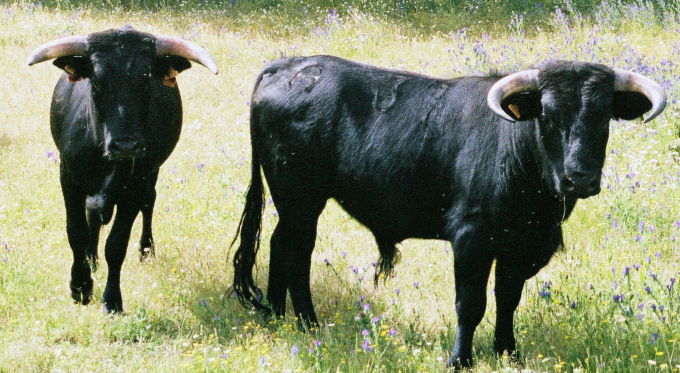
Our minds absorb words as blotting-paper soaks up ink. Phrases carve beehives deep in our inner circuits. No te preocupes / don’t worry. Yet tone and carry are different in each language and the comfort-blanket serenity of note preocupes does not translate easily from Spanish to English. The verbal vibes are just not the same. Nor do the catcalls from the soccer, aimed equally at opponent and referee, and tumbling raucous from the stands where people sit. Shrill whistles sound in the bull ring: a matador who seems afraid to approach this particular bull for reasons only known to him, yet his shakiness visible to all who watch and understand what they are seeing. The Cordobés answers the telephone he places on the bull’s nose, yet fails to approach between the horns and his sword rebounds off bull bone: pincha hueso. Each one wounds, the last one kills. El Viti, stately, graceful, an elderly churchman proud of his vocation and always willing to perform to perfection the weekly ceremony of the sacrifice. The boos when the bull enters the ring, stumbles, and comes up lame and limping. The cheers that accompany the arrival of the seventh bull. The refusal to eat meat that has been slaughtered in the bullring, even though it is advertised outside the butcher’s: tenemos solomillo de toro de lidia / we have tenderloin steaks from fighting bulls. Bulls who have led the best of lives, fed on the tenderest pastures, watered by flowing streams. Bulls grown for slaughter and public sacrifice.
The real thing: young fighting bulls (novillos) on a bull farm in Salamanca, Spain.
Guernica. The bull fight in the sand-filled square. Except it wasn’t a fight, it was more a circus. The slippery pig. The hens and chickens. The rabbits and hares. All the animals running scared. The animals released, one by one, and the spectators jumping into the ring, really a sand-filled square, one by one, and chasing down the animals, taking them home for dinner, if they could catch them. Then the bigger beasts. The mule, ferocious, jumping into the air, kicking four tormentors, one with each leg, and biting a fifth with his teeth. No fearful, clucking chicken this, nor the cow who came after with her padded horns. Participants moved more carefully now. She watched them from her querencia, the where she chose to fight, not die. She knelt, scraped off the rubber balls that covered her horns. Re-armed, she charged and the crowd scattered, all but one young kid, caught, falling to the ground, the cow standing over him, ready to gore again. Sixteen years old, an outsider, I jumped with others over the barrier, twisted this away and that, thumped the cow’s side, smelled her fury, her fear, the whole soured being that emanated from her. Together, we hustled her, bustled her, dragged her kicking, butting, from the ring, backwards, pulled by the tail. Visible scars of damaged animals. Scars of the participants. That young man who broke his leg. That old man, inebriated, stuffed with food and drink, who loosened his belt to move more freely. We watched as his pants slipped from his waist to fall around his knees and trap him, just as the cow charged. He survived but will bear the scars forever, some visible, many not. Long summer days, on the Sardinero, the Segunda Playa, playing soccer. Different rules, different skills, different swear words: I carry a dictionary tucked into my bathing trunks and refuse to play while I look up the words spat at me by my opponent. Good heavens, I think, is that anatomically possible? The ball bounces away on the hard, sand ridges. I chase it and steadily dehydrate under the hot sun. A sea-salt wind desiccates my body. My mouth fills with salt water when I swim out to retrieve the ball from the sparkling sea. My tongue sticks to the inside of my mouth. When I spit, I spit dry and everyone laughs. Now I am totally dry, shiver, and no longer sweat. On the way home, we get off the trolleybus early, at Jesús del Monasterio and enter the long string of bars that lead past Numancia towards Perines. Red wine in glasses, in porrones, with tapas and raciones to soak up the alcohol, morcilla, mariscos, callos, patatas bravas, wine consumed until our blotting-paper bodies are ready once more to sweat. Bread soaks up the wine that relieves the oil that now filters through our skins and who needs suntan lotion when the oil is inside us and bodies are oiled, well-oiled, from the inside out? These excursions are all male, just like the soccer teams. I have four friends and I know them by their nicknames and the way they play soccer. I also know them from the way they try to trick me and laugh at my mistakes, or the way they treat me as a human being and help me to understand this new world into which, sink or swim, I have been thrust. Total immersion in another culture does not come with a set of instructions and the rules of soccer change from grass field to beach sand. Pedro plays centre-half, loves heading the ball, even when it’s laden with sand. I watch him playing field hockey one day, out at La Albericia, and when a low shot heads for the corner of the goal, he dives and heads it away. They carry him off on a stretcher, blood everywhere, and you wonder if his scars will ever heal. Tennis on the clay courts, also at La Albericia. I play so slow but they play so fast. I learn top spin, side spin, back spin, cutting the racket beneath the ball and learning to bend it sideways off the clay that is not clay really, but a fine-packed Italian sand on which I can slide and glide, and commit to a shot running one way then turn and commit to another in the opposite direction. I try it on a hard court, after the immersion period ends, when I get home, and my foot sticks on the tarmac (or whatever that hard, non-slip surface is) and over I go, skinning my knees, creating more scars.
Comment: Another Golden Oldie reclaimed from the reject file. I remember the scenes so well, even though I have moved deliberately in the piece from Elanchove and Guernica (Basque Country) to Santander (now Cantabria). I got lucky and was able to attend a series of workshops on memoirs run by Brian Henry of Quick Brown Fox. Taking his workshops, I realized that most of what I write is more akin to Creative Non-Fiction (CNF), rather then memoir, though much of what I write is rooted in memory. What thrills me in this style of writing is the rhythm that emerges, the word patterns I knit with my pen and a skein of ink, the remembered brightness of the Spanish sun, the sparkle of the waves, the warmth of a people, still grieving after their losses in a bitter civil war, their willingness to accept me, a foreigner, and take me to their hearts. The Other: we talk so much about The Other. But when we ourselves have been That Other, have been dependent on Other Others for food, drink, warmth, care, and love it is so much easier to understand what The Other is lacking and what we can give. Warmth, not scars; a hug, not a punch; open arms, not a fist… so easy to say. I have been there. I know. But can we, deep in our hearts, find it in ourselves to make the sacrifices for The Other that other others have made for us? Only time will tell.
“Don’t Get Off The Bus!” Wednesday Workshop Wednesday 14 June 2017 Journal: Roger Moore had the honor and pleasure of addressing the artists in residence at KIRA / Kingsbrae last night. He gave a brief biography of himself then stated that he did not consider himself to be a poet, the honor of the […]
An acolyte in a charcoal suit runs by. He neither stops nor speaks but slips on slippery words dripping from another monkey’s tongue.
This other monkey has eyes of asphalt, a patented pewter soul, ice water flowing in his veins. “Hear no evil! See no evil! Speak no evil!”
The hatch of his mind is battened tightly down. Nothing gets out nor in. The acolyte’s fingers grasp at a khaki folder, his manifesto for success.
Senior monkey stalks to his office and turns on the radio. His favorite music: the clink of mounting money.
Disturb him at your peril: this monkey is very important, and very, very busy. He’s also clever: a real smarty.
First, he empties all the chocolate candies from the box then he sorts them into little piles: green with green, brown with brown, blue with blue, red with red.
Then, like the Good Shepherd checking His flock, he counts them again and again, to ensure that none have been stolen and not one has gone astray.
Comment: Another Golden Oldie, this time from Monkey Temple. I have updated it slightly so it won’t be exactly the same as it is in the printed text. Senior Monkey has, of course, built a bigger box into which he can place all his chocolate candies and tuck them away for ever and ever. I guess if he were a bull and not a monkey, he would have tucked them away for heifer and heifer. Such is the sad state of reality in the Monkey Temple. But if monkey were a bull, he would be living in the cow shed, not the Monkey Temple. Oh dear, oh dear: and oh what a tangled web we weave when first we practice to deceive with fiction, flash fiction, creative non-fiction, and all the other sugar and spice which goes into the spinning of spider-webs and fairy tales. Speaking of which, did I ever tell you the story of the… well, maybe next time. So tune in again tomorrow. Same thyme, same plaice, and I’ll sing you a song of the fish in the sea… and a fishy tail that will be.
Some of the worst educators I have been unfortunate enough to work with over my undergraduate and graduate years have come up with cliché after cliché in an effort to the sway students into believing that they really are getting an excellent education. One such phrase is the infamous: “We are teaching you to think outside the box.” So, what is their definition of ‘the box‘? Alas, I do not know. They deal in clichés and, by definition, a cliché is a phrase that both parties (teachers and taught) accept as being meaningful, even though it is often without meaning. It is also a conversation closer, as in ‘it is what it is’. It’s hard to argue with that or to reason your way around it. ‘But it doesn’t have to be!’ rarely cuts the mustard aka mouse-turd.
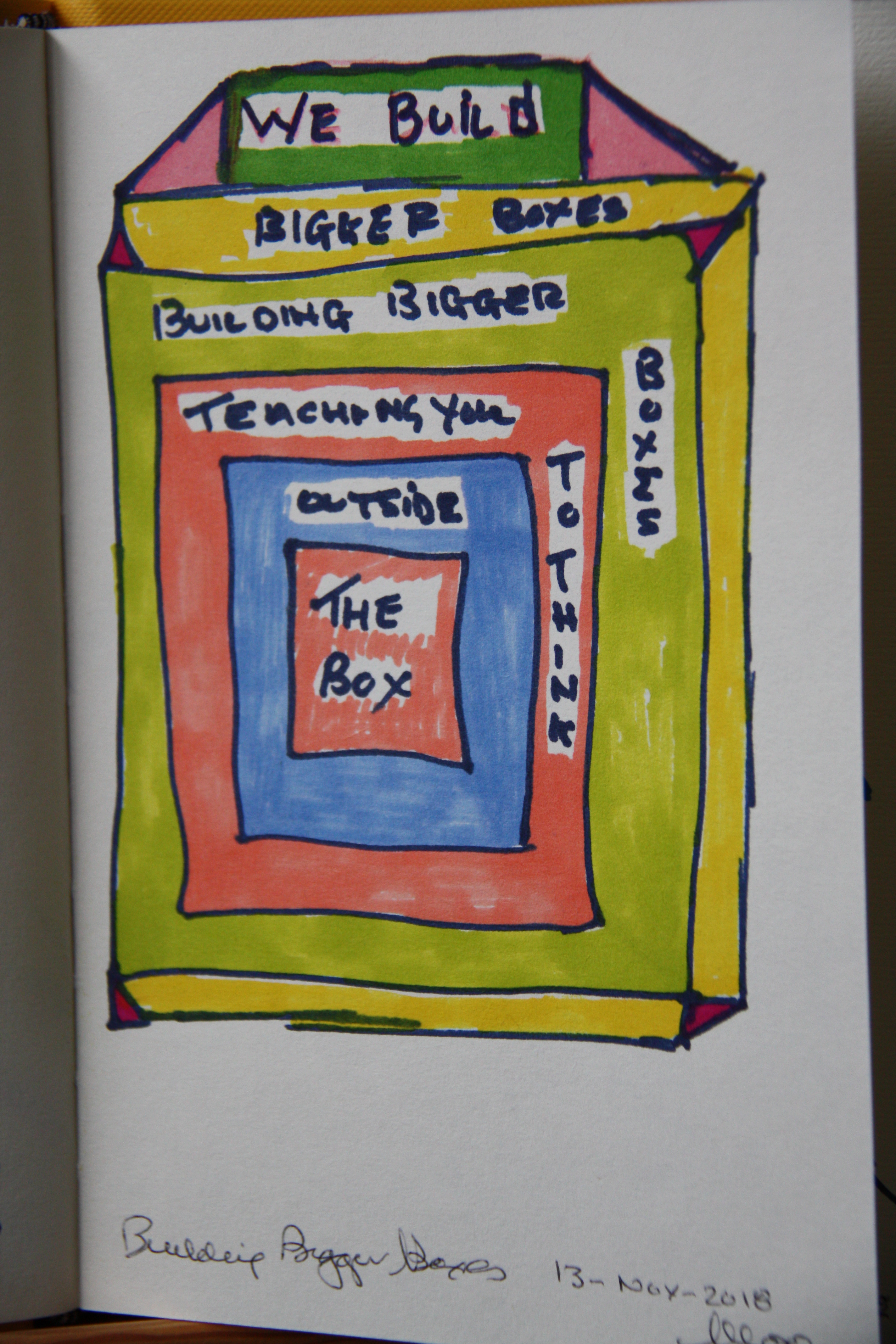
So, if these teachers are teaching their students how to think outside the box, how are they managing to do so? Why by building bigger boxes inside which each student can be safely taught to think, without asking questions, and without looking for independent answers.
Today’s cartoon has two titles: (1) Brave hearts escaping, finding meaning outside the bigger boxes and (2) can the true heart escape its coffin in a bigger box? I love the boxes within boxes and the drawers within each boxed segment into which the young, developing mind can be stuffed and crammed. How do we release those hearts? How do we develop those minds? Certainly not by confining them in bigger boxes. In the battle for hearts and minds, how do we set our students free?
It must be done on the student’s terms, each student, one by one, in co-operation with intelligent, meaningful teachers who step away from cliché and commonplace to enter the learner’s world and to themselves learn how to contact each learner at a mental, spiritual, and intellectual level. Only then will teacher and taught be able to speak of true intellectual freedom. Until that happens, be very careful when your child comes home and announces that today, of all days, that child has been taught to think outside the box. “Verily, I say unto you, open the cage door. Let in the sunshine and the light. Set those children free.” But remember, it must be on a case by case basis, with each individual weighed, assessed, understood, and released to find their own individual way of earning the things they specifically need to know. In true education, one size really doesn’t fit all.
Comment:Another Golden Oldie that suddenly surfaced and, on emerging from the depths, reminded me of another of my callings: that of a teacher of philosophy and a teacher with a philosophy. Retired now, I can no longer help young minds to create and shape themselves. This is doubly true with Covid-19 haunting us, waving at us from the shop-windows, supermarket aisles, and street corners, flapping its wings and trying to fly into our bodies. And remember to distinguish between clichés and things that are not clichés, like ‘Wear a mask’, ‘wash your hands’ (twenty seconds, with soap), and ‘keep a safe social distance’. Do this all the time and hopefully you will avoid thinking inside the bigger box of a six foot pine Covid-19 coffin.
I saw my father yesterday evening. I walked through the zócalo, opened the main cathedral doors and walked in. The doors closed behind me. I looked towards the main altar and there my father stood, motionless. The evening light shone through the engraved glass panels and illuminated him as if he were some long passed saint come back to visit me. We stared at each other, but I couldn’t open my mouth to speak. The hairs on my neck stood on end and my hands shook. When I forced my mouth open, words stuck in my throat. He wore his best grey suit over a light blue shirt and a dark blue, hand woven tie: the outfit in which I had buried him.
Three old women, dressed in black, broke the spell. One stood in front of me and wouldn’t let me approach my father. She held a large bag of knitting in her hands and the wool spilled everywhere as she pushed me away. The second threatened me with a pair of scissors that she held in her left hand and thrust towards my face. The third smacked a tailor’s measuring rod against my father’s head. He nodded, smiled sadly, and they all turned their backs on me and hurried away out of the cathedral and into the square.
Just for a moment, I stood there in silence. Then I pulled the doors open and ran in pursuit of my father. The setting sun filled the square with shadows that whispered and moved this way and that, as if a whole village had come down from the hills to walk beneath the trees and dance in the rays of the dying sun. I stood on the cathedral steps and called out my father’s name, but I could see no sign of him among the cut and thrust of the shadowy crowd.
I ran out into that crowd and pushed at insubstantial people who stood firm one moment and then melted away the next like clouds or thick mist. I came to a side street and saw real people, flesh and blood beings, a group of villagers gathered behind their band. I stopped and as I did the village elder put a live match to the taper of the rocket that he clutched between his thumb and forefinger. The taper caught on fire and the rocket soared upwards with a searing whoosh. The village band marched forward and started to play a traditional dance as the rocket clawed its way into the sky to explode with a loud knock on the door of the gods.
Tired of grasping at shadows and afraid of this living phalanx of men that marched towards me I went back to the cathedral and knelt at the altar of La Virgen de la Soledad, the patron saint of Oaxaca. Real wax candles stood before her altar, not tiny electric lights, and I inserted five pesos in the slot, took a taper, and lit a fresh candle from an ageing one that had started to sputter. I knelt and, for the first time in years, I prayed. I prayed for the soul I had saved from extinction by lighting my candle from another’s flame. I prayed for my father and my mother and, above all, I prayed for myself.
On the way home to my second-floor apartment where I live alone, I bought two litres of mescal, one to send me to sleep, and the other so I would survive the next morning.
Comment: A Golden Oldie that I had forgotten about. I found it among the drafts of earlier work. Monte Alban is also known as Dani Ba in the indigenous language of the region. Click on the link for more on Monte Alban. And click on this link for another piece on my father and Oaxaca. It’s a funny thing about Golden Oldies: sometimes they stick with us and are ‘unforgettable’, but sometimes they were better off left in the pile that gathers dust, like a forgotten book on a forgotten shelf. Speaking of which, have I told you about the time when …






 rogermoorepoet