My Top Ten Books

IMG_0062.JPG

My Top Ten Books

For Tanya Cliff
https://postprodigal.com/2016/07/14/top-ten-books-that-changed-my-life/

It sounds so easy, doesn’t it, to choose your ten favorite books? But really: it isn’t.

Clare’s great aunt made the best sponge cakes and rock cakes I have ever tasted. Her formula? Not weights and measures but a simple scale: the egg on one side, the flour on the other — and balance them.

How do I weigh a book?

I think in terms of authors rather than their individual books. For example, on one side of the scale place Les Fleurs du Mal of Baudelaire and on the other, his Petits Poèmes en Prose. Literary and cultural history would opt for Les Fleurs du Mal, and quite rightly so. My own personal preference, and I love them both, is for Petits Poèmes en Prose. De gustibus non est disputando / there is no arguing over taste. My choice is for Baudelaire, the author, rather than for one of his works, selected above the other.

If I apply this theory to other authors, what happens to, for example, William Shakespeare? Must I choose MacBeth over Henry the Fifth,  King Lear over Julius Caesar or A Midsummer Night’s Dream over The Merchant of Venice? And what if I refuse to do so? I would much rather choose Shakespeare over any of his plays, the Complete Works, including the sonnets, over any single play. And why shouldn’t I?

By extension, should I choose Shakespeare over Lope de Vega? Corneille over Molière? Racine over Calderón de la Barca? Mira de Amescua over Jean Anouilh? Bernard Shaw over Samuel Becket or Beaumarchais or Ionesco? And look at how Euro-centric (English, French, and Spanish) I am, especially when I am not familiar with the great playwrights of other Western nations: the Russians, the Norwegians, the Germans … and yet they are all Europeans. Are there no other literary nations in the world? Of course there are, but I am not that familiar with their literature and culture, and there is only so much a reader can read in its original form.

So, blessed and privileged as I admit I am, I can read books in English, French, and Spanish … lucky for me. However, I admit to difficulties with books written in Portuguese, Italian, German, Catalan, and Galician. As for Chinese, Hindi, Japanese, Russian, Arabic … I can only offer my apologies, but for me, these are closed books and I can only reach them in the translations, however good, however bad, that are placed before me. This is true too of the Pre-Columbian Mexican codices, the Zouche-Nuttall, the Vindobonensis et. al. These are also books and they outline the peoples and cultures of Mexico as they were before the arrival and conquest orchestrated by Cortés. And let us not forget Bernal Díaz del Castillo, the man who, in later life, wrote the true history of  Cortés’s conquest. And speaking of conquests, how about Julius Caesar’s Bellum gallicum, his personal account, in the third person, of his conquest of Gaul? As a school boy, long ago, I struggled through it in Latin, but I enjoyed it later, in translation.

Translation: traductor / traidor, according to Cervantes, who was undoubtedly following someone else, means translation / betrayal … or does it? Translation: the reverse side of a tapestry (also Cervantes) from which we may through a glass, darkly, glimpse only shape and shadow while stumbling over all those knotted threads … so here’s another question:  why would we choose a translation, with all its flaws, over a work we can read and enjoy and hopefully understand in the original?

So far, I have mentioned mainly playwrights; Cervantes was a playwright and wrote a goodly number of plays (Ocho comedias y ocho entremeses). I should also mention novelists. Charles Dickens, for example; or Honoré de Balzac or Gustave Flaubert or Marcel Proust or Pío Baroja or Benito Pérez Galdós or Gabriel García Márquez or Carlos Fuentes or William Faulkner or Kurt Vonnegut or William Golding or Chuck Bowie or John Sutherland or Kevin Stephens … not to mention Charlotte Bronte … Emily Bronte … Jane Austen … Virginia Woolf … Should I then choose just ten novelists and forget the world’s playwrights? And how can I choose just one book from a single novelist’s vast production, think Trollope, think Balzac?

What about poetry? My ten favorite poems? My ten favorite books of poetry? My ten favorite poets? Perhaps the latter is more achievable. If that is so, I must then choose between Quevedo … Góngora … Antonio Machado … Juan Ramón Jiménez … José Hierro … Wilfred Owen … Dylan Thomas … Gerard Manley Hopkins … Baudelaire … Verlaine … Rimbaud … Prévert … R. S. Thomas … Federico García Lorca … Miguel Hernández … T. S. Eliot … Seamus Heaney … Pedro Salinas … José María Valverde … and how do I choose between the writers I know and love … Patrick Lane … Richard Lemm … Fred Cogswell … Norman Levine … Donna Morrissey … Susan Musgrave … Joan Clark … Erin Mouré … and the ones I work with on a regular basis … Jane Tims … Kathy Mac … Shari Andrews … Michael Pacey … allison Calvern … Ian LeTourneau … Judy Wearing … Rachelle Smith … Cheryl Archer … Judith Mackay … Julie Gordon … ten poets … ten books … ten poems … ten fingers … ten toes … ten commandments … only ten?

Hold on a second: I have forgotten St. John of the Cross / San Juan de la Cruz, one of the western world’s great mystics. I must also mention St. Teresa of Avila, a Doctor of the catholic church, and Fray Luis de León, and now I am about to enter a great cloud of unknowing in which mystics, some named, some unnamed, have blessed us with their life thoughts and works.

Things fall apart, the centre cannot hold … and I have also forgotten W. B. Yeats and James Joyce and I have failed to remember the Poema de Mío Cid and the anonymous epic poems and ballads of the European middle ages, some of which are so deliciously delightful. Alas, I will be forced to abandon so many of my teachers and my friends … ten books, ten speeches, ten lectures, ten words … my life in literature reduced to ten teaspoons of instant coffee, instant tea, instant knowledge.

“My friends, we will not go again
nor ape an ancient rage;
nor let the folly of our youth
become the shame of age.”

Oh yes, that’s G. K. Chesterton. I had forgotten him. When asked what book he would take with him to read in exile on a desert island, he replied: “Green’s Practical Manual of Ship Building and Ship Sailing.” Now that’s a book that should be in everybody’s top ten, especially with the seas rising and disaster lurking round every corner of the suspicious, weather-warmed mind.

However, as I look back on my reading life, believe it or not, some books do stand out. When I entered graduate school and realized the enormous amount of reading that was being thrust upon me, I took a speed reading course. Over the ten weeks of that course my reading speed rose sharply from about 200 words a minute to 800 words a minute. Without that one book, I would have been unable to read so many of the others. Where is it now? It is not on my shelves: ah yes, I gave it to my daughter when she went to law school.

The second special book is the Spanish text book that, in regularly updated versions, I relied on for teaching basic Spanish grammar throughout my academic career in Canada. Without that textbook and the employment it ensured me, I would not have been able to put my family’s bread on the table. I guess you might call it influential. Perhaps the third special book is my own doctoral thesis: that allowed me to gain academic employment and is so very, very special to me, but for all the wrong reasons.

Ladies and Gentlemen and Fellow Bloggers, here I am, marooned in Island View, with not an island in sight, and no reason, as yet, to build a librarian’s arc. I will now replace my selected books and authors back on the shelves from which, one by one, I have taken them down, dusted them off, and glanced through the pages. I admit my inadequacy. I cannot for the life of me choose ten books, let alone ten authors. I lay down my pen. I remove my fingers from the keyboard. I abandon my task. Soon I will leave the room with one of my favorite books in my hand. Will it be Jane Tims’s Within Easy Reach or Chuck Bowie’s Steal it all or John Sutherland’s master work, The Two-Shot Compendium. I think I’ll go with Two-Shot and re-read the first story, Two-Shots Lands in Trouble, as I sip my mid-morning coffee. Meanwhile, I will leave you with this thought from Guillaume Apollinaire.

Je voudrais dans ma maison
une femme ayant sa raison,
un chat passant parmi les livres,
et des amis en toute saison,
sans lesquels je ne peux pas vivre.

DSC02576.JPG

Miracle: Flash Fiction.


F1030024 2.JPG

Miracle
Bistro 15

A tiny man in a dark brown robe bustled into the library.

“Brother Marcos: come quick. There’s a miracle. We’re witnessing a miracle.”

Brother Marcos raised his eyebrows and Robin looked horrified. Will didn’t know what to think.

“A miracle?” Brother Marcos asked. “What kind of miracle?”

“There are angels and visions. Oh, I can’t explain. It’s happening now. You must come and see. Oh, you must come and see.”

The tiny man scampered out of the library door and Robin and Will followed him.

“Ship of fools,” said Robin to nobody in particular. “We’re all sailing in a ship of fools.”

“Wait and see,” said Brother Marcos. “We must not pass judgment. Wait and see.”

The man in the brown robe led them to the main altar at the heart of the monastery where the lignum crucis stood on display.

A group of tourists clustered around a man on his knees in front of the true cross. A ray of sunlight pierced the stained glass window and picked out the kneeling figure whose arms spread out like an angel’s wings as he knelt there motionless.

It was LJ. His eyes were open and his chest hardly moved. Fragments of colored light from the stained glass window flowed over and around him and at times they gave the impression of flowing through him too. They gifted him with what, in the shifting light of the sun’s ray, seemed to be a halo round his head. Golden specks of dust sparkled in the sun’s bright rays and danced like little angels in the air.

Brother Marcos drew in a deep breath, knelt, and made the sign of the cross.

“Little angels, ascending and descending,” he mused out loud. “How many, I wonder, could dance on the head of a pin?”

“It would depend on the size of the pin,” said Robin. He pushed past the staring crowd. Some were on their knees, their rosary beads clacking through their fingers. Others stood and looked on in wonder at the light descending. Others crossed themselves and looked towards the altar where the lignum crucis was displayed, the time-blackened nail hole exposed in all its glory.

“Come along, now, LJ,” said Robin, touching him on the arm. “That’s enough of that. Get up off your knees now. We’re going.”

There was a low mumble of disapproval from the absorbed spectators.

“Don’t touch him,” said one.

“It’s a miracle,” said another.

Noli me tangere.” The voice, a deep voice, not at all the voice of LJ, rose seemingly from the kneeling man’s mouth.

The crowd sighed. Some drew closer, in seeming awe. Others drew back in fear.

“I didn’t know LJ spoke Latin,” Will said.

“He doesn’t,” Robin shook his head. “But he could have learned those words at any time while he was in school. Even I know them. It’s a neat trick with the voice, though.”

“It’s no trick,” Brother Marcos crossed himself. “We have witnessed other miracles in this very place, though none quite like this.”

“This is my beloved son in whom I am well pleased.” The voice spoke again. And immediately the crowd responded and with the exception of Robin and William those still standing dropped to their knees and joined in the prayers. More rosaries appeared.

“Let the night’s stone be rolled away. Let sunshine pierce the shadows. LJ, my son, pick up thy cross and follow me.”

Two things happened almost at once. First, the sunray that illuminated the scene flickered and vanished and then LJ toppled over and lay on his side.


F1030024 2.JPG

Obsidian’s Edge 23

IMG_0240.JPG

11:00 PM
Calling it a day

1

This auriferous sky,
sewn with sharp sequins.

Is there a warp, I wonder,
a lurch towards meaning,
a leaning towards
sun or moon?

When they planted
our first footsteps
did those little prints
take root and grow
or did they wander,
restless,
across this planet?

A rampant foot stands firm
on the highest rampart:
instant gratification,
timeless possession,
each passing cloud.

2

A rocket streaks upwards.
Immediate
this release from the sender’s
earthbound misery
or is it merely
a message of anguish?

Who knocks
now at heaven’s gate?

The low moon glows:
lesser incandescence,
departed sun.

3

A satellite glides
its razor edge,
slicing distant pin
pricks of light.

The moon rides
her orange unicycle
across a thin black
line of hill.

Here on the azotea,
midnight slowly
covers the sparkling town
with a dark gray cape.

4

If their grief is our grief,
and all grief is one,
do we all then bleed in vain?

IMG_0067.JPG

Nochebuenas, tulipanes,
flowers of every crimson hue
pour blood from each
thorn-pierced wound.

5

This zapotec measuring cloth,
this mixtec weaving wool,
this trique with her knife:

who will sever the artery
that binds us to the loom
at Obsidian’s Edge?

Building on Sand: Poetry

Building on Sand

fundy 05 mist+wolfepipers 153.jpg

1
Everywhere the afternoon
gropes steadily to night.
Some people have lit fires;
others read by candlelight.

Geese litter the river bank,
drifts of snow their whiteness,
stained with freshet mud;
or is it the black
of midnight’s swift advance?

They walk on thin ice
at civilization’s edge.
Around them,
the universe’s clock
ticks slowly down.

2
Who forced that scream
through the needle’s eye?

Gathering night,
the moon on the sea bed
magnified by water.

Inverted,
the big dipper,
hanging its question
from the sky’s dark eye lid.

Ghosts of departed
constellations
walk the night.

Pale stars scythed
by moonlight
bob phosphorescent
flowers on the flood.

3
The flesh that bonds;
the bones that walk;
the shoulders and waist
on which I hang
my clothes.

Now they stand alone
beneath the moon
and listen at the water’s edge
to the whispering trees.

They have caught the words
of snowflakes
strung at midnight
between the stars.

Moonlight is a liquor
running raw within them.

4
There are striations
in my heart, so deep,
a lizard could lie there,
unseen, and wait
for tomorrow’s sun.

A knot of
sorrow in daylight’s throat;
the heart a great stone
cast in placid water,
each ripple
knitted to its mate.

Timeless,
the worm at the apple’s core
waiting for its world to end.

Seculae seculorum:
the centuries
rushing headlong.

5
Matins:
wide-eyed
this owl hooting
in the face of day.

Somewhere,
I remember
a table spread for two.
Breakfast.
An open door.
“Where are you going, dear?”

Something bright has fled the world.
The sun unfurls shadows.
The blood whirls stars
around the body.

“It has gone.” she said. “The magic.
I no longer tremble at your touch.”

6
You can drown now
in this liquid
silence.

Or you can rage against this slow snow
whitening the dark space
where yesterday
you placed your friend.

The silver birch wades
at dawn’s bright edge.

Somewhere,
sunshine will break
a delphinium
into blossom.

7
Tight lips.
A blaze of anger.
A challenge spat
in the wind’s face.

High-pitched
the rabbit’s grief
in its silver snare.
The midnight moon
deep in a trance.

If only I could kick away
this death’s head,
this sow’s bladder.

Full moon
drifting
high in a cloudless sky.

8
After heavy rain
the house shrinks.
Its mandibles close.

A crocodile peace
descends from the jaws of heaven.

I no longer fit my skin.
Iguana spots itch.
Walls encircle me,
hemming me in.

The I Ching sloughs my name:
each lottery ticket,
a bullet.

None with my number.

9
Late last night I thought
I had grasped the mystery:
but when I awoke
I clasped only shadows and sand.

fundy 05 mist+wolfepipers 081.jpg

Writing or Re-Writing? 5


IMG_0130 copy 4.jpg


High Tide exists in two separate forms under two different names: (1) the prose poem High Tide and (2) the poem, Though Lovers Be Lost. The title of the poem comes, of course, from Dylan Thomas.

High Tide     

High tide in the salt marsh and now you are a river flowing silver beneath the moon, your body filled with shadow and light. I dip my hands in dappled water. Twin gulls, they fly down stream then perch on an ice floe of half-remembered dreams. An eagle with a broken wing, I am trapped in this cage of flame. When I turn my feathers to the sun, the black and white of a convict’s bars stripe my back.

Awake, I lie anchored by what pale visions fluttering on the horizon? White moths wing their snowstorm through the night. A feathered shadow ghosts frail fingers towards my face. Butterflies stutter their kisses against the closed lips of shuttered eyes and mouth. Hands reach out to grasp me. A candle flickers in the darkness and I am afraid.

Who mapped in runes the ruins of this heart? Eye of the peacock, can you touch what I see when my eyelids close for the night? Black rock of the midnight sun, blocking the sky’s dark cave, when will I be released from my daily bondage? Last night, the planet quivered beneath my body and I felt each footfall of a transient god.

The prose poem shortens the verse poem and turns it into a rushing hurly-burly of breathless words strung together by metaphor and magic. They flash and twist this way, that way, like minnows in shallow waters, allowing no time for pause, no time for thought. When I have read the passage in public, the listeners have always looked slightly stunned, bemused, battered almost by the storm of emotion tied into the piece.

The prose poem was published in Fundy Lines (2002) but it was originally conceived as a poem written in stanzas and took this form when published in Though Lovers Be Lost (2000). When the poem is set out in stanzas, it is shaped by the spaces that surround each line. These spaces slow the poem down, allowing the reader to permit the listener, to dwell on each group of words. Obviously, in a silent and private book reading, each one of us will read poetry and prose in our customary way. That said, in a public reading, I usually read the prose slightly faster than I do the poetry. The metaphoric nature of the language stands out in the longer version, and instead of the rush of words (prose), we have a measured resonance that shapes meaning. Impact in prose versus depth of meaning in poetry: I think both forms work in different ways.

In addition, the prose poem has been very selective and has abandoned several of the images and themes that appear in the poem. This increases the sense of urgency and unity while diluting the strength of the metaphors. Although the words are basically the same, the shapes and forms make for two different works, two distinctive appearances.

Though Lovers Be Lost

1
Once,
you were a river,
flowing silver
beneath the moon.

High tide
in the salt marsh:
your body filled
with shadow and light.

I dipped my hands
in dappled water.

2
Eagle with a shattered wing,
my heart batters
against bars of white bone.

Or am I a killdeer,
trailing token promises
for some broken god to snatch?

Gulls float downstream.
They ride a nightmare
of half-remembered ice.

Trapped in my cage of flame,
I return my feathers to the sun.

3
Awake,
I lie anchored by
what pale visions of moths
fluttering on the horizon?

A sail
flaps canvas wings
speeding my way
backwards into night.

A feathered shadow
ghosts fingers over my face.

Butterflies
stutter against
shuttered windows.

Strange hands
reach out to grasp me
and again I am afraid
of the dark.

4
When was my future
carved in each sliver of bone?

A scratch of the iron pen
jerks the puppet’s limbs
into prophesied motion.

Who mapped in runes
the ruins of this heart?

Above me,
a rag tag patch of cloud
drifts here and there,
shifting constantly;

like this body of water
in which I sail.

5
Eye of the peacock,
can you touch
what I see when
I close my eyelids
down for the night?

Black rock of the midnight
sun, rolled up the sky,
won’t you release me
from my daily bondage?

Last night, the planet
quivered beneath my body
and I felt each footfall
of a transient god.

6
Thunder knocks
on the door of my dream
and I am afraid.

I no longer know my way
through night’s dark wood.

Who bore her body
out in that rush of rain?

Could she still sense
the sigh of wet grass?

Could she still hear
the damp leaves whisper?

7
A finger of fog
trickles
a forgotten face
down the window.

The power of water,
of fire, of frost;
of wind, rain, snow,
and ice.

Incoming tide:
stark waters.

Rising.

I would welcome any comments you may have (a) on the difference between the two forms, as they impact you; (b) on the perceived differences between the prose poem and the poetry; and (c) on the perceived revision and thought process that turns poetry into prose, and vice-versa.

Writing or Re-Writing? 4

IMG_0130.jpg

Writing or Re-Writing? 4

 I visited San Diego for a conference in 1994 and, while I was there, I decided to cross over the border and visit Mexico, a country to which I had never been. I took the train from San Diego to Tijuana, crossed the border, and went downtown to the cathedral. As I opened the cathedral door, a man who looked exactly like my father walked out. My father had passed away in 1989, four years earlier. We stopped and stared at each other. I blinked, turned away for a second, and when I looked back, I was alone on the cathedral steps and the man was no longer there. That event continues to haunt me. I wrote about it in People of the Mist, my first novel.

  1. People of the Mist

As I step into the church a man comes out. I look at his face and I stare into the washed out blue of my father’s eyes. We stand there gazing at each other in silence. My father’s fawn raincoat is still missing a button at the neck and the old scar of a stain marks the absence on his lapel of the usual carnation. He is also wearing the grey suit with the blue shirt and the red and black tie in which I dressed him before I buried him.

Then, the spell breaks. My father starts to speak but his hand claws at his throat and no words emerge. His mouth twists in an anguished “no, no, no.” The small hairs stand erect on the back of my neck. A cold hand moves down my spine and I shiver. I close my eyes for a second, take a deep gulp of air and when I open my eyes, my father has disappeared.

If it really was my father … I wish I had said something, caught him by the arm, held him. I should have told him that I missed him, told him what had become of me. If it wasn’t my father, I should have asked him who he really was, told him he looked like the man I had buried far away and long ago. I should have asked him if I could see him again … But the moment has passed and the man who seems so much like my father has gone.

I go into the church, light a candle, fall down on my knees, and pray.

It is hard to explain such a disturbing event and even harder to come to terms with it in writing. I have returned to it again and again, both as a single piece and as part of a larger narrative. I decided, as part of the re-writing process, to take myself out of the story, and to re-tell the story in the third person. In this re-write, Tom, the central character meets his father on the steps of the church.

  1. Gravitas

Last summer, in Oaxaca, Tom bumped into his father. Candles flickered on the engraved glass panels of the cathedral’s main doors illuminating Tom’s father’s face as if it were that of  some long gone saint. Tom’s father wore his best grey suit over a light blue shirt and a dark blue, hand woven tie. In the funeral home, Tom had had dressed him for burial in just that outfit. Both the suit and its wearer had perished the following day in the crematorium.

Tom and the apparition who appeared to be his father stared at each other but neither of spoke. Tom’s neck-hairs bristled, his mouth ran dry, and his hands shook. He opened his mouth and tried to speak, but words stuck in his throat and meaningless sounds emerged.

Three old women, dressed in black, broke the spell. One stood in front of Tom and struck him with the large black bag of knitting that she held in her hand. Thin threads of red wool spilled out as she pushed him away. The second old lady threatened Tom with a pair of scissors that she held in her left hand, jabbing them repeatedly towards his eyes. The third produced a tailor’s measuring rod and, using it like a cattle goad, prodded Tom’s father in the side. Tom’s father nodded, smiled sadly, and then the three women shepherded Tom’s father away, hurrying him out of through the cathedral’s glass doors and into the square. Tom stood motionless for a moment and then as the doors snapped shut he pulled them open and ran out after the group.

The setting sun filled the square with shadows that whispered and moved this way and that as if a whole village of dead people had walked out of the cemetery to stand beneath the trees and dance in the rays of the dying sun. Tom stood on the cathedral steps and called out his father’s name, but he could see no sign of him among the cut and thrust of the shadowy crowd.

Tom ran out into that crowd and pushed at insubstantial people who stood firm one moment and then melted away the next like clouds or mist so thick one could almost lean on it. He ran as far as a side street that led away from the square and there he stopped and let out a loud cry of grief.

Real people, flesh and blood beings, turned to gaze at him.  Villagers carrying the banner of a small town in the hills stood in a group behind their village band. An elder, deep lines scarring his face with living shadows that danced in the last rays of the sun, put a live match to the taper of the rocket that he clutched between his thumb and forefinger. The taper caught fire and the rocket soared upwards with a long-drawn out whooooosh. The village band marched forward and struck up a traditional country song as the rocket clawed its way into the sky to explode with a loud knock on the door of the gods.

Afraid of grasping at shadows and scared by this living phalanx of men that now marched towards him seeking access to the main square, Tom retreated to the cathedral and knelt at the altar of La Virgen de la Soledad, the patron saint of Oaxaca. Tall wax candles stood before her altar. He  inserted fifty pesos in the slot, took a taper, and lit candle after candle.

He knelt before the virgin and, for the first time in years, he cried. Tears ran down his cheeks, his breath came in short, sharp bursts, he clenched his fists so tight that his finger nails gouged into his palms, and, for the first time since the funeral, he broke down and he prayed for his father, and his mother and, above all, for himself.

The changes are radical and obvious. My own thoughts, as I re-wrote, were that I had found a new freedom and a release from the autobiographical content of the original episode. This freeing up of the narrator is so important. Now I can concentrate on the power of the piece and the possible meanings tied up, not in the autobiographical event, but in the narrative sequence itself. It is packed with potential. What happens, I asked myself, if the man is not the father, but some sort of doppelganger?

I googled doppelganger and found this:

 A doppelganger — also written “doppelgaenger” or “doubleganger” — is quite simply a double. It can be a ghost or physical apparition, but it is usually a source of psychological anxiety for the person who sees it. The word comes from the German Doppelgänger, literally meaning “double-goer,” and has found widespread use in popular culture.

 Many different types of doppelganger have arisen in cultures around the world. A doppelganger may be an “evil twin,” unknown to the original person, who causes mischief by confusing friends and relatives. In other cases, the double may be the result of a person being in two places at once, or even an individual’s past or future self. Other times, the double is merely a look-alike, a second individual who shares a strong visual resemblance. The goals of the doppelganger often depend on the role it plays for the original person.

 In folklore, the doppelganger is sometimes said to have no shadow or reflection, much like vampires in some traditions. These doubles are often malicious, and they can haunt their more innocent counterparts. They may give bad advice or put thoughts in their victim’s heads. Seeing one’s own doppelganger or that of a friend or relative is usually considered very bad luck, often heralding death or serious illness. In some traditions, a doppelganger is considered a personification of death.

http://www.wisegeek.org/what-is-a-doppelganger.htm

My next experiment was with the idea of the twin brothers. What happens if one twin dies and the other survives? What happens if the wrong twin survives? Can there be a replacement? These waters run deep. Here is the third re-write. Did I really write “the third re-write”? I shouldn’t have: this is, rather, the third major revision in the sequence of multiple rewrites that this little event has engendered. There will, I am certain, be many more.

     3. Gravitas 2

Last summer, in Oaxaca, Tom bumped into his twin brother, Gerry. Candles flickered on the engraved glass panels of the cathedral’s main doors illuminating Gerry’s face as if it were that of some youth martyred for his faith. Mouth open, Tom stared at his brother, but neither of them spoke. Tom’s neck-hairs bristled, his mouth ran dry, and his hands shook. He closed his mouth, tried to swallow, but the dryness in his throat prevented him from doing so. He opened his mouth and tried to speak, but words stuck in his throat and meaningless sounds emerged.

Three old crones, dressed in black, broke the spell. One stood in front of Tom and struck him with the large black bag of knitting that she held in her hand. Thin threads of red wool spilled out as she pushed him away. The second threatened Tom with a pair of scissors that she held in her left hand, jabbing them repeatedly towards his eyes. The third produced a tailor’s measuring rod and, using it like a cattle goad, prodded Gerry in the side. Gerry nodded, smiled sadly, and then the three women shepherded Tom’s twin brother away, hurrying him out of through the cathedral’s glass doors and back into the square. Tom stood motionless for a moment and then as the doors snapped shut he pulled them open and ran out after the group.

The setting sun filled the square with shadows that whispered and moved this way and that. It was as if the earth had shaken, a hole had appeared in the cemetery wall, and a whole generation of dead people had walked out of the cemetery to gossip beneath the trees and dance in the rays of the dying sun. Tom stood on the cathedral steps and called out his brother’s name. Gerry turned his head, but the three old ladies closed around him and herded him on.

Tom ran out into the crowd and followed the shadowy quartet, pushing his way through insubstantial people who stood firm one moment and then melted away the next like clouds or mist so thick one could almost lean on it. He ran as far as a side street that led away from the square and there he stopped.

The three crones pushed Gerry into an alley and Tom ran after them and followed them in. At first, it was dark. Then, as he brushed through a final curtain of mist, he emerged into a sunlit courtyard. Three beautiful young women, working at an enormous loom, beckoned to him. He approached and they pointed at the loom where tiny figures walked up and down the fabric as it was being woven. He felt himself grow smaller and smaller. Then one of the ladies picked him up and placed him firmly on the loom and wove him into the threads. The wooden shuttle clacked and he remembered no more.

Gerry emerged from the alley and entered the square where real people, flesh and blood beings, turned to gaze at him.  A group of villagers carrying the banner of a small town in the hills stood in a group behind their village band. An elder, carried a live-match in his hand. Deep lines scarred his face with living shadows that danced in the match-light. He put the live-match to the taper of the rocket that he held in his other hand. The taper caught fire and the rocket soared upwards with a long-drawn out whooooosh. The village band marched forward and struck up a traditional dance tune as the rocket clawed its way into the sky to explode with a loud knock against the door of the ancient gods.

Afraid of grasping at shadows and scared by this living phalanx of men that suddenly marched towards him, Gerry retreated across the main square and hurried back to the cathedral. There, he knelt at the altar of La Virgen de la Soledad, the patron saint of Oaxaca. He inserted fifty pesos in the collection slot, took a taper, lit it, and applied it to candle after candle.

Then Gerry started to cry. His brother Tom had been wearing his best grey suit over a light blue shirt and a dark blue, hand woven tie. These were the same clothes in which Gerry had had dressed him for burial just last year. Both the suit and its wearer had perished the following day in the crematorium.

Gerry was on his knees before the statue of the Virgin. Tears ran down his cheeks, his breath came in short, sharp bursts. He clenched his fists so tightly that his fingernails gouged into his palms. He looked into the Virgin’s eyes and prayed for his brother, Tom. Then he prayed for himself and, for the first time since Tom’s funeral, he allowed himself to truly grieve for the brother he had lost.

Comments on preferences and the re-writing process will be very welcome.

Re-Writing or Writing? 3


IMG_0130 (1)


Fear of the Hawk

For Jane Tims
https://janetims.com/2016/06/29/mourning-dove/

            I was inspired to write this particular blog when I read Jane’s account of how she had worked and re-worked her poem on the mourning doves in her yard. Thank you, Jane, for encouraging me to complete this exercise.

              Empty Nest, the first version of Fear of the Hawk, started as a short story featuring a series of dialogues between an elderly couple who lived in a world filled with misunderstanding. They had no children and were more interested in the birds in the garden than they were in each other. The man buried himself in his journal and the woman occupied herself with the everyday details of running the house: an odd couple indeed, but far more normal than we sometimes realize. I tried to emphasize the gaps where the two ends of the conversation didn’t meet, the lack of understanding, the concentration on the trivial things that made up their existence, but I never felt that the story functioned properly as a story. It was, like their relationship, loose and woolly, and the narrative elements contrasted too strongly with the poetic elements. All in all, it was a mixed-up mish-mash, a tangle of gnarled strings. But I liked it.

Empty Nest (2013, 1458 words)

“I heard a bang against the window. When I went out, I found him lying there; he looked like an abandoned sock. Do you think he’ll get up and fly away?”

“She looks dead to me.”

“He can’t be dead. It was only a little bump.”

“Look at how the breeze is ruffling her feathers: she’s dead alright.”

“What do you think we should do with his body? We can’t just put him in a plastic bag and throw him in the garbage. I know: we could bury him in the flowerbed; then you could say nice words over him. You can fold his little wings and lay him gently down. He’ll trust you. You’re so good with words.”

“I am?”

“Of course you are. You’re always writing in your journal. We’ll have some lunch and then we’ll bury him in the garden.”

“Ground’s too hard.”

“You’ll think of something. I don’t want him eaten by the neighbor’s cat.”

“Just put her in the garbage.”

“Don’t say that. If you had been an ethereal spirit and had flown the skies with the wind ruffling your feathers, you wouldn’t want to be buried in a garbage bag.”

“If I were dead, I wouldn’t care.”

He writes: On the balcony there is a sudden flurry of Mourning Doves. They are nipping at each other and pecking the grain she has put out for them. Unmated males do aerial displays rising up then descending in a long spiral glide. Sometimes they get spooked by hawks, or the shadows of hawks, and then they fly into the windows. It’s not unusual for one to break his neck.

“Shall we have some lunch now? You must be hungry. We only had half a grapefruit and a slice of toast for breakfast. What would you like for lunch?”

“I don’t mind.”

They call them Mourning Doves because they mate for life and mourn, such a sorrowful sound, if one of them dies. There’s safety in numbers: one or two perish but the flock survives. Swift flash of the shadow hawk skimming the feeder: empty husks blown on the breeze, the birds have scattered. Just one remains, lying there, lifeless. Tonight, without him, her nest will be empty. We can only hope that the chicks have already flown.

“I’m worried about that bird. Will the cat eat him?”

“I doubt it.”

“After lunch, we’ll put him in the garden and pile stones around him. That way he’ll rest in peace. You can say a little prayer; then when spring finally comes, he’ll fly away to heaven to become a Morning Angel instead of a Mourning Dove.”

“A Morning Angel: that’s nice.”

The Evening Grosbeaks are wild. Christmas decorations, they sit in the leafless trees and chatter with excitement. The Redpolls are random, like thoughts, and totally untamable. They hop up and down and flit away when anyone appears. Only when the balcony is empty do they drop down for food and even then they’re scared of their own shadows.

“I’m going to make lunch now. Would you like some soup? I’ll take the vegetables left over from last night, add a tomato or two and a drop of sherry and then I’ll put it in the blender and warm it up. It’ll be lovely: lots of roughage and vegetable fiber.”

“That sounds nice.”

“Or would you rather have a tin of soup?”

“You choose.”

“You always like tomato soup. I’ll open a tin of tomato soup. While the soup’s warming, I’ll cut some bread.”

In spite of the bright light from the morning sun, there are secret shadows everywhere. The light prances and the old snow is no longer smooth, but dimpled; it sparkles with tiny dots of color. The spring snowflakes fly everywhere covering the ground with a delicate tracery that sparks beneath the sun. It reminds me of another day, long ago, cold like this, when the ground was hard and the snow danced in the wind.

“Lunch is almost ready. Put your pen down; come along now: I love it when we do things together. Here’s the soup.”

“Where’s the bread?”

“I haven’t cut any yet. Do you want plain bread and butter? Or would you like me to make toast?”

“I don’t mind.”

“Isn’t the soup nice? I do like tomato soup. Isn’t it a lovely day?”

“Not for that dove, dear; she’s going to her own funeral.”

The light is special here in the kitchen. Streams of sunlight bounce off every surface. The amaryllis has opened four scarlet trumpets of joy. The hyacinths weigh down the air with a heavy scent. As for the cyclamen, its soft white leaves are fringed with an emperor’s purple and its sharp leaves point the path to spring. They make me think of those other flowers.

“That was very nice. I’ll make some tea then we can go out and bury him. Would you like some tea?”

“Please.”

“I’ll just put the kettle on and make you a nice cup.”

“Sure.”

I have pondered the chances that led us here. ‘What would have happened,’ I often wonder, ‘if they had lived?’ But they didn’t; and that’s all in the past and best forgotten.

“Here’s your tea. Now, I’ve given you milk, but no sugar. Stop that writing and drink your tea before it goes cold.”

“Yes, dear.”

“Are you thinking of some nice words to say over that poor dove? I’m sure he’ll appreciate it, knowing as he flies to heaven that your words have sped him on his way.”

“I’m thinking.”

“A few simple words will do: ‘Mourning Dove, Mourning Dove, fly away home … your nest is on fire and your children have flown’ or something like that. You’re so good with words.”

“I’ll think of something.”

“Now drink up your tea, it’s getting cold. And do be careful. Thank heavens I gave you a saucer. You’d spill the tea everywhere, if I wasn’t here to look after you. You’re like a little child. You wouldn’t know what to do without mother to look after you. And don’t be long: you know how short the days are. I want to bury him in daylight, not in the dark.”

“She won’t know the difference.”

“Oh yes he will. How would you like to be buried at midnight, with the owls hooting? There’s no telling where you might end up. No, a proper daylight funeral is the only thing. He’ll be much happier when we’ve tucked him into his little earthen bed with the sun still shining, won’t he?”

“I suppose so.”

“Come along now. Put down your pen and drink up your tea. The tea’s no good to you cold. You must finish whatever it is you’re doing and come out with me so we can bury him.”

“I’ve nearly finished, dear.”

“Come along then. I’ll just go to the bathroom and then I’ll put on my hat and coat. And you get those lovely words ready. Wrap up warmly. We don’t want you to catch cold.”

That dead dove is a female, not a male. She could never distinguish between the sexes. We are burying HIM, not HER. Males have a light grey crown with iridescence at the side of the neck. Females are a uniform brown. It’s funny how memories flock back. It’s twenty years almost to the day since we buried the children. She buried our son and I buried our daughter. After the accident it was even more difficult to tell them apart. But I knew: she didn’t. The snow was falling, just like today, as we laid them side by side. We are both only children and one day one of us will have to bury the other. And who will look after the survivor now the nest is empty and the chicks have gone?

“Are you going to sit there and finish that bottle?”

“Yes.”

“Why don’t you come and watch the television with me? There’s a nice program on.”

“I’m thinking.”

“Are you thinking about that little chap we buried today?”

“Sort of.”

You can drown now in this liquid silence. Or you can rage against this slow snow whitening the dark space where you placed your children. The silver birch wades at dusk’s dark edge. Somewhere, sometime, sunshine will break spring flowers into blossom.

“I heard that ‘pop’: you aren’t opening another bottle, are you?”

“Yes: and I’m going to drink it.”

Tight lips. A blaze of anger. A challenge spat in the wind’s face. High-pitched the rabbit’s grief in its silver snare. Staring skull: the midnight moon floating deep in a trance. If only I could kick away this death’s head sow’s bladder. Full moon drifting high in a cloudless sky. Emptiness. Empty nest.

            By 2014, I had re-visited the story on several occasions, picking at it, pulling it apart, sharing it to my online writing group, worrying over it with them. I was looking for something more dynamic, something that would catch and hold an audience. After much thought, I shortened the story considerably, removing the dialog and the wife, and came up with When the telephone rings (2014). In many ways, this was the start of Fear of the Hawk.

When the telephone rings (2014, 873 words)

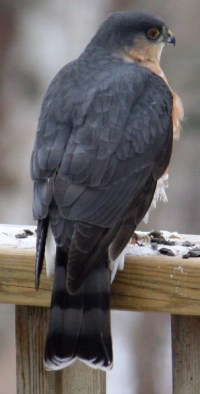
            The sharp-shinned hawk glides in on silent wings. He sits on top of the hydro pole and surveys his empire. Bored, he takes a step into space and drops the weight of his body onto the gangplank of the fragile air. He opens his wings and sends his feathered arrow streaking across my garden.

Yesterday morning, the television news anchor talked of another IED attack in Afghanistan and this morning video clips showed thick, heavy smoke rising from a destroyed vehicle. My son’s regiment has been ambushed twice already. He always e-mails me before he calls, but we haven’t spoken for a couple of days now. I hate it when he sets out on patrol to protect those friends who may yet be enemies and lightning strikes so fast over there, often from a cloudless sky.

            The late spring sun carves charcoal lines of shadow. Light dances and reduces the snow to tiny islands of white that float in a rising sea of green blades. What remains of the winter snow is no longer smooth, but dimpled and wrinkled, glowing with a million tiny dots of color. Dew point: an occasional snowflake floats down like a feather.

The mourning doves clamber all over the back porch. They nip at each other, pecking at the black oil sunflower seeds I have scattered. I watch as unmated males perform their aerial displays rising up then descending in a long spiral glide.

The hawk is back. He skims his shadow over the feeder and the doves scatter, merging with the empty husks blown on the breeze of the predator’s passage. One bird flies my way and thumps into the window. I look out: on the porch, the stunned bird twitches weakly, once or twice, then the grey glove bursts into life, spreads its wings, and flaps away. A military robin, nonchalant in the sunshine and bright in his scarlet uniform, steps his sentry duty across the lawn.

The feathered arrow comes from nowhere, makes contact, feet first, lifts the robin and slams him against the ground. The redbreast’s shrill shriek emerges from a beak that shreds failing air. The hawk tightens his grip. I watch the claws clench, the robin’s movements weaken, one pair of eyes glaze over, the second pair throws a defiant light across the garden towards the window from which I watch.

One final spasm, a last quick twitch, and the robin is gone, one wing dragging, borne skywards in the claws of the triumphant hawk.

I open the door and walk to where the killing took place. Feathers and blood mark the spot. Around me, not a leaf moves: the woods are silent.

I gaze around the garden. Beneath the silver birch a large bundle of brown and white feathers flutters in the breeze. A red-tailed hawk, one of our largest predators, lies there motionless. It possesses, even in death, the yellow eyes of a juvenile. I turn its body over with my foot and see the gashes, beneath its left breast, where marauding beaks have punched their way through the white bones of the rib cage into the heart. No wonder the crows were making so much noise earlier this morning.

I walk to the garage, fetch a shovel, and pick up the hawk. Then I carry it to the back step and leave it there while I go inside and make a cup of tea.

As I sip my tea, a flight of pine grosbeaks crowds into the feeder. They are the wildest birds of all. They squat among the light green fists of leaves like Christmas decorations and chatter with excitement. Then they descend to the feeder in waves. They lock claw to claw in aerial combat and rise in frantic displays to fight over their food.

           
What shall I do with the hawk? I can’t just throw the corpse into a plastic bag and leave it for the garbage men. I’ll have to dig yet another grave and bury it in the trees at the garden’s foot near the spot where once I planted the ashes of my wife and daughter to keep them close.

           
I go to the garage and exchange the shovel for a spade. The ground’s still a little bit hard, but I’ll be able to scratch a shallow grave for the hawk, a scrape, if nothing more. It will be enough to keep the neighbor’s cat at a distance and to deter stray dogs.

When I return to the kitchen, dots of refracted sunshine spin out from the sun-powered crystals that turn in the window. They cut through the heavy air that the hyacinths weight with their redolence. The soft white flowers of the cyclamen respond to the dancing points of light and the curved edges of its veined leaves soak up the sun. Redpolls clamor at the feeder. They are random, like thoughts, and completely untamable.

“Never two without three,” I think as I sit at the window and watch them dance.

The telephone breaks suddenly into life. I jump to my feet, catch my breath, and place a hand over my heart. A hard lump rises in my throat and my mouth twitches into a grimace as I reach for the phone.

The bare bones of the story are visible from the start. Yet the balance still isn’t right. Hawks, doves, crows, grosbeaks, redpolls: there are just too many birds and bird species. As a result, the essence of what might be a story is cluttered and fails to stand out. I tried to rewrite the story on several occasions, but at this stage I was unable to pinpoint the faults. They were still present in the second version in which I expanded the situation in Afghanistan. That second version didn’t convince me either: and if I cannot convince myself, how can I convince a reader? It is still wordy. It still lacks sharpness.

           I left the story for nearly a year. During this time I thought about it, re-read it, shuffled the words around, and then abandoned it. I had read it at least twice in public, but my readings hadn’t convinced me that this was the tale I wanted to tell, written in the way I wanted to tell it. I abandoned it. But there were episodes that I really liked. I revisited those episodes and determined to turn them into poems. Here they are, sharper, cleaner, more focussed.

Sharp-shinned Hawk

She surveys her empire
from a tall tree then steps
into space and plunges her
body’s weight into fragile air.

A feathered arrow, she makes contact,
feet first, and pins the unsuspecting robin
to the ground. His shrill shriek emerges
from a beak that shreds failing air.

The hawk’s claws clench
as her victim’s movements weaken
and his eyes glaze over.

One final spasm,
a last quick twitch, and the robin is gone,
one wing dragging, borne skywards
in the hawk’s triumphant claws.

Passerines

Light dances and reduces spring’s snow:
tiny white islands floating in a rising sea of green.

The late spring sun carves charcoal lines of shadow.
What remains of the winter is no longer smooth,
but dimpled and wrinkled,
glowing with a million tiny dots of color.

Dew point: occasional snowflakes
float down — feathered parachutes.

Dots of refracted sunshine spin out from the sun-
powered crystals that turn in my window.
They cut through the heavy air that the hyacinths
weight with their redolence.

The soft white flowers of the cyclamen
respond to the dancing points of light,
the curved edges of its leaves soak up the sun.

Returning passerines clamor at the feeder.

They are random, like thoughts,
flighty and totally untameable.

Crows

Masters of the airways,
they ride the skies,
fingertips spread to grasp
handholds of air
only they can feel.

Tribal, territorial,
they mob a hawk

spearing and stabbing
till the hawk body
tumbles to the grass.

Beneath its still warm wing,
sharp beaks broke bone bars,
laid bare the intruder’s heart:

a murder of crows.

            As I converted prose to poetry, some interesting things happened. First, with the exception of one possessive adjective, my window, I have withdrawn the narrator from the poem. The birds are the central characters. They are the poem. Second, the poem has sharpened each chosen moment and allowed the reader to focus on a single event. Third, the outside narrative has been abandoned completely. Whether it be good or bad, this is poetry: a narrative cut down to its most intimate and challenging moments. This poetic skeleton served as the framework around which I again rewrote my tale, a tale that has now been shortened to 675 words.

Fear of the Hawk (2016, 675 words)

The hawk glides in on silent wings. He sits on top of the hydro pole and surveys his empire watching for the slightest weakness. Bored, he takes a step into space and drops the weight of his body onto a gangplank of fragile air. He opens his wings and speeds the feathered arrow of his passing across Frank’s garden.

CBC reports another incident. This time, Frank’s son’s regiment is involved. The boy hasn’t e-mailed his father for seventy-two hours now and Frank’s worried about him. The father thinks of his son making all those patrols among today’s smiling friends. These friends may well turn out to be tomorrow’s scowling foes. Frank knows that every day something bad may be coming, but neither he nor his son knows how or when.

Outside in Frank’s garden, the morning sun carves charcoal lines of shadow. Light dances and reduces the snow to tiny islands of white that float in a rising sea of grass. What remains of winter is no longer smooth, but dimpled and wrinkled, glowing with a million tiny dots of color. From the cloudless sky, an occasional snowflake parachutes down, cross-wise, like a feather.

A military robin, nonchalant in the sunshine and bright in his scarlet uniform, steps his sentry duty across advancing grass.

The predator comes from nowhere, makes contact, talons first, lifts the robin, and slams him into the ground. A single prolonged shriek emerges from the robin’s beak. The sharp-shinned hawk tightens his grip. Claws clench, the robin’s movements weaken and his eyes glaze over. The hawk’s eyes throw a defiant light challenging the space before him. One final spasm, a last quick twitch, and the robin is gone, one wing dragging, borne skywards in triumphant claws.

Frank opens the door to the garden and walks to the killing field. A white tail feather and several bright beads of blood mark where the robin surrendered his life. Silence reigns around the place of execution.

A flutter of feathers beneath the silver birch catches Frank’s attention.  A red-tailed hawk lies there with the wind ruffling its plumage. Frank walks to the bird and turns its body over with his foot. He examines the gashes beneath the left wing where the crows’ marauding beaks have punched their way through to the white bones of the rib cage and into the heart. No wonder the crows were making so much noise earlier this morning, he thinks.

He walks to the garage, fetches a spade and places the blade beneath the corpse. Then he carries it to the back porch and sits down beside it on the step while he talks to the hawk. What shall I do with you? I can’t just throw your body into a plastic bag and leave it for the garbage men, or can I?  No, I’ll have to dig another grave and bury you in the garden.

Frank has buried so many bodies at the garden’s foot. When he lost his wife and daughter to a highway tractor that swerved into the vehicle they were driving, he scattered their ashes beneath those trees. He still prays there daily and tells them all the news. Burials: he’s done them before and he’ll do them again. He thinks of his son and the lack of emails. He hopes all is well, but he fears that any day now he may receive that fatal call.

The ground’s still hard, but he’ll be able to scratch a shallow grave, a scrape, if nothing more. It will be enough to keep the neighbour’s cat at a distance and to deter stray dogs. Never two without three, he thinks as he walks to the garden’s foot and starts to dig.

The digging done, he returns to the back porch and sits on the step. From there, he watches the sunlight playing touch and go with the early ovenbirds that scratch among the dead leaves.

Somewhere, high above, another hawk casts its shadow across the lawn.

Inside the house, the telephone shrieks like a dying robin.

The creative process is strange. It takes us over and we are totally absorbed as we become engaged in the story, the poem, the act of creation.  I am sure some readers  will really like Empty Nests; in fact, I know they do. I have received positive commentaries on that early story. Other readers and listeners, for I have read the story in public on a couple of occasions, have expressed their enjoyment of When the telephone rings. I published the three poems in a chapbook entitled Triage (2015) and they and the book were quite popular. For now, I will leave Fear of the Hawk in its current form. I do not know where it will take me next.

The main point of this exercise is to re-frame the question: are we writers or re-writers? I claim the title of re-writer for myself. A secondary point is to examine the creative / revision / re-creation process as I envisage it. For me, all writing is experimentation, a search for the right words in the right place at the right time. But now, at the end of this stage of the process, another question arises: how do I know when the story is finished? My guess is that the answer to this question varies with each one of us. In my case, I feel that, with this particular set of writings, I have reached closure. I have no more to say at this point in time. I am happy with what I have now accomplished and I have no deep-seated feeling that this particular work is unfinished and that the show must go on. The three poems are published and complete in themselves: I am happy with them. I am also happy with this final version of the story … except for that last line. I must revisit that very last line. I think it can be even stronger.



Bistro 9 Flash Fiction

Grave Expectations

For Tanya Cliff

https://postprodigal.com/2016/06/27/curdled-milk-in-burning-hands/

IMG_0051.jpg

“Good evening, ladies and gentlemen. Thank you for being here tonight”

Jerry took a sip of water from the glass on the lectern. The hand that held his speech shook and the sheets of paper whispered like reeds in the breeze. He cleared his throat.

“My eldest brother, Eric, is according to many, and judging from the prestigious teaching awards he has won, a fabulous teacher. Part of his skill has been to involve the learner in the act of learning to such an extent that the subject learned becomes part of the learner’s life-style. Teaching and learning then become an act of love in the course of which learners reshape and rethink themselves. This reshaping does not come in a narcissistic imitation of the teacher, but in an act of self-discovery which releases and hones latent talent.”

Jerry looked up from his pages and glanced around the room, trying to catch the eyes of as many as would look at him. Some stared at the remains of food on the table, others gazed up at the ceiling or shuffled their feet.

“My second brother, Phillip, is named after our grandfather who was an outstanding professional athlete.”

A murmur of interest slid around the room. Jerry watched as several heads nodded in appreciation.

“Phillip, my brother, was a reasonably good rugby player who turned into an exceptional coach. He coached at all levels: junior high school, high school, club, junior and senior provincial, regional, the national championships, and even internationally. His teams won regularly both in leagues and play-offs at the provincial and regional level. He was also an instructor of coaches and for nearly 20 years all the area rugby coaches at Levels I and II (National Coaching Certification Program) were taught and assessed by him. In addition, he worked in administration and was the president of the provincial rugby union for 6 years.”

A soft sigh greeted these words, the letting out of a gentle breath.

“I am the third brother, the academic, the one who won scholarships and was the first of our family to go to university.

Jerry raised his voice at this last word and, owls on a branch, the guests at the nearest table nodded their heads.

“I am also the only one to go on to graduate school and earn an MA and a PhD. Throughout my academic career I received national and international recognition for academic publications and have been an editor, an associate editor, an assistant editor, an editorial assistant, a book review editor, and a proof reader. I currently sit on 2 editorial boards in Spain, 1 in the USA, 2 in Canada. This editing has gone hand in hand with research and publishing as anyone who has consulted my books, my online Bibliography and data base, or one of my 70+ peer-reviewed articles will know.”

Jerry took another sip of water. Two tables away, the guests sat with their eyes shut, meditating. At another table, a man with a long white beard that flowed over his chest breathed deeply, head down.

“My youngest brother, Peter, is quite possibly the best of us. He is the dreamer, the poet, the writer. He has won several writing awards and has written and published 8 poetry books, 9 poetry chapbooks, and 12 short stories. Lately, he has produced a score of films and videos. He loves working in multi-media and has built two web-pages packed with audio-visual displays in which photos and videos stand beside poems in a series of expressions which he calls video poems and photo poetry.”

Jerry turned the page. He sensed a bored restlessness in the audience’s slow adjusting of body angles, in their shuffling of feet.

“My parents would have enjoyed tonight’s celebratory dinner and tomorrow’s ceremony, but unfortunately, they cannot be here. They passed away some twenty years ago. My brothers would have loved to have been present, but alas, that too would be impossible. My older brother, Eric, was still-born. Phillip and Peter died at birth.”

Heads jerked up, glazed eyes brightened. The audience sniffed as they sensed a fresh wind carrying revelation and scandal.

“Although they died in the flesh, their spirits have never left me. Eric’s spirit represents my career as a teacher: I dedicate it to him.”

Some of the guests put palm to palm in light applause.

“Phillip’s spirit represents my adventures in sport and coaching: I dedicate them to him.”

Jerry emphasized the last word and the audience responded.

“My academic and research career, for better or for worse, is my own.”

The audience clapped and one man stood, only to be pulled down by the woman beside him who tugged at his sleeve.

“Peter’s spirit represents my creative side: I dedicate my creativity to him. I have thought about the lost potential of these three brothers of mine every day of my life. Their presence has never left me. It has been a privilege to incorporate their three different spirits, personalities, and work ethics into this unique life with which I have been blessed.”

Spoons tinkled against cups.

“I would like to thank you, the members of this university community, for permitting me to work here for so long.”

A murmur of appreciation rose from the audience and body positions were again re-adjusted.

“You have given me the space and freedom to express not one, but multiple personalities and talents: researcher and teacher, athlete and coach, academic and editor, and last, but by no means least, creative artist in image and word. I would also like to thank my nominator and the Board of Governors, who unanimously approved my nomination. I look forward to receiving the honorary status of Emeritus Professor which you will so kindly confer upon me tomorrow.”

The audience, sensing an ending, stamped their feet and tapped open palms on the tables.
“Well deserved.”
“Well done.”
“Hear, hear.”

“In honoring me, you honor my parents and my brothers, whose spirits continue to thrive and work within me. You also honor my wife and my daughter who have played such an important role in keeping me balanced, committed, healthy, positive, productive, and, in spite of the occasional insanity of the world around me, sane. Thank you all. And to all a goodnight.”

The audience struggled to its feet and former colleagues touched Jerry’s arm as he walked from the podium back to his table. He sat down and took a sip of water. As he glanced around him, he took in the mad babble of voices, the swirls of divergent conversations, and realized, sadly, that nobody had understood, really understood, a word that he had said.


Bistro 8 Flash Fiction

Fear of the Hawk

IMG_0085.JPG

The hawk glides in on silent wings. He sits on top of the hydro pole and surveys his empire watching for the slightest weakness. Bored, he takes a step into space and drops the weight of his body onto a gangplank of fragile air. He opens his wings and speeds the feathered arrow of his passing across Frank’s garden.

CBC reports another incident. This time, Frank’s son’s regiment is involved. The boy hasn’t e-mailed his father for seventy-two hours now and Frank’s worried about him. The father thinks of his son making all those patrols among today’s smiling friends. These friends may well turn out to be tomorrow’s scowling foes. Frank knows that every day something bad may be coming, but neither he nor his son knows how or when.

Outside in Frank’s garden, the morning sun carves charcoal lines of shadow. Light dances and reduces the snow to tiny islands of white that float in a rising sea of grass. What remains of winter is no longer smooth, but dimpled and wrinkled, glowing with a million tiny dots of color. From the cloudless sky, an occasional snowflake parachutes down, cross-wise, like a feather.

A military robin, nonchalant in the sunshine and bright in his scarlet uniform, steps his sentry duty across advancing grass.

The predator comes from nowhere, makes contact, talons first, lifts the robin, and slams him into the ground. A single prolonged shriek emerges from the robin’s beak. The sharp-shinned hawk tightens his grip. Claws clench, the robin’s movements weaken and his eyes glaze over. The hawk’s eyes throw a defiant light challenging the space before him. One final spasm, a last quick twitch, and the robin is gone, one wing dragging, borne skywards in triumphant claws.

Frank opens the door to the garden and walks to the killing field. A white tail feather and several bright beads of blood mark where the robin surrendered his life. Silence reigns around the place of execution.

A flutter of feathers beneath the silver birch catches Frank’s attention.  A red-tailed hawk lies there with the wind ruffling its plumage. Frank walks to the bird and turns its body over with his foot. He examines the gashes beneath the left wing where the crows’ marauding beaks have punched their way through to the white bones of the rib cage and into the heart. No wonder the crows were making so much noise earlier this morning, he thinks.

He walks to the garage, fetches a spade and places the blade beneath the corpse. Then he carries it to the back porch and sits down beside it on the step while he talks to the hawk. What shall I do with you? I can’t just throw your body into a plastic bag and leave it for the garbage men, or can I?  No, I’ll have to dig another grave and bury you in the garden.

Frank has buried so many bodies at the garden’s foot. When he lost his wife and daughter to a highway tractor that swerved into the vehicle they were driving, he scattered their ashes beneath those trees. He still prays there daily and tells them all the news. Burials: he’s done them before and he’ll do them again. He thinks of his son and the lack of emails. He hopes all is well, but he fears that any day now he may receive that fatal call.

The ground’s still hard, but he’ll be able to scratch a shallow grave, a scrape, if nothing more. It will be enough to keep the neighbor’s cat at a distance and to deter stray dogs. Never two without three, he thinks as he walks to the garden’s foot and starts to dig.

The digging done, he returns to the back porch and sits on the step. From there, he watches the sunlight playing touch and go with the early oven birds that scratch among the dead leaves.

Somewhere, high above, another hawk casts its shadow across the lawn.

Inside the house, the telephone shrieks like a dying robin.


Re-Writing or Writing? 2

IMG_0130 (1)

As one of my friends mentioned recently, writing is indeed a lonely profession. However, it is essential to define what we mean by writing, for that one word covers so many different things from shopping and laundry lists to twitter, tweets, e-mails, and blogs to journals, poetry, prose poems, flash fiction, short stories, novels, to skits, plays, ads, film scripts etc etc … clearly the one word WRITING covers a vast area of understanding and its associations vary in each of these forms. While some of parts of the creative process used in writing is lonely work, some parts are clearly social, hence social media, and demand a different thought process, and a different response and a set of different needs for a response. A writer, for example, does not (and should not) expect instant gratification from the preliminary version of a laundry list, a sonnet, or a short story, whereas one might expect (and hope for) a quick response from an e-mail sent to a friend in a sequence of e-mail exchanges.

In the same way that writing has so many different connotations, so does the act of revising. Some acts of writing need revision, others don’t. Social media is fraught with danger because it is all too often instant thought written down and fired off, sometimes in the heat of the moment. With no live facial expression to guide and no tonal variations to shape the recipient’s response,  there is much room for misunderstanding as writer and reader may well (and often do) attach different meanings to what appear, on the surface, to be the same words.

“Shooting from the lip”– this neat phrase illuminates the perils of the politician on the high wire of the televised interview. There have been many such instant responses, words shot out on the spur of the moment, instantly regretted, and endlessly debated, described, retracted, revised, doctored and spin, span, spun. Fortunately for most writers, their words are rarely exposed to the publicity spotlight that picks out each possible meaning and rarely is the everyday writer banished to the fiery flame.

My motto, for many years, rather than shooting from the lip, has been “think before you ink.” This means thinking out the possible ramifications of any combinations of words before putting them down on paper. Once the words are written, “think before you ink” takes on the meaning of a review and a double think before clicking the send button and allowing the selected combination to wing its way towards the intended and unsuspecting reader. Long ago, Horace (65 – 8 BCE) wrote that nescit vox missa reverti / a word once spoken can never be recalled. We ignore his warning at our peril: for his words still hold true. For me, the necessity of thinking about that word, before it is spoken, before it is written, before it is sent, is paramount.

This brings me to my central idea: if we are serious, deep-thinking, creative writers, rather than instant action, social media, quick response specialists, then thought and revision are necessary parts of our writing skills. Unfortunately, revision also presents the writer with another set of problems. T. S. Eliot has expressed the problem of choosing the right word in the right place better than anyone. He writes

Words strain,
crack and sometimes break, under the burden,
under the tension, slip, slide, perish,
decay with imprecision, will not stay in place,
will not stay still.

And that is only one among many of the writer’s problems: which word to choose and what exactly is the right word in the right place. The examination and re-examination of the words we use is an exercise in itself. If we write rhyming poetry do we stick with the easy rhyme, the first one that comes into our head? Do we shuffle and cut the rhyme scheme, change the order of the sentences, search and re-search for le mot juste, the one that adds meaning and rhythm as well as rhyme? I would like to think that we do, but I know that all too often we take the easy way out. I know I do. And the words themselves are like shifting sands, drifting, moving around, changing their potentialites, not standing still.

And what if we decide to revise? Are we, as revisers, the same poets who penned the initial thought? In other words, do we feel the same way now as we did when we initially put pen to paper? By extension, what do we gain when we revise and what do we lose? I would answer those questions first by referring back to Heraclitus who, according to Plutarch, wrote that it is not possible to step into the same river twice, nor can one come into contact twice with the same person for people and states of mind may well change between meeting and meeting, and people are rarely ever quite the same. For Heraclitus, as the waters flow, so the river changes, and it is never the same river, even though you think it is. For T. S. Eliot, on the other hand,

… every attempt
is a wholly new start, and a different kind of failure
because one has only learned to get the better of words
for the thing one no longer has to say, or the way in which
one is no longer disposed to say it.

Clearly, then, revision is fraught with peril and this is why some people prefer to preserve their thoughts in the original state of inspiration and never revise them. To revise or not to revise: the choice is yours. In my case, revision is always a part of the writing process. In that sense, I think of myself not just as a writer, but also as a re-writer. In that second guise, I revisit my work regularly, re-reading, re-thinking, and, where I deem it necessary, re-writing as well.