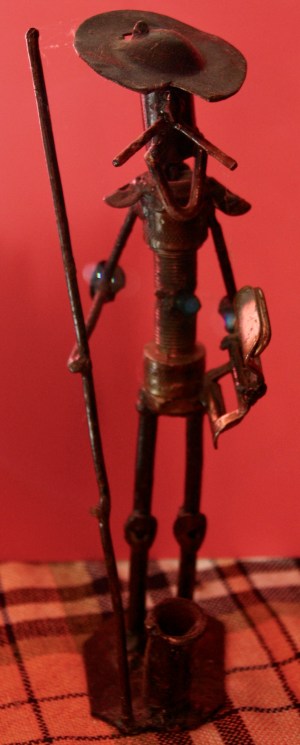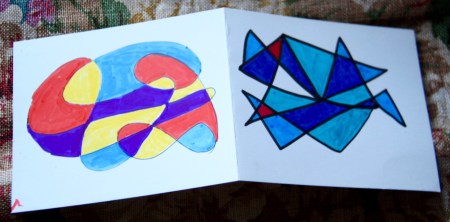
Sancho Panza

img_0282

San Chopanza

 Men of La Mancha

“How much did you say?
Is it in writing?
Let me see the words.
Better, since I cannot read,
let me taste the gold.

You have not brought it?
Just this paper signifying cash?
And promises? Promises
I can trust because you’re known
to keep your word?

Thank God I cannot write.
I will not make my mark.
Men like you I met
when I governed my island,
and I chased them from my realm.

Owners of hollow staffs,
muscular women
strong in the arm and weak
in defense of their honor.
Do you, sir, take me for a fool?

When you awake the man,
beware the grown-up’s fist.
Do you know who I am?
Have you read my history
that tours the world in print?

 Read it, sir, and know me
for who and what I really am.
And the next time that we meet,
if you would drive a bargain,
bring gold, good food, and wine.”

People Poems 4

img_0202-1

People Poems are dedicated to people who, for one reason or another, have distinguished themselves in my life. People Poem 4 is dedicated to Jane Tims who first encouraged me to start this blog. So, Jane: please accept this bouquet of flowers, just for you!

Jane is a wonderful poet who researches deeply into the past of New Brunswick. Her current project on New Brunswick schools and the early education system in the province takes her back in time to study the names and places on the old censuses. She then travels the back roads and visits the small country communities where the old often one-room school houses still exist. This is the research part. Then Jane imagines what life would have been like walking to those schools and working in them, in summer and winter. The result is an old world, re-created.

Other projects of Jane’s include the covered bridges of New Brunswick, all photographed, sketched, and recreated in verse. She has worked too on the fruit and vegetables of the province, all of them Within Easy Reach, the title of her latest book. An efficient and competent multi-tasker, Jane is also working currently on meniscus, a science fiction fantasy story in poetic form. I have had the privilege of reading an early version of the manuscript. In addition, I have heard Jane read extracts from it. It is a wonderful creation and I look forward to seeing it thoroughly finished.


img_0274

Jane is also a great artist and I love the drawings and sketches she includes in her books. Above all, I really enjoy her paintings. This one, Apples, she gave to me not long ago when Clare and I visited her in her studio home. It hangs in our kitchen beside my chair and reminds me of the beauty of art and the nature of friendship: light, kindness, generosity, and a love for the world in all its many forms. Thank you for being here, Jane: the world is a better place with people like you in it.

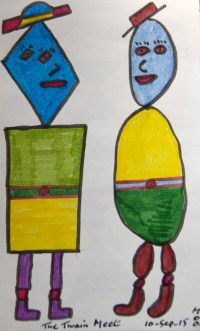
Don Quixote

IMG_0282.jpg

Donkey Hotay

 Men of La Mancha

Saddle his steed
and let him ride
uphill and down.

The world is wide
enough for a knight
and his faithful squire
to find at road’s end
what they most desire.

Let him obey his vow.
Let him best portray how
a true knight,
worthy of the name,
guards from shame
his knightly honor
and his beloved’s fame.

Let no mage
despoil that Golden Age.

Onward, ever onward,
to glory and renown,
and let him once again

tilt at windmills and knock
falsehoods down.

Gifts: Wednesday Workshop

img_0177

Gifts
Wednesday Workshop
16 November 2016

Gifts or blessings? I am never sure which is which for many a gift is a blessing and many blessings are gifts and sometimes the ones come disguised as the others.

So here I am, in retirement from a career in teaching. I miss my students. I miss the hurry and scurry of the classroom, the deadlines for essays and exams, the highs and lows, the setting of goals, the solving of problems, the light at the end of the tunnel when, after four years, the students, armed with their degrees, set out to face the world, their world, their  brave new world fit for brave new students.

Nowadays, I feel like the lost man, the forgotten man. The deadlines have gone. There is no more rush and tumble. Peace rules the office in my house and dust and spider webs gather in the corners of my mind. I am reminded of the words of Francisco de Aldana: “lo mejor es estar muerto en la memoria del mundo” / best of all is to lie dead and forgotten in the memory of the world. Then I look around me and see the gifts.

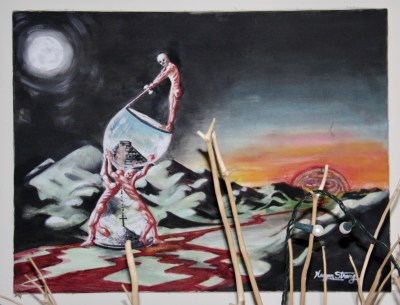
From Megan Strong:
IMG_0297.jpg

“Do I have to write an essay?” Megan asked me. “Couldn’t I do something else?”
“What would you like to do?”
“A painting. I’ll explain it in Spanish.”

And she did. There are no essays pinned to my walls, but this gift of a painting reminds me of something very precious: a student’s will to be creative, the presentation of knowledge in formats that are not necessarily the expected ones, the ability to be flexible, to understand, to open one’s eyes to the world around one, to see and encourage talent. These were the blessings, some of them anyway, that came with Megan’s gift and her ability to paint.

From Jane Tims:

IMG_0274.jpg

Clare and I visited Jane in her studio home. We drank tea and shared the afternoon sunshine together. Then, just before we left, Jane asked us to choose a painting. Clare chose this one: Apples. We went home and, after much thought, placed it on wall in our kitchen, just beside my chair. I see it everyday and so does Clare. It brings light and warmth to the room and reminds us of Jane’s gifts: her writing, her poetry, her research skills, her drawings, and her paintings. This one above all, for it is so meaningful to us and brings us light, peace, and stillness: such precious gifts.

From Jan Hull:
IMG_0279.jpg

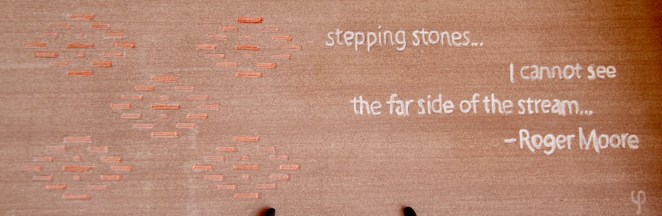
I cannot say enough about this stone sculpture gifted to me by Jan Hull in Shediac, New Brunswick, on November 4, 2016. Jan Stoneist has taken one of the motifs from my book Stepping Stones and has placed it on the left hand side of the carving. On the right hand side she has taken one of the verses from the book and added my name. The result is both a gift and a blessing. Jan searched carefully for the right surface on which to carve her offering and finally found it: Welsh Red Sandstone. What better gift for a poet from Wales … and indeed, Jan makes me feel truly blessed.

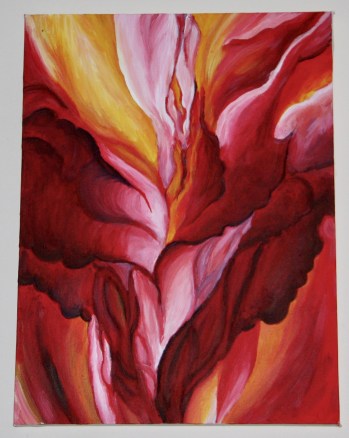
From Ainsley Swift:
IMG_0294.jpg

In the days immediately after my retirement, when I found myself at the bottom of the well, looking up at the daylight through a long, dark tunnel, Ainsley appeared at my door and asked me if I would be willing to mentor her as she was having some difficulty with certain aspects of her studies.  Brightness descended upon me and Ainsley and I have worked together for some time now. One day, she turned up with a brown paper parcel and announced that “This is for you.” I didn’t even know that she painted, let alone that she was a talented artist. Another gift, another blessing, light breaking where no light shone, and that brightness still surrounding me.

From Juanra Sánchez:

IMG_0290.jpg

What does one say about the man who persuades the retired stone-cutter in Avila to make one last carving in the style of the verracos that were carved by the Celt Iberians thousands of years ago? Here it is, my own verraco, gifted to me by the best of friends who, every Sunday for four consecutive summers, drove me around the Province of Avila and showed me the love he held for his land. Thanks to Juanra, I saw places and things, too many to enumerate,  that no tourist will ever see. A weighty gift indeed, and a true blessing that will last as long as granite bulls stand firm beneath wind, rain, and snow.

This verraco comes with a story. It is very heavy and very solid. I placed it in my carry-on bag and hoped that nobody would think to weight it. Tired of carrying it on my shoulder at the airport in Madrid, I stood in line, then placed the bag upon the ground. The line wasn’t moving, so I walked a few paces to the wall and leaned up against it. Lines shuffle and flex, as we all know, and that’s what happened. Gradually a small space opened up between my bag and the man in front of me. The man behind me was impatient to close that gap. He looked at me as I leaned against the wall. I half-closed my eyes and watched him. The line shuffled forward. He brought his leg back and gave my bag a mighty kick, right on the rear end of my granite bull. I can still see that man hopping on one leg, cursing, and my bag sitting there, having moved not an inch.

Gifts and blessings, along with kind words and actions, move the heart and soul. I will write more on this subject at another time. Meanwhile, remember the old song: if you can’t sleep, “count your blessings instead of sheep.” I just did and five of them are listed right here.

Bacchants

IMG_0157

Bacchants
after

Velásquez

Go down to Queen Street
on a summer evening,
or walk to Odell Park
and look in the dark
beneath the trees:

you’ll find them
gathered round a fire,
drinking meths or after-shave.

Fly Karsh from Ottawa.
Lodge him in the Beaverbrook
then bribe these Bacchants with free
booze and bring them to him.

One day their photos will hang
with those of Hatfield or Robichaud
in the New Brunswick Hall of Fame.

That’s what Velásquez did
when he painted his dwarfs
and topers, and you can see them
in the Prado today,
as famous as
Spain’s King and Queen.

Planners, Pantsters, and Thinksters: Wednesday Workshop

img_0177

Planners, Pantsters, and Thinksters
Wednesday Workshop
9 November 2016

Two new writers (John King and Amy … ) have joined our writers’ group (Chuck Bowie, Kevin Stephens, John Sutherland, and Roger Moore) and now we are six (with apologies to Winnie the Pooh). In addition, we have a virtual member (Allan Hudson) and a potential member (Victor Hendricken). Amy has joined on a first name basis. Alas, there were only four of us last night: Amy, John K, Kevin and Roger; Chuck and John S were both indisposed. We wish them good health.

This leads me to the question: what is the best way to integrate new members into an already established group of writers? I have no answer. Last night’s activities seemed quite successful.  First we introduced ourselves, first names only (oh dear!) and then we invited Amy to tell us about her writing. What an adventure. She has completed one novel, 110,000 words, and has two more planned in the series. She is questioning her opening chapter: is it the right one or should she begin after chapter three? Without having read the work, I personally find it difficult to give advice.

We explored some of the themes Amy presented to us and discussed a series of images that recurred and seemed to link the novel together. The idea of iterative thematic imagery serving as a leitmotiv came forward and we analyzed how repeated images can tie a novel (or a poem, or a short story) together. We spent some time on triggers that motivate actions and reactions from the characters. What is the trigger or the hook that draws the readers in, makes them look to the future, and persuades them to want to continue finding out more about the characters?

We also discussed Kevin’s favorite topic: planners and pantsters. Kevin is a planner who works everything out in advance. His charts, photos, character guides, outlines, and plans are an exemplary work of art in themselves and are highly admired by the group members. Many writers are pantsters; that means to say they pick up their pens or sit by their key-boards and write by instinct and fly by the seat of the pants. I find myself in between these two extremes, for, like Fray Luis de León and Juan de Valdés long before me, I think most of my writing out and keep it in my head until it comes time to put it down on the page. Perhaps this makes me a thinkster; I would like to think it did.

We also discussed the importance of The First Five Pages (Noah Lukeman’s book, sub-titled: a writer’s guide to staying out of the rejection pile). We invited Amy to send us her first five pages for an online critique. Our next step will be to look at the first five pages of the chapter with which she is proposing to start. It was an exciting conversation. I hope it was not a scary one for Amy’s first time out.

John K has been to one of our previous meetings, plus we had a long series of discussions with him at the WFNB meetings last weekend in Shediac. He and I helped close the hotel bar in Shediac at 1:30 am, so we are very proud of our efforts there. He presented us with the outline of a ‘tale’ that he is developing. Good man: he writes with a pen in a notebook, jotting down his ideas as they come to him and elaborating them in pen and ink, just as I do. Kevin and Amy had their tablets and their computers while John K and I had our pens and notebooks.

Without going into the details of his story and giving anything away, he walked us through the tale as he has it at present. he has great ideas, but at present is in search of a format in which to present his ‘tale’. Is it a short story? Too long and too many episodes. A novella? Could be. A full length novel? We didn’t see why not, and more and more potential episodes suggested themselves as we went along. In many ways it sounded like a film or a televisions series and John K’s active photographic mind, he has done courses in film and script writing, painted an engaging series of linked pictures, all of them with great potential. We are hoping that John K will send us an outline sketch, maybe even a storyboard,  of what he is planning. Perhaps we should also ask Amy for a chapter plan, or would that be too ambitious?

As for Kevin and I, we joined in the conversation, presented commentaries and ideas, outlined some of our own plans and directions, and had a thoroughly enjoyable time. Kevin’s book DiAngelo will be released on 22 February 2017. He is at the final editing stage right now and is busy, busy, busy with the final version of the text. We are all excited for him and are pushing him to keep at it and get the first novel of his planned five novel series out, and up, and running.   He is also planning a series of pre-release advertisements scenarios, all of which are sure to catch the eye of potential readers.

And that may well be the topic for another day: how do we market our books and what is the best way to attract readers?

Pilgrim

IMG0024_1.jpg

Pilgrim

Santiago de Compostela

She drew me out from inner darkness,
told me to rise and walk.
“But first,” she said, “your wounds.”

She washed them in laughter,
dried them with her smile.

I left that night
walking west beneath the stars
to where the red sun
dips beneath the horizon.
South I wended my way,
where winds are warmer.

Hope flowered anew each day.
Dew on the morning grass
gifted both food and water.
Birdsong raised its morning voice
to the creator and her creation.

Sunlight flooded my body.
It flowed out through my heart,
a beacon to light my way.

At night, when star song
brightened the owl’s path,
I saw my road
stretched high above me.

Pilgrim through once barren lands,
the light she lit for me
burns within me still.

 Rain, sleet, snow, ice, fire:
they’re all the same.
No lion shall me fright.
I’ll with a giant fight.

“Constant,” she said to me.
“Come wind, come weather.”

El Cristo de Carrizo

F1030024 2

El Cristo de Carrizo

For Tanya Cliff

“Contemplate this crucifixion.

Each time you sin
you plant a fresh
thorn in your savior’s
crown.

Each misdemeanor
spears the sacred side
or hammers a nail
in hand or foot.

Christ lives in you.
your daily misdeeds
nail him daily to the cross
he bears for you.

No death, for him,
no resurrection:
just an everlasting hanging
from these nails you daily drive.”

Court Dwarfs: Velásquez

IMG_0188

Court Dwarfs

Calabacillas, the idot of Coria;
Francisco Lezano, the child of Vallecas;
don Diego de Acedo, the cousin;
and don Sebastián de Morra
in his red velvet coat:

a pride of lion-hearts,
these medieval jesters,
blown up
in some practical joke to
a full life size
that competes with their majesties
for our dialogue
with this time and place.

 Their captive souls
run the gauntlet
of their canvas jails.

Their eyes
recall those of Segismundo,
imprisoned in his tower,
drugged, then dragged
from darkness
to the palace’s brightness.

On his return to prison:
“Man’s greatest sin
is having been born,”
he cries.

Heir to a kingdom,
surviving in darkness,
rags and chains
binding his royal flesh:

 “Life is a dream,”
he sighs,
“and every dream,
a lie.”

Titles: Wednesday Workshop

img_0177


Titles
Wednesday’s Workshop
02 November 2016

I am currently thinking and re-thinking the titles to my books.

Clearly, the title is of the utmost importance. The title should draw the reader in while offering some information on the content. Alas, my earlier titles did not do this.

Monkey Temple, for example, really doesn’t say much about what the book contains. Nor does its subtitle: A narrative fable for modern times. Those who have read poems from the book or who have heard me read excerpts from it, know what it is about. However, deep down the title really says little about the life and times of Monkey, the protagonist who works and suffers in the corporate Monkey Temple.

In similar fashion, Though Lovers Be Lost is a wonderful title, taken from Dylan Thomas, and illustrating his theory that “though lovers be lost, love shall not, and death shall have no dominion.” If readers have these lines on the tip of their tongues, as most people from Wales do, then they will have a fair idea about the contents of the book. However, without that intimate knowledge of one of the great Welsh poets … many readers will be lost and the title will lack meaning, check my post on Intertextuality.

Bistro is a collection of flash fiction. I am not sure that the title suggests that instead of a standard and expected table of contents the book has a menu that refers to the 34 pieces of flash fiction are contained within its pages. The pieces are so varied, rather like a meal of sashimi or sushi, that it is difficult to describe the contents (or menu) in such a short thing as the title. Does the one word, Bistro, draw the reader in? The cover picture might and the combination of title and picture and cover may go further. However, I have my reservations.

Empress of Ireland, on the other hand, is a book of poems about a specific event: the sinking of the Empress of Ireland  in the St. Lawrence River in May, 1914. Here, title and event are closely linked and hopefully the title is rather more indicative of the contents. Even here, as in the cases of the books mentioned previously, a brief description of the book is necessary.

Sun and Moon is a great title, provided you have lived in Oaxaca, Mexico, and know that Sun and Moon are the official symbols of the state of Oaxaca. Without that knowledge, the sub-title, Poems from Oaxaca, Mexico, is essential. The cover photograph with the state symbol of Sun and Moon is intriguing, but it is still necessary to read the description to find out what the book is about. Are title and sub-title enough in themselves? I’m still not sure.

Obsidian’s Edge is a tricky title. I thought everybody knew that obsidian is the shiny black glassy stone produced in volcanic areas. Further, I thought most people knew that the edge of obsidian is used in weapons and knives that cut. By extension, obsidian knives were used by the Aztecs and others in their human sacrifices … so much knowledge that is clear to the writer but unclear to the reader who may not realize that we all live at Obsidian’s Edge with the sacrifice of our own lives hanging by a thin thread on a daily basis. Oh dear, I have been to workshops and readings recently where people knew nothing about obsidian and its properties … my title gives so little information.

Land of Rocks and Saints has yet to be revised and rewritten. Few English readers will associate it with the old Spanish saying, Ávila: tierra de cantos y santos / Avila, Land of Rocks and Saints. The tragedy of living a life in more than one language is that the cultural knowledge so easily understood in one does not necessarily transfer readily into a second or third language. Some of my readers write me to say that they Google all these terms and learn a tremendous amount from the books. Alas, I have to improve my titles. I need to sharpen them and use them to draw my future readers in.

Ávila: cantos y santos y ciudad de la santa, the Spanish translation of Land of Rocks and Saints that I have just put up on Amazon / Kindle, is a better title. Avila is both the province and the capital city of the province. The rocks and saints are clearly linked to the name and the city itself is the city of the saint, St. Teresa of Avila, of course. Hopefully, this title, in Spanish, will attract some Spanish readers. I can only hope.

The book on which I am currently working was originally called Iberian Interludes and had no sub-title. In my revision, I am selecting poems about Spain from various earlier collections and placing them together in one large compendium. I have selected poems from two collections Iberian Interludes and In the Art Gallery (oh dear, I never mentioned that it was the Prado and that all the paintings could be found there). To these I have added a selection of individual poems either published in reviews and literary magazines or taken from other collections.

I am still working on a title for this collection, hence today’s post. I have rejected Iberian Interludes as too vague (how many of my potential readers know that Spain is Iberia) and I am now looking at a bold assertion: Spain. If I do this, I will need a sub-title. The evolution of the subtitle looks like this: Bull’s Blood and Bottled Sunshine, ¡Olé!  >  Bull’s Blood and Bottled SunBottled Sun and Bull’s Blood. I wonder if Spain: Bottled Sun and Bull’s Blood will be catchy enough. Will it draw readers in and attract them? There’s still time for me to think and re-think and all observations will be gratefully accepted.

By all means, let me know what you think.