Wheelbarrows

img_0183-2

Wheelbarrows
Secret Garden #6

Once upon a time,
an inmate at Cefn Coed,
the Swansea lunatic asylum,
walked around the garden
with his wheelbarrow
upside down so nobody
could put anything in it.
Not so crazy, eh?

That’s what you and I are
without each other:
upside down wheelbarrows,
or wheelbarrows
with the one wheel missing,
or wheelbarrows
with the bottom boards gone
and everything falling out.

So here’s my card for you
on Valentine’s Day:
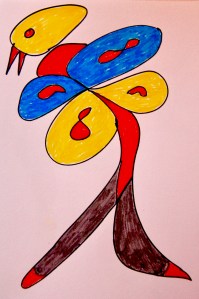
I’ve painted an upside-down
wheelbarrow missing a wheel.

There’s not a flower
or a heart in sight.
Anyone can give hearts
and flowers.
Only someone really special
merits a wheelbarrow,
upside down,
with the missing wheel
long gone.

Secret Garden 4

IMG_0137.jpg

Secret Garden 4
Pause for Thought

My love, are you my muse?
Or do I write to amuse myself?
I don’t know any more.

I only know for sure
that every second is precious
here in our secret garden
where we cultivate these creative
moments when the world stands
still and our breathing makes
light of the void within us.

Right side, left side: who cares
what’s dominant when our bodies
are tuned like strings on a lute
and you blend with that blood-
red body space beneath my ribs
until my heart beats to your rhythms,
Princess of Paradise, fair of face.

We must never permit these memories
to fade. All too soon chaos will serve us
its tainted apple, tunneled by surging
worms, dark-serpent heralds fore-
telling death’s angel, the night to come,
and the cold of our ultimate separation.


Ice Pack

IMG_0162.jpg

Ice Pack

Downstairs at 3 AM with frozen French Fries
stuffed down the back of my jammies and
tightly pressed between chair back and spine.

Yesterday, when the pains in my lower back
ran rampant and I was too stiff to bend,
I lay on my back in bed, begging you for help.

Seventy-two hours flat on my back with my feet
on a chair did nothing to improve my temper.
I thought of my mother lying hopeless,

of my father being dressed, washed, shaved,
cared for as if his return to a second child-
hood was accompanied by a necessary

humiliation, a lowering of every inhibition
that gives a man his manhood and allows him
a minimum of dignity. Lying there, helpless,

my feet stretched out before me, I saw my
future as if it were an endless pack of ice
barring the horizon, groaning when I moved.

I must learn to lean on the closest shoulder.
This is really love, my love, your gentle hands
pulling sock over foot and ankle, lacing my shoes,
standing by my side, letting me lean on your arm,
refusing to discard me in my time of trouble.

Overnight Rain

IMG_0229.jpg


Overnight Rain

Do you remember sharing the single
bed in my room in Bristol? It was
not so much the sound of raindrops
falling, but rather that of water gurgling
through gutter and pipe that kept
us awake, turning to each other, rest-
lessly for comfort and dreams.

Downstairs, in our little yellow
house, the dogs are quiet. Upstairs,
rain drums its rhythms on our thin
tin roof and I cannot go to sleep.
The grass will be much too wet
to tackle and scrum: tomorrow I’ll
call around and cancel practice.

Funny how this season winds down
to its end. Tomorrow, no practice.
Then two more games, three maybe,
and a portion of my life will fade
into history. How many forty minute
periods can the human mind retain,
with wins and losses all crammed in?

A strange thing, memory. Even now
I can sing the tunes from the kiddy
shows I watched so many years ago:
Bill and Ben, The Woodentops, Andy
Pandy, Muffin, The Magic Roundabout.
Some nights, in my wildest dreams,
Mr. Plod, the Policeman, still comes

into the tv room with shiny handcuffs.
He leads me to my childhood cell,
high beneath the eaves, and I am
condemned to bed with nesting birds
rustling beneath the roof, rats and mice
scratching, half-heard waters whispering
off-beat lullabies: all oddly disturbing.

Comment:

This is one of my favorite poems from the sequence of love poems I wrote for Clare back in the nineties. It recalls the persistence of memory: how all things are linked throughout our lives and how one thought triggers another. The phenomenon of rain is the starting point for a journey back to a time or times that still remain firmly embedded in the writer’s mind. Memory is indeed a strange thing. I am certain that no two people recall the same incident in exactly the same way. How could they when viewpoint and memory create such wonderful and different links?

One thing I will never forget: the rats and mice in the rafters of our bungalow in Gower. My father and grand-father built it in 1928 and my uncle was the caretaker who took loving care of it throughout his life. They did their best to keep the bungalow vermin free. But we closed it down in September and over the winter all manner of things found their way in. Those first spring nights, until the rafters were cleared again, were full of the sounds of nature’s revolution against humankind.

The other thing I remember very vividly was the lack of running water and electricity. Wood stoves, a fireplace in the dining room, an enormous cast-iron kitchen range, wood and coal burning, on which my grandmother cooked and did the baking. Then there were the cows that wandered through the bungalow field. They would be there, all night, nurtured by the bungalow’s warmth. Many’s the night I wandered out to the outdoors bathroom, the out-house, in fear of a meeting a nocturnal cow. One of my worst memories: walking barefoot through a cow-pat, warm and wet, and the moisture rising up soft and squishy between my toes. Those were the days … the stuff of which memories are made …


Secret Garden 2

fundy-05-mistwolfepipers-081

Secret Garden 2

Five a.m.: The moon on the back porch
shines with  light as bright as day. It’s cold,
much too cold for August. Orion is back. To the left,
in the East, he has hoisted himself over the horizon.
Winter can’t be far behind.  Upstairs, in bed, I can
hear you twisting and turning, looking for me in your
sleep. I am not there. The garden is magic beneath
the moon-shadow playing on flower and plant. Withered,
it is all dried up from summer’s heat. A false light
casts moving shadows as whispers of clouds murmur
close to the moon’s ear. Orion heralds the bitterness
to come. The long bright winter nights, aurora borealis,
more than a dream, a vision dancing in brittle
air that crackles and snaps in changing sheets of color.
I know you are there, upstairs, waiting for me,
hoping I will sneak quietly back to bed,
waiting for my footstep on the stair.
What will you do when I am no longer there?

Predicting My Death 3

fundy-05-mistwolfepipers-081


Predicting My Death before Yours

3

Know this: I have no regrets. Not in anything that touches you.
No regrets, that is, save for the thing I have done to hurt you.
Many things. Some underhand. Some unsuspecting. Some deliberate.
You know, after all these years, the way I am. Unthinking.

Selfish. Never unfeeling. Often unknowing. So many negatives.
Is it negative to embrace my death before it comes? I don’t
think so. Perhaps it’s the most positive thing I’ve ever done,
this coming to grips with the maggots that gnaw me away,

night and day, gnawing me away. They aren’t invisible. You see
them  sometimes yourself: in the bottle I drain to send me to sleep;
in my tone on the phone when I answer an unwelcome call; in kicks
delivered to sleeping dogs that I can never let lie. Why? I cannot

answer that question. It bounces like a pinball round my head:
why? why? why? But try as I may, there is never any answer.
Why am I made as I am? Why do things happen the way they do?
Why do you still love me, in spite of all my faults, my kinks?

There: I’m being negative again. Be positive: this is my last will
and testament. My love, I leave to you the pleasant memories.
Days in the sun in Spain; our daughter born healthy; grooming
the show dogs; digging the snow together. Our very presence here

in Canada is a sign of the highest bond that could ever unite
two people: leaving their homes, their families, their friends,
their birthplace, their nationality to set up a new home together,
crossing the sea to reach this new found land of ice and snow.


Predicting My Death 2

fundy-05-mistwolfepipers-081

Three Poems Predicting My Death before Yours

2

There never was anybody else but you. Too late now when
you’ve discovered this to tell you that there probably
never will be anyone else. Middle age: I look back on all
the things we’ve done together. Shall I count the ways?

No: I’ll make a list. So often we’ve sat together at the table
planning the next set of duties that will keep us occupied
by driving us apart. But of all the people in the world
you’re the only one who doesn’t need a list of what we’ve done

or haven’t done. Goodrich Castle, last year in England,
was your discovery. We went there together at your instigation.
A part of you that will always be me, that first discovery
of ruins, new to us, growing from red bed-rock. I thought I had

seen everything worth seeing till I looked on Goodrich,
explored its towers, its labyrinth of connecting rooms.
Civil War tore down the curtain walls, fired the stables,
driving the horses wild with fear. Sometimes, at night,

I can feel that fear pumping through my veins. Knowing
I will die before you, knowing I will leave you alone
to defend yourself between curtained walls, isolated,
besieged by the same memories that mill in my mind.

Predicting My Death 1

fundy-05-mistwolfepipers-081

Three Poems Predicting My Death before Yours

1

I cannot always talk to you. There are so many barriers.
The hoovering, the cleaning, cooking the daily meals.
When we go to bed, you are tired, I’ve had too much to drink.
We know our routine answers off by heart. There’s never any time

for each other. House work, gymnastics, paying the bills,
even housekeeping on the computer: they all take time.
Time, time: so little of it left. I can feel death’s seeds
rooting in heart and chest. Premonitions: so little time.

Comment:

Rummaging in the dusty memories that line my bookshelves, I rediscovered a sequence of love poems I wrote for Clare, 25 years ago, in 1991. This is the second in the sequence. A Golden Oldie, it grips today even more than it did back then. I am growing old. The insurance company’s statistics tell me that soon, all too soon, I will join those statistics and become another black number on a white page. According to those statistics, Clare will survive me, but we don’t know by how much.

How do we prepare ourselves for such things? Our society, a society that sees violent death every day on the road, on the street, on television, backs away from death. We don’t face it, not in the same way they do in Oaxaca, for example, where it is celebrated once a year on the Day of the Dead. Homes are lit up. The dead ones favorite food is prepared. Little altars are illuminated by candles. Photos appear. Do the dead return to their homes to join in the celebrations? Sometimes, I guess they do. Certainly the would be made welcome if they did.

Perhaps Francisco de Quevedo, the seventeenth-century Spanish poet who was the subject of my doctoral thesis, was right. “The day I was born, I took my first step on the road to death.” He writes too of “this death that I carry within me, that has walked beside me all my life.” “If death is a law, and not just a punishment,” he writes, “then we must accept it and obey its call.” I guess it’s easier, if you are a Stoic or a Neo-Stoic, to face up to such things.

I once asked my grandfather, a man who survived the trenches of the First World War, if he was worried about dying. He looked at me in silence for a long time. I was very young and we were sitting in the sunshine on the bench by the old Swansea Hospital where he went daily to gossip with his friends. “Roger,” he said. “We are all going to die. We will die if we worry about it. We will die if we don’t. So why worry?”

I certainly don’t want to go. I didn’t want to go twenty-five years ago and I really don’t want to go right now. I have decided to take my grandfather’s advice. I’m not going to worry and I am going to continue to enjoy myself for as long as possible because: “For there are many fine things to be heard and good things to be seen / before we go to Paradise, by way of Kensal Green.”


Secret Garden

IMG_0146

Secret Garden 1

Being the secret love poems
I write to Clare at midnight
while she is upstairs, asleep.
They make up for the things
I can no longer say because
I am uptight, or under pressure,
or working too hard. Or maybe
because we are quarreling over
something stupid. So these are
some of the seeds I wanted to plant
but never did because I was busy.
They are also the things
that I would like Clare and Becky
to remember me by if I should
suddenly pass away without being
able to say good-bye. My parents
left me nothing but bitterness.
I want my wife and child to have
a garden they can wander through
without my being there, knowing
I have cultivated these thoughts,
at night, sleepless, without them.

Gorilla Drives the Zoo Bus

img0046_1

Gorilla Drives the Zoo Bus

Gorilla drives the same zoo bus all day, every day,
same starting time, same finishing time, same route, same stops,
different passengers, but all passenger equally faceless.
Gorilla doesn’t want to know their names.

“Please tender the exact fare!”

Not a penny less, not a penny more, and he polices every penny.
Bus conductor and master of every passenger’s destiny,
he opens and shuts the door, letting passengers on and off the bus,
but only at official stops.

Every passenger has a ticket,
and Gorilla punches every ticket with a neat, round hole.
He never makes mistakes.
He grinds, like God’s own mills, exceedingly small.

He has spent all his life in uniform.
He has a belt and braces to hold his trousers up.
He’s always prepared for the worst.

Ten, fifteen, twenty years:
an anonymous wife; anonymous little babies;
at shift’s end, a pension, and another bus.

St. Peter’s at the wheel.
He doesn’t want to know where gorilla wants to go:
he wants to know where he’s been.

Commentary:

This poem follows on from my statement in Structure in the Short Story that “my greatest fear then becomes the gate-keepers, those anonymous figures who sit on shadowy selection committees, place ticks in appropriate boxes, and judge the quality of writing by consensus in committee.”

A long time ago, on holiday in Cardiff, the capital of Wales, we caught the bus from where we lived into the city center. I made a mistake in the name of the stop to which we wanted to travel and the bus driver insisted we got off at the place I had named. He would not let us travel to the stop a little further on to which we wanted to go. It was raining hard and so I told him that, rather than get wet, we would pay the difference in fare, but he said he had no change and insisted we get off the bus. I didn’t have any change either and had only a five pound note, so I gave him that and after a few curses and meaningful looks, he pocketed the money (more than three times the original fare), allowed us to stay on the bus, and took us to our true destination.

I have often thought about the “anonymous, shadowy people” who rule a tiny kingdom and insist, sometimes with the utmost vigor, that everything should be done exactly they way they want it done. There is no room in their lives for creativity, for adventure, for generosity, for a different way of life. More to the point, they seem (many of them, but not all) to enjoy bullying the people over whose lives they have for control for such a small amount of time. Some school teachers I have known fall into this category: utterly miserable people whose sole joy consisted in indoctrinating and dominating their young charges.

I think of them as the gate-keepers. They hold the key to a very small gate through which we all must pass, but their motto is a famous one “no pasarán” — you shall not pass.