Codex

Ay Ay Ayeres

Codex (Solace 3 & 4)

3
Down below, in the courtyard, the handy man wakes me as he tumble dries a TV ad in the washing machine of his song sparrow throat. He gargles with gravel and churns stony lyrics skywards until they grate at my bedroom window and drag me from my dreams.

My ears fill up with a crackle and roar. Wave after wave of sunlight breaks over the azotea. Blind with music, deaf with light, I am awash in the sea-surge rhythm of this surfacing sun. My dreams break up like biscuits and between my fingers I feel a sandstorm of crumbs.

Morning blows fresh colours into each corner of my waking mind. An early breeze shakes cobwebs and dust from my brain. New visions crawl out from the vellum codex I left open last night on my table. Red and green gods wearing black and white masks crawl through spaces still alive in my mind. Sometimes they move when the eye doesn’t watch them, but when I concentrate, they freeze in intimate poses. I link them with lines and arrows and vow that my life will never again be scarred by their secretive smiles.

The red glare of the day’s first rocket climbs its ladder of sky to smash at the gods’ front door. A second rocket draws me back to daylight. Awake, I lie there, counting. A third explosion is much closer. The fourth rocket surges skywards and the fifth and sixth rockets are two fiery giants exploding above my apartment. I pull back the bed clothes and swing my legs over the side of the bed. My day has begun.

4

The codex lies open on the dining room table I use as a desk. I scan the interpretation I made late last night, transferring the visual to verbal.

“Two breasts: one green, one yellow, symbolic of the hill where the church stands; the church itself bi-coloured, strong stone walls, a spire. A large red heart symbolic of the love we bear for you, our masters. Two feet walking the path of enlightenment you opened before us are accompanied by two hands pointing the way. The feet below the heart; the hands above the heart, like wings; and the heart becomes the body of the new place you have built for us. And in the heart is our sacred symbol: the Earthquake, a sign of leadership and power used only by those of Royal Stature and the Noblest Blood. Attached to the heart is the Numeral One which means Lord of the Earthquake; for you are Number One in our Hearts. Attached to the heart is a speech scroll showing felicitous words of praise; below it is the sacred earthworm, and beneath that the serpent head of wisdom and the flint knife promising strength through sacrifice.

But be wary: for our symbols are double-edged! The colors of the hill are divided, as the hill is divided, showing strife and division. The church is on top of the hill, for the symbol has conquered the people, and the people are starving, subject, and destroyed. The feet are pointing in opposite directions, for the people are stalled. They have no forward movement, nor will of their own, for they are conquered by the sword and not by love. And the hands are pointing in opposite directions; for the right hand knows not what the left hand is doing. And the hands are reversed showing anguish and distress. The sign of the heart is the sign of the disembodied heart, torn from the heaving chest of the vanquished and thrown to the dogs. The sign of the earthquake is also the sign of movement. And that movement is a bowel movement. And one movement in the middle of the sacrificed heart is the victor excreting on the vanquished and treating them with scorn and contempt. The scroll protrudes from the nether part and says that the victors are speaking words of excrement, that verbal diarrhoea issues from their lips. And the serpent has no feathers; it cannot fly. It is as a snake treacherous and bitter, crawling on the ground. The head of the serpent is two tongued and tells of treachery and of deceit. The flint is attached to a heart; it speaks of the heart that is as hard as flint, knowing no mercy. And at the end that heart will receive no mercy in its turn.”

Figures on the codex page take on a fresh life. They walk and strut, nod their heads, move their limbs. The sun climbs in the sky. Shadows shorten. Footsteps march steadily across the page from right to left. I blow a kiss to the piggy-back bride and she waves back.

Too much, too early. I reach for the remains of last night’s bottle of mescal and gulp them down. Order is restored. The cartoon figures go back to sleep. Normality, whatever that may be, returns.

Dream World


img0073_1


Dream World (Solace 2)

2

… dream worlds circle outside my bedroom window … starry sky … two full moons floating, one real, one mirrored in the glass …  inside the bedroom, tulips inscribe red gashes on white-washed walls … sharp fingernails scrape across paint, blood red shadows trickle down to the floor …

… above the azotea, the temples of Monte Albán string out their sheets on the sky’s washing-line, glowing in the moonlight … against a background of granite and stucco, trenchant shadows sculpt dancers into grotesque, pipe-wire shapes as they struggle to escape their carved imprisonment …

… priests in long black robes gape at the night sky. From their sanctuary in the observatory, they plot how they will persuade the people to believe the future they will foretell as night’s giant finger herds the wild-cat stars …

… three young women walk at an angle up the temple steps … when they reach the top, a moonbeam holds them in its spotlight and they wax with the full moon’s beauty …  the doorway to an unclosed grave opens its crocodile jaws and the three women descend the temple steps, ageing as they walk … at the temple’s foot, they enter the tomb’s dark mouth … an old man in a faded grey suit walks behind them … the grave swallows them all, burying them in the hidden depths beneath the mound …

… dreams back themselves into a cul-de-sac, a wilderness of harsh black scars … an ancient Aztec god catches Rabbit by his ears and throws him against the second sun that sizzles in the sky … his sharp teeth burrow, burying themselves deep in the sun-fire’s light … the second sun loses its glow and turns into the moon’s cold stone …  the rabbit’s skull simmers in the new moon’s dwindling pool …

With a clicking of claws, knitting needles come together to pluck me outwards from my dreams and upwards towards death’s golden guillotine that floats in the sky. The moon sharpens its knife edge on the keening wind and sets my blood tingling. I want to be free, free from those nightmares, those nocturnal visions that rise up from the past and stalk me as I lie in bed.

Drowsing, I long for the alarm clock to shuffle its pack of sleepless hours and to waken me with its piercing call as it tears me from these winding sheets, these grave clothes in which I lie. I wait for the sun to shine into my window.

My Father

IMG_0137

My Father (Solace 1)

1

            I saw my father yesterday evening. I walked through the zócalo, opened the main cathedral doors and walked in. The doors closed behind me. I looked towards the main altar and there my father stood, motionless. The evening light shone through the engraved glass panels and illuminated him as if he were some long passed saint come back to visit me. We stared at each other, but I couldn’t open my mouth to speak. The hairs on my neck stood on end and my hands shook. When I forced my mouth open, words stuck in my throat. He wore his best grey suit over a light blue shirt and a dark blue, hand woven tie: the outfit in which I had buried him.

               Three old women, dressed in black, broke the spell. One stood in front of me and wouldn’t let me approach my father. She held a large bag of knitting in her hands and the wool spilled everywhere as she pushed me away. The second threatened me with a pair of scissors that she held in her left hand and stabbed towards my face. The third beat a tailor’s measuring rod against my father’s head.  He nodded, smiled sadly, and they all turned their backs on me and hurried away out of the cathedral and into the square.

               Just for a moment, I stood there in silence. Then I pulled the doors open and ran in pursuit of my father. The setting sun filled the square with shadows that whispered and moved this way and that, as if a whole village had come down from the hills to walk beneath the trees and dance in the rays of the dying sun. I stood on the cathedral steps and called out my father’s name, but I could see no sign of him among the cut and thrust of the shadowy crowd.

               I ran out into that crowd and pushed at insubstantial people who stood firm one moment and then melted away the next like clouds or thick mist. I came to a side street and saw real people, flesh and blood beings, a group of villagers gathered behind their band. I stopped and as I did the village elder put a live match to the taper of the rocket that he clutched between his thumb and forefinger. The taper caught on fire and the rocket soared upwards with a searing whoosh. The village band marched forward and started to play a traditional dance as the rocket clawed its way into the sky to explode with a loud knock on the door of the gods.

               Tired of grasping at shadows and afraid of this living phalanx of men that marched towards me I went back to the cathedral and knelt at the altar of La Virgen de la Soledad, the patron saint of Oaxaca. Real wax candles stood before her altar, not tiny electric lights, and I inserted five pesos in the slot, took a taper, and lit a fresh candle from an ageing one that had started to sputter. I knelt and, for the first time in years, I prayed. I prayed for the soul I had saved from extinction by lighting my candle from his flame. I prayed for my father and my mother and, above all, I prayed for myself.

               On the way home to my second-floor apartment where I live alone, I bought two litres of mescal, one to send me to sleep, and the other so I would survive the next morning.

Hummingbirds

Hummingbirds

IMG_1034 (2).JPG

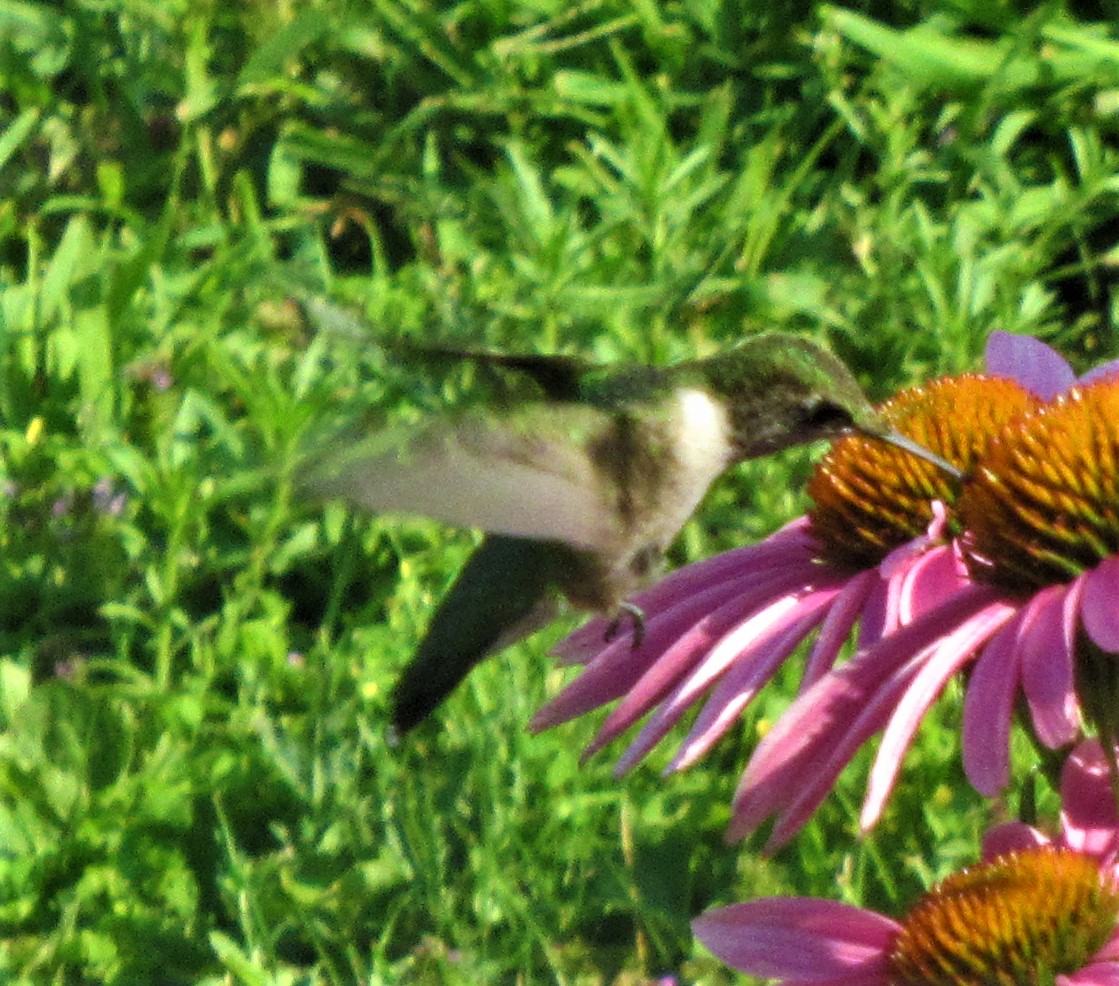
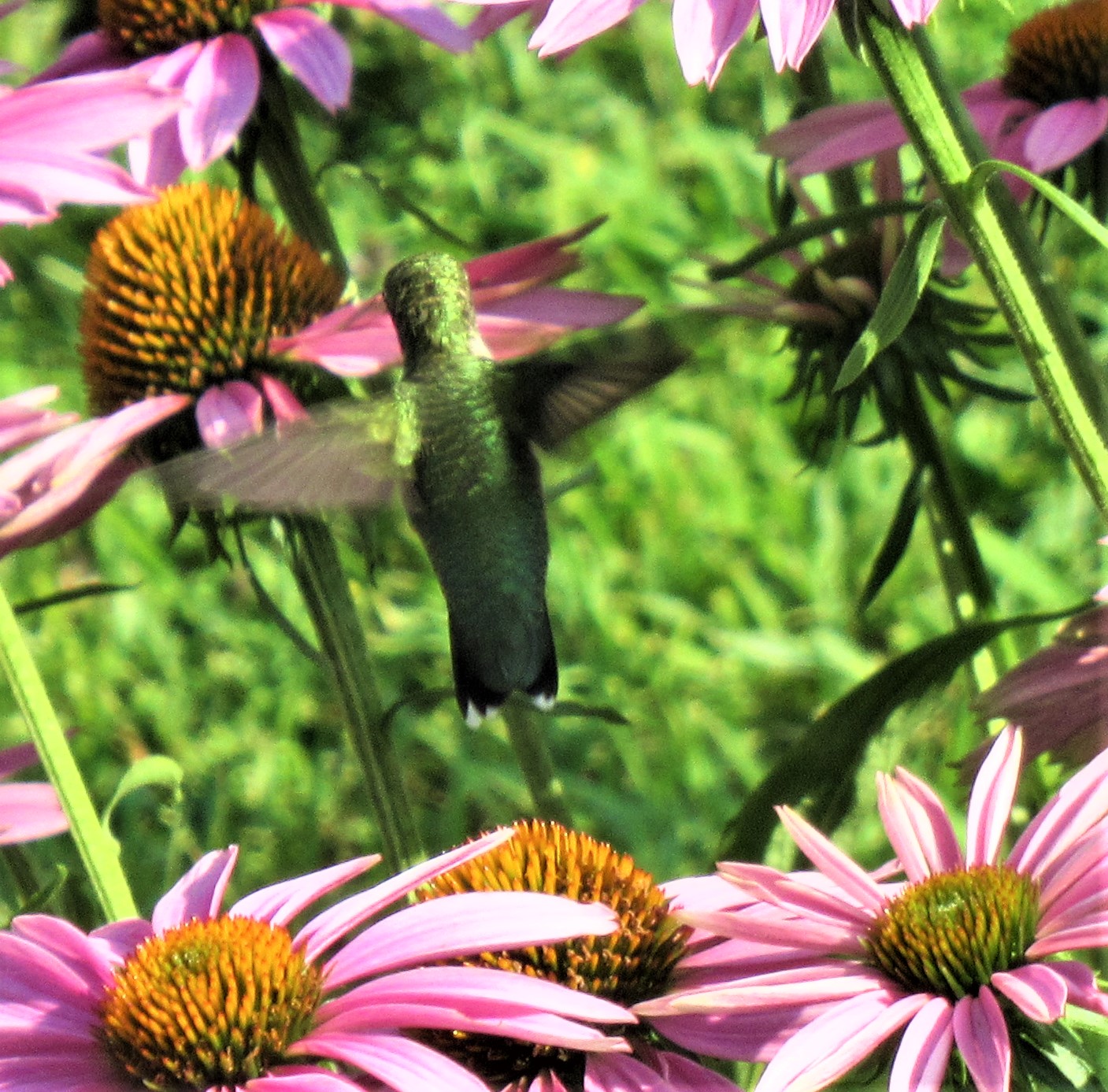
Do hummingbirds hum? Only when they’re humming birds. Otherwise they are quite silent, when alone, and the whirring of their wings is what whisks them up and away. In Oaxaca, the colibris are the souls of dead warriors killed in action. Their bravery is rewarded by their transference to a colibri in the afterlife, for colibris are given the gift of serving the sun in Mexican Mythology.

IMG_1033 (2).JPG

Here in Island View, New Brunswick, we only see the ruby-throated hummingbirds. No ruby throat, and they are usually females. Obviously, when they have their backs to us, then it is more difficult to determine male or female.

IMG_1035 (4).JPG


I desperately wanted to catch one feeding in the hollyhocks. Alas, they vanished inside the larger flowers. Also, they were much too quick for these old eyes and ageing fingers. So I just clicked away and hoped and this was the best I could do. I am still hopeful though… there’s still quite a bit of summer left.

IMG_1032 (2).JPG


Carousel

Carousel

carousel.png

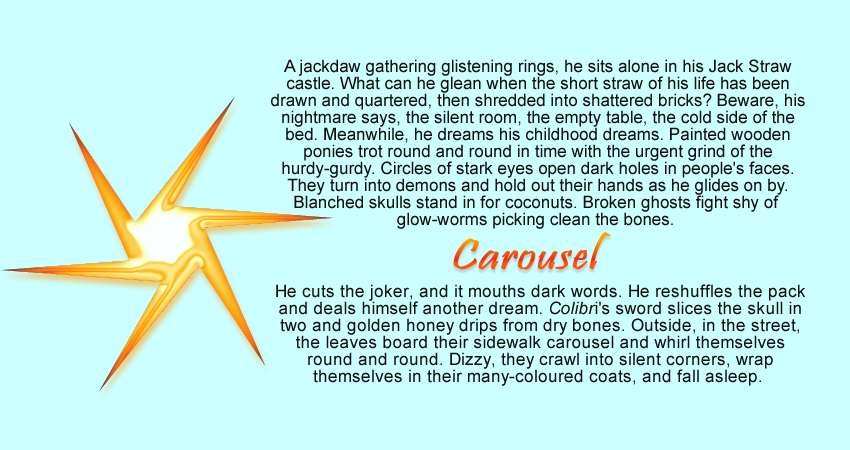
Around and around a roundabout! I love it when the painted wooden horses open their mouths and rock up and down, and the little children hold out their hands to watching parents and grandparents, and big sisters and brothers hold them tight and keep them from falling off and the world passes by in a blur and open mouths are black holes in faces sucking the carousel in as it spins past in triumph.

And never forget the dodgem cars, weaving in and out, never dodging anything, but jousting like armor-clad knights of old, bumper to bumper, and ready, steady, charge! Or the old swing boats, twin-roped, non-mechanical, lifting us up to the skies and dropping us back to earth with that stomach-churning fall from stardom to the loss of innocence as the wooden break grinds, our thruppence is spent, and the ride is over.

Those days are as forgotten as one a penny, two a penny, or the tuppenny loaves that the elephants dropped, or the sing a song of sixpence where the twenty-four blackbirds descended like clothes pegs to devour the bread and honey and peck off the nose of the open-eyed innocent who never tired of the joke until the ultimate childhood squeal as his or her freckled or un-freckled nose was pinched and stolen away. So much lost, so much forgotten.

For two weeks now I have tried to photograph the hummingbirds, colibris, who visit the hollyhocks. Tonight, after a hundred or more photos, I managed to catch one in the fish-net of the camera. What joy: success after days and days searching for that delicate flash of red and green, only to find nothing there. Oh hummingbirds, I weep to see you, to capture you in the camera’s eye, to preserve you … for such a short, brief, moment of time.

IMG_1033 (2).JPG

Wanderer

Wanderer
El Árbol de Tule

caminante.png

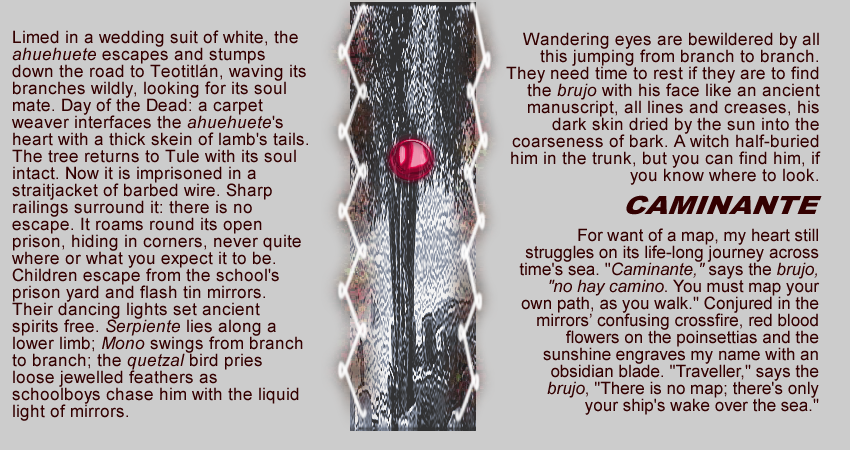
So many tales are told about the árbol de Tule, that thousand year old tree standing outside the city of Oaxaca. Hernán Cortés is said to have sat beneath it when he came to Oaxaca in 1525, or thereabouts. And it was old then, and famous in folklore. The tree is also famous for the pictures that nestle in trunk and branches. For small change, the little boys, released early from school, will point their mirrors up, into the tree, and spotlight with reflected sunshine the features that you seek. A thousand years, or more, have produced a thousand images, or more. Even the face of  Hernán Cortés himself is said to be captured somewhere along the tree-trunk’s art gallery, if you can only find it.

Like Borges’s eternal library, your own portrait can be found there, somewhere. You must search patiently for it, staring into the tree bark until it takes on your features. Then you can move on, knowing that whatever happens you will be caught forever in the life of one of the world’s wonders: el árbol de Tule. But beware of imitations and avoid the plastic imitations and the photos from cheap camera’s that will trap your soul forever, leaving no trace of you in the real world. Ignore these warnings at your peril, or you too will be locked into your cell phone and sentenced to life imprisonment within those digital walls.

Breakdown

Breakdown.png

Commentary:

This was the first time I had been to the baths in Oaxaca. These came highly praised  by family and close friends and the combination of mist, steam, and herbs, combined to loosen the body and soothe the soul. The Mixtec baths and massage are very highly regarded, incidentally, and one can go to the equivalent of sweat lodges in order to enjoy a day at an ancient historic spa. The masseur himself was incredible. I lay face down initially. When he want to turn me over, he got a bucket of cold water, threw it over me and flipped me in mid-air as I reacted to the ice cold water. Hard to believe now. I also remember having to buy a small bar of paper-wrapped soap. And locking my valuables up in a little chest to which only he had the key. These baths feature in my novel, People of the Mist. Unpublished, alas, but I may get around to revising it one day. All I need is some encouragement!


Balloon Lady

Balloon lady.png

Commentary:

Nine o’clock in Oaxaca is the ‘witching hour’. That’s when the young children go home and the balloon lady packs her bags and walks with her balloons out of the square. She really does build a castle. She stacks her balloons around her and lives within its walls selling balloons to children. Each Oaxacan child receives a balloon on his or her birthday and name day. These balloons are cherished, held carefully by their strings, walked like aerial dogs through the square.

The State band practices most nights int he central square and the balloons are moved by the music, especially that of the wind instruments, and then they wander to and fro. Sometimes they take on a life of their own and escape, skip away, go absent with out leave, and seek the freedom of the open skies. Sometimes they get caught in the trees. Then the strings are jigged and older children, experts in the art, place sticky tape on their own balloons and send them upwards in rescue missions which can be surprisingly successful. Oh what joy when the errant balloon returns to earth, stuck to its new mate. Oh what wailing when a birthday balloon bursts and the deprived child must persuade its parents to purchase another!

I can see them now, those colored balloons, floating skywards, sailing freely into the freedom of those blue Oaxacan skies. Up and up, level with the cathedral roof, ascending the cathedral tower, up, up, and away  … soaring like souls into the innocence of a sky blue heaven.

Yesterday

Ay Ay Ayeres.png

Commentary:

Ocho Venado / Eight Deer is a legendary person who is described in the pre-Columbian Miztec códice known as the Zouche-Nuttall codex. He lived from 1063 to 1115, the date of the codex. The códice describes his life and conquests. I brought a facsimile copy of this códice home in 1995 and my beloved started reading it on Boxing Day. It took her two days to decipher the first page. One day for the second page and, by my birthday, she had read the whole thing. She inspired my love of the codices and they figure largely in my writings from that time, especially The Oaxacan Trilogy (Sun and Moon, Obsidian’s Edge, and Obsidian 22, the first two available on Amazon).

Eight Deer appears frequently in my poetry, partly because we have a family of deer, often as many as eight (!) that walk through our garden in Island View. The joining of the Canadian natural world with the Oaxacan historical and mythical world brings me great joy and it is wonderful to weave stories and poems where the two worlds mingle and become one. Hence the dream world of the prose poem that figures above. Chocolate beans, incidentally, were one of the cash currencies used in Oaxaca at the time of the arrival of Cortés and the Spanish. Oaxacan chocolate (xocotl) is something wonderful.


Autumn Leaves

Autumn Leaves.png

Commentary

This is another of my beloved’s multi-media mock-ups for one of my Oaxaca Prose Poems. I have enlarged the photo so the text of the prose poem is more easy to read. I have several more of these and will post them one by one. I visited Oaxaca regularly, teaching there in November -December (1995-2001).  I came to love the city and I was entranced by its streets and squares. The casco histórico was particularly interesting.

Coffee in the zócalo, a walk through the cathedral, up the andador turístico to Santo Domingo where the old lady sang so beautifully, every day at twelve. Then back via the shops and home for lunch. I was always astonished by the leaves that swirled through the zócalo. They hustled, rustled, and bustled through the arched colonnades on the main square, gathered at the post office, and hurried and scurried  away from the trees where they dwelt to drift, who knows where, on the wild winds that blew in from nowhere and then blew out again.