Secret Garden

IMG_0146

Secret Garden 1

Being the secret love poems
I write to Clare at midnight
while she is upstairs, asleep.
They make up for the things
I can no longer say because
I am uptight, or under pressure,
or working too hard. Or maybe
because we are quarreling over
something stupid. So these are
some of the seeds I wanted to plant
but never did because I was busy.
They are also the things
that I would like Clare and Becky
to remember me by if I should
suddenly pass away without being
able to say good-bye. My parents
left me nothing but bitterness.
I want my wife and child to have
a garden they can wander through
without my being there, knowing
I have cultivated these thoughts,
at night, sleepless, without them.

Your Voice

IMG_0196 2.jpg

Your Voice
Love poem

Still in the still of the rain
I sense you near.

The room is full
of the scent of emptiness
yet even the silence
turns my head.

The walls expand
to enclose the world.

With gaudy flags
on a colored map
I mark your progress
through my memory,
upwards and inwards
your progress to my heart.

A moth glistens in the circle
cast by my reading light.

Your stealthy footsteps
sound in the corridor.

A voice, your voice,
drifts through the night

Structure in the Short Story

img_0177

Structure in the Short Story
Wednesday Workshop
30 November 2016
Posted: 4 December 2016.

I just attended, with one of my writers’ groups, a writing workshop offered by a guest speaker. Our speaker threw out some interesting ideas on structure in general and structure in the short story in particular. The first comment he made was “Are you sure that your novel is not a short story and vice versa?” He then suggested that often beginning writers run out of steam because their novels are not really novels but are short stories that need cutting, rather than expanding.

He followed this up by suggesting, and I made no notes so I write from a memory that fails me more often than it used to, that a short story should have a structure that runs something like this:

stasis > key occurrence > end of old world (stasis broken) > beginning of new reality (the world upside down) > quest (the search for  new balance) > climax (when all the events of the crisis come together) >  the moment of truth (when the central character is faced by a decision) > the choice (the protagonist chooses) > pay-off for protagonist (order is restored and the protagonist is changed or confirmed by his choice) > pay-off for readers (who see that change and are themselves changed by looking at the same old world through different sight and a new knowledge or insight gained).

 One of the group members circulated his notes from the workshop and summarized the idea rather more succinctly:

The first thing I remember … in any story, the main character has to be changed at the end from what s/he was in the beginning.

The other item was the list of elements in a story: Stasis, Trigger, Quest, Surprise, Critical Choice, Climax and Resolution.

            Clearly this is a theoretical structure, but many short stories follow it or versions of it. Through this structure, our speaker suggested, there often runs a leitmotiv and this can provide a thematic unity that also holds the story together. Returning to this thematic unity and writing selectively from within it, can often produce the desired change in reader and protagonist. Equally clearly, there is no length to this structure and the resulting story may be very brief or suitably enlarged.

According to our speaker, the character of the protagonist is very important and the key aspects of the protagonist’s character must be clearly drawn, right from the start. The protagonist must also go through some sort of change as the story and the protagonist’s character both develop. Place is also important and the protagonist should be linked into a place and preferably a time. The protagonist in the short story is, after all, in a dialogue with his time and his place (his chronotopos, as Bakhtin would phrase it).

This is certainly a prescription for short story writing, one of many prescriptions, I might add. A quick search turns up another definition, this time of a five-point narrative arc offered by Mark Flanagan:

“Sometime[s] simply called “arc” or “story arc,” narrative arc refers to the chronological construction of plot in a novel or story. Typically, a narrative arc looks something like a pyramid, made up of the following components: exposition, rising action, climax, falling action, and resolution.”

            Flanagan continues with a definition of each moment in the story. Exposition reveals the characters and the setting. Rising action is a complication that hinders the protagonist. Climax is the point of highest stress or tension. Falling action is a releasing of the pressure and the resolution ties up all the loose ends. (Taken from this site)

http://contemporarylit.about.com/od/literaryterms/g/Narrative-Arc-What-Is-Narrative-Arc-In-Literature.htm

Lope de Vega, the Seventeenth-century Spanish playwright, suggested a simplified three-part structure: situation > complication > unfolding / dénouement. Of course, the complications may be multiple, resulting in an action that runs situation > complication > further complications > complicating the complications > even more complications > even more complicated complications > and then the final unraveling of the ‘by now very twisted’ plot. An even simpler two-part definition, also from Spain’s Seventeenth-century, offers us the dual structure of a ‘world in disorder’ > ‘a world in order’ — how the characters progress from disorder to order is up to you as a writer.

Of course, the author may decide NOT to tie up all the loose ends and re-order the world to perfection. When this happens, we may have a dystopia: the disaster continues; or we may have an open ending that prompts the reader to wonder what might happen or what might have happened. As for ‘beginning at the beginning,’ there are also stories that begin in the middle (in media res) and then go backwards in time before going forwards again. This raises the awkward question: how short is a short story? I won’t attempt to answer that one here.

Whether you describe or prescribe, there are many possibilities in the world of short story telling and it is always the story that counts. If it is good, then perceived structural flaws that go against these prescriptive methods may well become a prescriptive structure for another future writer. Interior monologue and dream, for example, linked thematically but not necessarily linked in time and space, may well distort or destroy yet another structural format, that of the three classic unities of time, place, and action. these, incidentally, are expanded into four by the great Spanish playwrights (among others, I am sure) who add unity of theme to the other three.

Robin Grindstaff, in an online article entitled “Narrative Arc: what the heck is it?”, available at

http://robbgrindstaff.com/2012/03/narrative-arc-what-the-heck-is-it/

suggests yet another simplification and reshaping, of the narrative arc idea.

“Think of narrative arc as a bell curve. It starts at a point on the lower left hand side of a graph, rises in a curve to a peak, and then drops back down again. The standard narrative arc is often referred to in terms of the three-act play: a beginning, a middle, and an end.”

            This is not unlike the structure outlined by Lope de Vega, except for the fact that ‘middle’ is a rather inadequate term for the multiple complications outlined in the Lope de Vega model. This statement may be a little unfair as Robin Grindstaff goes on to outline the complications that may occur in the second act in the following fashion:

“In act two, the main character must try to overcome the conflict presented by the inciting event. The character wants something, has a goal in mind. The conflict and tension of the story rise, and obstacles are thrown in the path of the character to prevent her from achieving her goal. The character faces these obstacles on her way to overcoming the conflict. The obstacles get bigger, more difficult, and the character may be on the verge of defeat or surrender. At this point, the character must make a critical decision or a moral choice that changes the direction of the story.”

            Clearly the ‘obstacles that are thrown’ compare favorably with Lope’s consistent throwing of obstacles and ‘middle’ therefore becomes a euphemism for ‘complications.’ Act three allows for the climax and resolution of the story and this includes character change or ‘death in defeat’ and tragedy. I recommend this article very strongly, as it goes way beyond the outline I have offered thus far and clarifies many features of the narrative arc.

In fact, Grindstaff then references Nigel Watts, Write a Novel and Get It Published, and outlines an eight-point narrative arc that runs

stasis > trigger > quest > surprise > critical choice > climax > reversal > resolution.

 This runs a close parallel to the circulated list (quoted earlier) of seven elements:

 Stasis > Trigger > Quest > Surprise > Critical Choice > Climax > Resolution.

 The main difference being the insertion of a reversal between the climax and the resolution.

So, we have now established an narrative arc, or a pyramid, with 2, 3, 4, 5, 6, 7 or 8 steps included within it. This is all very prescriptive: do it and you will succeed. My greatest fear then becomes the gate-keepers, those anonymous figures who sit on shadowy selection committees, place ticks in appropriate boxes, and judge the quality of writing by consensus in committee. I can hear them now: “#7 is missing. There’s no reversal. Reject!” “I don’t like #5. The choice isn’t critical enough. Reject!”

As writers, we must remember that all these arcs and numbers are just theories. The most important thing is the command ‘Take up thy pen and write’! All the theory in the world does not produce a good short story or a good novel. In fact, the opposite may be true: too many rules may stifle our narratives at birth or choke them to death My advice: know your theories, then smash them into little pieces and create the new structures, the new formats, the next new great piece of writing that will lead you, as a writer, to boldly go where no writer has gone before.

 Blessings, happy writing, and follow your creative instincts.

Catching Crickets


IMG_0265.jpg

Catching crickets, caging them, and making them sing

We track them through their courting ceremonies
hunt them down by the noise they make
clutch them tight between anxious fingers

We weave glass jails
sentence them one by one to green imprisonment

At day’s end we ferry them to city apartments
incarcerate them like canaries in their cages
and wait for them to sing

At first they are silent in this strange environment
we feed them with bread dipped in brandy and wine
and sooner or later they sing in their captivity

Now they will not eat
they await the liquor that burns them
into fiery tongues of song

 Our midnights are haunted by their spirituals

Commentary: This is a “Golden Oldie”going back to when we were living in Santander, Spain. When we visited the beach at Noja, we would lunch with our Spanish family and all their children on the grassy headland overlooking the sea. After lunch, the children would hunt for crickets. When they caught one, they would weave a grass jail from blades of grass and place the crickets in there, one by one. Then, when they went home, they would bring the crickets with them and cage them. The crickets usually ‘sang’, but if they didn’t then alcohol was used as a bribe and a persuasion. I told this story in class one day and one of my students, Sheree Fitch, herself an excellent poet and story teller said: “It’s a poem: quick, write it down.” And I did. And here it is. With many thanks to Sheree Fitch.

NB Our cricket, the one they caught for us, wouldn’t sing. Clare and I took it down to the local gardens and released it when nobody was looking.

Balancing the Books

DSC03693.JPG


Balancing the Books

I knew that I did not have the strength and stamina to make a living as a writer. I knew too that I could not put my beloved and my family through the strain of maybe, or maybe not, making it as a creative writer. And I wanted to be an artistic writer, a poet above all, not just a commercial writer, writing adverts for a living, or pandering to the lusts of a baying multitude.

So: the most difficult thing for me would be look after my family and balance the books. Rather than writing full time, I chose a career in academia. My career as an academic led to 90 research articles in my various fields, 70 book reviews, the publication, in book form, of part of my doctoral thesis, and an online bibliography, now turned into a searchable data base. Add in unpaid, voluntary overload teaching to maintain a small program in a small university, overseas travel programs for students, a relatively successful coaching career at club, provincial, regional, and national levels, and a commitment to various editorial positions, in 14 local, regional, national and international journals, and my creative writing career has understandably suffered. In spite of that, I published 10 poetry books, 11 poetry chapbooks, 12 short stories and 130 plus poems in 20 Canadian (and other) journals, and won several writing awards. Indeed, to have been a full time creative writer and to have maintained a house and a family and a second career would, in my opinion, have been impossible.

Now that I have retired from university teaching, I can finally write full time. In my part-time creative writing career, maintained while I worked in academia, I kept a journal and made sure I spent at least one hour a day writing creatively, even if I had to get up early to do so. This resulted in a couple of poetry books with small presses and later a series of self-published poetry books that doubled with various festivals and other writing sequences. My poetry books did not sell well, and there is very little money in poetry anyway, so I started to give the books away to friends and well-wishers who were interested in what I was writing.

In retirement, I discovered CreateSpace and I now have eight books up on Amazon and Kindle. I am working on my ninth. What do I love best about Canadian Culture and Creativity? That it allows a person like myself, born in Wales, and speaking English, French and Spanish, to live and write in Canada about Wales, England, France, Mexico, Spain, and my adopted homeland. However, the literary and cultural industry boasts of our international character while totally ignoring me and writers like me. We ignore the self-published (calling them adherents to the vanity press) and we put down those who have not progressed in the ways that the literary societies accept.

Do I care? Of course I care. That is why I am writing this and why I will continue to write. Will anyone read this and take any notice? I doubt it. Will anyone take any action as a result of this tiny pebble cast into a Great Canadian Lake? I really, really doubt it. I can see the shoulder shrugging now as the eye-brows raise themselves slightly and the reject pile beckons. Will literary Canada keep staring at its own belly button and congratulating itself on its wonderful cultural opportunities for self-expression in writing? I guess it will. Will things change for artists on the periphery, for struggling artists, for artists like myself who with great difficulty have fought throughout their lives to balance the books? I doubt it very, very much indeed.

But I am here, as others are here. We have a voice. A very powerful voice. A voice that has been side-lined by the establishment and the institutions. But we are many. Very many. And one day, we will be heard.

A brief commentary:

The Writers’ Union of Canada (TWUC) invited its members to contribute a piece on their Canadian Writing Experience to Canadian Heritage, a group interested in gathering comments by Canadian Writers about their experiences. I thought about it for a while, penned this piece, and submitted it for their consideration. I was very pleased to have it accepted and it has attracted some attention.


Power Out-[R]-age

IMG_0303.JPG


Power Out-[R]-age

A tree fell across the wires.
Our power went ‘poof’!
No lights. No water. No heat.
We lit a log fire and strove to keep
sub-zero temperatures at bay.

It was as if God had stepped
away from the high altar
and gone out for a coffee
at the local Tim Horton’s
leaving a deserted church
to the mercy of the elements.

Guttering candles surrender
their skimpy lives but scarcely
warm us as more snow falls.

Shadow demons creep in
with the gathering night.
Shivering beneath piled blankets,
we cling together and hope
to keep out the growing cold.

 Warning: Raw Poem

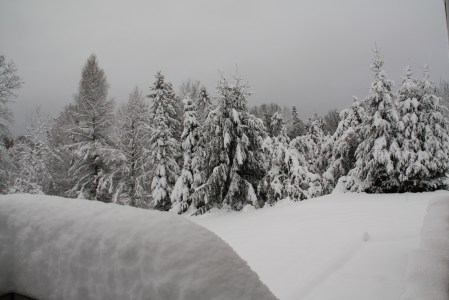
Another raw poem. We lost power at 8:30 am on Wednesday, 30 November and it returned on Friday, 2 December at 2:00 am. 42 hours without power and the temperatures not rising above +2C and dropping to -3 / -5C. No light. No heat. No water. No phone. No internet. I thought of the victorious general who announced to the tune of the bombs bursting behind him on our tv screen that “We bombed them back to the Stone Age.”

Well, here we were sitting in our own miniature stone age and mentally unprepared for the shock of what it all means. What a struggle: to light the fire, to keep it alight (day and night), to keep warm, to prepare hot food over a log fire in an insert fireplace (and us so lucky to have one; some of our neighbors didn’t), and we won’t talk about going to the bathroom! At least, I now what it means to lose power at the start of winter. However, I really don’t understand what it means not only to lose power, but to know that an enemy deliberately and callously stripped that power away.

I tried to put those thoughts into the first version of the poem, but then I took them out as I didn’t want to politicize what is right now a nature poem, pure and simple. The out-[R]-age is there, with or without those other memories and that out-[R]-age comes partly from the knowledge that our civilization, if indeed we can truly claim to be civilized, is indeed skating on very thin ice.

Baby Angel

IMG_0012.jpg

Baby Angel

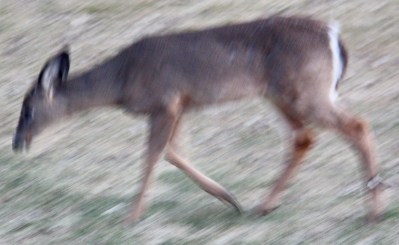
yesterday a baby angel
lay dead beside the road
the trees
caught their breath

the air stood still
a red fox
tore from the woods
a runaway leaf
so quick so silent
a shadow across the road
melting away to hide in the forest

I can still see the occupants of the stricken car
standing with their cell phones in their hands
punching urgent numbers

the mother deer’s dead eyes
gazed at them from inside the windshield
shock had rounded the driver’s snow white
lips into an O for Operator

Dream of Oaxaca

IMG_0165.JPG

Dream of Oaxaca

I can bring you a Bird of Paradise, but I cannot bring you the sounds and smells of Oaxaca. The pungent odour of the first drops of rain falling into dry dust, the tang of waxen candles burning in the cathedral’s dark, the high notes sung at the altar by the old woman, dressed in black, who sings each day, on her knees, before the golden images in Santo Domingo: these sounds and smells defy any words I can pen. Nor can I place on the page the bustle of the abastos, the bickering of rooftop goats, the barking and growling of the dogs who patrol the azoteas at head-height and snap at your ears.  Other things escape me: the salty taste of sweat, the heat and heaviness of the midday sun as its hammer falls vertical from the sky, the sandpaper touch of hand-hewn stone, cobbles hard beneath the feet, the visual impact of the revolutionary bullet holes still scarring the church where Benito Juárez got married and reminding the tourists that violence in Mexico is never far away. The silk smooth threads that run through the vendor’s carpets contrast violently with the harsh sharp tares still lodged in hand carded wool. Colors and scents: coffees and chocolates blending and blended in the open air-market, the spice stall with a hundred different kinds of peppers, the golden yellow flower of the gourd — flor de calabaza — as it floats on the surface of spiced soup or lolls luxurious upon Oaxacan cheese or tortilla and quesadilla. Such things are the substance of daily reality: I remember them well, but I cannot gift you with their taste, nor their smell, nor their sound. At night, strings of fireworks hang down the cathedral’s towers and, at the spark of a match, these castillos as they call them, burn. Cataracts of light flicker and flow as rockets claw upwards into the sky to knock on the doors of the slumbering gods. A bull’s head, attached to a wooden frame, bears fireworks that crackle and spurt fire as the bull charges at the gathered crowd. Sparks char cotton and wool, young girls shriek and flee, a striped, carved tiger emerges sparkling from the shadows and his eyes light up with another set of fires … But there is always something missing from these words. How much can I describe? How much am I forced to leave out? How close can I get to an imagined reality that is more imagined than real, more creation than memory? I live in a world that has forgotten poetry. I live in a world that has laid aside the great myths and replaced them with a media that misleads and falsifies. I live in a world in which the power and glory of words is used not to delight and educate, but to manipulate. I live in a treacherous world of lies and deceit, the world of Descartes’s evil genius, for not everything is as it seems to be and the people have been misled. But this world of ours is old, and older, darker powers than ours still dwell on this earth: a pinch of salt thrown over the shoulder, index finger and thumb pinched into a magic circle that wards off the evil eye, the traditional hunchback – el jorobado –, carved from jade, who packs our cares and troubles into his hump and carries them away … as I have been carried away, on this tide of creation that ebbs and flows, a virtual sea, a wave of autumn leaves that washes up to my door, then falls asleep, golden, brown, peaceful in the vacuum that is left by the wind’s sudden absence. So, for a while, after you have read these words, avoid all shadows, do not step on the black lines that divide sidewalk and pavement into squares, do not crush the elf’s dry bones hidden in a fallen leaf, avoid black cats, make sure the crow flies on the correct side of the road …  then find a quiet corner of the street where the leaves dance to the wind’s tune, and fall asleep to re-create your own life in dreams.

Thought Police

img_0184

Thought Police

Why are they always men,
these blue-clad figures
who wear our dreams like badges
and stare into our eyes,
bright lights behind them,
as they check our numbers
and make us count from one to ten
and up and down again.

Be warned:
you can’t walk in the street
without seeing a curtain
flicker at a window;
unseen lips repeat your words
as they wander,
stray cats and dogs,
from house to house.

Walls have watchful eyes
and lusting ears
that clutch each wayward thought
reporting it to people
who have our best interests at heart,
or so they say.

Don’t look up
but there’s someone
leaning over you,
reading these words right now.

Questions

img_0141-2

Questions

I hear her voice, delicate, distant and I run to the sound, jump on the table, and sit in my usual spot just beside her play thing, but she isn’t there. He’s there, damn it, talking away on that little black thing with buttons. I can see him, smell him. I hate him, his other sex perfumes, his heavy-footed shuffle, his loud voice, his walking-sticks. I run when he approaches, run and hide myself away, making myself small, fitting under furniture where he can’t get at me, trying new places, new spaces …

Downstairs in the basement is good. He has problems with the stairs – shuffle, shuffle, clump, clump – and I get plenty of warning. Not that he ever comes downstairs to the basement. There’s nothing down here for him and I can sit here and snooze and dream and wait for my darling to come back. She will come back. I know she’ll come back. I know she’ll never abandon me, like she’s abandoned him. I am faithful, I can wait.

Besides which, I am training him. It takes time, but he’s beginning to understand that he must do things my way now. I chat him up for food and whisk myself around his legs and down comes the kibble, like manna from heaven. He often spills the food, so I get extra bits, nipping in quickly while he searches for a broom or a dustpan, or that noisy sucking thing I hate so much. That’s not just him, I run when she uses it too: it hurts my ears. And my feelings: I think they’re shooing me away because they don’t want me near. Not that I want to be near him, oh no.

I stay away from the upstairs and the bedroom while he’s here alone. Sometimes we meet on the stairs when I have completed my ablutions, but I give a little shimmy and scoot and leave him star-struck and stranded. He’s just not quick enough. He’s not cruel, mind. He doesn’t kick me or hit me with his stick or anything like that. I just don’t like men. I remember that other man, the one that beat me before she came to the place with all the other cats and cages and took me home. I think all men are like that first man, if you give them the chance, and I’m not giving this one a chance, not until I’ve trained him properly. And he isn’t trained yet. I wonder how long I’ve got?

There he is, hanging on to that little black thing, and when he stops talking, I can hear her beloved voice. It’s distant and a little bit tinny, with a sort of echo, and there are other sounds in the background that I can’t quite make out, but it’s her, I’d know her anywhere, and I whimper and scratch, and he puts down a hand in my direction, but he doesn’t tempt me, and then he holds that black thing down and she calls me by my favorite names and I sit there, silent, and gaze into space, remembering her touch, her gaze, her hand upon my neck, my back … no, I won’t let him that near me, not yet.

Yesterday, he sat at her place by the table and turned the picture machine on. Then shadows appeared and her voice came out of the machine. The shadows moved and played and people chatted back and forth and I didn’t understand it, I just didn’t understand. My whiskers stiffened and I sat there and bristled. The machine was warm and I snuggled up to it, behind the flat piece, where I could listen but he couldn’t quite touch me, even though he stretched out his hand. And she called my name, again and again, but I didn’t move, I just sat there and sat there, waiting.

Then I came to the front of the machine where the shadows danced and her voice was stronger. A shadow, I couldn’t make it out, then her voice again, my whiskers stiffened, I leant forward and sniffed, but no smell, it was her voice, and the shadow shifted the way she does, but they had no smell, and scentless, I could not really sense her, I bristled and she called me, called me by my favorite names, and mewed, I mewed back.

But I couldn’t smell her, and there was no sense of touch … is this the hell all pussy cats will suffer … shadows on a screen, a haunting voice, memories shifting and dancing, no touch, no hugs, no sense of smell … and nothing solid … just shadows and absence … and a sense of chill … forever and forever?