Sous-Chef

IMG_0375 2.jpg

Sous-chef

“I’ll be your sous-chef,” she said,
with a twinkle in her eye,
and she was as good as her word.

She brought me all the ingredients,
laid them out in the right order,
peeled potatoes and carrots,
sliced onions under cold water
to ensure that neither of us cried.

She added crushed garlic into hot
oil, measuring spices and slicing
the chicken into chunks.

I extracted the cork so the wine
could breathe. We sipped sherry
and talked of wind and weather,
of our time together, and how
we would grieve when, early next
day life would force us to part.

Later that night, after dessert
and liqueurs, we climbed up
the stairs and she joined me
in bed, in a sur-chef adventure

that went to my head, with me
as the sous-chef, her as the head.

Comment: Very rare, raw, naughty poem. I wrote it in the garage this morning, waiting for my tires to be rotated. It was cold, I was bored, and I needed warming up. This is one of those poems that I might regret later. I certainly hope not. The rhythms aren’t quite what I wanted, so I may re-do it, and possibly sharpen up the recipe. Your comments and advice will be welcome.

An Old Man

img_0360

An Old Man and His Memories

Me and my broken-record memories,
like a vinyl disc going round and round
on the turn-table, and the needle stuck
in a groove, as I repeat myself endlessly
like any old man with his stories and jokes,
told and heard so often that his old lady
knows the endings before he clears his
throat to start the tale, and the ancient
mariner who lives in his brain stops
people in supermarket and street to tell
them, again and again, about life’s doldrums
where no winds blow and the ship is stuck,
like a gramophone needle in a one-track
groove, no moving air to fill the sails,
and life’s albatross lies heavy on this old
man’s neck, and bends his back so he leans
on his canes, and points with rubber-tipped
stick at the falling snow, never as thick and
heavy as it was in his youth, when he climbed
Mount Everest and ran a four minute mile,
though that’s about the time now for his
one hundred stumbled meters, as he leans
on a grocery cart, like other old men who
grin and wink and nod “Nice cart, eh lad?”
and back in those days, every game was won,
except when the ref was biased, and look:
he still walks lop-sided from that collection
of chips off the old family block that he carries
around, like a slow snail carries his house,
always on the move, from face to fearful face.

April Ducks

IMG_0462.jpg


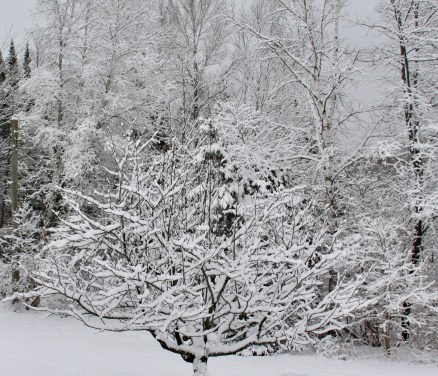
April Ducks … in Spanish … Patos de abril. Patos … because the double two of 22 look like two little ducks … and April … that’s the month we’re in … so Patos de abril … the twenty-second of April, or 22 abril … aka todaythough you wouldn’t think so from the phototaken today … just a few minutes ago …

Nice weather for ducks we say when it’s raining. But what do we say when late snow falls and we have between 4 and 6 inches of fresh snow down on the ground … on April 22nd … and it’s meant to be spring … and yesterday everything was green … and this is meant to be a color photograph … would you believe it? … and yesterday that Mountain Ash was full of birds … a downy woodpecker, creepers, purple finches, American Goldfinches, chickadees … robins were patrolling up and down the garden and juncos gathered with the early morning mourning doves beneath the feeders to pick up fallen seeds …

IMG_0463.jpg


Patos de abril … and winter has returned … we know the snow can’t last too long … we hope the sun will emerge and take it all away … I was late changing my snow tires this year … was that an omen? … I go in on Monday and get them done … we haven’t changed the garage around yet … the snow-blower sits by the garage door … a lion in winter in waiting and ready to roar … soon we will banish him to the back of the garage and bring out the mowers … soon … but not just yet … and certainly not today …

IMG_0464.jpg

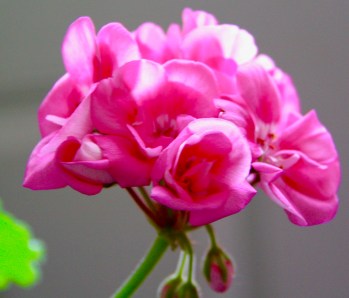
Patos de abril … our indoor geraniums have survived the winter and defy the snow … they are sure the sun will return and the snow will emigrate somewhere … we don’t care where … if only we could build a wall … a great, big, expensive wall to keep winter away … an enormous, gigantic wall … a beautiful wall that unwanted snow storms wouldn’t cross … a wonderful wall … for which, of course, someone else will pay …

Skeleton in the Cupboard: Flash Fiction


Skeleton

Skeleton in the Cupboard

Spring sunshine and I pull out my old summer coat, the one with its pockets stuffed full of memories and dreams. It hides all winter in the clothes cupboard and I free it each spring with the melting snow and the tiny tongues of grass that push through the winter debris that covers the lawn in early April.

Battered and bruised, its elbows discolored where the dry cleaner’s chemicals left disfiguring splodges, it has served me for twelve long summers. It is my constant warm-weather companion, hanging on my arm, my shoulders, gracing me with its comforting presence. Everywhere I travelled for the last twelve years, it has accompanied me.

It is shabby now and grubby. Wine from the bars in El Rincón, El Rastro, El Portalón, Casa Guillermo and many other landmarks have fallen upon it. Octopus, squid rings, mussels, clams, shrimp, goose barnacles, and various types of omelet have left their marks upon it. The English language, with its fish and chips, its bangers and mash, and its sosi, jegg and chips, all bourgeois meals, can never do justice to the pure poetry of Spanish tapas whose names roll off the tongue: pulpo, calamares, mejillones, almejas a la marinera, gambas a la plancha, percebes, tortillas españolas y vegetales. Here I spot a golden stain from riñones al jerez and there a black one from calamares en su tinta.

Weathered by wind and rain, this coat has climbed El Zapatero and walked with the transhumance herds up and down the old Roman road of the Puerto del Pico. It has followed the Ruta de la Plata, the silver trail that led from South America to Sevilla and up the Silver Road past Ávila to Madrid. It has walked through the house in El Barco de Ávila and seen the kitchen where they tore down a wall and found a walled up library, just like the one described by Miguel de Cervantes in the Quixote. It held books proscribed by the Spanish Inquisition that had been hidden away since 1556. It has walked through Piedrahita, San Miguel de Corneja, and Villatoro. It has walked the streets and squares of St. Teresa’s walled city of Ávila on multiple occasions and knelt with me, in prayer, before many a saint on many an altar.

It kept me warm in the hills around Gredos when the mists dropped suddenly down and turned warm day into freezing night. It accompanied me to the Monasterio de Yuste, where the Holy Roman Emperor, Charles the Fifth, retired to live out his days in prayer. It visited the spice towns of La Vera, and ventured into Garganta de Olla, to walk those ancient streets with me. It walked with me in the birthplace of St. John of the Cross and entered with me the depths of the earth where the verdejo is stored in huge oak barrels deep below the town of La Seca.

This old coat keeps its secrets. It remembers the moon hanging its lantern above the battlements on the Paseo del Rastro. We wandered there, she and I, arm in arm, entranced by the shadows that danced on the Medieval walls. When she shivered, I wrapped her in that coat and still it holds the perfumes of her body, the warm touch of her skin, the enchantment of those magic nights when the world stood still and we lay alone at its centre. Oh, and that green stain, there, at the back: that’s where I lay my coat on the grass in the little park under the walls by El Puerto de San Vicente, the one where the lovers go, late at night, beneath the trees, to be together in their loneliness …

Comment: A long time after posting this story, enlightenment knocked at my door. The new cartoon that I had used to illustrate My Old Coat was called Skeleton. Surely, I thought to myself, given the story’s ending, Skeleton in the Cupboard would make a better title. And it would. And I have changed it. A little bit of serendipity at a time (+3C outside the week after Easter) when I need some sunshine in my life. Any comments on the use (or overuse) of Spanish in this story would be very welcome. Best wishes to all my faithful (and unfaithful) readers.

Scribblings

img_0186

Scribblings

Words and thoughts
and symbols and images and
metaphors and myths
and all things missing and
some present in-between sheets
lined and unlined as a line of ants
crosses the kitchen floor
in search of sugar so sweet
these dreams where truth
and lies and smiles and
sighs seize highs and lows
and the light and
dark of a life as it might
have been and was perhaps
on another planet
in my darkest dreams
and my sharpest awakenings and
if I am dreaming then let me sleep
on and on and never wake up
to what passes as reality


Sinister

IMG_0186

Sinister

What the left hand does
when the right hand doesn’t
know what it’s doing
is an attempt to re-pattern
the brain, to slow it down,
as the pencil spider-walks
its wandering way over the page
like my father’s did when,
stroke-stricken in the right hand,
he transferred his pencil to the left
and sought to-re-establish control
over tiny, manageable things,
and yes, he often cut himself
shaving, but he didn’t like beards
so he never gave in and shaved
every day, died fighting,
and did not go gentle,
and neither will I.

Comment: This is a very raw poem, in more senses than one. I fell over on Tuesday, on the back porch. One of the porch nails, forced up by the winter ice, caught in my open-toed sandal and over I went. My head had hit the deck before I even knew I was falling. It wasn’t as bad as the tumble I had when chasing the black bear and trying to photograph it, but this fall left me quite stunned. You can read about the fall HERE. The actual bruising, not the fictional ones, can be found in #3 of that sequence. I wrote the above poem, on Thursday evening, with my left hand, while my right hand was being iced. Funny how we think of one thing while doing another: I had visions of my father, stroke-stricken as I say, trying to write with his left hand. He fought so hard to do just the smallest things. Oh yes, I have a nice bump on my head, too, and as I told the chiropractor when I visited her later that Tuesday afternoon: “I think I have already had my back adjusted once today.” The other thought that comes to me: how slow we are to heal, once we pass a certain age, or, as my good friend Jan the Stoneist says, “an uncertain age.” With that latest fall, I have indeed entered into The Age of Uncertainty.

Love Poem @ 70

img_0146-3

Love Poem @ 70

1
We walk on tiptoe round the garden,
peeling free the sunlight cloud by cloud.

Sometimes, the heart is a sacrifice of feathers,
bound with blood to an ornate altar.

Petrus:
this rock cold against my chest.
Piedra:
centuries of stone carvings
come alive in your face.

If our arms were to meet
around these columns
of sun-warmed flesh and stone,
what would become of us?

2
Beneath my skin, the woad
flows as blue as this evening sky.
Your skin is bronzed
in the warmth of my gaze.

Yellow light bends
low in the fields below us,
each darkening pool
a warrior fallen
beneath time’s scythe.

The moon paints a delicate circle.
Its great round eye opens out
above the rooftops,
a cathedral window
opening on the sky.

Tonight it bears
the wisp of an eye lid
carved from  cloud.

Your teeth are diadems of whiteness
aglow in your face.

We tie shadows to our heels
and dance in triumph
to the village music
sounding in street and square.

3
Daylight bends itself round rock
and turns into shadow.
We flourish in blocks of flickering flames.

Dreaming new selves from roots and branches,
we clasp each creation with greedy fingers.

Dark angel bodies with butterfly wings,
our shadows have eloped together.
They sit side by side holding hands
at a table in the central square.

4
Church bells gild the barrio’s rooftops.
Our fingers reach to the skies and hold back light.
We draw shadow blinds to shut out the sun.
Night fills us with stars and a sudden sadness.

We dream ourselves together in a silent movie,
closed flesh woven from cobwebs
lies open to a tongue-slash of madness.

The neighbor’s dog wakes up on the azotea.
He barks bright colors as dawn declares day
and windows and balconies welcome the sun.

Can anyone see the dew-fresh flowers
growing from our tangled limbs?

Your fingers sew a padlock on my lips:
We listen to the crackle of the rising sun.

Never The Twain


IMG_0157.jpg

Never The Twain

“And never the twain shall meet.”

This was the chorus that my grandparents often chanted at me when family members started rowing with each other over one trivial incident or another.
“But what happens when the twain do meet,” I used to ask.
“Don’t be silly,” they said. “The twain never meet. Ever.”
But I know very well that they do.
I know.
I’ve seen them together.

Funny things, they are, the twain, and opposites in so many ways. But so nice, in spite of what some people, especially my grandparents, used to say about them.

Not only do they meet, but they can be happy together and very, very friendly.
“Long time, no see,” the twain say, and they often embrace quite warmly with a bunch of flowers held between them.

Mind you, the twain can also be quite awkward and occasionally very abusive towards each other. I remember my mother and father fighting “like cats and dogs” as my grandparents used to say.

Now, my grandparents had a cat. It was black and white and striped like a zebra. They called it Spot. My parents had a dog. It was an English Cocker Spaniel, gold in color, and off-spring to a famous sire, the Six-Shot Woody Woodpecker. They called the dog  Wimpy but it was by no means a wimp and fought with everything in sight, especially the cat.

So when my father and mother fought and the family cat and dog fought, I thought, quite reasonably in my opinion, that the dog (with his short hair) was male and the cat (with her long hair) was female, and that was the reason why they fought like cats and dogs. And “never the twain shall meet” as my grandparents used to say about my mother and father and the cat and the dog.

I guess it was too early to learn about the birds and the bees when, young and all too innocent, I was learning about the cats and the dogs.

And of course it’s only natural that the twain should meet. My mother and my father, like the cat and the dog, had to meet somewhere, didn’t they? How else would I be here? Now, we weren’t the sort of family that practiced contraception by throwing stones at the storks to keep the babies away.

But I could never work out why the cat always had female kittens while the dog had all-male off-spring. That was a bit too much for me, and nobody ever really explained anything I those days.


Easter Seals

IMG_0133 2

Easter Seals

So, I’ll put my cards on the table:
it’s Easter and the seals are dancing
in the garden, and they are ring-tailed,
like raccoons, and they’re dancing
because it’s Easter and they’re Easter
Seals after all and you can’t blame them
for dancing when their time is upon them
and they’re in season and everybody
dances when the time’s right, don’t they?,
because I know I do, and I’m dancing right
now, dancing with joy and happiness
because last night, for the first time in two
years since I started my cancer treatment,
I only peed once, at half past three,
and I went to bed at ten and dammit,
that’s five and a half hours of sleep,
for the first time in two years, and I
usually pee every ninety minutes
and that’s five or six times a night,
but last night, I peed just that once,
and I went back to bed and I slept
for another four and a half hours
until eight o’clock in the morning
and that was almost ten hours straight
for the first time in … well, you remember,
I don’t need to repeat it yet again …
but boy, do I ever feel good this morning,
and yes, I’m laying my cards on the table
and I’m dancing, just like those Easter Seals.

Comment: I finally finished my poetic journal, A Cancer Chronicle, and I put it up on Amazon last Friday. A Cancer Chronicle is sub-titled ‘one man’s journey’ and in it I write about my reactions to the treatment I received for prostate cancer. I met many people at the cancer hospice during my eight week stay, most of whom were a lot worse off than I was. I admired the courage of my fellow sufferers and learned so much about human beings and how they face adversity. I was particularly impressed with the bravery of the women who were suffering from breast cancer. They were so strong, so courageous. In spite of their troubles, my fellow patients reached out and helped me from the first day of my stay. They pulled me through the difficult days and shared their experiences with me. I will never forget them. If this book can comfort just one cancer sufferer, I will be so happy.

It’s just a guess, but I am assuming that finishing A Cancer Chronicle took a weight off my shoulders and allowed me the peace of mind to finally sleep. I do hope that this is a milestone and that my recovery will continue. Pax amorque / Peace and Love.