Teddy and the Angels

Teddy and the Angels

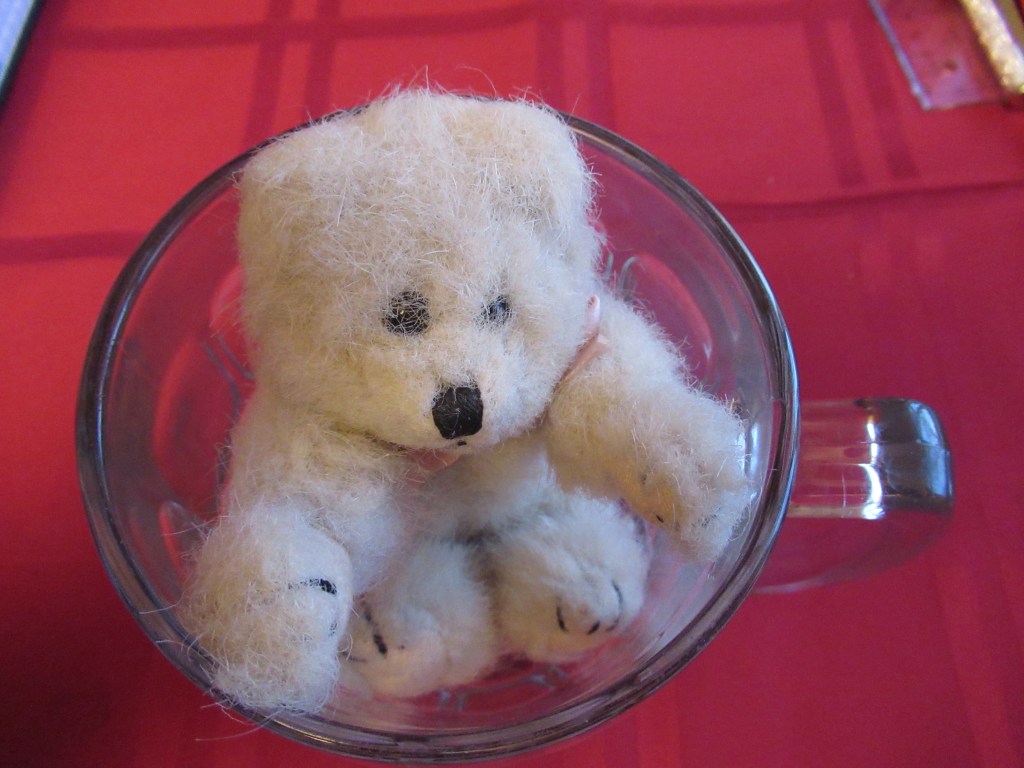
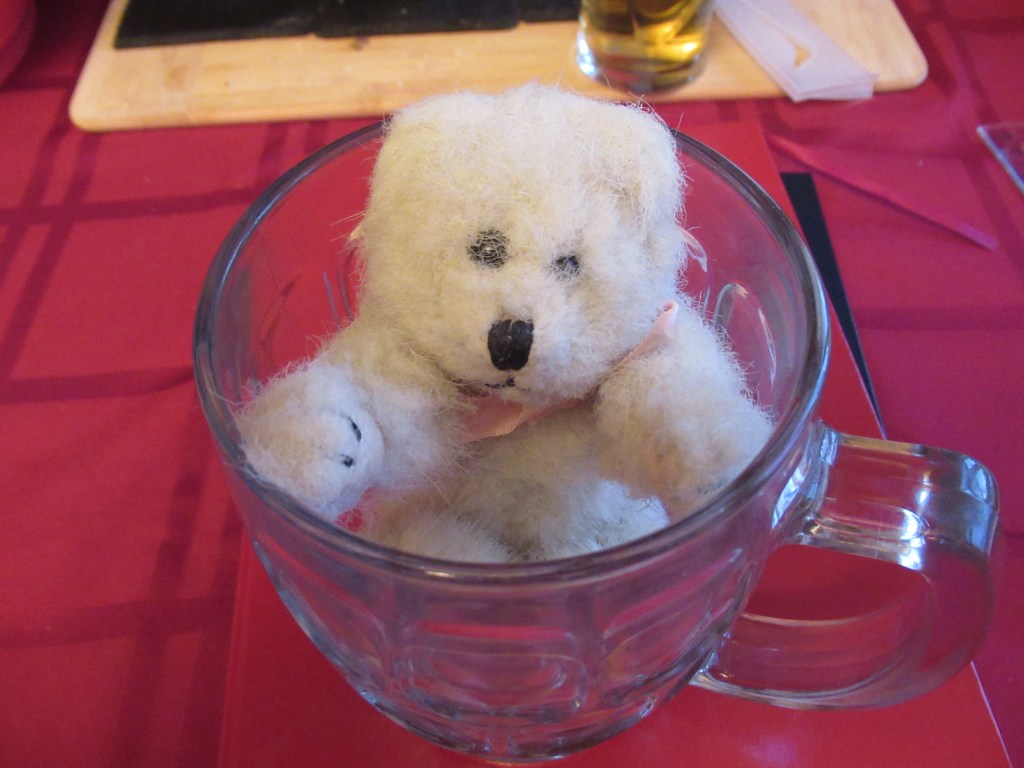
Warm in Bed. Cozy. I roll over and the flashlight clipped to my Teddy Bear’s ear drives its hard, metal lump into my face.
            “Are you awake?” Teddy’s soft voice lilts across the pillow.
            “I am now.”
            “Look!” Teddy points with his little leather paw. “The moon: it’s climbing the fir tree.”
            Sure enough, a thin fingernail of gold is perched on a branch. It hides its face among the fir’s darkness and vanishes for a moment.
            “The maple tree has a garland of tiny Christmas lights,” says Teddy, pointing again.
            “Those aren’t Christmas lights, they’re stars.”
            “Spoilsport. Look, that one’s moving. I think it’s an angel.”
            “What time is it, Teddy?”
            “I don’t know.”
            “Here, lend me your flashlight.” I pull him towards me, switch on the torch, and focus its light on my wristwatch. “4:55 AM. That’s the early morning flight from Toronto. It’s a plane.”
            “I’d much rather it was an angel.”
            “Me too.”
            “Can we pretend it’s an angel, a Christmas angel?”
            “Of course we can. But it’s gone now.”
            “Perhaps angels don’t live long when they come to earth.”
            “I think they live for ever. Especially if we believe in them.”
            “Do you believe in angels?”
            “I was taught to believe in my guardian angel.”
            “What’s a guardian angel?”
            “He’s the one who looks after you when you sleep at night.”
            “But you don’t need a guardian angel. You’ve got me.”
            “But you’re a teddy bear, not a guardian bear.”
            “That’s true, but you’ve got Blueberry. He’s your guardian bear. Look at him standing there, on guard, all night long to protect you from the Night-Bumps.”
            “Ah yes, good old Blueberry. I’ve got a busy day today. I need some more sleep.”
            “Okay. Blueberry and I will watch over you. I’ll watch over you. I’ll let you know if any more angels climb the tree.”
            “That would be nice. Now I’m going back to sleep.”
            “Good night. Or should that be ‘good morning’.”
            Some days, when I wake up, I think I have dreamed all of this. Other days, I believe in talking teddy bears and angels. Today, I’m not so sure.
Monkey and the Bean Counter

IMG_0026

Monkey and the Bean Counter

An acolyte in a charcoal suit runs by.
He neither stops nor speaks
but slips on slippery words
dripping from another monkey’s tongue.

This other monkey has eyes of asphalt,
a patented pewter soul,
ice water flowing in his veins.
“Hear no evil! See no evil! Speak no evil!”

The hatch of his mind is battened tightly down.
Nothing gets out nor in.
The acolyte’s fingers grasp at a khaki folder,
his manifesto for success.

Senior monkey stalks to his office
and turns on the radio.
His favorite music:
the clink of mounting money.

Disturb him at your peril:
this monkey is very important,
and very, very busy.
He’s also clever:
a real smarty.

First, he empties all the chocolate candies from the box
then he sorts them into little piles:
green with green, brown with brown,
blue with blue, red with red.

Then, like the Good Shepherd checking His flock,
he counts them again and again,
to ensure that none have been stolen
and not one has gone astray.

Comment: Another Golden Oldie, this time from Monkey Temple. I have updated it slightly so it won’t be exactly the same as it is in the printed text. Senior Monkey has, of course, built a bigger box into which he can place all his chocolate candies and tuck them away for ever and ever. I guess if he were a bull and not a monkey, he would have tucked them away for heifer and heifer. Such is the sad state of reality in the Monkey Temple. But if monkey were a bull, he would be living in the cow shed, not the Monkey Temple. Oh dear, oh dear: and oh what a tangled web we weave when first we practice to deceive with fiction, flash fiction, creative non-fiction, and all the other sugar and spice which goes into the spinning of spider-webs and fairy tales. Speaking of which, did I ever tell you the story of the… well, maybe next time. So tune in again tomorrow. Same thyme, same plaice, and I’ll sing you a song of the fish in the sea… and a fishy tail that will be.

Milton Acorn and the Jack Pine

Milton Acorn and the Jack Pine

            I met Milton Acorn in the photocopying room of the university in which I taught. I didn’t know who he was, but I soon found out.
            “Oy! You,” he waved his strong, carpenter’s hands, and stabbed me with a gnarled index finger.
            “Are you Milton Acorn,” I asked. “The poet?”
            “Yup. Make this machine work.”
            “I’m meant to be taking you to lunch.”
            “Got this job to do first,” he pointed at the machine. “Turn it on.”
            I typed in my code and the copier leapt into life.
            “Now go away. I need to be alone.”

            A few minutes later, I returned to find him lying on the photocopier, eyes shut, face pressed against the glass. Lights flashed, the copier whirred, and a copy of his face emerged. He descended from the machine and added his face to the pile of photocopies that lay at his feet.
            “Tape,” he said. “I need tape,” he again stabbed me with his finger and held out his hand.
            “I’ll go and get some.”
            I went to my secretary’s office.
            “What the heck is he doing in there?” she asked.
            “I haven’t got a clue. But now he wants some Scotch tape,” I held out my hand and she handed me a roll of tape “Thanks,” I said.

            I gave Milton the tape and watched as he taped the copies together. He had photocopied his whole body, arms, legs, back sides, feet.
            “Me,” he said happily. “That’s me,”
            Triumphant, he showed me his work: a self-portrait, shadowy and cloudy, still warm, with him all whiskered and worn, smelling still of photocopying ink, unique, unmistakable, uncouth, unseemly, but the real Milton Acorn, a jack pine sonnet self-grown in his own poetic image.

Dog Daze

Street of Life or Death

Dog Daze

Memories deceive me with their remembered shows,
shapes shifting with a click of the magician’s fingers.
What magic lantern now slips its subtle slides

across night’s screen? Desperate I lap at salt-licks
of false hope that increase my thirst and drive me
deeper into thick, black, tumultuous clouds.

A pandemic storm lays waste to the days that dog my mind.
Carnivorous canicular, hydropic, it drinks me dry,
desiccates my dreams, gnaws me into nothingness.

At night a black dog hounds me, sends my head spinning,
makes me chase my own tail, round and round. It snaps at
dreams, shadows, memories that ghost through my mind.

Tarot Cards and Tea Leaves are lost in a Mad Hatter’s
illusion of a dormouse in a teapot in an unkempt tale.
Hunter home from the hill, I return to find my house
empty, my body devastated, my future a foretold mess.

Comment: Tough days around us and even tougher ahead. Covid-19 in the schools and people I know, young and old, frightened and in quarantine as a result. People I know and members of my far-flung (thank you, Jennifer, for that long-lost word) family. Funerals to the right of me, funerals to the left of me, of friends I know, acquaintances I hardly know, and many more whom I’ll never know now. “Into the jaws of Covid-19 rode the gallant six hundred, all masked, many falling, fewer of them every minute of every day.” Gallows humor keeps me alive. Last night my favorite teddy bear went AWOL. I got up at 3:00 am and sent out a search party. Sharp eyes spotted the copper band I lost last week. It had been hiding under the pillow. Then, joy of joys, they spotted Teddy’s black velvet band, the one that ties up the hair that falls over his shoulder and gets up my nose and makes me sneeze. They hauled him out from under the bed. I picked up the phone and cancelled the 911 call before the masked men in their jackboots and their PPE could break down the door and strip search the house for a missing bear. Alas, dear Mabel: I would if I could but I am not able.” How those words resound in my ears. Left ear, right ear, and, like Davy Crockett, a wild front ear. I will not give in to morbidity. ‘He who fights and runs away lives to fight another day.” I will survive for another day. Meanwhile, I’ll call for General Worthington, the fellow who can always make the enemy run. “Will you have a VC?” I said “Not me: I’d rather have a bottle of Worthington.” Alas, they don’t make it anymore. And Watney’s Daft Red Barrel has bitten the dust and gone the way of the dodo. And all my friends are in the doldrums, watching, as Admiral Brown abandons ship, mans the boats, and hauls away into fairer weather and cleaner waters. You say you do not understand? ‘Blessed are the poor in intellect, for they shall know peace in these troubled times.’

The truth goes marching on.

Sunday in Wales

To be Welsh on Sunday
(This prose poem should be read out loud, fast, and in a single breath!)

              To be Welsh on Sunday in a dry area of Wales is to wish, for the only time in your life,  that you were English and civilized,  and that you had a car or a bike and could drive or pedal to your heart’s desire, the county next door, wet on Sundays, where the pubs never shut  and the bar is a paradise of elbows in your ribs and the dark liquids flow, not warm, not cold, just right, and family and friends are there beside you  shoulder to shoulder, with the old ones sitting  indoors by the fire in winter or outdoors in summer,  at a picnic table under the trees or beneath an umbrella that says Seven Up and Pepsi (though nobody drinks them) and the umbrella is a sunshade on an evening like this when the sun is still high  and the children tumble on the grass playing  soccer and cricket and it’s “Watch your beer, Da!” as the gymnasts vault over the family dog till it hides beneath the table and snores and twitches until “Time,  Gentlemen, please!” and the nightmare is upon us as the old school bell, ship’s bell, rings out its brass warning and people leave the Travellers’ Rest, the Ffynnon Wen,  The Ty Coch, The Antelope, The Butcher’s, The Deri, The White Rose, The Con Club, the Plough and Harrow,  The Flora, The Woodville, The Pant Mawr, The Cow and Snuffers — God bless them all, I knew them in my prime.

Comment: I wonder how many other ‘serious drinkers’ or ‘amateurs’ remember these pubs and clubs. And, oh yes, there were so many more. The Mexico Fountain, The Tennis Court, The Old Market Tavern, The New Market Tavern, The Load of Hay, all those many colored dragons: green, black, blue … the Three Lamps, the Cricketers, the Villiers Arms, the Birchgrove Arms, the Rose and Shamrock, several Red Dragons, the Church, the Black Swan, I can’t remember how many different Georges, and Kings’ Heads, the Vine Tree, the Sun, the Oak tree, the Penguin, the Naval Volunteer, the Quadrant, the Coronation Tap, the Mauretania, The White Horse, the Black Horse, the Old Grey Mare … so many memories, and all deniable, and I’ll never forget the Wheelbarrow Race (ask me about it), nor Pickety Witch, one of those pubs at which I never stopped!

Monkey Throws Away the Keys

Monkey Throws Away the Keys

Monkey is tired of writing reports
that are never read.
He is fed up with frequently asked
questions and their unread answers.
To every lock, there is a key.
Monkey looks at the red and gold
locks of the last orang-utangs
and wonders how to unpick their DNA.

Monkey would give his kingdom
for a key, a key, a little silver key:
the key to a situation, the key to a heart,
the office key, the key to the door,
at twenty-one, the keys of fate,
the Florida keys, the key to San
Francisco’s Golden Gate,
a passe-partout, a skeleton key,
the key to Mother Hubbard’s cupboard,
where she hides dry bones …

On the last day, when monkey leaves work
he takes a lifetime of keys
and throws them down a deep dark well.

As they halve the distance to the water,
he listens to the sound of silence and wonders
if they’ll ever hit the bottom.

Monkey Temple:
the complete book, is available on KDP and Amazon.

Monkey’s Clockwork Universe

Monkey’s Clockwork Universe

Some days, monkey winds himself up
like a clockwork mouse.
Other days he rolls over and over
with a key in his back
like a clockwork cat.

Monkey is growing old and forgetful.
He forgets where he has hidden the key,
pats his pockets, and slows right down
before he eventually finds it
and winds himself up again.

One day, monkey leaves the key
between his shoulder blades
in the middle of his back.
All day long, the temple monkeys
play with the key,
turning it round and round,
and winding monkey’s clockwork,
tighter and tighter,
until suddenly, one day,
the mainspring breaks
and monkey slumps at the table:

no energy, no strength, no stars,
no planets, no moon at night,
the sun broken fatally down,
the clockwork of his universe
sapped, and snapped.

Paella

Paella

A bullfrog lives in my computer.
He eats all the full stops and I can’t
type a period to end my sentences.

I imagine he thinks they are tadpoles,
though the commas, with their short,
twisted tails, would be visually better.

I could live without commas, I can’t face
an endless future with no periods in sight
and www-comma-com just isn’t right.

I guess I could survive a future without
frogs, though cuisses de grenouille appear
each summer at my local super market.

I ate a paella québécoise in a Spanish café
in Montreal once. It was full of frogs’ legs
and was very, very tasty. I wonder if I can
find that bullfrog and put him in a paella.

Empty Head


Empty Head

I sat in class, head in hands, avoiding eye contact. I hoped the priest wouldn’t point me out, call on me, nominate me with a finger, but to no avail. He called my name.

“You have sixty seconds to speak about,” he paused, then produced the rabbit from the hat. “Matches. Come along, stand up, sixty seconds, starting,” he watched the second hand go round on the classroom clock, then counted down: “5, 4, 3, 2, 1 …” waved his hand, and shouted: “Start now!”

            Images flashed through my head: matches: cricket matches, boxing matches, rugby matches, soccer matches, chess matches, matches to light the burners on the gas stove, the oven, to light the fire in the fireplace … matches, matchsticks, Match Box toys, Dinky toys, toys for little boys, toys for big boys …

            “Fifteen seconds have gone … you have forty-five remaining.”

            “When I think about matches, I think about …”

            … the first spring day in the bungalow, our summer home. The rooms are cold and damp after the winter and nobody has been here since last year. We lay a fire in the grate, but the wood is damp, as is the old newspaper we gather from our last visit. We search for sugar to aid the blaze that we hope to start, but the sugar bowl is empty. We go to the stove. Cold, winter ashes crowd the fire bowl. We scrape them together in a desperate search for charcoal remains …  but we find nothing. We move to the oil-fired lamps and oil stoves. Matches dragged across soggy sandpaper fail to spark …

            “Come along, boy. We haven’t got all day. You’ve got thirty seconds left.”

            Silence fills the room. It is broken by the childhood sniggers and chuckles of long-forgotten classmates who never became friends My cheeks grow red. I start, stammer, and stop.

            … we leave the bungalow. Go next door to where our neighbours winter over. We knock on the door. “Can you lend us a match?” we ask, holding out our hands. Mrs. Williams beams at us. “A match,” she says. “First time in after the winter?” We nod. “I thought so. Saw you arriving. Wondered why you hadn’t come earlier. The weather’s been nice. Here: I can do much better than a match.”  She moves over to the fireplace, picks up the little coal shovel, scoops up a generous portion of her fire, heaps on another lump, then two, of fresh coal, and “Here you are,” she says. “Just put it in the fireplace and add some wood and coal. This can be your first fire. Here, you’d better have some matches too.” “Thank you, Mrs. Williams,” we say. “No problem,” she replies. “It’s good to see you back. It’s been lonely here this winter without you.”

            “Time’s up,” the priest says. “That’s sixty seconds of silence and you can hardly find a word to say on a simple subject. Are you stupid or what?

            My face turns red and I suffer the hot, burning cheeks of childhood shame.

Comment:

This is a theme to which I have returned on many occasions. Click on the link to see the original post. https://rogermoorepoet.com/2016/05/page/2/