Underworld

Underworld

In the secret world of my goldfish bowl
I speak in bubbles but only hear silence.

My fish-eye lens bends the pendulum
of the grandfather clock. Westminster chimes,

inaudible, do not intrude. Noiseless are time’s
ripples across the surface of my submarine sphere.

I feel, rather than hear, my troubled heart beat.
The foreboding sounds of distant voices leave

me untouched and becalmed. Rocked in love’s
cradle, these amniotic waters nourish and soothe.

In my beginning will be my end. One day I’ll return
to the beaches of my childhood, where the sun

always shines, and the moon path over the waves
is a welcoming walkway leading to the underworld.

What is the most important thing to carry with you all the time?

Daily writing prompt
What is the most important thing to carry with you all the time?

What is the most important thing to carry with you all the time?

Things I carry with me

            That old black cast-iron stove, wood-fired, that baked the best ever breads and cakes and warmed the bungalow on cold, summer mornings. The Welsh dresser with its age-blackened rails that displayed the plates, and cups, and saucers. The old tin cans that ferried the water from the one tap located at the end of the field. Full and wholesome, its weight still weighs me down as I carry it in my dreams. The Elsan toilet from the shed by the hedge and the shovels that appeared, every so often, as if by magic, as my uncle braved the evening shadows to dig a hole on the opposite side of the field, as far from the bungalow as possible.

            The outhouse at the end of the garden. The steps down to the coal cellar where they went when the sirens sounded, to sleep in the make-shift air raid shelter, along with the rats and mice that scurried from the candles. The corrugated iron work shop in the garden where my uncle built his model ships, the Half-Penny Galleon and the Nonesuch. The broken razor blades I used to carve my own planes from Keil Kraft Kits, Hurricanes and Spitfires, an SE5, and once, a Bristol Bulldog. Twisted and warped, they winged their ways into nobody’s skies, though once we built a paper kite that flew far away in a powerful wind and got tangled in a tree. The greenhouse from which I stole countless tomatoes, red and green. Kilvey Hill towering above the window ledge where the little ones sat when there were more guests than chairs in the kitchen. The old bombed buildings across the street. The bullet holes in the front of the house where the Messerschmidt strafed us.

            The old men spitting up coal dust from shrivelled lungs. The widows who took in lodgers and overnight travelers. The BRS lorries, parked overnight, that littered the street. The steep climb upwards into those lorries. The burrowing under dirty tarpaulins to explore the heavy loads, and many other things. The untouchable, forbidden drawer where the rent money waited for the rent collector’s visit. The old lady, five houses down who, when the shops were shut, sold warm Dandelion & Burdock and Orange pop for an extra penny a bottle.  The vicious, snub-faced Pekinese that yapped fierce defiance from the fortress of her lap. The unemployed soccer referee who on Saturdays walked five miles to the match and five miles back just to save the bus fare, his only financial reward. My father’s shadowy childhood. His first pair of shoes, bought at five years old, so he wouldn’t go barefoot to school. 

            Wet cement moulded onto the garden wall, then filled with empty bottles to be smashed when the cement set solid. The coal shed where the coal man delivered the coal: cobbledy-cobbledy, down the hole. The outside toilet with its nails and squares torn from yesterday’s newspaper. The lamp-lighter who lit the lamps every evening as the sun went down. The arrival of electricity. The old blackout curtains that shut in the light and shut out the night. The hand rolled fabric sausage that lay on the floor by the door and kept the heat of the coal fire in the kitchen. The kitchen itself with its great wooden chair drawn up by the fire. That chair: the only material possession I still have from that distant past.

Describe one habit that brings you joy.

Daily writing prompt
Describe one habit that brings you joy.

Describe one habit that brings you joy.

Creativity. I was told, a long time ago, that genius is 99% perspiration and 1% inspiration. When I started creating – poetry, mainly – I waited for the muse to arrive and lamented when she didn’t. Then I tried to force her to visit me – and that didn’t work either. Then, in 1985, I started a journal. I wrote in it every day that year and, as I wrote, I realized that most of what I was writing was gibberish. But – and it’s a big but – a few literary gems gleamed out from the rubbish. The question then became – how to recognize them. The answer to that has come more easily, the longer I have worked at writing. It’s not the muse who needs persuasion, it’s the artistic eye and mind that need to be trained so that they can see the creative art in the surrounding world.

Now, after 38 years of regular journaling – and I try not to miss a day – I can distinguish easily between art and rubbish. My poetic creativity, often via a streak of surrealism, has wormed its way from poetry, into poetic prose (short stories and novels), and from there into my style of quasi-surrealist, quasi-expressionist paintings.

Where is the joy? The joy lies first, in the work itself, the contemplation of the blank page, then the slow tidal flow of words that fill the empty spaces. Then comes the joy of recognition, followed by the joy of selection, followed by the joy of polishing, and eventually, the joy of publication. The same is true of painting. Here, the empty canvas, like a beach with the tide coming in, fills up with color and shape and, like Matisse, I try to make meaning out of those colors and shapes. Am I great artist? Of course I’m not. I’m a dibbler and a dabbler, unknown and unrecognized, but joyous in my joy of creating something that will stand, for a little while, against time’s rising tide.

Qué será

Qué será

Peace in the Peace Park,
here on the headland,
where cool grass slopes
down to the water’s edge.

Geese have nested close by
and gifted us with goslings.
Golden balls of fluff, they walk
on the land right now,
but soon will take to the water.

A thin, yellow line, they will
paddle behind their parents,
webbed feet invisible
beneath the water’s flow.

And I, in the metal coffin
of my over-heated car,
sit and watch them, envying
their freedom of movement,
waiting for whatever will come.

My beloved draws near.
I sense as much as see her,
as I covet her strong steps,
the ageless sway of her body.

Alas, I am growing old,
and not with any grace,
but fighting it all the way,
and qué será, será
is all that I can say.

Rebirth

Rebirth

“El mundo nace
cuando dos se besan.”
Octavio Paz

A new world is born
when two people kiss.
The hummingbird sips
at the hollyhock’s lips.
Bee enters the blossom
and, sated, comes out.
A butterfly perches,
flutters its wings.
The sun enters a cloud:
radiance is born.
Silver linings
morph to gold.
The sun’s needle stitches
the world together.
Oh to be a part of Eden,
Paradise born anew,
in the moment when
lip meets lip and the tongue
is a twister, touching down.
Two hearts a-whirl,
their world aflame.
Their world reshaped,
new shapes now born.
Wild flowers swaying
in an age-old dance.
Life’s journey renewed,
not always by chance.

What traditions have you not kept that your parents had?

Daily writing prompt
What traditions have you not kept that your parents had?

What traditions have you not kept that your parents had?

What traditions have you not kept that your parents had?

To the best of my knowledge, my parents only had three traditions. I have not kept any of them.

Tradition 1: They took two weeks holiday every year in August. Both were hard-working, and that holiday was always a precious break from work. Being employed in academia and a life-long inhabitant of the Ivory Tower, I have not had holidays forced upon me by a 9 to 5 work schedule. Research and creativity do not function according to a 9 to 5 clock. I realize how fortunate I am, and I give thanks every day for my intellectual and creative freedom.

Tradition 2: They fought like cats and dogs at every opportunity. It was so bad that, at one stage, in my innocence, I thought that cats were females and that dogs were males, and that was why they opened instant hostilities whenever they saw each other. Luckily, I have no siblings to challenge this view of events, and my parents are long gone, so they won’t be worried either.

Tradition 3: My maternal grandmother’s birthday was just before Christmas. On her birthday, every year when I was a child, my mother would come home early from work, but my father wouldn’t. He often didn’t come home at all. Office parties. My mother would hang around the house for a while, consoling herself. Then she would get angry, tell me to pack a bag, pack one herself, and call a taxi. This would take us to the railway station or the bus station, and off we would go to grandma’s house to celebrate her birthday. My father, looking sheepish and hang-dog, would arrive late Christmas Eve, or early Christmas morning. On Boxing Day, the gloves came off, and they were at it again. That’s why it’s called Boxing Day. Well, that’s what I thought anyway.

So there you have it. Three traditions that my parents had and that I have never kept.

If you could bring back one dinosaur, which one would it be?

Daily writing prompt
If you could bring back one dinosaur, which one would it be?

If you could bring back one dinosaur, which one would it be?

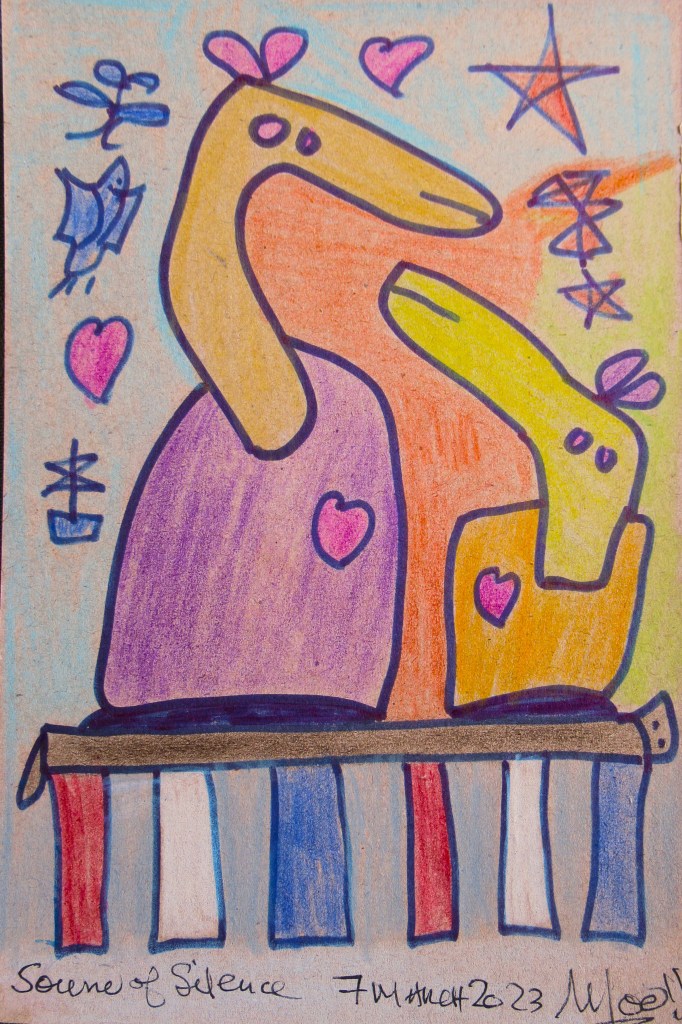
Probably my maternal grandfather. He was always a bit of a fossil, ostrich-like, with his head buried in the past. A great-story teller, he spun a web of intrigue about things that happened in his youth, like when he ran away to sea, age 12, Swansea in the old days, and his time in the trenches during WWI. I would climb up the back of his chair while he was sleeping, and blow on the bald spot at the back of his head to wake him up. Then I would climb onto his lap and say, “Grandpa, tell me a story.” And he would.

My friend Moo painted a picture of the two of us together when I was younger. That’s him, on the left. I am the smaller one on the right. He would walk with me all over Swansea Sands, telling me stories as we walked. “This is where the medicine man would pitch his stall,” he’d say. Then he would tell me about the fraudulent way the doctor sold his bottles of cough mix. A miner, with no voice would approach from the crowd. One sip of the magic potion and he’d be singing hymns and arias, voice fully restored. “Bribed, of course,” Grandpa would tell me.

Next to the snake medicine stall, a travelling dentist would pitch a stage with a small brass band and his chair. Patients would handover their three penny coins, the band would start to play, the patient would open his mouth, the dentist would wield his pliers, and out would come the tooth. Then doctor and patient would dance to the band music until the patient stopped screaming. “No anesthetic back then, see,” Grandpa would chuckle.

Oh yes, that’s the dinosaur I’d bring back. And I’d record his voice, and write down, in full detail, every story, each tall, or short, tale he told me.

Heartbreaking

Heartbreaking

How many have broken their hearts,
reading what I have written, as I have
broken mine, reading what others wrote?

My words reach out, naked, stripped
of false trappings, fake images,
my flesh and blood damp on the page.

Who knows where my words will land,
on fertile ground, on desert sand, or will
they lie on dry, stony paths, infertile?

So many people now scorn living words,
preferring those dull dry three-word chants,
fists clenched, or raised, that hypnotize.

Their love of words, thoughts, ideas, life
have been coffined in confining boxes,
cardboard castles, corrugated cans,
that they lock, then throw away the key.

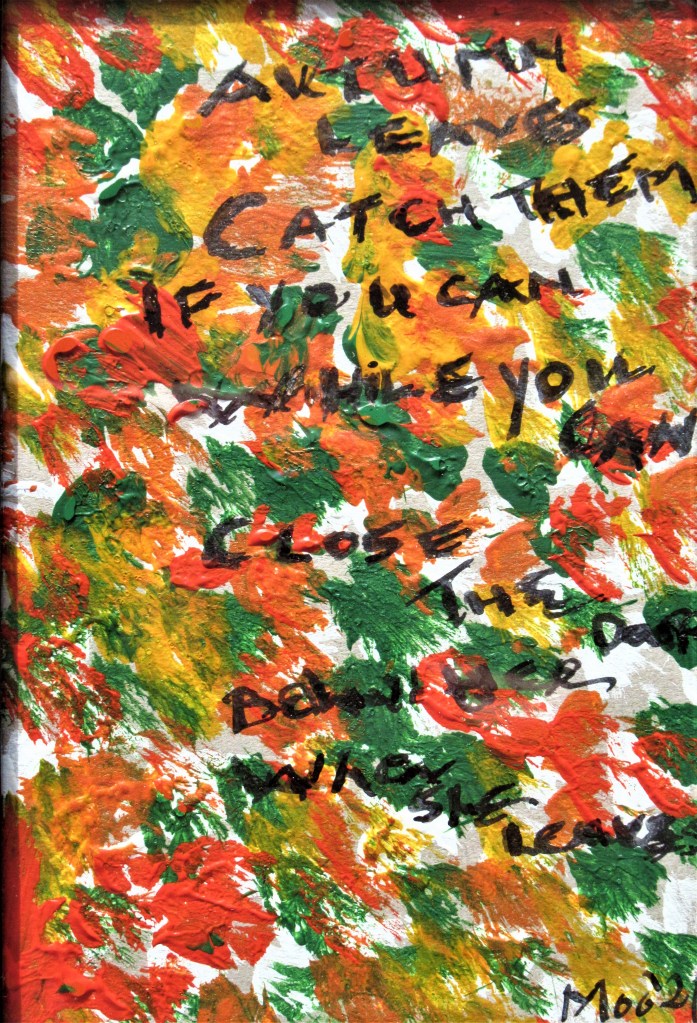
Comment: Thank you Moo for your painting – Words fall like leaves and drift away. It make a fine companion to the poem.

One Small Corner

One Small Corner

 And this is the good thing,
to find your one small corner
and to have your one small candle,
then to light it, and leave it burning
its sharp bright hole in the night.

 Around you, the walls you constructed;
inside, the reduced space, the secret garden,
the Holy of Holies where roses grow
and no cold wind disturbs you.

 “Is it over here?” you ask: “Or over here?”
If you do not know, I cannot tell you.

But I will say this: turning a corner one day
you will suddenly know
that you have found a perfection
that you will seek again, in vain,
for the rest of your life.

Comment: This is the title poem of the book One Small Corner – A Kingsbrae Chronicle, written at the first Kingsbrae International Residences for Artists (July, 2017), and published on Amazon – Kindle that same year. This is the video that accompanies the poem. https://www.kingsbraeartscentre.com/ – turn up your sound. My thanks to all those involved in that first residency and especially to Mrs. Lucinda Flemer, Geoff Slater, and my fellow resident artists, Ruby Allan, Carlos Carty, Elise Muller, and Ann Wright. One Small Corner, along with some other publications, can be found by clicking here. Special thanks for the making of the video itself go out to Geoff Slater, Jeff Lively, and Cameron Lively.

Ghost Train

Ghost Train

I remember the little electric railway
that ran on a single loop around
the kitchen table, diddly-da-diddly-da,
just like a real train, except no smoke,
no puff the magic dragon, no sense
of a schedule or arriving and departing
when circular time is meaningless,
as are the numbers on the sundial
when the sun isn’t shining,
or the hands on the clock’s blank face
when the numbers are missing,
and you don’t know whether you are
looking in time’s distorting mirror
or are standing on your head
in the Antipodes, and all the while
the clock hands are marching round
and round, tick-tock, and there is
no track by which time can be tracked.

And the runaway hands go round the track,
and the electric train goes round the table,
 and the ghost train hoots whoo-hoo,
as it vanishes into the timeless tunnel,
then exits, the engineer, like Rip Van Winkle,
grown old with a long beard, and the carriages
all covered with cobwebs, and skeletons
leaping out of the compartments,
then sitting beside the travellers
as they snore on their seats.

Comment: Another poem based on a prose prompt. What a great source for poetry those prompts can be, when you don’t take them too seriously and allow your imagination to run riot and your memories to flow. Not automatic writing, but writing that springs from an absurd, surrealist approach to the crazy world that surrounds us. Rain that causes the yucca plant to grow, then falls so hard that it is battered to the ground by the very thing that gave it life. And so it is with my memories of the many trains on which I have travelled and with which I have played. Once upon a time, I couldn’t conceive of life without the railway. Where is it now? I haven’t been on a train for more than fifteen years. Strange how their ghosts flit through my dreams at night: fast trains, slow trains, the wrong train at the wrong time taking me to the wrong place in time. Ah, the poetry of trains yet, “ni temps passés ni les trains reviennent.” And you can give yourself a glow of satisfaction – thank you Tommy Reed – if you recognize the quote, and two more if you know who Tommy Reed is. I use the present tense because, although long gone, he is ever-present in my mind.

Today’s painting – another gift from my friend Moo.