Thursday Thoughts Ubi sunt …

IMG_0576 (2).JPG

Thursday Thoughts
Ubi sunt …

Ubi sunt qui ante nos fuerunt? Where are they who went before us? As St. Augustine is said to have written: O homo, dic mihi, ubi sunt reges, ubi sunt principes, ubi imperatores, qui fuerunt ante nos… “O man, tell me, where are the kings, where are the princes, where the emperors, who had been before us” {Wikipedia]. Many philosophers have written on this theme, and many poets, including Villon in his famous ballade “Mais où sont les neiges d’antan?” Where is last year’s snow? Cervantes also echoes the theme with this slight variation “No hay pájaros en los nidos de antaño.” There are no birds in last year’s nests.
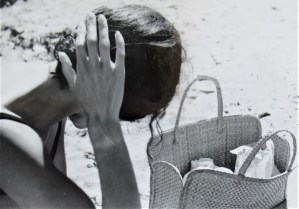
IMG_0573 (3).JPG

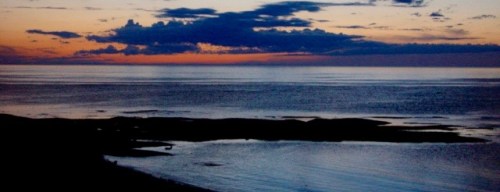
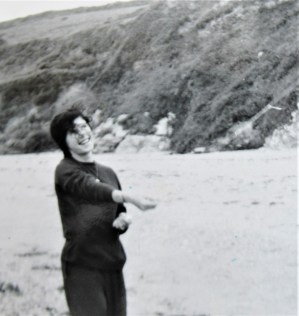
Goran Haven, Cornwall, July, 1966. I was waiting to receive the results of my final exams from Bristol University. Clare and I decided to spend a week in Cornwall and ended up in Goran Haven. When we came back, I made her a book of photos from the trip with hand-written poems beneath them. I discovered that book the other day and was taken back to a time when I wasn’t even thinking of coming to Canada. Fifty-three years later, looking at these photos, I ask myself ubi sunt … where did those days go? All those days, the old country, and everything that went with our youth … ubi sunt?

IMG_0574 (2).JPG

Same thing happened when I visited McAdam Railway Station: wonderful memories of all the steam trains of my youth. And those railway names: Great Western Railway [GWR], London Midlands Scotland [LMS] , London North Eastern Railway [LNER]. So many things that I can never forget: the smell of the old steam engines, the sound of their wheels going clackety-clack, the taste of smoke and ash when I thrust my head out of the window, in spite of the sign that said, Do not lean out of the window, the feel of those worn cloth seats beneath the fingers, and the sense of excitement and joy when an empty corner seat begged to be sat in. Something else I’ll never forget: the cold taste of a Cadbury’s Milk Flake stuck in an ice-cream on a warm summer’s day.
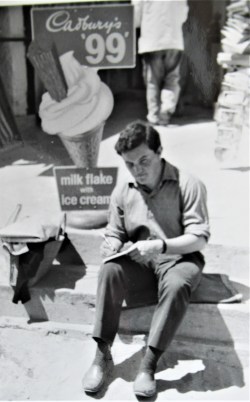
IMG_0570 (3).JPG


The Joy of A New Book

IMG_0915 (2).JPG

The Joy of a New Book

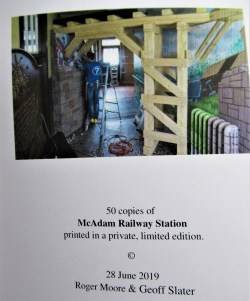
Very little to beat it actually, the joy of receiving and opening a new book, especially when it is one you have written yourself, in cooperation with a group of friends. In this book are the twenty-four (24) poems that I wrote for McAdam Railway Station.

IMG_0921 (2).JPG

I went to McAdam to watch Geoff working on his mural and installation (diorama). While there, I heard stories about the railway and started to write them down in stanza form. While I did write them, most of them were based on stories and anecdotes heard or overheard while the guides were guiding the tourists round the site. This is indeed a limited edition. We originally intended to print only 50 copies, but when we heard that there might be up to 300 people at the unveiling of Geoff’s mural, in McAdam, at 1:00 pm, Sunday, 30 June, 2019, we doubled the number of books we printed. I will be donating the majority of the 100 to McAdam Railway Station Historical Association. They can either give them away or sell them to help fund and support the impressive restoration work they are doing.

IMG_0923 (2).JPG

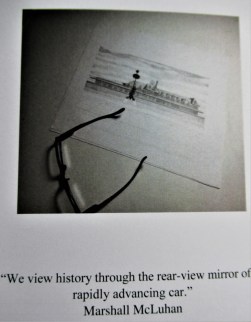
“We view history through the rear-view mirror of a rapidly advancing car” … and writing these poems was a veritable journey back into the past. Geoff left his glasses by his half-finished drawing, and that’s when the idea of linking McLuhan to Moore to McAdam occurred. Several of the poems focus on my own experiences of railway stations. Travel by train was a frequent choice in my childhood and  I went almost everywhere by train. A local in-town train ran from the station at the end of our road and I often took it when visiting friends, shopping in town, or following the local soccer team, Cardiff City, aka the Bluebirds. As a result, much of the imagery within the poems involves my own knowledge and love of trains, while the narrative structures themselves are often based on those overheard words.

IMG_0919 (3).JPG


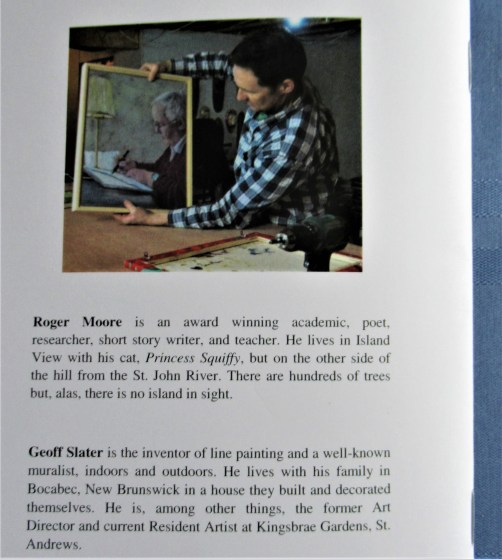
We wanted a photo of Geoff and me on the back cover and I discovered this one in my files. The portrait was done by Ruby Allan, my fellow artist in KIRA (June, 2107). She painted Roger Writing in the Red Room from a photo taken by another KIRA resident artist, Carlos Carty, the Peruvian pipe, as I was working at the desk in my room. Geoff framed the portrait and Mrs. Lucinda Flemer gracefully allowed it to be hung over the desk in the Red Room at KIRA, an honor for which I am exceedingly grateful. What a nice way to put our pictures on the cover of our book! If you are down McAdam way this Sunday, 30 June, drop in and see us. We’ll be there. Books and all.


Westbury White Horse

th.jpg

Westbury
White Horse

Winter in Somerset. No trains from Frome.
They sit in the engine sheds, boilers frozen.

Clare drives me to Westbury, in Wiltshire,
the neighboring county. She leaves me there

and I stand on a platform as white with snow
as Westbury White Horse towering above.

People arrive, flapping their arms, stamping
their feet, walking around trying to stay warm.

Finally, to shouts, cheers, and laughter, a train
arrives, its boiler successfully thawed. People

rush forward, open doors, claim their seats.
It’s a corridor, not a compartment train.

“Is this the eight-fifteen to Temple Meads?”
I ask the porter. “Nope,” he says. “That wll

be arriving later.” “When?” “About ten
or eleven, I expect.” “What train is this?”

“Ah, now this is the six-thirty to Bristol.
Running about two hours late. Better be quick.

The guard’s waving his flag. She’s about to leave.”
I open a door, climb on the train.  All

the seats are taken. I stand in the corridor,
shivering, all the way to Temple Meads.

Gower

Empress 070.jpg

Gower

To be Welsh in Gower is to spell it funny
and pronounce it worse: Gwyr.
It’s to know how to say Pwll Ddu.
It’s meeting the cows in the lane to Brandy Cove
and knowing them all by name and reputation,
which one kicks, which one gores,
when to walk in the middle of the lane,
and when to jump for the safety of the hedge.

It’s to know the difference between the twin farmers
Upper and Lower Jones.
It’s to recognize their sheepdogs, Floss and Jess,
and to call them with their different whistles.
It’s knowing the time of day by sun and shadow;
it’s knowing the tide is in or out
by the salt smell in the air
without ever needing to see the sea;

and now, in this far away land called Canada,
it’s hearing your stomach growl for crempog or teisen lap
whilst memory’s fish‑hook tugs at your heart
in the same way your father hauled in salmon bass
at Rhossili, Brandy Cove, Pennard, Oxwich, and Three Cliffs.

Commentary: I was checking Gwyr, the Welsh for Gower, where I was born, and found this interpretation of the name. <<G is for generous, your giving nature. W is for wise, more tomorrow than today. Y is for young, the years never show. R is for rapport, friends seek you.>> I don’t know if that’s me, but it certainly wouldn’t be a bad set of descriptors to live up to.


My Welsh Granny

IMG_0452


Poem for the Welsh grandmother
I never really knew

Six o’clock! The cuckoo whirrs its clockwork arrow
from the dark wood of its ambush and the flight
of my granny’s forgotten youth flashes before my eyes
to be buried among the trees. Cats! I can still count
her 1, 2, 3 cats, each one lapping milk from its saucer.

If I close my eyes, I can recall her house, her clothes,
her hair, the very bend of her body bowed over
the ironing board in the kitchen and everywhere,
the sweet and sour smell of white fish bubbling
on the stove for the cats’ supper. The cuckoo clock
strikes again. Each one wounds, the last one…?

Who knows what the last one will bring? Life’s
bitterest blows perhaps? Or missing memories
restored and with them, my granny’s own lost beauty,
with her standing upright, like some glorious flower
illuminated by a sunbeam in the wood’s dark depths.

International Day

14633208_10207317214799871_1242532105939959170_o

International Day
St. Mary’s Street

To be Welsh in Cardiff on International Day
is to be decked entirely in red from deep
between your ribs where the Red Dragon
throbs pumping its blood through the Arms
Park along with your heart and bright blood
surges as you wear your scarlet jersey like
a flag as you step onto the grass ready to play.

You shed your grey hairs like a sheep
sheds its coat on the Wenallt or Caerphilly
Mountain or the Brecon Beacons and Boyo,
you know you’re unbeatable. So come
the four corners of the world to Cardiff
with a rugby ball and they shall be defeated,
ground into the Arms Park mud, humiliated.

Flower-power


IMG_0902 (2).JPG

Flower-power
or
Why should the young kids have all the fun?

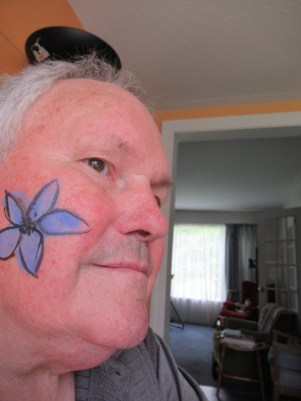
So it’s children’s day at the local supermarket. As I push my shopping cart through the door, I see the face-painter with a young girl sitting before her, getting her face painted. Behind the willing victim, several young children wait, shuffling their feet in expectation. I go out to the car park, unload my cart, and push it back to the supermarket.
As I park my cart, I see that the line-up has disappeared and the face-painter sits alone, cleaning her brushes. I walk up to her table and ask “How much?”
“It’s free,” she tells me. “It’s children’s day.”
“Will you paint my face?” I ask her.
“You’re not a child,” she looks at me in astonishment.
“No, I’m not,” I reply, “but I’m in my second childhood.”
I pull out the chair and sit down.
“I’ve got some photos on my phone, or I can try and paint whatever you would like. Would you like to see some pictures?”
“No, thanks. Just  look at me and paint what you think I would like.”
“What are your favorite colors?” she looks at me and smiles.
“I don’t have any favorite colors, but I always avoid green, yellow, and gold.”
“Oh, well, how about a nice flower?”
“Great!” I say.
One of the trolley boys who return the shopping carts in great convoys walked by.
“You need a mirror,” he says, “so people can see themselves.”
“Great idea, stay here, I’ll go and get one.”
“Don’t worry. I’ve got a mirror in the car. I’ll have a look when I get there. Meanwhile, it’s a surprise. I’ll put a photo up on my blog when I get home.”
“Promise?”
“I promise.”

IMG_0903.JPG

I gave her my blog address and I kept my promise. Unlike many people I know, I usually do.

IMG_0903 (2).JPG

Commentary: with many thanks to Emily, the face-painter, who treated my second-childhood with humor and dignity. As I said to her at the time, ‘why should the young kids have all the fun?”


Swansea

IMG_0898 (2).JPG

Swansea

To be Welsh in Swansea is to know each stop
on the Mumbles Railway: the Slip, the Rec,
Singleton Park, Blackpill, West Cross, Oystermouth,
the Mumbles Pier. It’s to remember where single
lines turn double by Green’s ice‑cream stall.

It’s to know where the trams fall silent, like dinosaurs,
and wait without grunting for one to pass the other.
As you wait you can hear the winter roar of the rugby
crowd or St. Helen’s summer “click” of ball on bat.

Today the tide is out and the nets are golden with starfish
as if a night sky stretched across day’s horizon.
Mudflats rule the bay beyond the sand, and banana boats
ride the distant waves, waiting for the tide to turn.

When it does, the Mumbles Railway has been sold
to a Texas millionaire and the brown and yellow busses
no longer run to Bishopston, Langland, Caswell,
Pyle Corner, Pennard, Three Cliffs, Ilston, Rhossili:
sweet names of sea and sand where my father fished
for salmon bass, his thin line cast defiantly at a rising sea
that would smash the walls of the sandcastles I built to last
forever, unaware that time’s rising tide would breach
their defenses, leaving them in ruins on the summer
beaches where I dreamed my buoyant boyhood away.

Commentary: The Mumbles Pier from Limeslade. This is the first water color painted by my father’s brother, my godfather after whom I received my second name. He took up painting after he retired and became a quite accomplished amateur water colorist. He gave me four of his water colors, I particularly wanted this, his first, and the later ones are excellent, especially the award-winning paintings, of which I have one.

Rhondda Fawr

IMG_0689


Rhondda Fawr

To be Welsh on the coalfield
is to speak the language of steel and coal,
with an accent that grates like anthracite ‑‑
no plum in the mouth for us; no polish,
just spit and phlegm that cut through dust and grit,
pit‑head elocution lessons hacked from the coal‑face.

We sing arias and deep, rolling hymns
that surge from suffering and the eternal longing
for a light that never shines underground
where we live our lives and no owners roam.

Here “gas” and “fall” mean violent death
and the creaking of the pine pit‑prop is a song‑bird
suddenly silent in its cage warning of danger
soon to be upon us…

… words and music stop in our throats
as up above us the sad crowds gather.

Featured Image -- 7454

Sunday in Wales

IMG_0795.JPG

Sunday in Wales

To be Welsh on Sunday in a dry area of Wales
is to wish, for the only time in your life,
that you were English and civilized,
and that you had a car or a bike and could drive or pedal
to your heart’s desire, the county next door, wet on Sundays,
where the pubs never shut and the bar is a paradise
of elbows in your face and ribs and the dark liquids flow,
not warm, not cold, just right, and family and friends
are there beside you elbow to elbow, shoulder to shoulder,
and the old ones sitting indoors by the fire in winter
or outdoors in summer, at a picnic table under the trees
or beneath an umbrella that says Seven Up and Pepsi
(though nobody drinks them) and it serves as a sunshade
on this Sunday evening when the sun is still high
in the summer sky and the little kids tumble on the grass
playing soccer and cricket and it’s “Watch your beer, Da!”
and the gymnasts tumble over and over the family dog
who hides beneath the table and snores and twitches until
“Time, Gentlemen, please!” and the nightmare is upon us
as the old school bell, ship’s bell, rings out its brass warning
and people leave the Travellers’ Rest, the Ffynnon Wen,
the Woodville, the Antelope, the Butcher’s, the Deri,
the White Rose, the Con Club, the Plough and Harrow,
the Flora, the Pant Mawr, The Cow and Snuffers,
the Villiers Arms, the Cricketers, the Mexico Fountain,
the Church (the one with handles on the prayer books),
God Bless them all, I knew them in my prime.

Comment: In the old days, when there were twelve counties in Wales, each county voted whether or not to permit the consumption of alcohol in public houses (pubs) on Sunday. Those counties who forbade Sunday drinking were called ‘dry’ and the others, who permitted it, were called ‘wet’. I remember hearing about the rush from Sunday Chapel Services in dry counties as the church-goers headed over the border into the wet counties where they could fill up in the proper fashion. The pubs listed at the end of the poem are all in the Swansea or Cardiff area, and yes, I have visited them all. The poem was designed to be read in a single breath … at quite high speed and in a Welsh accent. Alas, it takes me more than one breath now and I, like the ageing church-goers, must stop a couple of times as I wend my way down Memory Lane, from the dry to the wet.