Empress of Ireland

15 May 2002 Pre-Rimouski 109.jpg

Photo: Museum and Monument to the Empress of Ireland, Pointe-au Père, PQ.

M Press of Ire

 Background and Dedication

The poems that have come together to form the M Press of Ire were begun in Ste. Luce-sur-mer, Quebec, in May 2002.

It was off shore from Ste. Luce, in the early hours of the morning of the 29th of May, 1914, that the Empress of Ireland collided with a Norwegian collier whose bows had been strengthened for ice-breaking. There were approximately 15 minutes between the moment of impact (1:55 am) and the moment the ship caught on fire and sank (2:10 am). Although the disaster has received little international attention, more passengers were lost in this incident (840) than in the loss of the Titanic (832) or of the Lusitania (791).

I read these poems, for the first time, at the University of St. Thomas at Houston, Texas. The Virginia Tech shootings took place on Monday, 16 April, 2007, and I read these poems on Wednesday, 18, April, 2007, while memorial services were taking place on university campuses all over North America. I dedicated that reading to the victims and survivors of the shootings. I now re-dedicate these words to all those who have been touched by sudden loss, shock, and / or grief, and especially to those who have suffered loss under extraordinary circumstances.

Introduction

I first heard those voices in the cries of the sea birds on the beach at Ste. Luce.

Borne on the wind, over the sigh of the waves, they seemed high-pitched, like the voices of children, or of men and women in distress. These were lost voices, the cries of people alone and frightened by the dark. I heard them calling to me.

That night, there were knocks at my cabin door and finger nails scratched at my window. Tiny sounds, almost beyond the range of human hearing: the snuffling of puppies when they turn over in their sleep and tug at each other, whimpering in their dreams.

“Who’s there?”

I started from my sleep. But there was only the wind and the waves as the tide’s footsteps climbed a moonbeam path to ascend the beach. When I walked on the sand next day, at low tide, there was a whispering behind my back. Little voices crying to be set free.

“Who’s there?”

A lone gull flew past my head and battered itself against the wind’s cage with outraged sturdy wings. That night, the mist descended. The church stepped in and out of its darkness and shadows gathered, persistent, at my door.

I walked out into the night and I saw a lone heron mobbed by gulls. It was as if an adult, surrounded by clamoring children, was standing guard over the beach. Then I saw the shadows of little children searching for their parents, the shapes of mothers and fathers looking for their off-spring, lost in the tide mark, among the seaweed and the grains of sand.

Beyond them, on the headland, the church stood tall above the shadows. I saw family survivors, their lips moving in supplication, kneeling before the granite cross that stands above the sea. As I approached, they turned to me, opened their mouths, mouthed silent words, then disappeared.

When I went back to bed, faces and voices visited me in my dreams. When I got up next morning, they came to me in the speech of birds hidden in the foliage, in the words dropped by the osprey’s wing, in the click of the crab’s claw as he dug himself deeper into the sand.

“Release us! Speak for us! Set us free!”

The words of the Empress of Ireland are not my words. They could never be my words. Foundered words, they are, rescued from the beach, and dragged from the high tide mark filled with its sea weed, carapace, charred wood, old rusted iron, and bright bone of long dead creatures polished by the relentless action of wind, sea, and sand.

Dialogue: Wednesday’s Workshop

IMG_0146 (1).jpg

Dialog / Dialogue

The Tuesday night writing group that I meet with is very small. It currently consists of four members (Chuck, John, Kevin, and Roger), though it was larger. Several members dropped out for sundry reasons, but we four get on well and we have continued our Tuesday sessions for a long time now. We usually concentrate on discussions, sharing ideas, and encouragement rather than on anything else. We also share work in progress by e-mail for commentary online and we throw out current writing difficulties for discussion by the group. We also indulge in other activities. For example, on Monday last, John, one of the group members, visited me at home and kindly showed me how to process a manuscript for publication on Amazon’s CreateSpace. This was a first for me, though John, a very accomplished writer, has some twenty novels published in this fashion.

I thought it might be of interest to set out elements of the discussion that took place yesterday evening at The Second Cup Coffee Shop. Here are the notes, slightly amplified, that I sent round the group.

  1. We began by asking Chuck if he had benefitted from the previous week’s conversation, when he had set out a problem situation from his novel that we had all explored. He outlined briefly how he had responded to our suggestions.
  2. He then noted that some people can write dialogue with ease, others can’t, and illustrated this with info from a workshop he had given in which 13 of the 14 submitted manuscripts were narratives without dialog, and only one contained dialogue.
  3. This led us in several different directions and we opened with using telephone messages as a means of conveying information and also as a back up to “mysterious” dialog –can you hear both ends of the conversation?
  4. This in turn developed into texting and tweeting and electronics and from here we talked about the potentially deleterious effects of social media on conversational skills, and hence lack of dialog in society.
  5. Computer techniques and knowledge at a cross-words + game play + thought play + voice interaction to rival or replace writing novels came into the conversation and we added some comments on writing by dictation and computer transcribing of voice.
  6. The question of the historical development of the Dialogue form was opened: can Plato’s dialogues be considered monologues since many of the responses to Socrates are of the ‘yessir, nossir, three bags full sir” variety. We talked about creating action via dialogue and compared the modern newscast to the Medieval visitor who tells his audience what happened ‘over there’ and answered questions set by them. We also mentioned some dialogued novels of the 15th 16th C.
  7. The transition of the Quixote from single character (I, 1-5) to double character (the rest of the book) and the important role that dialogue played in the development of Cervantes’s novel also came forward. This led to the use and development of dialogue in other novels. We discussed dialogue on TV with reference to As Time Goes By and the Midsomer Murders. We discussed dialogue as a composite of what is said, how it is said, how it is delivered, and we emphasized the importance of timing of dialogue.
  8. We ended with a brief discussion of the age effect and development of narrative and dialog in children, especially in light of the effects of electronics on young developing minds and the substitution of screen for dialog.

Kevin was absent last night, but John and Chuck agreed to contribute a paragraph each in which they show their use of dialogue. I have added a poem in dialogue, just for the fun of showing a different usage. These are by no means state of the art models of how to proceed. They are examples of the type of work we are doing. Electronic links follow each example where appropriate.

Chuck Bowie: Steal it all.

“You know you got off lucky, Hendricks. It would have been so much easier, and given me so much more pleasure to have put the two slugs through that melon of yours. Now, get up. I want your seat.” While he spoke, he drew the blind closed. Walking over to the side of the small room, he turned off the ceiling light, leaving them with just the desk lamp to view one another.

Ace hauled his massive bulk out of the chair and shuffled around to the side of the office nearest the door. He eased into a dusty metal chair, taking care to avoid touching anything with his right arm.

“Tell me this.” Donovan waved his gun at the arm. “Why is it when a guy hurts his arm, he limps? I never figured that out.” This elicited another curse from Hendricks, and his attacker tossed him a roll of paper towels, which he failed to catch. Both ignored the useless roll as it found its way into a corner of the office.

“I’m very interested to hear your story, Ace. You’ve hurt a lot of people, some of them my friends. Want to talk about it?”

“You go square to ‘ell. My men’ll be here in a minute, and that’ll be the last of you, mate.”

Donovan shook his head.

“You have no more men. They’re all dead. Twelve separate industrial accidents, is how I heard it. Plus the scum you sent to kill Gemma. She weighs one hundred-fifteen pounds, by the way. Just before she killed him with her bare hands, he probably apologized to every woman and child he ever bullied. Nope, all you have left is that old

man, tied up by the garbage bin outside. And your millions. Um, nope, you no longer have that, either. Shit, you’re not really in good shape, my friend.

“But here’s what I can do for you. I can kill you, to save you the mortification of seeing your failure in tomorrow’s headlines. Is now a good time?”

Hendricks shook his head, unsure if Donovan was serious. The cloth around his elbow had darkened, and a drop or two had begun to puddle on the floor beside him.

“Okay, then. Here’s what I’m willing to do. I’ll name a name, and you’ll tell me the story. The more names you chat about, the longer you get to live.”


Buy Link for Steal It All:

https://www.amazon.ca/s/ref=nb_sb_noss_2?url=search-alias%3Dstripbooks&field-keywords=Chuck+Bowie

John Sutherland: Convergence of Fates.

Before he drove off he decided to make another call. He’d better report what he had learned, to the Park Rangers in the Clark National Park. They’d had a bear go missing a couple of weeks earlier. The phone rang a few times before it was answered.

“Is Scott there, please?” Then, he recognized the voice.

“Melissa, it’s you” He identified himself. “Charlie Easton. Hudgin’s Mills. Remember that bear you told us to watch for, about ten days ago?”

He didn’t need to say any more, and nodded in response to her suddenly pointed questions, interrupting what he had been ready to say. Why anyone would nod into a telephone seemed a strange thing to do, but it was a reflexive action.

“It might be here. Hudgin’s Mills. At least, close to it. I just took two people into hospital. One of them had been attacked by a bear.” He listened for a while and responded as far as he could, giving her more details about his injuries.  She seemed satisfied that it had been a bear attack.

“Yes I can show you where I picked them up.” He listened further. “I don’t have a clue who he is, but I know the young woman. Susan Whitcomb. She’s….” Melissa seemed to know her, but of course she did; they were related in some way through her grandmother. He continued to nod.

“The Rollins road, ten miles out of town. The young man was pretty torn up, and bleeding like a stuck pig, but….”

Melissa cut into what he was saying and asked those questions important to her, getting the responses she needed to hear.

“It must have happened not long before I picked them up. Ten, maybe twenty minutes before. He was still bleeding. He didn’t say much, but he was conscious all of the drive in. I couldn’t see any injuries on her.

“It could be your bear. I thought I’d better tell you. From the looks of them, they should both be in the hospital for a day or two at least, maybe a week, for him, so you have time.” He listened further, and looked out at the weather.

“Rollins Road,” he repeated. “Where the river comes closest to the road and before it joins the main channel. Ten miles out, where it’s fordable. There’s only one place it does that. They were both wet, so they had waded across that river.”

He saw a flash of light and then heard a rumble of thunder about five seconds later (his subconscious told him it was about a mile away), and then responded again.

“I don’t know. You’d have to talk to him to find out where, exactly. You could probably follow his blood trail back on the other side of the river and find out, except for this rain. There’s only that one shallow place where they could have crossed, but it might not be passable by morning if we get the amount of rain they’re forecasting.

“If you call the Hospital in a couple of hours, they might be able to tell you something by then. Ask for Doctor Lewis. That young man I brought in might even be able to talk to you, if they let him. I’ll be home about midnight. You can call me there in the morning if you need my help to show you.”

From what Melissa said, Scott, her husband, the man to hunt that bear down, was already fairly close to Hudgin’s Mills on other business, so he’d be on his way as soon as she talked to him, and she wouldn’t be far behind.

“In the morning then.”

Charlie rang off, and decided that he should make one more call before he headed out.

https://www.amazon.com/John-K-Sutherland/e/B007C8DCCQ


Roger Moore: Monkey Temple.


Monkey FAQs
(with apologies to all those who draw them up
at their work place, knowing they will never be read)

“What news from the ark?”

“Only the dark waves pounding the hull, the wet winds blowing.”

“Who placed the whale ribs on this mountain
and called them a cathedral?”

“Sunshine blossoms through hollow vaults and shadows shimmer.
The day is striped across my back
and I bear its weight like a beast of burden.”

“When the anvil rings out, will the armorers appear?”

“When I snatched a blade of grass, its fine glass sliced my finger.
Yet, when I grasped the nettle, its swan-song perished in sunlight.”

 “Who will forge chains for sun and moon?

“The peregrine falcon slices my eye in two and I am a mole,
blind with a weather’s wind.”

“Who will carve a cell door for errant stars?”

“I snuffle round the tightness of the temple clock:
its legion of Roman numerals marches to the beat
of a dull, dry pendulum.”

“Why are there no birds in last year’s nests?”

“The ox tongue sandwich on which I snack
talks back to the lettuce and salt clogs the tomato.”

“Why are you avoiding these questions?”

“Speak up: the wind is high. I can no longer hear you.”

This Kevin Stephen’s  excerpt from DiAngelo: Revelations

“Can we talk Mel?” asked Caitlyn.

“Are we not? What is your mind?”

“I’m getting bad readings, like all the time, but you’ve been busy or gone for the last couple of weeks so I couldn’t talk to you.”

“Why not talk on our road trip?”

“Because. Everyone would think I sucked if I said that Tarot reading was confusing. Alex wouldn’t let me live it down.”

“Well, things are being… Vse ne tak. Crazy? For me lately. I have this moment. Ask your question.”

“For the last few weeks the Moon, the Hanged Man, and the Seven of Cups all came up in the same three positions, six, nine, and ten for everyone.”

“It is not impossible for people to be having same cards. Who is saying people do not have same outlook?”

“Well, in the last two weeks more than sixty people have had the same reading. You think that’s normal? I thought it might the sign of an impending natural disaster but then Roan came along.

“I thought the shared experience had passed when Roan pulled different cards but then he pulled the Death card in position nine time and time again. He even had that card face up when he drew a second copy of it. I didn’t have two Deaths in the deck but he really did look as surprised as I was. It had to have been a prank right? That’s what Fran thought.”

Somnambulant Flash Fiction

IMG_0181.jpg

Somnambulant
Bistro 25

Tommy has started to sleepwalk. Not that he really walks in his sleep, but when he gets up in the night to go pee he no longer wakes up completely. They told him it would be like this, the going pee. “Every hour or so,” they said, “probably in time with your emergence from deep sleep.” They were right about that, but they never told Tommy about the sleepwalking.

“It’s the injections make you pee,” they said. “But you’ll get better when the effects wear off, in about eighteen months time.” Well, it’s been a year now, and Tommy still goes pee every ninety minutes, as regular as clockwork. He’d say as regular as a train, but the trains he knew never went anywhere on time and Tommy can set his watch by his middle of the night aquatic meanderings.

It’s funny really. If he wakes up properly, there’s no problem. But if he’s only half awake, then who knows where the pee’s going. Sometimes he wets his pajamas, just pees on them, half-asleep. There’s nothing like warm urine rapidly cooling in the cold night air to shake Tommy from his dormant state. When that happens, he takes his pajama bottoms off and hangs them on the bathroom door. They are often dry again a pee or two later and then he can put them back on.

Tommy tries not to turn on the light, because it wakes his wife and she needs her sleep even more than Tommy does. His wife has started to become used to Tommy’s schedule and about four o’clock, every morning, they both wake up and pee together. On April the First, last year, Tommy wrote a poem about it.

April Fools

When we were young
we used to wake up
at night and
come
together.

Now we are old,
we wake up
at night and
go
together.

            It’s quite funny, really. Tommy and his wife now use separate bathrooms. Tommy uses the en suite while his wife walks down the corridor to the guest’s bathroom. Tommy remembers to raise the seat by repeating to himself: “Gentlemen raise the seat” like they used to say in the old railway trains back in the UK. Tommy has come to think of it as a definition: “Gentlemen raise the seat.” Sometimes, though, he thinks of it as a sort of toast: “Gentlemen: raise the seat.” It all depends on the punctuation and the intonation, and Tommy can never say it quite like they did on Beyond the Fringe. At Tommy’s age so much depends on so many things.

Tommy wishes he knew what the direction of his pee depended on: it seems to have a life of its own. While he usually remembers to raise the seat, he sometimes forgets and then of course he does his best to wipe the seat clean and dry. He’s usually pretty good at it, but it’s difficult to be certain in the dark. He found the high-pitched shriek that followed when his wife’s warm cheeks hit the cold wetness very disturbing, especially when attached to a roar of anguish turning rapidly into rage. They never said anything in the hospital about that either, but that’s the real reason why Tommy and his wife now use separate bathrooms.

And he’s started sleeping with his teddy bear in his arms. Teddy’s very good for Tommy. Tommy clings on to Teddy and Teddy never complains if Tommy wakes him when he gets out of bed to go pee. Teddy doesn’t complain about the night sweats either. Oh yes, they told Tommy about those in the hospital, too. Every time Tommy gets out of bed and goes into the cold night air, he starts to sweat. When he gets back into bed, Teddy is nice and warm, like a hot water bottle. Tommy gives Teddy a squeeze and a cuddle and Teddy never wakes up and never complains.

Tommy likes Teddy

Shit Happens Flash Fiction

IMG_0186.jpg

Shit Happens!
Bistro 24

Pain in the joints so bad I decide to get in the bath and soak in hot water. I run the water, test the blend of hot and cold, if baby turns red, I remember, don’t insert elbow in bath, water too hot for elbow.

Bath water bubbles in. I set the fan for steam extraction. Test the water. Seems fine.

High the step into the bath and I cannot raise the right leg high enough. The left leg is worse. I lay flat along the bath edge, naked, of course, and think: “How do I get in?”

The left leg will not rise. I stand on tiptoe, pushing up from the right leg’s toes: cramp, shit! I slide back down, swivel, and my belly is cold against the bath’s edge.

I refuse to give in. I try again. I raise the left leg, ouch, cramp in the right toes, and slide the left leg over the bath’s edge. I slide weight to the left, raise the right leg and slip into the bath, on my knees, face down.

I grab the sides of the bath, flip myself over, and victory: I am on my back in warm water, feeling the comfort of the whirlpool’s heat seep into my bones.

Exercises: I raise my legs and move ankles, then do the windshield wiper, left right. I feel immediate benefits in hips. Then comes the slow military march, legs slightly raised against bath end, left, right, left.

Raise both hips now, then gyrate them, left to right, twenty times, and reverse. Now up and down, raising them in a familiar though nearly forgotten motion.

Twenty minutes, they say, or else you may suffer. So I call my wife and she runs upstairs and turns off the motor. The whirlpool ceases.

Now I must get out. I have a funny feeling that something is wrong. My wife pulls the plug and water drains from the bath. The last thing I want is to lie face down in an inch or two of water and drown.

I roll to the left and slip on the bath’s bottom. I roll to the right and slide again. I grasp the handle on the left … it comes out in my hand. With nothing to grasp, I can’t sit up. So I lie there with the water draining away.

I start to panic. Mustn’t panic. I’m in pain. Not that much pain. I must fight. I can’t give in. Again I try to turn over … and again.

Tears. Sweat. I get cramp in the toes, and in the lower legs, where I push against the bath’s end. Panic now and a tightness in my chest with bile edging up in my throat to choke me. I half-turn but fall again and bang my head. Don’t struggle. Don’t panic. Think.

I ask for the towel and my wife slips it under my feet. No good: my hips still slide. I need to pee. Hang on. I can’t hang on. I tighten my stomach muscles involuntarily and urine spurts. My wife slides the towel under my knees: I get more grip but my arms won’t hold. I slip and squeeze. Oh no: my bowels are turning to water. I groan and hope but I can’t hold on and bath and body are soiled. But I have rolled over and now I lie face down, in push up position, humiliated, soiled, tears streaming down my face, breathing above the absent water.

My wife goes downstairs to get the garden kneeler. It won’t fit in the bath. I experiment with my walking stick, but it’s no good, it slips and just won’t hold. Naked, shrunken, smelling like I don’t know what, I can’t face calling the neighbors or the fire department.

My wife kneels beside me. Together we haul the now wet towel beneath my torso and finally I gain a dry base on the slippery bath; no sliding now. I curse as my wife sinks sharp fingers into my fragile flesh and helps me to rise. Together we force me into a kneeling position. From here I can empower my arms and push myself up.

It has taken me twenty-five minutes to get out of that bath. I stink and I am no longer clean. Dipped in my own excrement, I hobble to the shower in the other bathroom and hose myself down.

Shadow Flash Fiction

IMG_0147.jpg

Shadow
Bistro 23

             The janitor said he saw LJ’s shadow lying down at midnight on the corridor floor. He dialed 911 and a police car came with a bucket and a mop to sweep the evidence under the carpet. LJ wasn’t there. He had climbed to his feet and scuttled away, a peregrine crab clicking his pincers over dry moonlight on a sanded floor.

He migrated to the elevator and the janitor watched as the needle jerked to a stop at every floor. Now they feared him in the washrooms. They stared at themselves in the mirrors and saw him as a kind of devil looking out with an offer of work for idle hands.

LJ is horned and hoofed and he breathes heavily as the customers clean their teeth and leave the cold tap running. When the water’s turned off, LJ’s long, thin fingers pluck the strings of their hearts and a quaint fibrillation fills the silence of this haunted house that breathes in and out, moving fine membranes of memory.

Upstairs, downstairs, a lonely route he treads while the wind at the window scratches tinkling notes. Something breaks loose in the confines of his mind and walks beside him. His twin brother stalks through this silvery sliver of splintered glass, this simian mirror wrinkling their troubled suits of skin.

LJ glimpses the old moon’s monkey face through a broken window. Jagged and coarse, it wanders like an itinerant snail, cobbled with clumsy clouds. A vagabond in a paving stone sky, it rumbles across metal cracks, a knapsack of nightmares humped on its old man’s back.

When the snail moves house who stores the furniture he leaves behind? The hermit crab lurks naked on the beach, seeking new lodgings. Two eyes in limbo watch LJ roll his snowman’s belly of flab across an unknown, clouded room. Who killed the candle and left him in the dark where a fallen star grazed by the lamppost?

A bouquet of golden sparks flew from an iron tree and sanctified the gutter. The gas lamps sputtered patiently in uniform rows. A scarecrow stuttered into the limelight and shook LJ’s hand. The skeleton was wearing LJ’s grandmother’s Easter bonnet, with all the flowers renewed, but she couldn’t keep his heart from last winter’s left over crumbs.

When a tulip thrust its tongue through the concrete. It became as red as a robin and flew into the lounge bar of a public house. The bronze leaf necklace circling LJ’s throat filled with a flow of springtime song. His heart stood upright like a warped piano and the skeletons in his cupboard emerged to tarry at the corner to play knucklebones with the wind.

Torn butterflies of news fluttered round the neighborhood. Yesterday’s horoscope winked its subversive eye and called to the hermit in his lonely cell: “Look out for the stranger with the tin can alley smile. Sharpen your knife and tie your heart to the tail of the first albino dog, white as a lily, that comes whistling down the street.”

Re-reading the Codices Flash Fiction

IMG0061_1.jpg

Re-reading the Códices
Bistro 22

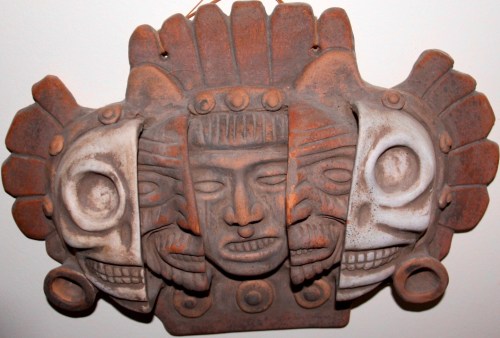
             The Mixtec Códices, indigenous screenfold books written on deer hide, 
are Pre-Columbian pictographs that record the history of the Mixtec peoples. 
There are no words: only brightly coloured scenes containing information about rituals, gods, heroes, and ceremonies. 
Only a few very precious documents
(Zouche-Nuttall, Vindobonensis, Borgia etc) survived the ravages of time
 and the continued purges of the Spanish priests. 
The following text, self-explanatory for the main part, verbalizes typical symbols from the códices. 
Clearly, such symbols, as the poems suggest, are ambiguous 
and open to radically different interpretations.

           “Two breasts: one green, one yellow, symbolic of the hill where the church stands; the church itself bi-colored, strong stone walls, a spire. A large red heart symbolic of the love we bear for you, our masters. Two feet walking the path of enlightenment you opened before us; two hands pointing the way. The feet below the heart; the hands above the heart, like wings; and the heart becomes the body of the new place you have built for us. And in the heart is our sacred symbol: the Earthquake, a sign of leadership and power used only by those of Royal Stature and the Noblest Blood. Attached to the heart is the Numeral One which means Lord of the Earthquake; for you are Number One in our Hearts. Attached to the heart is a speech scroll showing felicitous words of praise; below it is the sacred earthworm, and beneath that the serpent head of wisdom and the flint knife promising strength through sacrifice.

            But be wary: for our symbols are double-edged.

            The colors of the hill are divided, as the hill is divided, showing strife and division. The church is on top of the hill, for the symbol has conquered the people, and the people are starving, subject, and destroyed. The feet are pointing in opposite directions, for the people are stalled. They have no forward movement, nor will of their own. For they are conquered by the sword and not by love. And the hands are pointing in opposite directions; for the right hand knows not what the left hand is doing. And the hands are reversed showing anguish and distress. The sign of the heart is the sign of the disembodied heart, torn from the heaving chest of the vanquished and thrown to the dogs. The sign of the earthquake is also the sign of movement. And that movement is a bowel movement. And one movement in the middle of the sacrificed heart is the victor excreting on the vanquished and treating them with scorn and contempt. The scroll protrudes from the nether part and says that the victors are speaking words of excrement, that verbal diarrhea issues from their lips. And the serpent has no feathers; it cannot fly. It is as a snake treacherous and bitter, crawling on the ground. The head of the serpent is two tongued and tells of treachery and of deceit. The flint is attached to a heart; it speaks of the heart that is as hard as flint, knowing no mercy.

            And at the end that heart will receive no mercy in its turn.”

Raptors Flash Fiction

IMG_0236.jpg

Raptors
Bistro 21

“Falcon, Richard?”
“Here, sir.”
“Finch, Thomas?” Mr. Shrike’s predatory eyes squinted out over half-rimmed glasses.
“Thomas Finch?”
“Not here, sir,” Dick Falcon answered.
“Why not? His trunk’s here.”
“Don’t know, sir.”
“Hawk, Peter?” Mr. Shrike continued.
“Here, sir.”

* * *
“Tom Finch not back?” Mr. Shrike perched by the fireplace with his conspicuous, upright stance. “Why not?” He addressed the staff room then spat in the fire.
“Tricky business,” Mr. Slaughter replied. “Important birthday, his mother said when she called. He’s at home but his trunk’s here. He’ll be back.”
“Pity,” Mr. Shrike winced. “That boy’s spineless. I’d like to…”
“Impale him on a thorn and hang him out to dry like the butcher you were in the war?” Mr. Slaughter peered down the long beak of his nose. “Not on school grounds, I hope,” he sniggered.

* * *
Tom and his mother lived with her parents. His birthday cake had thirteen candles that year. He blew them out and made a silent wish: “Let me be brave enough to do it.”

* * *
After tea, Tom’s mother sent him into the kitchen while she talked with her mum and dad.
“He’s got to go back to school,” Tom’s grandfather cleared his throat and spat in the fire. Tom’s mum recoiled at the stench of burning phlegm.
“He doesn’t want to go,” she murmured. “The boys bully him and the masters are worse.”
“Just like the army: he’ll get used to it. It’s me paying his fees; it’s my money you’re wasting when he’s not at school,” he spat again.

* * *
Tom leaned over the chipped porcelain sink in the kitchen. His fingers brushed against the damp red flannel and the soap dish. Then he touched the leather case of his grandfather’s cutthroat razor.
The folded razor lay cradled in his left hand. He nursed it, swaying back and forth on his feet. He found the groove and pulled the cold steel blade from its protective casing.
The razor formed a glittering right-angled claw. Then it became the sinister half-wing of a hawk that fluttered for a second, hovering above his wrist.
It pounced.
A fierce talon slashed into Tom’s wrist and a red river of pain sprang out. Tom fought the urge to scream as he stared at the flowing blood. The great claw of the triumphant hawk lay deep in his wrist. Strong wings flapped and bore him away.

* * *
“Falcon, Richard?”
“Here, sir.”
“Finch, Thomas?” Mr. Shrike’s strident voice pierced the classroom. “Thomas Finch?”
“Not here, sir,” Dick Falcon answered.
“Why not?” Mr. Shrike surveyed the class.
“Don’t know, sir. But he won’t be back.”
“How do you know that?”
“Saw his trunk being sent home, sir.”
“Finch, Thomas: absent,” Mr. Shrike looked down at his list and skewered the boy’s name with the absentee’s black cross. He smiled a cruel, calculated smile, and returned to his list.
“Hawk, Peter.”

* * *

Remembrance Day Flash Fiction


039

Remembrance Day
Bistro 20

Previously published on
http://commuterlit.com/2015/12/wednesday-remembrance-day/

            The old man watched a drop of red wine slide slowly down the side of the bottle. It was November 11, his birthday.

Seventy-three years ago, Father John had taken the boy’s ear lobe between thumb and forefinger and pinched the nail deep into the flesh until the blood ran.
“This afternoon you will go down to the bamboo grove and cut a cane. Bring that cane to me and I will bless it.”

That night, the boy woke up. Snuffles, snores, and an occasional sob broke the dormitory’s silence. The bamboo was a long, cold serpent drawn up in bed beside him.

The next day, he awoke to his seventh birthday.

Father John beckoned and the boy followed him to his cell and knelt with his hands stretched out like those of Christ on the Cross. The priest struck him with the bamboo cane six times on each hand.
“Your Savior, blessed be His name, suffered more, much more for you,” the priest sighed. “Examine your soul. Find fault with each flaw, for you are unworthy. Remember: the eye you see is not an eye because you see it,” Father John droned on. “It is an eye because it sees you. Christ sees you as you kneel there. He sees. He knows. He judges. Examine your soul with care and stay there until I return.” The priest raised his right hand and made the sign of the cross in the empty air.

The boy spent his birthday kneeling before the crucifix in prayer. He contemplated the wounds of Christ. He imagined each blow of the hammer and imagined the pain of cold nails biting into his warm flesh. He tasted bitter vinegar as it dripped off the sponge, gasped at the thrusting spear, felt the lash’s sting as it fell across his flesh. He became the flagellated Christ and knelt before the crucifix, staring at himself eyeball to eyeball in the same way he looked at himself in the morning mirror. The crucified Christ gazed back at him, his brother, his soul mate, his double.

After an hour, a red drop of paint slipped slowly from the nail hole in Christ’s right hand. The boy blinked. The red drop trembled then fell.
After two hours, Christ opened his eyes and smiled at the boy.
After three hours, salt-water formed at the corner of Christ’s eye. It glistened in a sunbeam that entered through the cell’s narrow window.
After four hours, tears began to flow down flesh and painted wooden face.
It was Remembrance Day, the boy’s birthday. He was seven years old.

Seventy-three years later, the old man sat at the table. He watched the red wine trickle down the bottle. He remembered it all and his tears flowed again.

Recalcitrant Flash Fiction

IMG_0013

Recalcitrant
Bistro 19

            The annual Old Boys Reunion took place in the sixteenth-century cellar of a world famous winery that also ran a restaurant and banquet service for pecunious customers. A man in a penguin suit, with a foreign accent, and a suspicious looking bulge under his left armpit, ushered the recalcitrant towards a set of well-worn of steps.
            “You are arriving slightly on the late side, sir,” the penguin whispered, staring mockingly at the checkered, American-style sports jacket worn by the man he escorted. “And not dressed like the others. But not to be troubled, I myself will escort you down to the place of the guests.”
As he descended the steps that led down to the former wine cellars, the recalcitrant heard the well-remembered, high nasal bray as his former headmaster’s brass voice pierced the ruminations of the penguin-suited herd that, having sniffed the glorious nature of the gregarious watering-hole, was intent on reminiscing, drinking, and feeding.
“Wonderful place … so fortunate … to be here … thank you … ” the old man neighed.
It was indeed a wondrous place, a semi-whitewashed room, warm in the center where bees wax candles in gold candlesticks blazed on antique tables and cool by the one wall left untouched since that same sixteenth century. Here the damp gathered in great grey clots and the spider webs, also untouched, sparkled and glistened, like “the mythical lights of fairyland” as the winery brochure announced to the limited circle of the wealthy to whom it was circulated.
Empty kettle … the recalcitrant thought as he remembered his old headmaster and then they were, face to face, the head and his obstinately defiant and anti-authoritarian pupil, staring each other down.
“You!” It was an authoritarian call to battle. “I remember you. The boy who denied all authority.”
“Yes, me,” the recalcitrant, eyeball to eyeball with the old enemy rejoiced in his newfound glory. And here he was, back in the old country on a lecture tour of six major universities, one of them being in this city, a full professor now, with international honors, multiple publications, department chair in a well-known university, a household name in his subject, and all of this at forty-two years old. “Yes, me,” he repeated.
“You have done well for yourself,” the ageing donkey brayed.
The gunman in the penguin suit, sensing the tension, placed himself in the gunslinger’s position from which he could survey the whole room. He lovingly stroked the armpit bulge, eyes gleaming with hope.
“Tell me,” the head drew a handkerchief from his pocket and honked his nose into it like a storm-bound goose. “How did your career take off?”
“Well, in two stages,” the recalcitrant paused, partly for effect, partly to gather his thoughts. “Just like a rocket: stage one was when I left your school and stage two was when I left your country.”
The old donkey, blinked, threw back his head, trumpeted down his nose with intense nasal wrath, and turned away with a wave of his hand towards another latecomer who had just descended the stairs. “Ah, there you are Smithers,”the fog horn blared. “At last. Saved me you have. This man was just about to …”
The rest of the sentence was lost in the rush and a hubbub as a new series of delights arrived, tapas, hors d’oeuvres, little sticky creations on fiddly little sticks, they all circulated from hand to hand along with the exquisitely chilled champagne, the single malt whiskies, and the ultimate in estate wines.
Not a penguin spoke to the sports-coated recalcitrant. Nobody offered him a hand. Nobody shared a memory with him. As he arrived at each little group, the penguins gathered in a tight circle, turned their black backs to him, and shut him out. Throughout the feasting, he sensed the gimlet eyes of the gunman glued to a spot mid-way between his shoulder blades.
The recalcitrant didn’t partake of the food or the drink, he just watched. Then, after an hour or so, he turned and climbed the sixteenth-century stairs, the gunman in the penguin suit right behind him, and walked away into the freedom of starlight and the cool night air.
He never returned for another reunion.
He never received another invitation.

Old Man Flash Fiction

IMG_0051

Old Man
Bistro

Old Man

I’m an old man now, discontent with the rumbles of incontinence that surge like an express train through my guts. They told me the after effects would last a year to eighteen months after the cancer treatment, and it’s nearly a year, and it should be over, but it isn’t, so I sit here, in my car, outside the washroom in the local park, waiting for that urgent call that will send me limping to my destiny and soon now, I know it will be soon now, as the cold shiver grips me, and then I start to sweat, great pearls of salt water, trickling down forehead to nose, and I open the car window, and there she is again, in a green and yellow string bikini, the twelve year old who has haunted me for the last ten minutes, ghosting round, staring at me, looking at the car, and behind her, her parents, her grand-parents, her family, muttering in some strange and ancient tongue, about this old man sitting in his car by the public washroom, being stared at by the girls, the boys, the young people as they enter and leave, bees around the honey-pot, and they gather by my car, and mutter and grumble, raising their voices and pointing their fingers at me, at the car, and always that surging wave of grumbled accusations, rising like this tide, this hot, red tide that now rushes through my guts and rumbles me towards my destiny, a plastic seat in a tin shack at the edge of the woods in a public place, this park, where I have every right to be, and the girl’s long blonde hair whisks again and again past my window, and she points and the old ones mutter, and there’s the boy again, squeezing himself, and looking cute, and I can guess what they’re thinking and saying, even though I don’t understand a word of their language, yet their grumbles are loud and their fingers are sharp and pointed in my direction, and I can see a cell phone, now, with a man taking pictures of me and the car and the number plate, and someone else is dialing, I can see their fingers punching the keys and I know they would rather be punching me, my face, anything they can get their fists into and why not, because it’s a free world and if I am what they seem to think I am, a predator after their children, not an old man, incontinent, in urgent need of the washroom yet afraid to brave the crowd and leave the safety of his car, then they would indeed have every right to be pointing at me in this way …. but hey, everybody is innocent until they are found guilty by twelve honest men, and twelve of them now gather out there pointing at me as I sit, glassy-eyed, sweating, afraid to move in case I make it worse, just hoping that they and this terrible pain will go away, this pain, this train, this express train, rumbling through my guts to its inevitable conclusion … and too late, I’ve left it too late, dammit … and so, rooted to the earth and this spot, I soil myself again.