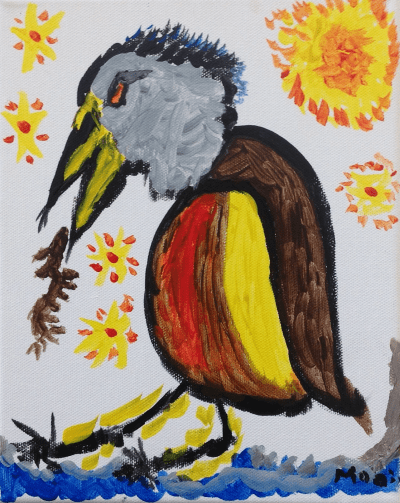
Early Bird

untitled

This is the first painting I ever did on canvas. Kingsbrae held their painting session for children in June 2017, and I joined in with the five and six year olds. It was such wonderful fun. They slapped the paint onto the canvas with unbounded joy. It was hard not to be joyful with them. Many of them expressed curiosity about my painting: “What is it?” then later “What are they saying to each other?” The conversation between bird and worm (or whatever it is) was of incredible importance to them. I thought of it as my “Bonjour, Monsieur Courbet” moment. Now that’s confidence for you.

My strange accent, slowly developing as mid-Atlantic Welsh, with a touch of West Country English and a dab of Upper Canadian and a touch of New Brunswick also fascinated them. “Where are you from?” “Fredericton.” “No. Where are you really from?” “Island View, New Brunswick.” “No. Where were you from before that?” The questions continued until they had ascertained that indeed, I was not a Canadian, a real Canadian, even though I was in Toronto in 1967 to see the Maple Leafs win the Stanley Cup. 1967: that’s 51 years ago, and I still support the Maple Leafs and I still have my strange overseas accent. “You’re weird,” they told me. “I’ve been in Canada a lot longer than you,” I told them. “Where did you grow up?” They asked. I silenced them with my answer: “I don’t think I have yet.”

Happy paint-splashers, we dabbed on and on in alternating mirth and silence. Some left the table and walked away. Geoff collected our paintings and left them to dry. Later that day, we hung this painting on the wall in the KIRA dining room. It sat there for several days and nobody noticed it. Alas, a hawk-eyed young lady finally spotted it the first night she came over for dinner and “What is that?” she asked, pointing at my painting. Bold and italics combined cannot reproduce the scorn and disdain rolled up in the single word: that. I remember the butler in a country house in Somerset removing with a pair of tongs the Communist newspaper The Daily Worker from the weekend newspapers left on the doorstep. He, too, was very disdainful.

I also remember the tone of an Old Etonian, well he said he was an Old Etonian and had a rasping, high-pitched nasality that made him sound the part. This jolly goof fellow summed me up at a dinner party one night in Toronto when I first came to Canada: “Oh, you’re Welsh.” The grate of his voice was the scrape of a stick removing a dog turd from a shoe. “No,” I said. “Irish, actually.” I used my broadest Welsh accent. “My family is Irish Catholic not Capel Cymraig / Welsh Chapel. Moore is an Irish name. Llewellyn ad Jones are Welsh names. I am not called Llewellyn or Jones.”

And this reminds me of my father, standing in the elevator in a posh hotel in Bordeaux, when three Irishmen walked in. They scanned him for a moment, and then one said, in the broadest of Southern Irish brogues: “T’is the map of Ireland written all over your face.” “Yes,” says my father in his thick, Welsh accent, “I am Irish. But I was born in England.” And that brings me back to my painting. Is it the early bird that catches the worm or the late worm that gets caught by the bird? And which came first, the chicken or the egg?

Ah, the beauty of children. They accept, often without judgement and often without speculation and I love their readiness to befriend the growing child within the old man as he ages. They may not hold doctorates in philosophy, but by golly they are true philosophers in their finest moments. And then of course, they go to school to learn how to behave … and may the good Lord have mercy on them.

Surrealism

IMG_0124

Surrealism
KIRA Retreat Day 4

Only one of the Kingsbrae alpacas could understand and illustrate what we did today. This one showed us so many things. Luckily we smuggled him into the writing classes and the art classes and nobody was any the wiser. In fact he taught one class himself, and one participant served as translator, moving from Spanish to English with almost as much ease as he taught.

He began this morning with a reading that linked Symbolism to Surrealism to Magical Realism. It was a fascinating piece that nobody in the room, myself included, had ever heard before. So, we began with a concrete, literary example, then moved to a theoretical session. The alpaca began by explaining the difference between a lama, an alpaca, and a vicuña. This was extremely interesting, and something we hadn’t considered before. Luckily, these three creatures, two of them mythical (but which two?), do not have-isms attached to them and were therefore much easier to understand.

The lama began the theoretical session by offering some meditation exercises, very peace-giving.  Then he moved into the nitty-gritty of automatic writing. He followed this with some examples of how, rather than copying the automatic writing, we could select prime elements from it. This selection process allows the writer to mine the subconscious while avoiding some of the repetitious nature of the automated pen on the suppliant page.

In all cases, all participants read from their work and the sharing of subconscious inanities was a great way to break any ice that came with the overnight change in the weather.

After lunch, we had a second writing exercise that stretched into two exercises. These were courtesy of a second lama and entailed describing unknown and known objects. One of the participants was very uncooperative and instead of writing words drew pictures in his notebook. This drew comments of ‘Naughty, naughty,” from the lama and that student was given a time out on the golf cart driven round the lawn by the KIRA equivalent of Mad Max.

In our final session, the art lama appeared. He had carefully plucked all the flowers in Kingsbrae and then eaten them. However, in an incredible act of bravery, the ladies present stole some from his hoard and placed them in water cups. The participants then scattered random dots of paint upon a canvas and agreed that, seen from a distance and in the dark, they looked like flowers on a tarmac road under storm clouds on a thundery night when nothing could be seen.

By now, the lama who had been tied to the fishing weir, oh, I forgot to tell you about that, sorry, had been rescued when the Old Sow let the water out of the Passamaquoddy bath tub (aka low tide). Luckily no harm was done and a delicious, fossilized piece of Turkish Delight was shared by the participants all of whom agreed that nothing like this had ever happened to them before, and I believe them.

Mad Max took everyone for a ride on the Golf Cart and we all chased deer round the Kingsbrae Gardens while singing “I’ve been working on the chain gang” and “For it’s a jolly good yellow.”

Bistro

Bistro Cover

Bistro

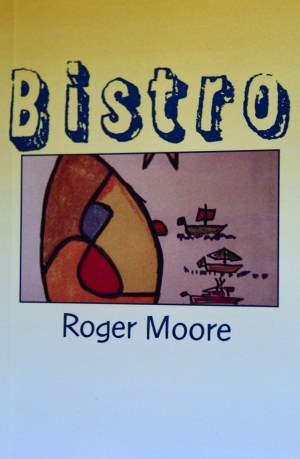
Thank you, Allan Hudson, for your kind words about my book of short stories entitled Bistro. Allan has also set out a brief introduction to five other novelists, several of them close friends and admired acquaintances.

Bistro was one of three finalists in the New Brunswick Book Awards (2016-17). I think it was the only self-published book to make the finals. So, all of you struggling self-publishers, it can be done and we can get recognized, as we know from the results of one of this year’s major French book awards, awarded to another self-published author, much to the chagrin of all the French publishers who had already turned his book down. The message to everyone is simple: “Don’t get off the bus. Keep believing. Finish the journey.” And remember, you’ll never finish the journey if you get off the bus / train / boat / plane / tram / trolley / whatever … before you reach your final destination.

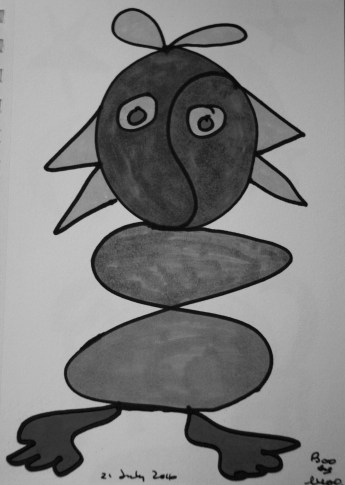
The cover photo, incidentally, is one of my cartoons that has appeared on these pages before. It shows a bird-man, beak open in astonishment, watching three ships approach his belly-button, as he sits there, naval-gazing, or should that be navel-gazing? “I saw three ships come sailing by …”

You can link to Allan’s Blog, the South Branch Scribbler, by clicking on the link. Bistro, incidentally, is available for purchase on Amazon and Kindle.

MT 2-6 Monkey Meets An Anarchist Ant

img_0188

MT 2.6
Monkey Meets An Anarchist Ant

(Memories of El Camino de Santiago)

The anarchist ant dresses in black.
He wears a little red base-ball cap
backwards on his head.
His eyes are fiery coals.

“Phooey!” He says.
“It’s folly to go with the flow.”
So he turns his back
on his companions and marches
in the other direction.

Some ants call him a fool.
The Ant Police try to turn him.
The Thought Police try
to make him change his mind.

Others, in blind obedience
to a thwarted, intolerant authority,
first bully him, then beat him,
then bite him till he’s dead.

Comment: One of the legends of the Road to St. James, the pilgrim route across Northern Spain that I walked in 1979, states that if you do not walk the road as a human being, in your own lifetime, you will come back as an ant and be forced to walk it ant form, when you are dead. I stood on the hill outside Astorga, looking back at the city. On the old pilgrim road, at my feet, and beneath the old Cruz de Harapos, a colony of ants was busy walking in a long line towards Santiago de Compostela. One turned his back on the group and started to walk the other way, but he didn’t last long. “Go to the ant, thou sluggard.” Fair enough. But watch out for the ant-police and the thought-police. 

MT 2-5 Monkey Meets Pontius Parrot

img_0181

Monkey
Meets
Pontius Parrot
(With glorious  memories of Macarronic Latin)

 Pontius Parrot is very clever
and very pontifical.
He pontificates from his pulpit.
“Pretty Polly!”

His name isn’t Polly
and he doesn’t have a pulpit
but he parrots words
in Macaronic Latin:

“Caesar adsum jam forte.”

Pontius Parrot is
perky at the podium.
He bounces up and down,
preens himself prettily,
rattles his chains,
shakes his bars:

“Brutus aderat.”

 Shame and scandal
wear him down.
A dysfunctional family
of feathered friends
henpecked him
until he was black and blue
and threw up copiously:

 “Caesar sic in omnibus.”

He dips his wings in holy water,
calls for some soft soap,
and washes
feathers and claws.

Poor Pontius Parrot,
He can only say
“Repent!”

“Brutus sic in at.”

Comment: Anyone who suffered through school Latin, especially if they went to boarding school or grammar school, will recognize famous Macarronic Latin quotes such as the verb bendo, whackere, ouchi, sorebum, and the one the author of Monkey Temple reproduces in the above poem. If you are unfamiliar with Macarroni Latin and have had the good fortune to have avoided both grammar and boarding schools, just read the Latin normally in English and you will establish its Macarronic meaning.

MT 2-4 Monkey Visits the Chimpanzees’ Tea Party

img_0181

MT 2-4
Monkey Visits
the Chimpanzees’
Tea Party

Dressed to the nines in their gala outfits,
they have come here for the tea party.

Hairy penguins,
they waddle back and forth
across the temple,
then lunge for a table
with its jumbo shrimp,
smoked salmon,
scallops, baked oysters.

Faces slashed from ear to ear
by enormous grins,
“Food’s free!” they say
and stuff themselves
regardless of the consequences.

Serviettes tucked into collars,
they scoff lobster and crab.
Birds of Paradise,
subtle delicacies
flown in from half a world away,
decorate the tables.

There is something about them,
these chimpanzees,
gripping cup handles
between finger and thumb,
enormously pleased to be
the centre of attention,
however clumsily they walk
in their hired-for-the -occasion,
ill-fitting, black and whte
penguin suits.

MT 2-3 Monkey Visits the Poisonous Snakes

MT 2-3
Monkey Visits the Poisonous Snakes

img_0181

Monkey Visits the Poisonous Snakes

A swift death
was never their style,
the cobras, the vipers,
the adders and subtractors,
the bean counters and snatchers,
the diminutive dudes.

They prefer death
by blow-gun
their poison dart
injected through
hollowed fangs

or Chinese Water Torture,
the slow drip after drip
of poison inserted into ears
and veins, a drop at a time,
and slowly gathering …

… until their victim slows down,
ceases to struggle,
stands there, eyes open,
unable to move,
poisoned and paralysed.

Comment: with all the exciting things that are happening concerning my new poetry writing, I forgot all about my monkeys. It seems they have been bouncing up and down, fretting in their cages, bounding all over the ruined, broken-down temple, poor little blighters. Apparently, on their last visit to the rest of Bristol Zoo, they left the big snakes and decided to visit the little, poisonous ones. I guess they didn’t like them at all. Does anyone? I hope there are no ‘snakes in the grass’ near you, and I don’t mean grass snakes. And watch out for snake charmers, some of those snakes believe more in harm than charms.

PS Let me know if you want a voice text. I haven’t recorded this one yet.

Bistro FFF

IMG_0155

Friday Flash Fiction
20 July 2018

Bistro 

LJ sat at a table in a dark corner of the Bistro. He held a plastic bag in his hands and moved what looked like dried brown fava beans, one by one, through his fingers. A priest at prayer, his lips moved in a silent mantra as he counted the beans:  “… twenty-seven, twenty-eight, twenty-nine.”

Robin and Will watched him closely, looking for the tell-tale signs that would announce LJ’s return to his former life.

Same-sex couples danced through the Bistro. They avoided this one corner that formed an oasis of severity amidst the gaiety and noise of Carnival celebrations.

“How much does he remember?” Robin looked at Will. Will shrugged and the two men exchanged worried glances.

A whooping conga of men dressed in garish, feathered costumes that revealed more than they concealed, approached the table where the three friends sat. The conga came to a stop in front of them.

“Now what have we here?” The leader asked. He turned to his followers flashing a white, toothy smile.

“Let’s see what you’ve got, darling,” he reached towards LJ’s plastic bag.

“Don’t touch him,” said Robin, rising to his feet.

Three large men broke away from the line and two grasped Robin while the third put his arms on Will’s shoulders and held him in his chair.

“I’m warning you,” Robin said.

“Shut it,” said the leader.

LJ closed the plastic bag that held the twenty-nine fava beans and put it in is breast pocket, next to his heart.

“Don’t put them away, darling, they look delicious,” the leader grinned his enormous grin. He was a big man, not tall, but broad and heavy. “Give them to me, I want to eat one. C’mon, I’ll just pop it in my mouth and suck it.”

The Conga crowd roared their approval.

LJ got to his feet. He was a small man, but wiry. The night-fighter, they had called him. He was the one who slipped out at night through enemy lines and knifed the sentries. One hand over their mouths, one hand on his knife, all sounds extinguished till they relaxed, lifeless, then that one quick twist of the knife and the ear-lobe severed as the dead man was lowered to the floor.

“Wanna dance?” The conga leader wiggled his hips and ran his tongue over his lips, then puckered a little kiss.

LJ’s face turned red, the veins engorged, and his eyes stood out. Nobody saw him move, nobody ever saw LJ move. He grasped the Conga leader’s windpipe with his left hand and drew him forward until they were locked eyeball to eyeball. LJ’s night-fighter knife lay flat across the man’s jugular.

“LJ, no,” Robin screamed. “Not number thirty.”

LJ kept staring at the man he held. His knife disappeared.

“You’re not worthy,” he said, leering into the Conga leader’s purpling face. “You’d dishonor them.”

Will and Robin breathed a sigh of relief.

Comment: Bistro is the title story in a collection of short stories and flash fiction. Bistro, the book, was one of three finalists (and the only self-published book) in the New Brunswick Book Awards (Fiction, 2017). Bistro (the collection) is available on Amazon. The sound recording below is my own reading of the story and the opening cartoon, Belle Bottom Naval Gazing,  is the picture on the cover of Bistro, the book. It is also my own work.


Friday Fiction: Woof!

IMG_0040 (3)

Friday Fiction
11 May 2018

Woof!

The old man limped up to the check-out in Chapters and placed a brown, hand-made, Italian notebook on the counter.

“Did you find everything you were looking for?” The check-out girl inquired.

“No.”

“Oh dear, what were you looking for?”

“My dog. I lost my dog.”

“Here? In the store? I can page security. I’m sure they’ll find it.”

“No, you mustn’t do that.”

“It’s no trouble. What color is it? Male or female? What breed? Large or small?”

“No, no. You’re much too kind. I lost him at home.”

“I lost my cat last week,” the check-out girl told him. “We searched everywhere for her.”

“I searched for my dog. All around the block. The dog usually comes home. This time he didn’t.”

“That doesn’t sound good. We never found our cat. My mom said the coyotes got her.”

“That’s not nice. We lost a cat.”

“To coyotes?”

“No. To mapaches, you know, to raccoons.”

“I miss my cat.”

“Me too. I also miss my dog.”

“I hope you find him.”

“I will. Oh, look. Here he is. Safe and sound.”

“I don’t see him,” the check-out girl looked around the store from her vantage point behind the cash register but didn’t see any dogs.

“His name’s Woof,” the old man pulled a small, fluffy, black-and-white dog out of his pocket and put him down on the counter. “Here, you have him. He’ll help make up for your lost cat.”

“I couldn’t possibly …”

“Don’t be silly.”

“No. Thank you very much. But I can’t take your dog. Here, put him back in your pocket. Oh, and that will be eight dollars exactly.”

The old man held out a five dollar bill, a toony, and a loony.

“Thank you,” the girl placed the money in the till and the little bell chimed happily. “Here’s your receipt.”

“Thank you,” the old man turned and limped away.

When he passed through the exit barrier, the alarm bell rang, but he took no notice. He walked rapidly to his car, close by in the wheelchair parking spot. He pressed the starter button, placed Woof on the passenger seat, and drove away before security arrived. As he drove, the old man extracted a brindle hound from his coat pocket and waved him proudly.

“Hello Woof,” he chuckled. “I want you to meet Winnie. Welcome to the family, Winnie. You’re free now.”

He put his hand in his other pocket and pulled out a fluffy Dalmatian, all white with black spots.

“And this is Pooh,” he announced. “Woof, Winnie, and Pooh: all broken out of prison. We’re one big happy family.”

He tooted the car horn and Woof, Winnie, and Pooh sat up straight on the front seat, wagged their tails, and woofed in time to the tooted horn.