Tomorrow

DSC02478.jpg

Tomorrow

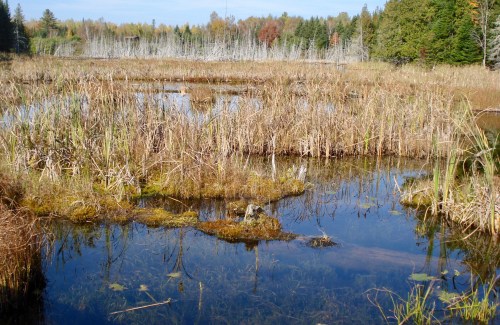
Tomorrow, early, my love, you’ll fly away. Today, all tense and stressed, your foot in the stirrup, as Cervantes would say, the anxiety of the journey on your back, you walk around the Beaver Pond where red and yellow leaves abound. I know you are hoping to see, once more before you leave, the Great Blue Heron that was here last week. Some ducks remain. I can see them standing on the water, flapping their wings, inflaming the wind, keeping themselves warm, not looking as if they really want to fly.

Alas, there are no beavers now. An abandoned lodge, the grass on its roof turning brown and dry,  lofts white sticks into the sky, but the waterways are clogging and the beaver have gone. Drowned tree trunks, beaver-gnawed and languishing, grow tiny clumps of grass and weed. Sometimes, they join together and form a miniature island that will grow at last into a grassland. The deserted lodge reminds me of our home, soon to be abandoned by the life and soul that animates it and keeps it alive. It will be sad and lonely living there without you. I know I will have the cat for company, but that’s not the same. I think I’m in charge of her, but I wonder sometimes if you’re leaving her in charge of me.

A thin grey woven webbing garlands one moribund tree. I don’t like tent worms or their equivalents. Every year we face a different invasion of this worm or that and the trees stand shocked by crawling creatures that infest their branches and build their silk cities up into the sky. I hate it when those dangling inhabitants, escaping from their cocoons, swing from low branches and twine silk threads around my face. Give me any day a fresh green frond caught by the morning sun in early spring, or else bright autumn leaves so soon to fall.

I love American Goldfinches when they sing that last departing song. I love most of all the occasional visitors that wing up north on the wings of a summer storm. Do you recall the Indigo Bunting that perched in the Mountain Ash just outside our kitchen window? He had the look of a lost bird and his call was more a cry of help than a birdsong. You took such lovely photos of him as he sat there, looking this way, that way, anyway for the way he needed to go home … and those two cardinals, orange the one, bright red the other, standing beneath the feeder, so bright against the early snow.

The hunting hawks give everyone a fright. They perch on top of a power line pole then step off into space to alight, claws first, on some poor songbird trilling away, quite free from fear, his unfinished symphony of song. Claws first? I gaze again at the photo you took of the Sharp-shinned Hawk that settled on our porch that day it rained. Claws? The massive yellow talons are high grade weapons fit for any war. I pity the poor bird clasped in those claws and brought to earth or lifted high into the sky, a feast for the marauder.

It’s getting late, my love. You walk towards me out of the woods like some lost spirit returning to this earthly world from some spiritual sanctuary. The season is ending. Thanksgiving is close. It will soon be time for you to pack your bags and go. Three silent wishes for you my love: enjoy yourself; don’t forget me … and don’t stay away too long.

Comment:
This piece goes back to the Fall of 2016. Clare and I visited the Beaver Pond at Mactaquac the day before she left for Ottawa. I sat at a picnic table and watched her as she walked through the woods and around the pond. ‘Parting is such sweet sorrow’: she didn’t want to leave me and I didn’t want her to go, yet we both knew how important it was for her to visit our grandchild for Thanksgiving. Time apart is good: it makes us realize how much we miss each other. For me, above all, it is a reminder of everything that gets done around the home without my ever noticing the care and love that is poured into each moment of every day. Having to provide that care and love for myself is an object lesson that makes me so thankful for the seemingly simple blessings Clare has brought to me throughout our married life …

Indigo Bunting, for Meg:

For you, Meg: photos, by Clare, of our second Indigo Bunting.

IMG_0206.jpg

He’s rather handsome. We usually get them in from the States following a strong south wind or  a summer storm.

IMG_0207.jpg

Great Blue Heron, for Tanya:

He was right over the garden: beautiful. We don’t often see them up here as we are on the far side of the hill from the river. Must have been raiding a neighbor’s goldfish pond.


IMG_0231.jpg

Claustrophobia

IMG_0291.jpg

Claustrophobia

“I’ve got to get out of here.”
“Why?”
“I can’t breathe.”
“Where are we going?”
“Anywhere.”
“Are we going to Gran’s?”
“Why not? Yes. Pack your bag.”
“What about Dad?”
“What about him?”
“Aren’t you going to tell him where we’re going?”
“No.”
“Why not?”
“Because he doesn’t care. If he cared, he’d be here.”
“Maybe he’s had an accident?”
“He didn’t have one last night, or the night before. He just doesn’t care.”
“We can’t just go …”
“We can.”

She called a cab and when it came, they turned the lights out in the house, and shut the front door behind them. Then they got into the cab. The cabbie turned to her and spoke over his shoulder.

“Merry Christmas, and where would you be going, Ma’am?”
“The station.”
“Bus or train?”
“I don’t care. They’re both the same.”

The cabbie shrugged and pulled away from the kerb. The bus station was closer and that’s where the cabbie left them. Mother and son stood there for a moment, under the station lights, looking at the coaches that squatted there, parked in regular lines. Then, mother and son, they walked into the ticket office.

“What time does the next bus leave?”
“Where do you want to go?”
“Home.”
“Where’s home?”
“Swansea.”
“The next bus for Swansea leaves in twenty minutes.”
“We’ll take it.”
“Single or return?”
“Single. Two tickets.”
“You should buy a return ticket; it’s cheaper.”
“We’re not coming back. Not this time.”
“How old’s the boy?”
“Seven.”
“He can travel half price.”
“One and a half then, singles.”

It was December 23rd, her own mother’s birthday. Mother and son sat together on the dark, empty bus. The cold seats chilled them as they waited  in silence. The boy looked out the window and coughed.

“Will Grampy be there to meet us?”
“No.”
“Doesn’t he know we’re coming?”
“No.”
“Does granny know?”
“No.”
“Mum, why are we going?”
“It’s granny’s birthday today. We’re going to give her a surprise.”

Two hours later, the bus deposited them in Swansea. The night had filled with heavy clouds and promised snow.

“Can we take a cab. mum?”
“There’s none here. We’ll have to walk.”

They walked side by side down the well-known streets. Christmas lights adorned the shops and they walked through alternate pools of light and darkness.

“Mum, I’m tired.”
“Give me your bag. We’re nearly there.”
“But mum …”
“I can carry both. Hold on to my arm.”

They kept on walking. After a while, they stopped beneath the streetlight outside the old family home and looked up into the street light’s glow. The first snow-flakes danced down.

“Can we go in now, mum? I want to see Gran and Gramps.”
“You go in. I’ll be with you in a moment.”

She watched her son climb the steps to the front door. He lifted the old brass knocker and banged it down. After a moment, the front light came on and the door opened a crack. She stood beneath the street lamp, inhaling, taking the chill air deep into her lungs. She felt the tight bands in her chest start to loosen. For the first time since this time last year, she felt free

Warning to the reader:
Raw material, still under revision, and probably needs lots of revising. I look forward to your comments. In some ways, this is my take on A Child’s Christmas in Wales. Not quite how Dylan Thomas saw it; more a sort of … well, you work it out for yourself!

First Snow

IMG_0033.jpg

First Snow

Lying in bed
on a snowy morning
with the first flakes
fast falling,
can you follow
the rag-tag-and-bobtail
drift of snow thoughts?

Filled with sparrow, siskin,
chickadee and finch,
the now leafless tree
stands outlined in the yard:
black skeleton,
white wind-drift.

A scarecrow
with many arms,
it braces against
these feathered weights
that settle
like colored snow.

Warning: raw poem.

I rarely let any of my writing out while it is still raw. These words will undoubtedly change, the snow will settle, the birds will fly away, a crow and a blue jay will startle the smaller species, the sun may come out, the wind may get up, and so may I. In addition, the poem, like the birds in the tree may or may not survive. The tree itself chose to surrender to a family of yellow-bellied sap-suckers and they changed into a chess board of small square holes that leaked the tree’s life blood throughout the summer. Perhaps the tree won’t survive. Well, I know it won’t survive for ever, but perhaps its life will be even shorter, curtailed by those ravenous little beaks.

Whatever: I have taken a risk by sharing early, and we will see how you, my readers and fellow bloggers, rise to the bait. Perhaps you will encourage me to place more early verse online. Perhaps not. Hopefully, you’ll click and make some comments: we’ll soon see.

Monkey Reviews Retirement

Monkey Reviews Retirement

IMG0056_1

“No more Latin, no more French, no more sitting on the old school bench.”

Monkey chants this famous ditty as he relaxes in the whirlpool bath, a glass of white wine on the tray before him and his faithful tablet sitting beside it.
“The olde order changeth …”  Monkey pauses and takes a sip of wine, “… lest one good custom should corrupt the world.”

“Welcome to heaven,”Monkey lies back in the jacuzzi and the beating waters whirl around him, sending him into a dream world.

No more committee meetings: The unter-monkeys sit in a circle, where all are equal but some are more equal than others.  They pass a lyre bird feather  round and round, weeping crocodile tears and lying through the tight monkey  grins of their alligator teeth.

No more writing reports: The dead text he revises is composed of misquotes, harsh judgements,  double-talk, and outrageous lies.

No more long-term contracts: “Will the defendant please rise. Sir: I sentence you to a term of two years’ detention at this institution, renewable for another two years. And, should you continue to to do well, and should you fail, over that four year probationary period, to fall by the wayside, or to do anything wrong, I sentence you to life imprisonment, till death do you and the institution part. Amen!!!”

No more promotion: Inmates with crowded heads and vacant faces, fools grinning at a universe of folly, paddled in piddle beside him.

No more cabin fever: Monkey has worked for forty years among foreigners and lunatics afraid of the rats who keep him company, devoured by his monkey lust to drive silver knives and forks through the watch springs of their inhuman, foreign hearts.

No more penis envy: They lounge in glass cubicles, checking each other out for size, weight, length, girth, with a roll of the eye, and a casual flicker of a forked lightning tongue.

No more water-fountain gossip: They prefer death by blow-gun, their poison dart injected through hollowed fangs or Chinese Water Torture, the slow drip after drip of poison inserted into ears and veins, a drop at a time, and slowly gathering … until their victim slows down, ceases to struggle, stands there, eyes open, unable to move, poisoned and paralyzed.

No more gala occasions: … gripping cup handles between finger and thumb, enormously pleased to be the center of attention, however clumsily they walk,  in their hired-for-the-occasion, ill-fitting,  black and white penguin suits.

No more macaronic Latin: Caesar adsum jam forte, Brutus aderat; Caesar sic in omnibus, Brutus sic in at!

No more thought police: The Thought Police try to make him change his mind. Others, in blind obedience to a thwarted, intolerant authority, first bully him, then beat him, then bite him till he’s dead.

No more Wittgenstein: Or is it just the act of perception, as Wittgenstein would have us believe, and nothing more, the money always spinning on its metal edge, never falling, the coin on its axis, a new day with its potential,  sunshine or shadow, thrown dice still skittering, a new world  imperceptibly poised in its own making?

No more Camus: “Il faut imaginer l’esclave heureux.”

No more Shakespearean tragedy: Down in the kitchen, the cooking staff are preparing the next nutrition break. As the cauldron boils and bubbles, three old monkey witches dance around the pot and polish that bright red poisoned apple.

No more annual reports: Monkey is not übermenschen, nor is he untermenschen, either. He thinks of himself as honorable mention, not a whole chapter in the book, but rather an interesting footnote to one of those less important pages that abound in local histories.

No more kowtowing to a vacant authority: “Yadda, yadda, yaddathree bags  full … and a fig for the frigging king beneath my frigging cloak.”

No more drugs: The bartender measures poison and monkey slips it skillfully into his veins.

No more avoiding direct questions: When asked where he grew up Monkey will now say “I don’t think I have.” When asked what he did for a living, Monkey will now say“I no longer know.”

There’s nothing more to say. The jacuzzi whirs on and on and Monkey continues his voyage serenaded by the buzzing of the bees as he walks past  the cigarette trees on his way to the soda water fountain.

Beaver Pond in October

dsc02200

The Beaver Pond
in October

Open are the pond’s bright spaces,
brown and withering are the reeds.

Clouds float in the pond’s dark mirror.
Small islands of grass seed
where underwater logs have clogged
and rotted themselves back into life.

Around us, emptiness, empty nests,
earth and its waters waiting for what
strange second coming?

Leaves,
like footprints, delicate on the water,
their pale green tongues lapping
towards the land and everywhere
the low light bright against stripped
white branches.

That lone mast standing still,
gift-wrapped this bouquet of grass
and cloud-enhanced,
magic, these sun

rays,
this October light,

descending.

DSC02197.JPG

Late Summer Angel


IMG_0003.JPG


Late Summer Angel

“It’s good to stop, while mowing,
and to rescue that one red leaf,
and that one yellow leaf,
and that other leaf
the sun has spotted,
like an old man’s hand.

And it’s good to stay
bent over for a while,
to rest and to gaze
at the October fungi,
mushrooms and toadstools,
thrusting from the earth:
puff balls, dust balls,
little brown umbrellas.

 And it’s good to see
where the moles
have dug new houses.”

 “Better yet,”
says the autumn angel,
“is to stand beneath
the trees, drinking up
the sunlight.

Raise your hand and see
your skin fragmented
into a coat of many colors.”

 Sunshine through
a stained glass window.

 Light rains
droplets down
through speckled leaves.

Note: Late Summer Angel is from All About Angels, the poetry collection that I am currently revising for re-publication. It will be available online at Amazon and Kindle in time for Christmas, 2016.


October Angel

IMG_0122.jpg

October Angel

birds peck their way
through egg shell skies
in search of summer

 ice pellets strike dead foliage

the October Angel
hangs suet from the rowan

a finger of wind
stirs stubborn leaves
whirling them round and round
in a carousel of color

she gathers her evening gown
and walks among ruined flowers

a snapdragon opens
the frosted forge of its mouth
and sprinkles the sky
with ice-hard shards of fire

Note: October Angel is from All About Angels, the poetry collection that I am currently revising for re-publication.

Fall


IMG_0193 (1)


Fall

Just one leaf dropping from the tree
and the fall a call of nature and no freak
chance of fate. What throw of the dice
eliminates Lady Luck? None at all,
or so the poet says, lying there, indisposed,
his ribs cracked hard against the wooden
boards of the porch and his right foot
caught in such a way that the hip slips
slightly from its socket and try as he may
he cannot stand but lies there in the chill
evening wind, a lone leaf, getting on in age,
plucked from his tree and cast to the ground.