Lament

IMG_0004.jpg

Lament

I remember the hawk well. One moment the garden was empty, next he was there, on the ground beneath the feeder, feeding, or rather, fed. I didn’t see the kill. I walked past the window on my way through the kitchen from somewhere to somewhere, and there he was, perched upon a pile of feathers. Whatever the victim was, all edible evidence had disappeared and only the feathers remained. I guess the hawk saw me, sensed, or caught the sound of the camera. Within a second, between click and click, he had flown.

IMG_0007.jpg

I went outside to look at the wreckage of what had once been alive. Feathers and blood. The grim reality of avian life in my Little World of Island View. Between cats and hawks, a great deal of destruction is handed on from generation to generation. But although I have witnessed nature ‘red in tooth and claw’, I have seen nothing like the devastation caused by the avian flu. We tried to follow all the appropriate instructions, but the passerines all vanished and they never came back. We still have a couple of mourning doves grubbing around on the porch and back step, but I can remember counting, one day, sixty or seventy perched in a cluster on the clothes line. Pine grosbeaks used to swarm, now to see one is a big event. We still get the occasional evening grosbeak, but the grey jays have vanished, as have the swallows who used to nest in our garage. We know of a pair of cardinals in the neighborhood, but they rarely visit us. We can hear a Greater Pileated Woodpecker in the distant woods, but they no longer dance and play among our trees. A few years back, we had a garden full of bees balm, but no bees. Last year we saw very few butterflies, though they used to be regular visitors. Our hummingbirds have become occasional visitors, and I do miss seeing them.

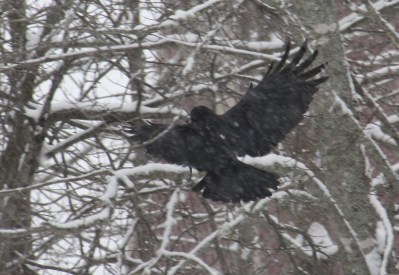
I long to see again all those beautiful creatures, the cat bird with his endless imitations, the orioles with their songs, even the sparrows seem fewer and further between. As for the garden, the crows have taken over. A family of seven caw in the trees and visit regularly. They are sharp, wise creatures and I am always bemused by their aerial manoeuvres. They still sit on the garbage cans once a week and announce their triumph to the world. But woe betide if you leave a plastic bag alone at the roadside. They make short work of it with their shiny beaks ad the bag’s interior is soon strewn all over the road for you to pick up and everyone to see.

Monte Alban

Southern platform2.png

Funny things, photos. When I updated my I-Mac, and I-photo became Photo, I lost some 10,000 photos, or more. Thanks to some hard work over the weekend by one of my good friends, we re-established contact with the missing photos. Skimming through them, I found this one, my words and Clare’s  computer art. I wrote it a long time ago, sometime after 1995, when I first visited Oaxaca. This piece records a visit I made, with Hayden Leaman, another good friend and an Oaxacan savant, to Monte Alban.

Under a hot sun that weighed us down and struck us like a hammer on an anvil, we wandered around the archaeological site and met with many vendors, some of whom seemed to have genuine artefacts, while others obviously offered us fakes. I couldn’t believe how the old men first discovered and then sat in the thin lines of shade emanating from a post, an edge, or a corner, la grata sombra / the welcome shade, as they say in Spanish. This one gentleman, who told us he had walked over from Arrazola,  some six kilometres or so away, asked us for nothing, chatted with us, and proved to be a wonderful source of local information. It was a pleasure to share our water with him. He was the possessor, he assured us, of a genuine green card, and didn’t believe in illegal immigration.

The words in the picture above summarize my thoughts at the time. I asked Hayden later where he wanted to go. He looked around at the temples, the monuments, the tombs, the ball court, the observatory … “Who wants to go anywhere?” he replied. “I am happy right here.”

I visited this and other sites later with Clare. She too proved to be very adept at finding the shade and just sitting still. Look and listen carefully: you too may be able to see and feel the beauty and the silence.

IMG0040_1

Impact

IMG_0017.JPG

Impact

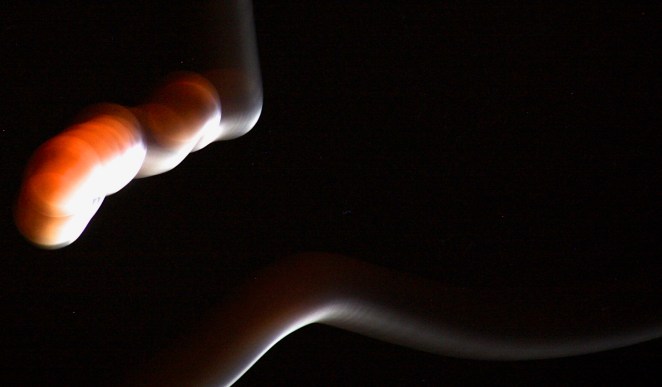
This photo comes up from nowhere, springs into your half-awake mind, diminishes your reality. W5: who, what, why, when where? But there is no who, save the person bearing witness to this moment in time, and you, the double witness who also contemplates and is therefore complicit.

Do you recognize this scene? Is this a moment in your life? Are you the one who struck the match and lit the flames in the lower corners? And are they even flames? Or are they moments of glory, flashes of fireworks, the world coming alive in a moment of combustion when light and dark are mingled until, fiat lux / let there be light, and the world is reborn, light and form, drawn from darkness, and earth and sea divided into separate realms. In principium erat verbum / in the beginning was the word and the world was born / reborn in this verbal-visual instant between sleeping and awakening, when dreams gain substance and ideas take on form and shape and grow in the observer’s mind until creation sparks into life.

Who now knows what will be, what might be? We see. We bear witness. We paint, draw verbal pictures, take snapshots, unfold our souls, placing them on paper and canvas capturing them by camera in snapshots … but What’s it all about, Alfie? Do you remember the film? The suspension in space, the knowledge that all is absurd, that this is a jigsaw puzzle of the worst kind, with no solution, no answer, and every path bifurcating before us, and each of us wandering in a maze, a labyrinth, with an entrance, but no exit.

Do you think up or down, when you’re floating in a space without gravity, where nothing is substantial and all the rules you ever learned no longer hold? The roller-coaster rolls on and you hang on, and sometimes the sun comes up and sometimes the sun goes down, and is that the first light of morning or is it the last light of day, and how can you be sure?

And where is it anyway? Have you ever been there? And if I told you where it was , what time of day it was, or what time of night, would you believe me? And if not, why not? And who and what am I? And why do you trust what I say? And why would you trust me, when you have never met me, and you do not even know who I am, or where I am, or what I am, and even I do not really know who I am or why I am, and why does any of this matter?

It matters because we need faith, we need substance, we need hope, we need to believe in something other than ourselves and beyond ourselves. We still want to wake in the morning and see the dawn. We want to grasp it in our hands, not just in our minds, and know that there is light beyond this darkness, there is hope beyond this gloom, there are better things ahead. See that forgotten candle? Pick it up. Take that match. Strike it against the box. Now light that candle. Take it out. Show it to other people. Encourage them to light their own candles.

Sometimes we need to enlighten the world, to turn it round, to reject it as it seems to be and to recreate it in our own image.  But take care: the image of the candle is not that of the laser beam or the searchlight. One by one, the small people, we must join together, and like tiny stars and light up the firmament. I cannot do it alone. But together, you, and you, and you, and you, if you walk with me, we can do our best. And that is the best we can do, in this, as Voltaire’s Candide once called it, the best of all worlds and the only one we have.


My Favorite Pen

IMG_0395.JPG

My Favorite Pen

This is my oldest Mont Blanc fountain pen. I must have bought it in 1986 when I traveled to London to attend a Spanish Golden Age seminar at one of the university colleges. I can’t remember which, though I do remember the seminar was on someone called Francisco de Quevedo. We met like spies, my pen friend and I, on the steps of the British Museum. I had never met him before, so he carried a specific book under his arm, one of Quevedo’s I think, by which I would recognize him. We lunched together at an Italian Trattoria, whose name also escapes me, and we discussed the ways of that ancient Hispanic world and our own research upon it. I paid for our lunch from my travel funds. I had a sabbatical that year and had arranged a short tour of four or five British universities in my search for knowledge. After lunch, he took me back to his London college and I sat and absorbed wisdom from 2:00 until 5:00 pm.

After the seminar, walking back to the nearest tube station, I passed a shop that had this Mont Blanc in the window. I went in and bought it. On the spot. No second thoughts. Then I caught the tube to Paddington station. While waiting for the train back to Cardiff, I sat in the station bar and ordered a pint of beer. A well-dressed man, slightly older than me, asked if he could join me. I said yes. He sat down and began to talk. He told me how to commit suicide by slashing my wrist with a knife.  There were many incorrect ways to do it, he explained. But only one right way, if you wanted to be successful. He rolled up his sleeve and showed me his collection of scars that ran crisscross and welted over his left wrist. Failed attempts, he said. But I’ll get it right next time. I wouldn’t want you to make the same mistakes as me, if you decided to try it.

Must go, I told him. My train’s about to leave. I left the remains of my pint on the table, looked back, and watched him finishing my beer. Good job I didn’t spit in it, I thought. Then I realized that I probably had, one way or another. I boarded my train and 90 minutes later I was back in Cardiff. No more post-war, coal and steam engines, a diesel this, powerful, fast, and smelly. It reduced the former four hour journey to much, much less than two. Cafeteria style, the train carriage offered a table top for every four seats. I opened my new pen and wrote in the pocket journal I had bought for the trip.

So many memories. But I don’t remember the names of either of these two men. I do recall those scars, though, deep and ridged, crisscrossing like railway tracks. Every time we clicked over a junction or a cross track I shivered and my writing wiggled on the page.

IMG_0396

Trains

img_0359

Trains

     You took me on holiday to the continent. Railway trains to Austria, Germany, and Switzerland. You loved those trains. I hated them. We stopped in the dark at unknown stations. I’m thirsty, you said. Get me some tea. I left the train, climbed down to the platform, went to the restaurant. I had a fistful of money, but didn’t know what it was worth. Tea? I begged the man behind the bar. My mother wants tea. They all shook their heads and offered me beer. My turn to say no. Coffee?  A pause. Uh-uh. They offered me orange juice, lemon juice, wine, and I finally water. A whistle shrilled. It’s the train, they said waving their hands in the direction of the door. I let them choose the money they wanted.  And something to eat. They gave me a sandwich, a slice of cheese in a baguette, then seized some more coins. The engine hooted, a lonely owl, calling for its lost chick.  I ran out of the restaurant, on to the platform. Carriages moved past, slow at first, gathering speed. The last passengers climbing aboard, the doors closing. I ran. The guard, at the end of the train, blew his whistle, waved a green flag, held the last door open, until I caught up. He helped me onto the train, gifting me with a storm of words in a language I could not understand. The doors between the wagons remained locked. My compartment lay to the front of the train. I couldn’t remember the number of my carriage or my seat. Wagons-Lits? I shook my head. Première classe? I shrugged. Touristique? I nodded. The guard grimaced, led me down the train, unlocked doors in the sleepers, led me on and on, until we arrived at my compartment. Restrained by another guard, you yelled and shed tears as you tried to pull the emergency cord that would stop the train. Ah, there you are. What the hell do you think you’re doing? I was worried sick. You slapped me. Now I stand on a different kind of platform, watching another train pull away. I stand here, abandoned, and watch you slide slowly into an unreachable distance.

Poinsettia

img0137_1


Poinsettia

     You can sense it, you can feel it, the alert spirit that guards this room. Walk in there at your peril. No, don’t. Just stand at the door and observe the poinsettia. You bought her a real one, a year ago, but she forgot to water it and when you visited, leaves and flowers, had crisped and dried, withered and perished. You even found cigarette butts stubbed into the pot’s powdery earth. You bought her another one, this time an ever-lasting, artificial flower, scarlet blossoms of silk with yellow-dotted plastic beads. Today a feather-duster breeze cleanses and enriches the leaves, replenishing their faded splendor. Motes rise, their dancing angels of dust hovering, suspended in a sunbeam that picks out their supple luxury. Their fiery tongues cry out to you from their green plastic pot in this empty room. The plant throbs with a startling vibrancy in this early morning light that enlivens piano keys, table top, and the polished, wooden chair arms you cleaned yesterday.  The poinsettias seem to wring butterfly hands as they gently flap in the breeze from the open window where thin lace curtains twitch, shaping the sunlight into light and shade. Her ash tray sits by the radiogram and awaits her return. That last cigarette, lipstick staining the filter, stubbed out and cold, waits for a companion. Later today, you will go to the hospital and visit her. You do not want to enter this room for its guardian spirit demands solitude and silence. You do not wish to create a disturbance, yet something moves you, and you walk over to her flower. A film of grey cigarette dust rises once more from the silk poinsettia, disintegrates, and dances before you. You bend your head to the silken surface and feel dry leaves brush their butterfly kiss across your cheek as you breathe in the ashen smell of stale tobacco.

Whisky

IMG_0067

Whisky

     Dry energy bristles through your body, tangible electricity, I dare not touch you. Sparks fly through your hair and light up pillows and sheets. Plugged into your flesh and blood, those instruments of life and death and in-between flicker and will not stand still, will not take appropriate measurements in the way doctors and nurses predict or want. Stranded on your beach of bleached white sheets, you are smaller than a seal, an otter, perhaps, a sea-urchin, or a star-fish, struggling in the high-tide mark, not with the sun and wind that dry you out, but with the sands of a time that is ticking away from you, filtering through your fingers, fleeing from your grasp. Your hair ruffles. Your forehead wrinkles. Your gaze sharpens. You have the hunting eyes of the unhooded hawk, or those of a peregrine falcon fixed on its prey, yet you cower like the land-bound beach-bird that he hunts. You are burning up, devoured in your own interior inferno. You slap at my hand as I take a risk and try to place it on your forehead to offer you consolation. What is it? I ask. What do you want? Shall I go and get the nurse? The doctor? You shake your head, your eyes flash, the air sizzles, and you whisper something, too low for me to hear. I put my ear closer to your lips. Your voice: coarse sandpaper over the soft balsa wood frame of a plane that will strive, one day, to grow wings, to take flight, to be a bird. Whisky, you whisper. I just want whisky.

IMG_0136

Swansea Bay

IMG_0055


 Swansea Bay

            My childhood in Swansea: a mixture of seaside and sand. Walking over the bridge at the Slip to reach the dunes at high tide, the fish nets at low tide, the dog ever before me, running fancy-free, chasing yellow-beaked gulls that swoop low, mewl, and lead him on and on, past bundles of bathers’ clothes in summer, and the dog lifting his hind leg, visiting each pile, marking them, one by one, a squirt at a time, and us denying we know the dog, not ours, we say, then beg for the empty pop bottles, taking them back to the vendors, pocketing the cash back on the bottles until we have enough for an ice-cream, a grown-up wafer, not a childish cornet, or a go on the swing boats, and the dog comes with us, gets sea-sick, air-sick, hangs his head over the wooden sides drooling thick saliva as we wait for the bump and grind of the wooden bar that will slow us down in spite of us pulling on the ropes, harder and harder, until we swing higher and higher into the heavens, and the sands dwindle into nothing, and the dog throws up, and the man who handles the swing boats calls us bad names, as we run away, across the sands, ‘I’ll tell your dad,’ he shouts after us, but he never does, and the dog wanders loose across the sands to drink salt water and throw up again, and yes, I remember the starfish, their golden triangles winking wet in the sunlight as they hang from their netted firmaments, and we walk out along the concrete sewer pipes that pour the town’s waste, the town, and not the city, never for me a city, and how could it be a city when so many uncles and aunts lived on Town Hill and my father worked in Town Hall, and Swansea Town were the Swans, and they played soccer on the Vetch Field, the old hanging ground for the town jail, never the city jail, and the Mumbles Railway ran its electric trams out from Swansea Docks to the quarries by the Mumbles Pier, and we took that train, sat on the top deck, The Slip, Singleton Park, Blackpill, the Mayals, West Cross, Oystermouth, where last year, after a hundred years of absence, wild oysters finally returned, the pollution from Copperopolis, the largest copper mining and smelting town in the world, finally drained from Swansea Bay and the waters now clean enough to keep those oysters alive in their cultured oysters beds at Oystermouth, on Swansea Sands, below Oystermouth Castle with its ruined walls where we went once, but I remember nothing about it, nor Swansea Castle, in the old town centre by Castle Street, its ruined walls banned with their Keep Out signs and Danger, but the warnings themselves enough to invite us in, except we knew we’d be beaten if anything happened and we were caught and everyone knew everyone in Swansea Town then,  and somebody would surely bear the tale to our parents or grandparents,  but that’s enough of that, and its’ out of the tram and across the wooden planks of the Mumbles Pier, out to the end where the old men throw their lines into the sea and sit and wait and hope, pulling on cigarettes, Players Nay Cut for preference, as they watch swirling waters, taking sips, like old men everywhere, from secret bottles in brown paper bags that cause them to wipe their lips with the back of theirs hands and cough with pleasure, waiting for God knows what to come along and tickle the end of their line, and out there, at the end of the world, the lifeboat house with its slipway and the lifeboat, launched only in the roughest weather when the tall ships founder or the small boats are blown away, out into the sea, that twinkles now with its wrinkled old man’s face as it moves back and forth beneath wind and sun, and everyone is smiling in the summer warmth, though it’s cold where the wind blows off the sea, and it’s into the corners away from the wind, or into the pavilion where the arcade games wait for our money, and it’s ‘please, please, one more go’, as the small metal arms armed with their claws, clutch at toys and dolls, and furry animals, and the fighter planes come swooping down in their practice arcs and yes, I am a gunner again, fighting my Battle of Britain in a spinning turret with a mobile gun-sight, and time and my money run out and it’s ‘ please, please, one more go’, and my head is spinning, as the turret is spinning, and the world is spinning on its axis as memory’s spider spins its web of illusion, delusion, and time rolls backward on the station clock, as the tram rolls up and we track our tired way back home, past Oystermouth, West Cross, Blackpill with its little Roman Bridge, Singleton Park, the Recreation Ground, St. Helen’s, to the Slip, where we boarded in he first place, and home we go via the fish-and-chip shop in the road at the bottom of our street, and all adventures end as we open the front door, calling out ‘we’re home’, and the smell of warm salt and vinegar soaks through the newspaper binding the delicacies we have brought to placate the gods who wait in silence for our return.

Kite


IMG_0011

Kite

Half-light, dim shadows, grim grey ghosts floating, drawn along by curtains shape-shifting in an early breeze. Sun rises, drops light down, filling the room with yellows and pinks. An empty, shell this house, yet the sun brings a morning bouquet, its golden egg-yolk, filtering into cracks in white plaster walls. Barren and bare, today, our world, our words. Sun-dried Roman aqueducts, built two thousand years ago, dry now, carrying no water, desiccated mouths channeling no sound. Lifeless kites, our painted faces, our twisted lips. What is this burden you will bear, so silent, to the skies? Not yet: for you are still earthbound, helpless, too heavy to rise, to surge skywards, to ascend in that one last kick for freedom. Frail your face, your frame. Your skin, mottled-brown sacking lagged around clogged and pitiful pipes. Barriers daily grow between us. They sandbag our lips, string barbed wire so our worlds, our words will never meet. Dead soldiers, forced over the top in a moment of glory, our thoughts hang in the air, wet washing hanging there beneath a casual flap of magpie and crow. A star-shell, kindling my mind, your kite-face, drifting away.

Family Album

IMG_0061

Family Album

I recall him early in the day, carving his field into brown-tipped waves, with his two sheep dogs  running loose beside the enormous cart-horses that give him the horse-power, huge, born to labor and the plough, as they create their own steam in the morning mist, so cool, but stay clear of their hooves, huge hooves, iron shod hooves, hooves that will break a leg or stove in the dog’s ribs as if he were a rowing boat crushed against an Atlantic rock in the fast ebb-tide of the local bay, and watch out for them in the stable where they lean together, side by side,  like the oxen twins, Bright and Lion, out at King’s Landing, and like the oxen they munch their hay and stomp their feet and blow hot air out through their nostrils, almost in unison, their sweet-smelling breath sugaring the air, and the bright hay surrounding them, prickly and tickly, and leaving its speckled rash on arms and legs and necks …  and I thresh in dream-memories, flailing from harvesting remembered brightness beneath a star-filled sky, gathering memories, ordering them into vital bundles, and every package a re-creation of everything that I was, and am, and ever will be, and those who come after will find less of myself, yet more, much more, than this empty snowball of flesh, which sits here at the table, pen in hand, scribbling the words that begin and end it all, the tell-tale words that blindly bind and knot the ties that tie me in place, forever, between these lines, between these covers, and I jot down supplements that will supply fresh blood to the memories of my rapidly fading life … how long will I hold on to them, those memories, those moments of glory, those seconds that turn into minutes, then hours, and  the hours stringing themselves together to form days and weeks  as memories gnaw away the years, as a mouse gnaws away at a cheese, with jagged teeth until all that is left are sad photos of unnamed, unremembered people floating in the family photograph album like the one that my grandfather once gathered, and glancing from page to page I know no one even if the name is written there, his wonderful copperplate standing out beneath the photograph, ‘my sister Betty, aged two’, ‘my cousin David, aged ten months’, ‘my grandmother’s father’s sister’s cousin by marriage’, and there she is, this anonymous being, riding in the sidecar of a motorbike, and the photo all speckled and brown, like a hen’s egg, waiting in its egg-cup for the silver spoon that will bring it magically to life, a real life, not the false life of a forged memory that floods through my mind, so young, they are, so small, so pretty, all of them, so dashing, so handsome, even in their old-fashioned clothes, and now they are here, their spirits trapped in this photograph, floating ghosts in the half-life of a sepia snap, and will this be the afterlife for all of us, these snaps, taken in an instant, and then lasting, at first for hours, and then, forgotten and laid aside, then surfacing in another country, held by another hand and viewed by foreign eyes that do not know and will never understand … how can they ever understand?