Revisions: Wednesday Workshop

IMG_0486

Revisions
Wednesday Workshop
27 June 2018

Below are the texts of a poem that I am attempting to revise. Any comments on the text(s) or the revision process will be welcome.

In Absentia 1
Princess Squiffy

I hear her voice, delicate, distant. I
run to the sound, jump on the table in
my usual spot by her plastic plaything.
She isn’t there. He is and he’s talking.

I can see him, smell him. I hate him, his
other sex perfumes, but there he is and
when he stops talking, I can hear her voice.

I move to his talk box. A shadow, I
can’t quite make it out, then her voice again.
My whiskers stiffen, I lean forward, sniff,
but no smell. She has no smell, and scentless,

I cannot sense her, I bristle, she calls
me by my favorite names, mews, and I mew
back in reply. But I can’t smell her. There’s

no sense of touch … is this the hell all cats
will suffer … shadows on a screen, a voice,
haunting, memories shifting and dancing,
nothing solid … just shadows and absence?

Problems:
Repetition of scents / smells, there, voice (4), plus avoid all cats

Solutions:
Seems easy to tidy up … but … how do I end the poem with I hate him? Would it make the poem stronger? It would man a total rethink and restructure. 

In Absentia 2
Princess Squiffy

I hear her voice, delicate, distant. I
run to the sound, jump on the table in
my usual spot by her plastic plaything.
She isn’t here. He is and he’s talking.

I can see him, smell him. I hate him, his
other sex perfumes. He stops talking. I
can hear her warm, sweet words: where can she be?

I move to his talk box. A shadow, I
can’t quite make it out, then her tones again.
My whiskers stiffen, I lean forward, sniff,
but cannot sense her. I bristle. She calls

me by my favorite names, squeaks, and I mew
back. There’s no sense of touch, of her presence.
Is this the way we all will suffer? Wood

burns. Firelight flickering, shadows on
cave walls, long gone memories revived to
haunt us. Are these the torments held in hell?
Will dark shapes shift on half-lit screens? Will the

memories of loved ones come back to taunt
us, haunt us?  Will there be nothing solid
in the afterlife, just outlines and absence?

First Revision:
I quite like it, but it has become much longer and the cat’s voice has either been conflated with the human voice at the end or it’s an exceptionally intelligent cat, knowing all about Plato,  unless those can pass as feline memories because she was in the cave with him.

In Absentia 3
Princess Squiffy

I hear your voice, delicate, distant. I
run to the sound, jump on the table in
my usual spot by your plastic plaything.

You are not here. He is. I can hear you
talk. I stalk to his noise box. I see a
shadow, moving, but I can’t make it out.

My muscles first tense, then stiffen. I sniff,
lean forward, but find no trace of female
smell. I cannot sense you. You call me by

my favorite names, mew at me, and I
respond. Shifting shadows, your haunting tones,
memories dancing to the music of

your absence. I can’t eat. I bristle when
he laughs. Where are you, my love? He doesn’t
care for me the way you do. I loathe him.

Second Revision:
This is much shorter, builds up to the proposed new ending, eliminates the repetitions, and replaces hate with loathe, a very catty sound. However, I have lost the ending that I liked so much: the suggestion of Plato’s Cave has now been lost. So, let’s head to Plato’s Cave.

In Absentia 4
Plato’s Cat Cave

Princess Squiffy

I hear her voice, delicate, distant. I
run to the sound, jump on the table in
my usual spot by her plastic plaything.
She isn’t there. He is and he’s talking.

I can see him, smell him. I hate him, his
other sex perfumes, but there he is and
when he stops laughing, I can hear her voice.

I move to his talk box. A shadow, I
can’t quite make it out, then her voice again.
My whiskers stiffen, I lean forward, sniff:
she has no smell. I bottle-brush my tail.

Envoi
by Plato

Firelight flickering, shadows on walls,
distant voices echoing, memories
perched on our shoulders, night owls hooting.

Is this the hell we all will suffer, shapes
shifting on a screen, voices taunting us,
memories dancing to half remembered
melodies, nothing solid, shadows, absence?

Third Revision:
This poem has now changed shape and direction. I quite like it but it is dependent on a knowledge of Plato’s Cave. Does the cat belong in Plato’s Cave … I think of Kipling’s Just So story The Cat that Walked … perhaps it does. Perhaps it doesn’t.

Decision Time:

Playing around with the text was fun. The text moved in several directions and now I must choose my final direction.

Comments on any of the versions or on the revision process I used will be very welcome. And yes, nothing perishes. My poems, like my cats, have nine lives (well, four in this case, with possibly a fifth to come).
Small Corner

Small Corner
18 June 2018

Here’s the original post from my time last June (2017)  in Kingsbrae / Kira. The text is attached.

https://rogermoorepoet.com/2017/06/06/small-corner-2/

Here is a recent reading.


It is interesting to compare the different voice versions. The text doesn’t change!


Juggler – Juglar

Juggler / Juglar
17 June 2018

This is the audio of the reading.  Click on the audio, then click on the text and read while you listen. Or listen, then read. Or just listen. So many choices and so much fun.


Here is the text.

https://rogermoorepoet.com/2016/10/18/juggler/

Wednesday Workshop: Voice Recordings

IMG_0027

Wednesday Workshop
13 June 2018
Voice Recordings

To be Welsh on Sunday

I am continuing today with my experiments with voice recordings, something that interests me very much. As I said earlier, my voice changes with audience and mood, and early morning, in Island View, with the microphone and Princess Squiffy as an audience, and the window open so the cool morning air can circulate before the heat of the day, is not the best way to induce mood, well, not in this reader anyway.

When I made the recording, I was reading from my book  Though Lovers Be Lost  (available on Amazon) my head was slightly turned away from the laptop’s built-in speaker, and, as a result, the reading is not as loud as I would have liked. It is also a little bit fast. I don’t mind the speed of it: when I was younger I would read this poem in a single breath, all 90 seconds or so of it. Now I need many breaths to get though it successfully. Ah, a young man’s fancy turned to dust …

I will do a retake of the poem, not on my laptop, but on my IMac, and I will add that later, below the first recording which will appear just below this introduction. Then I will add the text. Yesterday I offered text, then reading. Today I offer the reading first. That allows the listener to listen first and then read the text OR to start the audio recording and then follow the text as it is being read. This is a Wednesday Workshop and this is all part of my workshop experiments in reading. Wonderful fun and highly recommended. Thank you for being here with me and remember, your comments are more than welcome, they convert a workshop from a soliloquy into a dialog.


Second recording to follow

To be Welsh on Sunday

To be Welsh on Sunday in a dry area of Wales is to wish, for the only time in your life, that you were English and civilized,  and that you had a car or a bike and could drive or pedal to your heart’s desire, the county next door, wet on Sundays, where the pubs never shut  and the bar is a paradise of elbows in your ribs and the dark liquids flow, not warm, not cold, just right, and family and friends are there beside you  shoulder to shoulder, with the old ones sitting indoors by the fire in winter or outdoors in summer, at a picnic table under the trees or beneath an umbrella that says Seven Up and Pepsi (though nobody drinks them) and the umbrella is a sunshade on an evening like this when the sun is still high  and the children tumble on the grass playing soccer and cricket and it’s “Watch your beer, Da!” as the gymnasts vault over the family dog till it hides beneath the table and snores and twitches until “Time, Gentlemen, please!” and the nightmare is upon us as the old school bell, ship’s bell, rings out its brass warning and people leave the Travellers’ Rest, the Ffynnon Wen,  The Ty Coch, The Antelope, The Butcher’s, The Deri, The White Rose, The Con Club, the Plough and Harrow, The Flora, The Woodville, The Pant Mawr, The Cow and Snuffers — God bless them all, I knew them in my prime.

Photo Credit: Princess Squiffy, my favorite listener. She never complains, but she rarely stays awake.

On Being Welsh

IMG_0040 (3)

Cherry
A careful listener

On being Welsh in a land ruled by the English

 I am the all-seeing eyes at the tip of Worm’s Head;
I am the teeth of the rocks at Rhossili;
I am the blackness in Pwll Ddu pool
when the sea-swells suck the stranger in and out,
sanding his bones.

Song pulled taut from a dark Welsh lung,
I am the memories of Silure and beast
mingled in a Gower Cave;
tamer of aurox,
hunter of deer,
caretaker of coracle,
fisher of salmon on the Abertawe tide,
I am the weaver of rhinoceros wool.

I am the minority,
persecuted for my faith,
for my language,
for my sex,
for the coal-dark of my thoughts.

I am the bard whose harp, strung like a bow,
will sing your death with music of arrows
from the wet Welsh woods.

I am the barb that sticks in your throat
from the dark worded ambush of my song.

Commentary:

Continuing with the audio experiments of the last couple of days, here is my voice recording of On Being Welsh. This poem can be found, along with several other Welsh poems, in Though Lovers Be Lost, available on Amazon.

Comments on the readings are very welcome. For my regular readers, if you have a favorite poem of mine that you would like to hear, just let me know and I will record it, specially for you!


I am indebted to my friend Jeremy Gilmer for this second reading of On Being Welsh. We will be collaborating on the creation of sound files and posting contrasting readings of various poems to see how different voices and rhythms change sound and meaning in poetry. Hopefully, this is the first in a longer series.


Good Heavens!

Skeleton

Good Heavens: it’s hard to believe that I am a blogger when, currently,  I so seldom blog. I guess it’s the online courses, back to back, eight weeks of creativity online, but a different line from the blog line, and then another eight weeks, five gone and three to go. So much to catch up with. So much to do. Also, all that hard work and then the discovery: a poem published on my blog is a poem published and it is not eligible for publishing elsewhere.

Oh dear … that somehow sucks … like a rose, a poem is a poem is a poem and there is an enormous difference between publishing, can you really call it ‘publishing‘, a poem here and publishing it in a journal or submitting it to a competition, with real live editorial groups poring over its content and then giving it the thumbs up, or thumbs down, as the case may be.  Whatever: rules is rules, I guess, made to be broken, but we lesser mortals break them at our peril, I guess.

Whatever: the reading lessens in three weeks time, also the writing load, and the critiquing load, and all the other loads we writers must carry around with us, on our backs, like a snail carries its shell, aka its house. Lesson: be like a hermit crab, moving in, moving out, changing your residence as it suits you … one way tickets that will keep you in the pink, or some other suitable color.

So: since the start of May I have written / revised more than seventy poems, but I daren’t put them on the blog … why not? Because I would like to publish them in more traditional fashion or else submit them for competitions where unpublished work is demanded. Screwed up? Yes, but the whole world is whirling towards a screwed up state right now. What to do? To publish or not to publish? Where to publish? Where not to publish?

You know, deep down, I am not sure that it matters a damn. I’ll play their game, by their rules, for a month or two, then when the shot-gun riders on the poetic garbage trucks (aka the gate-keepers) move in and warn me off, I’ll come back here and publish it all anyway.

Meanwhile: believe, breathe deep and believe. I’m not going away, not just yet, anyway. But I am taking a small break, and I am moving in a slightly different direction … but I am absolutely certain that I’ll be back.

Wednesday Workshop: Codification

IMG_0068 (2)

Codification
Wednesday Workshop
30 May 2018

For me, it is vital to see how others read and interpret my work … what comes across, what doesn’t, how things are understood and read, sometimes in the same way, sometimes in different ways. It is always easy to pick out some favorite phrases. However, deciphering, interpreting, and then reacting to, a poem’s inner code, is a very different matter.

I love the cut and thrust of dialog … I was at our Tuesday night writing group meeting last night from 7-9:30 pm and we had a great time, back and forth across the table pecking, like wild birds perched on a literary feeder, at each others’ texts. My own texts are thickly layered and highly codified and I have become very interested in the theory of literary codification.

My own ideas are a development of those of Northrop Frye as he expressed them in The Great Code. When we lose our common code, to what extent do we need to explain a private one? This is of great import to Frye’s studies on William Blake, perhaps (in spite of his seeming simplicity in certain poems) one of the most difficult of English poets.

Perhaps the answer lies in Karl Jung’s theories on the racial subconscious: that we all share deep, (human) racial symbols that transcend words and often appear as symbols and images. If this is true, then we communicate, at a non-speech level, through metaphor and symbol, and that is more powerful and outreaching than linear language, however well and clearly codified it may be.

This emphasis on symbol, image, and metaphor leads us, of course, into surrealism, free writing, concrete poetry, sound poetry, and all those efforts to abandon the linear and reach into the subconscious roots of ‘that which binds us together as human beings’ … in my humanistic theories, to find the links that behind is more productive than the reinforce the fears and misbeliefs that separate. Alas, not everyone thinks that way in the literary world, and private codes can easily be used as wedges to force people apart.

We need codes, preferably codes that we can share. The question is, how explicit would we be, as writers, in explaining those codes? How closely should we imitate the writing codes of other people?

The eternal mystery of Aladdin’s Lamp: “New codes for old.” And don’t forget the magic words “Open Sesame.”

Ah, the joys of codification.

Commentary
This is my first post for some time, ten days in fact, 20 May. No excuses other than other commitments: to the WFNB, to my online poetry course, to my physical writing workshops, to my own creative condition … I am creating furiously at present. Codification is something that has interested me for some time: the Biblical Code, The Western Tradition, Courtly Love, the Icy Fires of Petrarchism, Romanticism,  Impressionism, Expressionsim, Surrealism. Modernism, Post-Modernism … the -isms, once started, are apparently endless. All of these -isms spiral round the ideas of verbal codes. In codification, I would like to start a discussion on what these codes are, how they affect us, what do they mean, especially when they can be so totally personal. By all means, join the discussion: what do you mean by codes? How do you use them? How do you interpret the codes of other people?

Looking Back

Empress 048

Looking Back

Looking back on a wonderful weekend, the WFNB WordSpring in Quispamsis, I remember the highlights.

  1. Picking up Kerry-Lee Powell and driving with her to Quispamsis. Never has the road seemed so short, and rarely has time passed so quickly. Whether it’s our shared Welsh roots or the course I took with her online at Toronto, we had so much to talk about.
  2. Arriving to find so many friends and all of them so willing to help with books and luggage and getting me to my room. Special mentions: Jeremy Gilmer‘s hug on arriving, Zev Bagel‘s offer to help with luggage, Chuck Bowie‘s warm presence and guiding hand, Cathy Fynn‘s hug and firm control of registration and checking in, and many others, some of whose names will appear bit by bit.
  3. Settling into the room was easy.  Then it was a case of preparing for the first workshop (The Sense of an Ending) that started at four and was due to run until five. I went early to the room and met the participants as they arrived. My first surprise: Barb Fullerton, another member of our online Toronto course, announced her presence with a warm smile and greeting. We had chatted online for eight weeks and now she was here at my workshop. Wonderful. Starting the spring conference with a workshop on endings seemed very inappropriate, until I remembered my T. S. Eliot: “In my beginning is my end …” The circularity of time and the intricate relationship of the end to the middle to the beginning … it made a great central theme for the workshop.
  4. The group was composed of many excellent writers and I was able to mention many of them by name. In addition to  some of those already highlighted above [Chuck, Jeremy, Kerry-LeeZev, Chuck] , Ana Watts, Jane Tims, Neil Sampson, and Terry Armstrong stood out and I urged people to circulate during the mobile, inter-active session, meet these writers, and talk to them about their undoubted finishing skills.
  5. Time passed too quickly and we found that an hour was not enough. No problem, I checked with Cathy and we kept going for another fifty minutes in a seamless transition of lengthened workouts.
  6. Friday night passed in a flurry of conversation in the hotel restaurant, coffee house, and bar. Chuck (the TWUC Atlantic Representative) introduced me to Marjorie Doyle, the Chair of TWUC and our guest speaker for the banquet, and we held a delightful, wide-ranging conversation on literary values and travels in Catalonia.
  7. Saturday morning saw the advent of my second workshop, this one entitled The Black Ink of Fear. This workshop was by request and I was more than a little afraid of how I would handle it. I circulated my own Fear Document  and invited people to read it. Victor, my Australian friend, found his sheet was upside down and amazed the room by standing on his head, to much applause, as he read it the right way up. This clearly broke the ice and we employed Chaos Theory to good effect by doing absolutely nothing in Chaotic Fashion and getting everywhere.
  8. Lunch was a delightful selection from Chef’s Table (Sussex) and Chuck Bowie played a major role in keeping me a seat (I arrived late) and getting me settled (thank you again, Chuck).
  9. Worn out after lunch, I missed the afternoon’s sessions and took to my bed in traditional Spanish fashion enjoying a well-earned, rather extended siesta from 2-5 pm.
  10. Supper was at 6:00 pm and I was truly honored when Jeremy Gilmer read my poem Inundation that I wrote on May 6, just when the St. John River flooding was at its worst downstream below Fredericton. We dedicated our thoughts and prayers to the people in Saint John and Quispamsis still affected by the now diminishing waters. It was a double honor when I was invited to say a traditional Welsh Grace, in Welsh, followed by an English translation: “Thanks be to the lord for good food and even better friends.”
  11. My weekend’s activities were not yet over and I received an award (3rd place in the David Adams Richards’ Prose Competition for my short story collection Devil’s Kitchen). I read in a thick Welsh accent a short piece of Flash Fiction from this collection, called Teeth. For some strange reason that I could not fathom, the room was highly amused by this true story of domestic bliss.
  12. Saturday night and we retired to the bar where a small group of us Marie, Louise, Angèle, John, Andrea, and I stayed up and sang to John’s marvelous harmonica and guitar music until one thirty am. Contrary to malicious rumors spread by unknown sources, not mentioned by name, we did not sing rugby songs, but a marvelous mix of Irish ballads, Newfoundland songs, Acadian and French chansons, and contemporary songs by internationally acclaimed singers, many of whom might not, midnight being long past, have recognized their own music.

Alas, all good things must come to an end. Later that Sunday morning, we made our sad farewells and Kerry-Lee and I headed back down the road to Fredericton where we arrived after what what seemed to be about five minutes driving (at well below the speed limit). I dropped Kerry-Lee off then stopped at the Happy Baker for cakes and croissants. These I presented to my beloved for Mother’s Day. We shared them over hot coffee … and that was that.


Recycling

Books

Recycling

“You never know when you might need it,” my
grandfather said, finger-nails cracking red-
waxed parcel string. Bright sealing wax rained down
on the tablecloth, covering it with hard,
scarlet chips. Wax cracked, tight knots emerged.
One by one, my grandfather first loosened
them, then sought the string’s free end, following
it along its snaking way from knot to
knot. Like Theseus following his twine
through the labyrinth below the palace, my
grandfather mused, hesitated, followed
the clues given him by the knotter’s mind.
Set free from its parceled knots and lashings,
he looped the string around his fingers and
tied the twine into a tight bow that he
stowed away for future use. Reef knots, slip
knots, sheep-shanks, bowlines, bowlines-on-the-bight,
he showed me how to tie them all. He taught
me too how to never tie granny knots.
“Never cut string with a knife: untie knots,”
strict his advice. I follow it today.

Commentary:
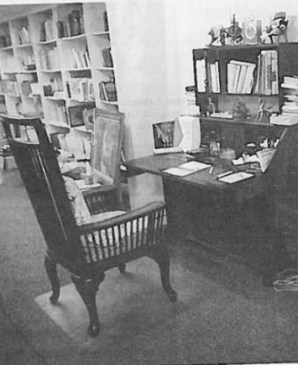
The photo shows my grandfather’s chair sitting before my basement desk where I write and store my books. I used to climb up the back of this chair when I was a tiny child, and blow on the bald spot on his head while he was asleep. Such memories nesting in the attic corner of the dormant mind. One day, I will write about that. Oh: I just did.