Hyperbole: Wednesday Workshop

img_0177

Hyperbole

It is no exaggeration to say that Hyperbole is one of the most exciting and fascinating aspects of rhetoric.

At its most basic, hyperbole means exaggeration. When we start to explore the term, however, it means oh so much more.

Looking up synonyms for hyperbole, for example, we find the following: exaggeration, hype, metaphors, overstatement, amplification, coloring, distortion, embellishment, enlargement, magnification, PR, big talk, embroidering, laying it on thick, making a mountain out of a molehill, tall talk.

But let’s not stop there. Merriam Webster offers this as a definition: The representation of something in terms that go beyond the facts. “Enough food to feed a whole army” is a common example of hyperbole. Here are some more suggested synonyms, with a few overlaps: caricature, coloring, elaboration, embellishment, embroidering, embroidery, exaggeration, magnification, overstatement, padding, and stretching. Related words include: amplification, enhancement, fabrication, misrepresentation, fudging, hedging, hype, puffery, plum-mcduffery, and superlative.

The Power Thesaurus suggests that there are over 263 synonyms for hyperbole. It offers 14 pages of them. Here is the start of page one:

exaggeration / image, parallel, flower

overstatement / exaggeration, adornment, coloring

metaphor / exaggeration

embellishment / exaggeration, excess, decoration

distortion / exaggeration

magnification / exaggeration, fancy, line.

We could go on and on and on with this, world without end, secuale seculorum, for ever and ever, and all that, without exaggeration. The point is clear, we have more than enough definitions here to fill several rather large books and clearly, without being too catty about it, it would take at least nine lifetimes to read and understand them all.

Meanwhile, hyperbole possesses an adjective: hyperbolical. This is sometimes confused with the term hyperbolic which in turn is occasionally confused with the term hyperbollocks, as in the saying: “this article is, without embellishment or exaggeration, a load of hyperbollocks.”

Chuck Bowie comments: “Down the road, I hope we get to see your take on how to employ this useful tool without reducing the document to caricature.”

Roger Replies: Thank you for your comment, Chuck. I think that the application of hyperbole to a literary text or an image within a text depends entirely on the individual author. As authors and human beings, even in our daily speech and our interactions with other people, we can and do exaggerate. How we apply hyperbole to our structures and stories and characters is very individual. Clearly there must be a balance between emphasis (potentially good) and over-exaggeration (potentially bad, but with strong potential for parody and comedy), but so much depends on the individual situation. A stylistic analysis of each instance will reveal if the hyperbole is excessive. However, in my opinion, that necessitates the presence of a text, rather than a doctrinal theory about ‘how to do it’. The easiest way might be to analyze a text or two and see how hyperbole functions in specific circumstances. Certainly, as you so rightly note in the above comment, hyperbole can be used for comic purposes, as I have done in my article. Its overuse can both be criticized and parodied. An interesting study, with the seeds of a doctoral thesis planted therein, would be to demonstrate how, in Don Quixote, Cervantes moves from a hyperbolic parody of his character to a truer understanding of the essential dynamics of the main characters’ essential personalities. If I were fifty years younger, I might start that doctoral thesis.  Alas, within the self-imposed parameters of  this blog, there is neither time nor space. We can continue this conversation at our leisure. Thank you for responding.

Bearing Witness

IMG_0176

Bearing Witness

Pen on paper,
words falling like tears,
salt waters that erode
the hardest of stones.

This man bears witness
to thought, word, and deed.
He’s the outsider who sees
the interior world
and drags forth its spirit
for others to see,

not painted in paint,
not sculpted in stone,
not a breeze through
bound river reeds,
just words on the page
lined up in thin lines
to flower and flourish
like an army that conquers
the world of the soul,
and leaves fresh footprints
on eternal snow.

Three Bears Wood

IMG_0156

Three Bears Wood

Nobody has seen them,
those three bears,
nor naked nor clothed.

So who now walks
in
Three Bears Wood?

Who now stands
where he once stood
in
the shadow of the trees?

Sometimes
he walks there
in
his dreams.

What magic power
puts him back there
beneath the trees?

What ghosts does he see,
what words does he hear,
what dreams does he dream
in
Three Bears Wood?

Hollow

IMG_0457.jpg

Hollow

I am a hollow man,
my heart and soul scooped out
by worry, wear, and care.
Water fills my bones.
My muscles shake like jelly.

Hope?
I abandoned it long ago.

Faith?
In these changing times
it’s a series of corks
bobbing their apples
in a party barrel.

Charity?
Love grows old and cold
and loses its charms
as we shiver in each other’s arms.

For now, I’ll dodder
my dodo way
towards extinction.

As I shuffle
from room to room
I’ll rest for a while
upon this chair.

My mother went this way.
My brothers and my father too;
I soon will follow,
just like you.

World Book Day

IMG_0131

World Book Day
23 April 2017

A word about World Book Day before it is over: April 23 is the death date of William Shakespeare, Miguel de Cervantes, and the Inca Garcilaso de la Vega. While the dates are the same, the days are not. Spain used the Gregorian Calendar, but England used the Julian calendar, with the result that Cervantes died on the same date as Shakespeare, but ten days before him.

The connection between these dates was made in Catalonia in 1925 and it was there that the death of Cervantes was celebrated. Don Quixote, after all, decided to travel to Barcelona, rather than Zaragoza, in the second part of Don Quixote (1615). The link to the Inca Garcilaso de la Vega (author of the Comentarios reales) linked two continents and three great, very original authors.  In 1995, UNESCO declared April 23 to be World Book and Copyright Day.

The conflict between the two calendars (Julian and Gregorian) also complicates the dates mentioned in the various ships engaged in the Spanish Armada that sailed for England in 1588. Battles took place on different day and different dates, according to the not always accurate logs of the two navies.

Two complicate things further, time at sea was very difficult to judge and candles, water clocks, sandglasses, and lanterns were all very unreliable and gave great differing times for the different actions that took place during the engagements.

In 1988, for the three hundredth anniversary of the event, instead of days and hours, the ships’ actions were logged into a computer along with the retro-calculated tidal tables. What emerged was a seaman’s account of time and tide in which actions were seen in the light of the actual sea environment. As a result, very different picture of that famous series of sea battles emerged.

Chaos

Chaos

Chaos

Chaos theory:
it states that we don’t know
what we’re doing and
it wouldn’t really matter
anyway, even if we did,
because life lacks meaning,
chance rules, and Lady Luck
with her lusty locks attached
to her forehead and she,
all bald and hairless
from behind, must be caught
as she arrives, because later
is much too late, and when past,
she’s gone for good and
our good luck’s gone with her,
and we’re left for ever,
sitting there, head in hands,
bemoaning all that milk spilled
before we ever had a chance
to actually taste it.


Skeleton in the Cupboard: Flash Fiction


Skeleton

Skeleton in the Cupboard

Spring sunshine and I pull out my old summer coat, the one with its pockets stuffed full of memories and dreams. It hides all winter in the clothes cupboard and I free it each spring with the melting snow and the tiny tongues of grass that push through the winter debris that covers the lawn in early April.

Battered and bruised, its elbows discolored where the dry cleaner’s chemicals left disfiguring splodges, it has served me for twelve long summers. It is my constant warm-weather companion, hanging on my arm, my shoulders, gracing me with its comforting presence. Everywhere I travelled for the last twelve years, it has accompanied me.

It is shabby now and grubby. Wine from the bars in El Rincón, El Rastro, El Portalón, Casa Guillermo and many other landmarks have fallen upon it. Octopus, squid rings, mussels, clams, shrimp, goose barnacles, and various types of omelet have left their marks upon it. The English language, with its fish and chips, its bangers and mash, and its sosi, jegg and chips, all bourgeois meals, can never do justice to the pure poetry of Spanish tapas whose names roll off the tongue: pulpo, calamares, mejillones, almejas a la marinera, gambas a la plancha, percebes, tortillas españolas y vegetales. Here I spot a golden stain from riñones al jerez and there a black one from calamares en su tinta.

Weathered by wind and rain, this coat has climbed El Zapatero and walked with the transhumance herds up and down the old Roman road of the Puerto del Pico. It has followed the Ruta de la Plata, the silver trail that led from South America to Sevilla and up the Silver Road past Ávila to Madrid. It has walked through the house in El Barco de Ávila and seen the kitchen where they tore down a wall and found a walled up library, just like the one described by Miguel de Cervantes in the Quixote. It held books proscribed by the Spanish Inquisition that had been hidden away since 1556. It has walked through Piedrahita, San Miguel de Corneja, and Villatoro. It has walked the streets and squares of St. Teresa’s walled city of Ávila on multiple occasions and knelt with me, in prayer, before many a saint on many an altar.

It kept me warm in the hills around Gredos when the mists dropped suddenly down and turned warm day into freezing night. It accompanied me to the Monasterio de Yuste, where the Holy Roman Emperor, Charles the Fifth, retired to live out his days in prayer. It visited the spice towns of La Vera, and ventured into Garganta de Olla, to walk those ancient streets with me. It walked with me in the birthplace of St. John of the Cross and entered with me the depths of the earth where the verdejo is stored in huge oak barrels deep below the town of La Seca.

This old coat keeps its secrets. It remembers the moon hanging its lantern above the battlements on the Paseo del Rastro. We wandered there, she and I, arm in arm, entranced by the shadows that danced on the Medieval walls. When she shivered, I wrapped her in that coat and still it holds the perfumes of her body, the warm touch of her skin, the enchantment of those magic nights when the world stood still and we lay alone at its centre. Oh, and that green stain, there, at the back: that’s where I lay my coat on the grass in the little park under the walls by El Puerto de San Vicente, the one where the lovers go, late at night, beneath the trees, to be together in their loneliness …

Comment: A long time after posting this story, enlightenment knocked at my door. The new cartoon that I had used to illustrate My Old Coat was called Skeleton. Surely, I thought to myself, given the story’s ending, Skeleton in the Cupboard would make a better title. And it would. And I have changed it. A little bit of serendipity at a time (+3C outside the week after Easter) when I need some sunshine in my life. Any comments on the use (or overuse) of Spanish in this story would be very welcome. Best wishes to all my faithful (and unfaithful) readers.

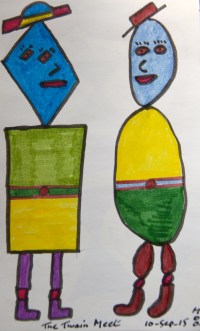
Never The Twain


IMG_0157.jpg

Never The Twain

“And never the twain shall meet.”

This was the chorus that my grandparents often chanted at me when family members started rowing with each other over one trivial incident or another.
“But what happens when the twain do meet,” I used to ask.
“Don’t be silly,” they said. “The twain never meet. Ever.”
But I know very well that they do.
I know.
I’ve seen them together.

Funny things, they are, the twain, and opposites in so many ways. But so nice, in spite of what some people, especially my grandparents, used to say about them.

Not only do they meet, but they can be happy together and very, very friendly.
“Long time, no see,” the twain say, and they often embrace quite warmly with a bunch of flowers held between them.

Mind you, the twain can also be quite awkward and occasionally very abusive towards each other. I remember my mother and father fighting “like cats and dogs” as my grandparents used to say.

Now, my grandparents had a cat. It was black and white and striped like a zebra. They called it Spot. My parents had a dog. It was an English Cocker Spaniel, gold in color, and off-spring to a famous sire, the Six-Shot Woody Woodpecker. They called the dog  Wimpy but it was by no means a wimp and fought with everything in sight, especially the cat.

So when my father and mother fought and the family cat and dog fought, I thought, quite reasonably in my opinion, that the dog (with his short hair) was male and the cat (with her long hair) was female, and that was the reason why they fought like cats and dogs. And “never the twain shall meet” as my grandparents used to say about my mother and father and the cat and the dog.

I guess it was too early to learn about the birds and the bees when, young and all too innocent, I was learning about the cats and the dogs.

And of course it’s only natural that the twain should meet. My mother and my father, like the cat and the dog, had to meet somewhere, didn’t they? How else would I be here? Now, we weren’t the sort of family that practiced contraception by throwing stones at the storks to keep the babies away.

But I could never work out why the cat always had female kittens while the dog had all-male off-spring. That was a bit too much for me, and nobody ever really explained anything I those days.


Why?

IMG_0154

Why?

Curiouser and curiouser
the vanishing smile
on the ginger cat
and wild dog dingo
grinning like a coal-scuttle,
why, oh why?

Who put the cur in curious?
Why was the dog-watch curtailed?
Cynicism, some say, and why
do we kneel before him,
heads bowed, waiting
the thumbs up, thumbs down,
of placet, placetne,
why, oh why?

Comment: Raw poem. I dreamed it up last night, but it wasn’t like this when it started. Cur: means why or what for in Latin and curs were large, mongrel dogs, bred for herding cattle in the Middle Ages. Cynicsm: because the cynics were also called ‘dogs’ partly for their shamelessness and partly for the faithful way they guarded their philosophical tenets. In Mexico, the Dominicans were often portrayed with dogs at their sides. The explanation: domini / of the Lord, -can / dog; hence they were the faithful guard dogs of the Lord. Placet: it pleases in Latin; the thumbs up sign that allowed the defeated gladiator to live, not die. “In any event, the final decision of death or life belonged to the editor, who signalled his choice with a gesture described by Roman sources as pollice verso meaning ‘with a turned thumb’ a description too imprecise for reconstruction of the gesture or its symbolism” (Gladiator: Wikipedia).

The Brick

img_0372

The Brick

 The brick sits on the master’s desk.
The master enters the classroom,
sees the brick, picks it up,
and without even looking
hurls it out of the window.

It is a warm, spring day
and luckily the window is open.

The schoolboys watch the brick
as it tumbles in slow motion
end over end through the air.

It lands with a thump in the quad
right at the feet of another master.

This second master looks around
but there’s nobody in sight.

He shrugs his shoulders,
bends down, picks up the brick,
puts it in his briefcase,
and walks away.