Butterflies

IMG_1053 (2).JPG

Butterflies

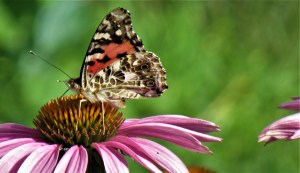
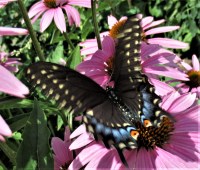
Here today and gone tomorrow. Ephemeral. Like all of us ‘poor creatures, born to die’ (as Dylan Thomas once wrote in Under Milkwood). It seems strange to look back on last summer’s photos and to remember that yes, they were here, those butterflies. Outside the window. Perching on the flowers. Showing their varied colors. Alive. Vibrant. Raising and lowering their wings.

Once upon a time, a long time ago, when I wore a grey suit and lived in a concrete, four-walled cell that they called an office, I was asked if I would edit a new journal for one of the institutions with which I was involved. ‘Sure,’ I said. ‘That would be great.’ ‘We’ll need you to submit a title and a theme,’ they said. ‘Sure,’ I said. ‘Of course I will.’

I thought about many things: titles, themes, topics, writers … Then I thought about other journals with which I had been involved in various capacities. Then I considered walking in the footsteps of the Journal of Higher Education with all of its cutting-edge articles and high-powered inspiration. I breathed a sigh of frustration, then of relief. ‘Got it,’ I said, and the Journal of Lower Expectations was born.

Alas, it was a butterfly that never spread its wings. ‘Your services will not be needed,’ came the curt reply when I submitted the title.

Think about it: a couple of years back, there were no bees in the garden: CCD (Colony Collapse Disorder). Last year, there were no birds. The feeders stood empty, and bird flu was the cry on everyone’s lips and the plague on every bird’s beak. Ephemeral. Butterflies on a rock. Australia burns and people are rescued from the beaches where they have taken refuge in the sea. Everyone, everywhere, now needs to live with lower expectations.
IMG_1058 (2).JPG

Butterflies and birds and bees: will they be back next summer? Who knows? I certainly don’t. But then, I am a true agnostic. I have no scientific background worth speaking of and neither ax no knife to grind on this topic. I genuinely do not know where we are heading. But I believe least those who protest most, especially when they bluster and bluff and try to pull the cocoon of disbelief over my eyes by shouting loudly their point of view. I have eyes. I can see, even if there are no butterflies, birds, or bees to be seen. Alas: I can still see and suffer their absence.

Please
will ye no come back again?”
Poor kangaroos, kookaburras, koalas,
wallabies and platypus ducks.
IMG_1047 (2).JPG

We will miss you so much if you any of you,
let alone all of you,
along with the butterflies, birds, and bees,
go AWOL.
On the beach

On the beach


IMG_0564 (2)

IMG_0565 (2)

Comment:

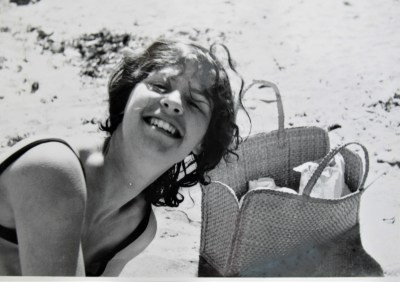
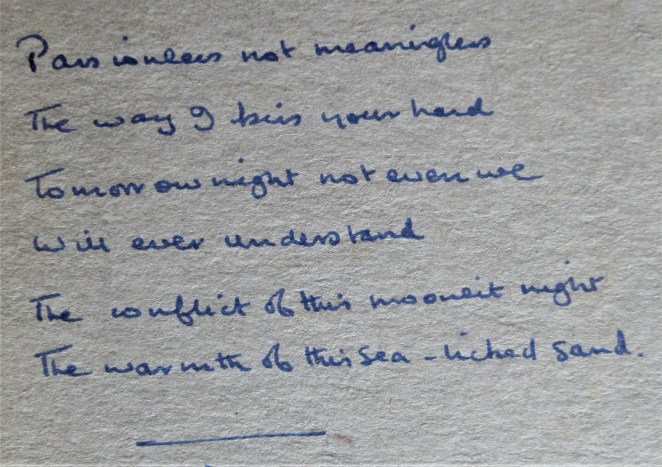
A daylight photo and a moonlit poem: I wonder how that came about? I guess we must have been beach-combing in the moonlight. It’s so long ago that I have forgotten the links between photo and poem. That said, Clare and I had spent a couple of weeks together in Santander (Spain) the previous summer, when we got engaged.

‘O bahía de Santander: tan bella bajo la luna’ / “oh Bay of Santander, so beautiful beneath the moon” as the Santander poet Gerardo Diego writes. And yes, Santander under a full moon: Mataleñas, the Segunda Playa, Jardines del Piquío, La Magdalena, the Bay of Santander itself, with Peña Cabarga in the background … there is something about beaches and midnight and moonlight which transcends the warmth of a summer’s day. It’s a sort of Midnight Magic that creates a madness of wonder in the blood. Imagine: all those silver fish, swimming their underwater roads, and rising to the surface, to ripple softly along the moon-path. Wander-lust / wonder-lust: sometimes buried words will not rise to the surface and those oh-so-precious moments of supreme poetry are lost among street lights, advertisements for this and that, street signs and the sort of stop signs that stop you and numb your mind into the dumb acceptance of daily reality: la vie quotidienne.

Memories: will they all vanish with us when we go? Of course they will. Many are fading now as we sit here at our desks, in our offices, before our computer screens. The grey screen hustle and bustle pushes memories, light and bright, back into the darkest corners. Where do I get off the bus, the train? Which number is it? Where is the office? Who am I meeting today and at what time? Did I shut the door behind me? Did I pack the children’s lunch? Did I let the cat out? And if so, out of which bag?

passionless not meaningless
the way I take your hand
tomorrow night not even we
will ever understand
the conflicts of this moonlit beach
the warmth of this sea-licked sand

PS. There, see, I told you I couldn’t read my own handwriting. Kiss / take; night / sand. Oh dear, the old grey cells are playing chess with my mind again: P-K4 / e2-e4 … whatever next? Well, I warned you!!!!


Treason

IMG_1203 (2)

Treason

The cans betray their contents.
Bulmer’s Strongbow cider,
used to be from Herefordshire,
pale and dry,
now made in Amsterdam
from apples that have never seen
Hereford nor heard of the Malverns.

Somerset cider,
not made in Zummer Zet,
apples never falling
from zyder apple trees,
but born in Denmark
with value added sucrose

and an extra sweet taste
that would never be allowed
in a Wurzel song
about schoolboys and satchels.

No self-respecting
Zummer Zet head master
would allow such muck
in his school when local Scrumpy
was available at twice the taste
and half the price.

I can see the school note now:
“Next time send proper zyder,
Zummer Zet
made.
This growing boy of yours
needs real apple juice
and lots of Vitamin C
to keep his young cheeks
red and rosy.”

Dozy basturds these furriners,
stuffing their cans with false fruit
and sucrose, taking in vain
those sacred names:
Strongbow, Hereford, and Zummer Zet.

Pax amorque

img_1092-2.jpg

Pax amorque

“Nowhere did she find peace and love
save in the dregs at the bottle’s bottom.
She solved life’s dilemmas with her whisky
aides: Johhny Walker, Glenfiddich, Bell’s.

Doctors told her that she must stop drinking,
not stoop to conquer yet another bottle.
The remedies they suggested didn’t suit her.
Family and friends lectured her in vain.

She knew she would not live forever,
no matter what the religious told her.
She opened bottle after bottle of Bell’s
Scotch whisky and hid them everywhere,

all over the house and garden so she could
always have one more before the road.
She drank until darkness overcame her.
Conquered by Shadows, she never emerged.”

Comment:
A found poem, overheard.
Pax amorque is the Latin for peace and love.

Rolling Stones

IMG_1159 (2).JPG

Rolling Stones

I have counted down the days, hours, minutes,
one by one, each tock of my grandfather clock
linked in pen and ink chains of endless words.

From arrival to departure, time’s fickle finger has
pointed me onwards into my future or backwards
into a delusional past that never was as I recall it.

Packed bags, backpacks crammed full of snacks,
ammunition against the hunger wars soon to be
upon them, they commence their long journey home.

Grown ups, some in their second childhood, bemoan
ties that bind, tides that rip us apart, tearing hearts,
swinging us in and out as, cockle-shell heroes, we man

our coracles and consult wide-ranging horoscopes that
never fail to comfort, the future’s wild words, written
in pitiless skies to guide and inspire all earthly creatures

born into sadness and death. No heroes in this house.
Just two old people, grey-haired, broken, contemplating
this soon to be silent home, knowing the Rolling Stones

were right, that rocks in motion don’t gather no moss,
that each lost moment is a finger-nail torn from flesh,
that today of all days could verily be ‘the last time’.

Commentary: Here for such a little while and gone already. Two years since they were here and two more years before they come back again. The silence is overwhelming. Only CNN with its endless cacophony breaks into the conscious mind, though that mind is unconscious now of words and their meanings. Images of emptiness, empty nests, this empty nest, these empty nests fill the vacancy of space. The heart is a black hole in the chest, sucking everything out of the light and into that dark, vacant space.

IMG_1112 (2).JPG

Butterfingers

IMG_0730 (2)

Butterfingers

My fingers turn to butter, but they taste of nicotine, garlic, and soap when I bite my nails. These butterfingers encourage cups to slip, saucers to fly off, run out of energy, stall, and crash to the kitchen floor where they lie in broken pieces, resting in peace, waiting to be picked up, one by one, and buried in the waste bin.

Arthritic fingers, grown clumsy now, struggle with bottle tops and glass containers screwed up so tight they refuse to open, even when soaked under the hot tap. I stick those jars in door jambs, lid first, closing the door with one hand, and twisting the jar with the other. Sometimes it slips and crashes to the floor, often with a portion of the contents spilling out.

I hate layer after layer of plastic wrapping. Flagrant in its defiance, it wages its guerrilla war against these ageing, uncoordinated fingers. I am often forced to use a knife, but a knife can slip or twist so easily. Occasionally, blunt, it will not even penetrate indomitable, multi-folded Saran wrap. So many slips between plate, teeth, and lips. Multiple precious items drop to the floor.

I cannot always bend to pick them up, and I cannot easily grasp them, not even with my new mechanical claw.

Memory

IMG_0437 (4)

Memory

By the time I remembered your name, I had forgotten your face. Then I couldn’t recall why I wanted to talk to you. I trace dark landmarks on the back of scarred hands: blood maps, unremembered, encounters with door knobs and unseen furniture, dust covered photographs, grey, grim, anonymous, hanging on the walls, not belonging in any family album. At night I cruise among islands, emerald green against sapphire seas. Why didn’t I visit these places when I was able to? Golden sand trickles through night’s fingers and time’s hour glass trickles out as stars sparkle and planets dance in Platonic skies. My memory is gradually fading into the distance, like a sailing ship leaving harbour. Each day, I wave another couple of memories good-bye. Each morning I wake unaware of where I have been the night before. It’s not that I sleep walk, just that things pass me by in the blink of a blurred eye. I still track the sails of drifting ships. I think of them as white moths, caught in overnight traps, chloroformed into oblivion, their bodies sometimes soaked in formaldehyde. Occasionally they come to life in the morning, batter their wings briefly against my fingers, leaving them covered with the finest moth-dust, before fluttering away into dawn’s forgiving light. I give chase with pen and paper, the worst of butterfly nets for wild thoughts waiting to be caught, then tamed. I stare at the mesh of the snow-white page and strive to grasp something just beyond my fingertips, trying to decipher it and deliver its message, but I can’t quite remember what it is.

Free

IMG_0624 (3).JPG

Free
Flash Fiction

            I am as free as my father was free. He was free to walk on his walker, as far as he could go down the street. Free to walk in the wind and the rain. Free to sit on his neighbor’s wall when his legs and back got tired. Free to sit there, although it was raining, until he had recovered his strength and energy. Free to get soaked so badly that he caught a cold. And the cold was free to turn into bronchitis and the bronchitis was free to turn into pneumonia and the pneumonia was free to perform its assassin’s work as it tried to kill him. But my father was still free and strong enough to call the doctor and the doctor was free enough to call at the house and visit my father and write him a prescription for an anti-biotic that would free his body from the pneumonia that was free to leave when its time was up and it felt ready to go. Pneumonia, the old man’s friend, they used to call it, sitting there, in my father’s lungs, muttering away to him, day after day, louder at night, and my father slowly getting stronger and the pneumonia growing weaker until one day it left and freed my father from his immediate ills. Then my father was free to get up or to stay in bed. Being a free man, he chose to stay in bed all day and to listen to the radio and to read a book and when he got bored with reading he just lay there and counted the lines on the wall “one, two, three…” and “one hundred and seventy five” he told me one day when I was free to visit him, “though I have lost count once or twice and have had to start again from the very beginning. And the sun gets up at 7:03, and strikes the third line at 7:53 … and goes around the wall 33 lines a minute; and leaves that third line from the right at a 3:15 …” And there he stayed, day after day. But he was free. And sometimes the home help came and sometimes she didn’t, for she too was as free as the birds in the garden. And sometimes she remembered to buy him some food and sometimes she didn’t. And she was free to come and go, free to remember or forget. And my father was free to mumble or complain or grumble, though he rarely did. And he was free to eat, so long as there was food in the house. But I went there I often saw that the cupboard was bare and my father had neither milk, nor eggs, nor bread nor cereal, nor tea nor butter. And all those people, those acquaintances, those friends, they too were as free as the sea-gulls in the sky. But to find the time to set my father free from the hunger and thirst he seemed predestined to freely suffer, they were never free enough for that, not even at Christmas.
Neither was I.

Bristol Temple Meads

IMG_0678 (2)

Bristol Temple Meads

Bristol Temple Meads

“Temple Meads, Temple Meads.”
Passengers on the platform shuffle
rearrange themselves to get closer
to opening carriage doors. Steam
hisses out from the engine in great
white and grey clouds. He gets out
asks a porter, “Is this Bristol Central?”
“No, son. This is Temple Meads.”
The young boy gets back on the train.

Next stop, Bath. “Is this Bristol?”
“No, son. This is Bath not Bristol.
You should have got off at the last stop.
You’ve over-run your ticket mate.
There’s a fine for that and you’ll have
to buy a new one to get back to Bristol.”

“But I asked them if it was Bristol Central
and they told me it wasn’t.” “Playing silly
buggers they was, son. Bristol Temple
Meads is Bristol Central, well, sort of.
And you’ll have to change platforms.
Go to the ticket office, over there, tell them
what happened, and maybe, just maybe,
they’ll let you take the next train for free.”

Commentary: Funny place, Bristol Temple Meads. I heard lots of funny things, all told in a West Country accent, or fluent Bristolese, while I was passing through there. Loved confusing passengers, they did, but more about that later. As for accents, well, the West Country accent and the Bristol accent are very different, but neither go well into prose, “coz, thee’ll never git a gurt big ‘ead like thine in a tiny l’il ‘at like this.” Thank you, the Wurzels. And as for reading and writing accents, click here.

Bristol Temple Meads
[Prose]

“Temple Meads, Temple Meads.”
The train slows, comes to a halt with a hissing of steam and a shuddering of brakes. Passengers waiting on the platform shuffle towards the edge of the platform, re-arranging themselves to get closer to opening carriage doors.

A young boy, not yet a teenager, gets out carrying his grand-father’s overlarge suitcase in his hand.
“Is this Bristol Central?” he asks a porter.
“No, son. This is Bristol Temple Meads.”
The young boy gets back on the train along with the other Bristol passengers who are travelling to Bath.

When he gets there, the young boy gets out of the train and again approaches a porter. “Is this Bristol?”
“No, son. This is Bath not Bristol. If you wanted to go to Bristol, you should have got off at the last stop.”
“But I asked if it was Bristol Central, and the porter told me it wasn’t. So I got back on the train.”
“Playing silly buggers he was, son. They’re like that in Bristle. Bristol Temple Meads is Bristol Central, well, sort of. He should have told you that.”
“What can I do now?”
“Well, you’ve over-run your ticket, mate. You’ll have to pay extra for coming on to Bath. And you’ll need a ticket to get back to Bristol. But it’s Temple Meads, mind. Don’t let them fool you again.”
“I won’t.”
“And you’ll have to change platforms. Tell you what, just go to the ticket office, over there, tell them what happened, just like you told me, and maybe, just maybe, they’ll take pity on you and let you take the next train for free.”

A question: Is the piece better in poetry or prose? Each version serves a different purpose, but I think the narrative rules. I’ll welcome any opinions you care to share.


Rhondda Fawr

IMG_0689


Rhondda Fawr

To be Welsh on the coalfield
is to speak the language of steel and coal,
with an accent that grates like anthracite ‑‑
no plum in the mouth for us; no polish,
just spit and phlegm that cut through dust and grit,
pit‑head elocution lessons hacked from the coal‑face.

We sing arias and deep, rolling hymns
that surge from suffering and the eternal longing
for a light that never shines underground
where we live our lives and no owners roam.

Here “gas” and “fall” mean violent death
and the creaking of the pine pit‑prop is a song‑bird
suddenly silent in its cage warning of danger
soon to be upon us…

… words and music stop in our throats
as up above us the sad crowds gather.

Featured Image -- 7454