bpnichol

IMG_1002 (2)

The day I met bpnichol

I picked him up at Freddy airport,
drove him home for lunch, Clare’s
home made Lasagna, discussed
on the phone. He wasn’t Vegan

Tousled, tangled hair, mangled maps,
Toronto streets and squares drummed
up with coded words wrapped in magic,
he signed my copy of his Martyrology.

His saintly street speech spoke like
grid-locked gears grinding on downtown
city streets, one step at a time, where no
apocalyptic horsemen ever rode.
Oh, the root, toot, hoot, flurry, scurry,
sounds simmering, spurring them on.

After lunch, we drove to the Beaver
Pond in Mactaquac. Swallows dipped
and dived, wetting their beaks. Crows
perched on barren ship mast tree-trunks
stripped of all foliage, coughing warnings.

Strong wing-pulse of the flying osprey
homing to the nest. A great blue heron
walked silent, stilting its grey way through
cool, green shade and shallow waters.

A wordy wilderness tumbled wild from
our questing minds. Images grew starry
flowers. Magic metaphors mushroomed
along tangled New Brunswick trails. No
trace of tarmac and Toronto, the big city.

Comment:

bp was a Toronto poet, still is in my books.
Hence the blue jay.
A good friend.
I miss him.

Pax amorque

img_1092-2.jpg

Pax amorque

“Nowhere did she find peace and love
save in the dregs at the bottle’s bottom.
She solved life’s dilemmas with her whisky
aides: Johhny Walker, Glenfiddich, Bell’s.

Doctors told her that she must stop drinking,
not stoop to conquer yet another bottle.
The remedies they suggested didn’t suit her.
Family and friends lectured her in vain.

She knew she would not live forever,
no matter what the religious told her.
She opened bottle after bottle of Bell’s
Scotch whisky and hid them everywhere,

all over the house and garden so she could
always have one more before the road.
She drank until darkness overcame her.
Conquered by Shadows, she never emerged.”

Comment:
A found poem, overheard.
Pax amorque is the Latin for peace and love.

Words Overheard

IMG_0198

Words Overheard while Waiting

“Just one of those things,” an old woman whispers,
“my husband gone and me alone with all the grand
kids.” “Was it four years ago?” her friend says.

I remember his name, but I forget his face.”
“I’ll cope somehow, and the fourteen-year old,
with her belly 
starting to swell.” Silence wraps
a warning scarf around their flapping mouths.

Lives and worlds end and begin. Back turned
to their words, I listen to them talk. They chatter
about friends, family, acquaintances, giving
intimate details of childlessness from cancers
and sudden sicknesses, all laid out before me,
willy-nilly, to root and grow in my listening mind.

Never will I put a face to the girls with breast cancer,
the overweight women with diabetes, the old men
with their heart attacks, strokes, and damaged brains.

Fine dust dances in a sun ray.  Floating motes,
my lost loves, buried before their proper time.

White Flame

IMG_0159 (2).JPG

White Flame
in praise of my beloved

White flame, her hair, emerging from shadows,
lighting her path downhill toward water’s edge.
Wind-driven waves splash lake-side. I watch
her footsteps, not now as firm as once they were.

Burgeoning age grips her hips. Toes and heels
no longer  lift in the same old way. Component
parts break down, arteries clog, arthritis worms
its stiffening way into fingers, wrists, and knees.

I recall nursery rhymes: “Jack be nimble, Jack
be quick,” but she isn’t anymore and neither
of us could jump over a candlestick. Her beauty:
inner light. Outer light, her hair, pure and white.

Her voice  is still as clear as a bell, soft yet
luminous, as she picks her way on a perilous
path through wayward woods, not stumbling
yet, and still she lives, as I still live, in hopes

to see each other, until earth stops our eyes and
we can see, sense, touch, and hear no more …

Autumnal


IMG_1258 (2).JPG

Autumnal

Skeletal rattle of autumn trees their crisp,
leaves fallen beneath barren branches.
Rat-a-tat rap of dead bone music dries out
flowers, shakes seed pods. Summer’s end
yammers its ruby-sweet, rose-tinted world
where petalled hope and October carnival,
with its ghoulish goulash, mish-mash mix
far-fetched mismatched face. Gruesome
uniforms, fairy-faced, gauze-winged, facile.

Cadaverous danse macabre of death mask
clowns posing distorted in a hall of mirrors
for selfies. The drowned moon needs a kiss
of life. Last night, she peeped through my
window and nuzzled me. This morning my
head is full of mystery, poetry, and dreams.
I analyse them. None of them make sense.

Bubbles

IMG_1173 (3).JPG

Bubbles

Count them. Each day she was here, a bubble. Little did I know as I saw them floating in the sun across the porch against a background of leafy trees that they would so soon burst and vanish, one by one.

Lost now, her voice, gone her footsteps from the stairs, no more the scrape of her chair as she climbs up beside me, calling my name. When I wake in the morning, I wait for her joyful call. How she loved to bounce on my bed. Knees up, but no Mother Brown this, just my grand-daughter, four years old.

And now she is gone.

Shower (A Selfie)

IMG_1256 (2).JPG

Shower
(A Selfie)

I smell. I whiff. I gloriously stink.
My arms, my feet, my crotch, reek with beauty.
This is me. I am still alive. I’m rank.
The time has come, the Walrus said, to take
a shower. I strip. I weigh. I obey.

Hot water streams. Bathroom steams up. I draw
faces on grey glass, smiling, glum. Soft soap
works its miracle turning Japanese
nylon into a rough body cloth that
rubs and cajoles all putrid dirt away.

Butterfly from its chrysalis, I step
from the shower, sniff with caution, and stench
no more. I am clean. I no longer pong.
My body has been taken over by
perfumes no longer mine. Who am I now?

I am no more myself. I am no more
my own gorgeous underarm muscular
ripeness. I have left my odor circling
in the soap suds and drifting down the drain.
What a pain. It will take me a week or
more to start smelling like myself again.

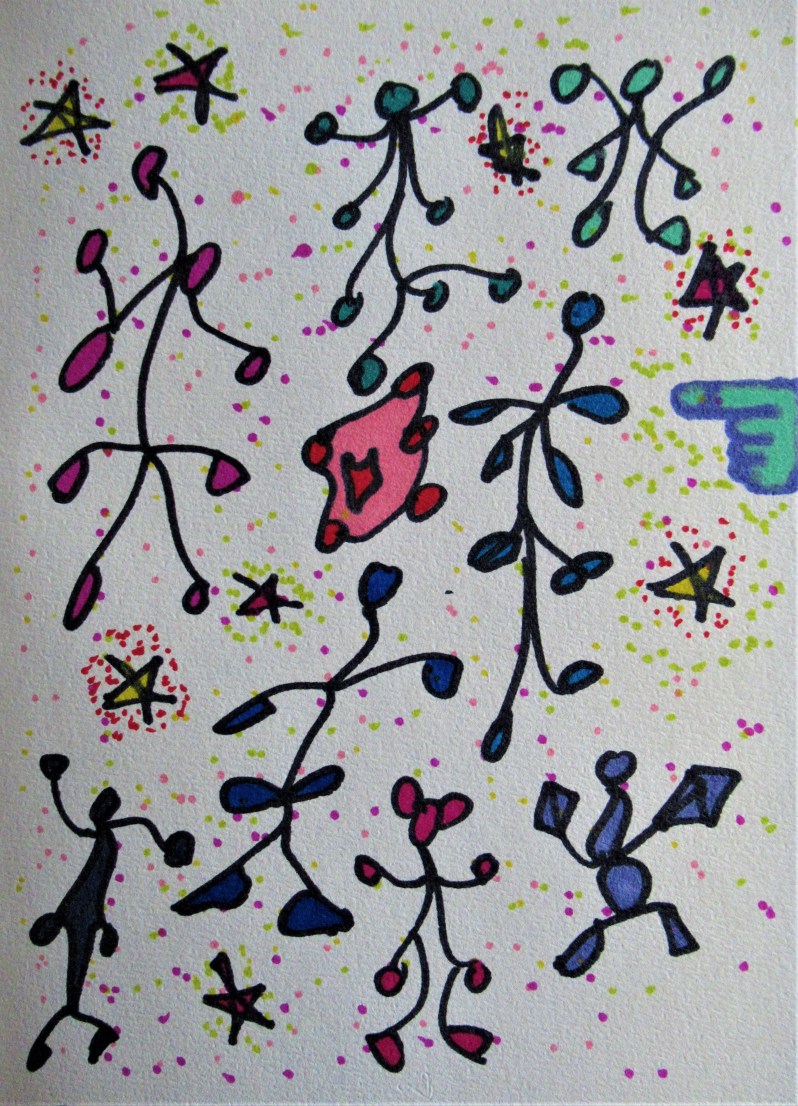
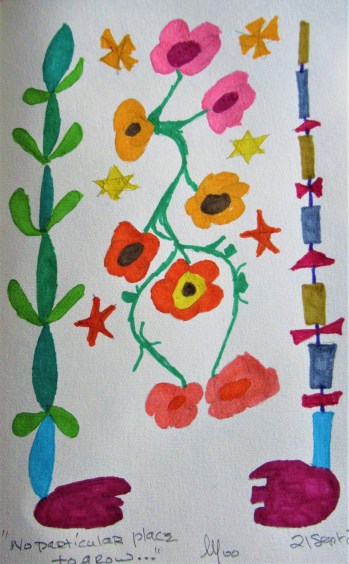
Comment: The cartoon is today’s effort. I looked out of the window and saw all the garden plants with ‘no particular place to go’ and that’s how it is sometimes, especially at this time of year, the summer behind, us fall present , and the winter ahead. We are left with the tiding up, the readying for next year, a sense of sorrow, and a feeling of hope that yes, the garden will return and yes, we will be here to witness it.

So, what are the figures in my cartoon saying to each other? Well, they have been reading the wise words of my olde friend, Oscar Wilde. “Be yourself,” he told them, ” everybody else is taken.” What are they you ask? They are themselves, as I am myself, and you are yourself, and yes, I am very happy to be who I am. And of course, everybody else is taken, so who and what is there left for us to be?

Old Pal

IMG_1002 (2).JPG

Old Pal
It’s as easy as ‘Bob’s your uncle,’ as we say in Wales. Yet Bob is my uncle and life with him is never easy. On Saturdays I drive him to the local supermarket so he can purchase his groceries. He also buys cans of Old Pal dog food for Paddy, his ageing and eccentric Cocker Spaniel.
Bob always strips the labels off the cans he brings home. He trades them in for stamps so he can buy cigarettes and things. However, this stripping reduces the cans to bright, shiny aluminum canisters that sit together on the pantry shelf. He claims he knows in which order he stacks them, but I think he’s playing Russian Roulette, because he can’t tell the difference between soup, rice pudding, and dog food. They’re all locked in look-alike cans. Bob doesn’t care. His diet is a lottery anyway. He shoves the can’s contents into one end and as long as they come out the other, he’s happy.
“That’s what life is all about,” he tells me. “Munchies in and munchies out.”
            Bob’s quite happy with mushroom soup for lunch, or eating rice pudding. If he opens a mystery can and finds dog food in it, he just adds a spoonful of curry powder and heats it up on the stove. He stressed out about eating the meat in dog food when Mad Cow Disease hit Wales and consumers avoided beef, but his family doctor told him not to worry.
            “You’ll never get Mad Cow Disease from dog food,” the doctor told him.
“Why not?” Bob asked.
“Because dog food’s made from horse meat.  You can’t get Mad Cow Disease from a horse.
Bob loves dogs, but he hates Welsh Corgis. One day, he asked me to take him out for a drive. He put Paddy in the back seat, on an old blanket then patted him on the head before closing the car door.
I was already in the driving seat. I had taken the precaution of placing a plastic garbage bag over the passenger seat, in case Bob had an old man’s accident, but he told me not to worry.
“I’ll be all right. “I’ve got my Old Pal with me,” he pointed to the canvas bag at his feet. It rattled when he kicked it.
“Where do you want to go?” I asked Bob.
“Down the road,” he replied. “Let’s visit the Corgis.”
Down the road we went, driving happily, until Bob’s face came alive with joy.
“Turn right,” he cried. “There’s a Corgi down that street. Drive slowly now.”
I slowed down while Bob counted the houses.
“Stop,” he told me. “Now. Stop now.”
I stopped and Bob turned around and started slapping Paddy until the dog began to howl. Then Bob rolled down the window, pulled an empty can of Old Pal dog food from the canvas bag, unzipped his fly, stuck his old man’s magic screwdriver into it, and peed.
“The Corgi’s coming. He’s nearly here,” I could hear Bob’s chest wheezing.
“There he is,” Bob screeched with delight as a black-and-tan Corgi appeared at the gateway to the house. Bob whistled at the Corgi and, as the dog looked up, he threw the contents of the can … whoosh! … all over the dog. The Corgi jumped back, blinked, shook himself, and growled and snarled as the can drenched him in a sticky, smelly, golden shower.
“Take that, you dirty dog,” Bob cried. “Quick, drive away, now, before anyone sees us.”
I put the car into gear and accelerated away.
“This is so much fun. I’m so excited. I’m so excited I want to pee again,” Bob pulled a second empty can from the canvas bag. “Turn left. Third house up. Get ready, Paddy. There’s another Corgi on the way.”

Railway Yards

IMG_0681 (3).JPG

Railway Yards

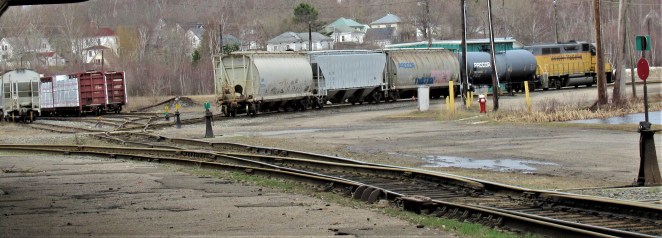
The enemy came to bomb them. And they did. Tracks rooted out, twisted like spaghetti. Engine sheds burned down. Rolling stock ruined. Many children that year lived with the fear of thunder and lightning as Swansea, my home town, burned, in spite of the black out curtains and the air raid precautions. My father’s father lived by the railway yards. When I stayed with him overnight, the shuffle and clank of steam engines and the clatter of coal trucks scarred my dreams.

My mother’s father lived by the sea and each night the ebb and flow of the tides rocked me to sleep when I stayed in his house. I told the time by the tides and I knew every ship that entered and left Swansea Docks. Standing on the front step, with field glasses to sweep the bay, I could read the ships’ names, painted on bow or stern, and then check their movements in the local paper, the South Wales Evening Post.

Timetables: they ruled my life: time tables for the trains, tide tables for the ships.
When they drove me away to boarding school, I was far removed from the rail yards and the sea. I was now summoned by bells, my every activity chimed in by bell after bell. Bells: wake up, get dressed, eat breakfast, be silent. Bells for each class, for the angelus, bells for dinner, supper, bed time, and baths. Bells on the altar as we knelt before tall candles that flickered light as the tinkling bells flicked sound across the chapel. The only escape from bells came during field games. No bells then, just whistles. But bells and whistles whittled the timetables of a carefully regulated working life.

When we moved from Swansea (Abertawe) to Cardiff (Caer Dydd), our new house also backed onto train tracks and railway yards. The rattle of rolling stock lulled me to sleep. Each day, I opened my eyes to the clash and clang of early-morning shunting. Each night, at exactly 3:10 a.m., the express train to London would rattle past my bedroom window and shake me awake as I lay in my bed. The one day I didn’t hear the train, I woke up anyway, listening for its sound. When silence stalked beneath the stars, I knew there had been an accident, and I couldn’t get back to sleep. Radio and newspapers, there was little television then, screamed the news, so many people dead and injured. We mourned for the unknown dead, just like we did in the mine disasters and the bombings.

Lights out at 9:30, prefects and house masters on patrol outside dormitory doors enforced the silence that ruled the night in those inland boarding schools that I was forced to inhabit. No trains, no ships, no tides, no rattling of rolling stock, no steam whistle, no salt smell of the incoming sea disturbed my dreams, just the snoring and whimpering of lonely little boys lost in their iron-frame beds and longing for the comforts of home.

On Learning Welsh

IMG_1238 (2).JPG

On Learning Welsh
            Here I sit, an old man now, in front of my computer, learning at last my mother tongue, Welsh. English is the language of the invaders, the mine-owners, the men who own the steel works and foundries, and who rule this land with a fist of coal inside an iron glove. Welsh is the tongue of farmers and fishermen, of the villagers who live on the hills and tend the sheep and plant potatoes in tiny small holdings where only the fittest children survive.
My mother’s father was the last of us to speak Welsh. It was banned in our house because it was bad for the kids. In a working-class household, Welsh, be it language or accent, was a barrier to success. And success came from imitating your English betters, and climbing upwards, like a vine, or Jack on his beanstalk, until you achieved the impossible and talked and looked and dressed like them.
Sitting here, I have discovered the beauty of simple words, not so much their meaning as their sound, the way they flow, the poetry of remembered rhythms:
Cwmrhydyceirw, the Valley of the Leaping Stag, though legend has it that ceirw was really cwrw, and cwrw is beer, and its real name was the Valley of the Brown Stream Frothing like Beer.
Words have their own music, even if you cannot pronounce them properly: Mae hi’n bwrw glaw nawr yn Abertawe / it’s raining now in Swansea. Mae’r tywydd yn waeth heddiw / the weather’s worse today. Bydd hi’n dwym ddydd Llun / it will be warm on Monday. Why, oh why, in Wales, do we always talk about the weather?
Place names also have their own magic: Llantrisant, Llandaff, Dinas Powis, Gelligaer, Abertawe, Cas Newydd, Pen-y-bont … Meaning changes when you switch from one language to another:  gwyraig ty / a housewife, gwr ty / a househusband, a concept of equality that has ruled Welsh lives since Julius Caesar invaded Albion, coming from Gaul with his legions in 55 BC.
            Un deg chwech, dau deg saith, tri deg wyth, naw deg naw … The photographer asks me to speak in English, then in French, then in Spanish, then in Latin, and lastly in Welsh. He checks the memory card in his camera and looks puzzled.
“You put on a new face each time you speak a different language,” he tells me. “Look, this is when you spoke French.” He shows me the photo and yes, I look happy.
“And this is when you spoke Latin.” He holds out the camera and I see myself on the screen. I look ever so grim. English, French, Spanish, Latin, Spanish, and Welsh: all different and each language is a new a map carved into my face.  Am I a clown, then, a comedian, a chameleon to wear so many masks and to slip so easily from one to another? Which, then, is my language and where is the Old Red Sandstone from Wales into which I can carve my memories and my dreams? More important, which of those many tongues will shape my story as I sculpt each letter of my tale?